
How to Integrate AI with Existing CCaaS: A 2026 Modular Strategy
The standard industry advice suggests that to modernize your contact center, you must dismantle it, yet the most resilient enterprises in 2026 are proving that the most powerful evolution isn't a replacement; it's an orchestration. You understand the suffocating weight of technical debt and the prohibitive costs of a total platform migration. It's exhausting to watch legacy systems struggle with multilingual demands or rising handle times while "rip-and-replace" vendors demand a blank check. You need a way to integrate ai with existing ccaas without compromising the reliability your customers expect.
You don't have to choose between stability and innovation. This article reveals how to master a modular, agentic strategy that preserves your core infrastructure while injecting it with elite intelligence. We will detail the technical steps to layer advanced agentic AI onto your current stack, from SIP-based overlays to live call translation, ensuring you achieve up to 60% faster resolution times while maintaining the rigorous privacy standards required in today's regulated environments. You'll discover how to bridge the gap between legacy reliability and modern AI empathy through a seamless, step-by-step roadmap.
Key Takeaways
- Stop the cycle of expensive overhauls by learning how to integrate ai with existing ccaas using a modular strategy that honors your current infrastructure.
- Gain technical clarity on SIP and API-first architectures to deliver real-time voice intelligence and fluid data synchronization between your AI agents and core business systems.
- Compare built-in platform capabilities against best-of-breed "Agentic Swarm" models to build a multi-skill contact center that prioritizes both precision and empathy.
- Master a deployment roadmap that uses Hybrid RAG to ground conversational agents in your specific enterprise knowledge, effectively eliminating AI hallucinations.
- Deploy high-impact automation with no-code tools to realize 60% faster resolution times while maintaining native connectivity to Genesys, NICE, or Avaya.
The Evolution of CCaaS Integration: Moving Beyond Silos
The contact center industry has arrived at a critical crossroads. For years, the prevailing narrative suggested that true innovation required a total abandonment of the past. This "rip-and-replace" mentality treated legacy infrastructure as a liability to be discarded rather than a foundation to be built upon. In 2026, we see a fundamental shift toward modular composability. Integration is no longer about simple plug-ins; it's the sophisticated unification of Large Language Model (LLM) intelligence with traditional routing protocols. When you integrate ai with existing ccaas, you aren't just adding a feature. You're evolving the very nervous system of your customer experience.
The traditional IVR tree is a relic of a deterministic era. These systems force customers into rigid, pre-defined boxes that often frustrate more than they facilitate. Modern agentic intent recognition, by contrast, leverages the power of deep learning to parse human nuance, transforming a frustrating series of prompts into a meaningful dialogue that resolves issues in real time. This evolution allows businesses to maintain the rock-solid reliability of their existing telephony while gaining the empathetic, reasoning capabilities of modern AI.
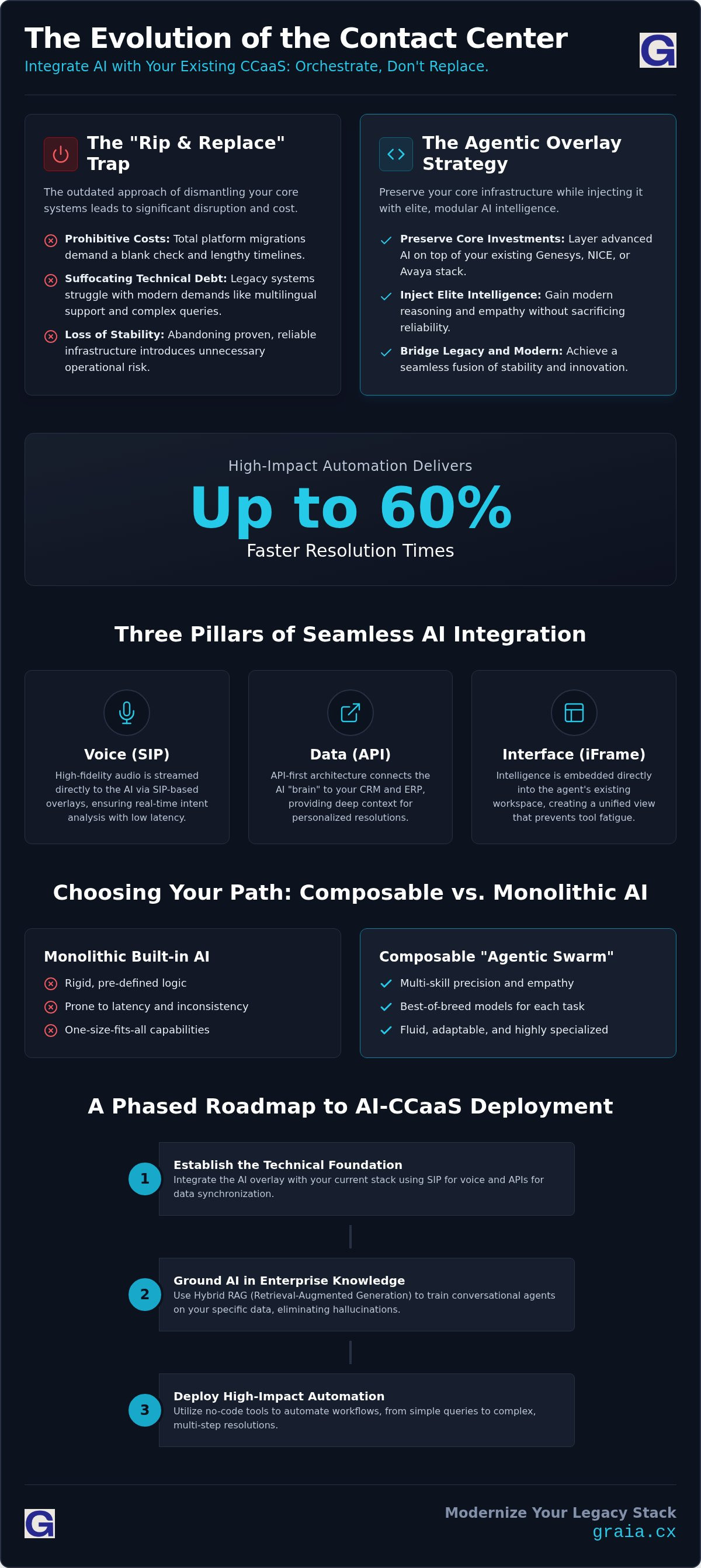
To achieve this seamless transition, three core pillars of integration must work in harmony:
- Voice (SIP): High-fidelity audio streams are piped directly to the AI to ensure real-time processing and low-latency responses.
- Data (API): The AI "brain" connects to your CRM and ERP systems, providing the deep context necessary for personalized resolutions.
- Interface (iFrame): Intelligence is embedded directly into the agent’s existing workspace, creating a unified view that prevents tool fatigue.
Why Legacy Systems Struggle with Native AI
Legacy platforms were built for a predictable world. Their rigid logic often clashes with the fluid, probabilistic nature of Generative AI. Older cloud architectures frequently suffer from latency issues that break the rhythm of natural conversation, making it difficult to maintain a professional standard. Additionally, the "Noisy Neighbor" problem in traditional multi-tenant environments can lead to inconsistent performance. These systemic flaws make it challenging for older systems to support the heavy computational demands of modern intelligence without specialized assistance.
The Rise of the Agentic Overlay
The solution lies in the agentic overlay. These sophisticated layers sit directly atop your existing Genesys, NICE, or Avaya stacks, handling complex reasoning while your telephony remains untouched. This approach allows you to upgrade the "brain" of your operation without the trauma of a platform migration. Utilizing a comprehensive Enterprise AI Contact Center Solution empowers your team to bridge the gap between legacy stability and modern empathy. By choosing to integrate ai with existing ccaas through an overlay, you protect your existing investments while positioning your brand as a visionary in customer connection.
Technical Architectures for Seamless AI Connectivity
Constructing a modular AI layer requires more than just a software license. It demands a robust architectural bridge. To integrate ai with existing ccaas without disrupting your current operations, you must focus on the protocols that govern real-time communication. SIP (Session Initiation Protocol) is the essential foundation for voice-based intelligence. By capturing the audio stream directly at the SIP trunk, your AI modules can analyze intent and sentiment in real time. This technical bypass eliminates the lag associated with cloud-to-cloud recording transfers, ensuring that every interaction remains fluid and human-centric.
Data connectivity serves as the second critical pillar. An API-first approach ensures that your conversational agents aren't just polite; they're informed. By establishing secure connections to your CRM and ERP systems, the AI can retrieve customer history or update shipping statuses without manual intervention. Webhook triggers further enhance this ecosystem by enabling proactive engagement. If a high-value customer experiences a service failure, a webhook can instantly alert an AI assistant to prepare a personalized recovery script. This intelligence is delivered through iFrame widgets that live directly within your agents' existing workspace. It provides next-best-action suggestions without requiring them to toggle between multiple tabs.
Integrating Real-Time Voice Translation
Global expansion often founders on the high cost of specialized hiring. Sophisticated Live Call Translation Software removes this barrier by enabling your existing team to support customers in over 100 languages. The technical secret lies in the "Original Audio" approach. Instead of replacing the human voice with a synthetic substitute, the system provides a real-time translated overlay. This preserves the emotional inflection and empathy of the live agent. You can tune the formality levels and upload custom vocabularies to ensure that industry-specific terminology is translated with absolute precision. For more insights on optimizing these workflows, explore our latest industry analysis.
Data Sovereignty and AI Guardrails
Security is not an afterthought in a modular strategy. It's the primary constraint. Integrating external AI requires the implementation of Prompt Shields to defend against injection attacks that could compromise your system logic. In 2026, compliance with GDPR and SOC2 necessitates automated PII masking. Sensitive data like credit card numbers or personal identifiers is redacted before the audio or text ever reaches the LLM. Most importantly, a privacy-first architecture ensures that your proprietary enterprise data is never used to train external models. Your intelligence remains your own. To integrate ai with existing ccaas successfully, you must prioritize this invisible layer of protection.
Choosing Your Path: Composable vs. Monolithic AI
The decision to modernize your customer experience often presents a deceptive choice between the convenience of an all-in-one platform and the precision of a specialized ecosystem. Monolithic CCaaS providers frequently market "built-in" AI as a seamless solution. While attractive on paper, these native tools often lack the depth required to handle complex, multi-layered inquiries. They function as a "black box," limiting your ability to customize the underlying logic or swap models as the technology advances. To truly integrate ai with existing ccaas, you must decide whether you want a static feature or a dynamic, evolving intelligence layer.
A composable strategy prioritizes best-of-breed modules over generic bundles. This approach allows you to select the most capable LLM for a specific task; perhaps using one model for technical reasoning and another for empathetic dispute resolution. This flexibility directly impacts your Total Cost of Ownership (TCO). While monolithic vendors often hide costs behind proprietary "AI tokens" or tiered seat licenses, a modular architecture enables you to scale specific capabilities without paying for unused overhead. It transforms your contact center from a rigid cost center into a fluid, adaptable asset.
The Agentic Swarm Advantage
Modern CX demands more than a single chatbot. It requires an "Agentic Swarm." This architecture distributes incoming inquiries among specialized virtual experts, such as dedicated agents for billing, sales, or technical support. Because each agent is grounded in a specific subset of enterprise knowledge, they provide answers with surgical precision. When a complex issue requires a human touch, the swarm preserves the entire interaction context during the handoff. This eliminates the need for customers to repeat themselves, contributing to 60% faster resolution times and a significant reduction in Average Handle Time (AHT).
Evaluating Vendor Flexibility
Resiliency in 2026 depends on your ability to remain LLM-agnostic. Relying on a single provider creates a dangerous point of failure and invites vendor lock-in. By utilizing open Model Context Protocols (MCP), you can ensure your AI "brain" remains compatible with the latest breakthroughs, whether they come from OpenAI, Anthropic, or specialized open-source models. The rise of the Cloud Based AI Call Center has proven that orchestration is the future. Your execution engine must be capable of switching between models like GPT-4o or Claude in real time to optimize for both performance and cost. When you integrate ai with existing ccaas, ensure your partner views integration as an open dialogue rather than a closed circuit.
A Step-by-Step Roadmap to AI-CCaaS Deployment
Execution is where vision meets reality. To successfully integrate ai with existing ccaas, you must follow a methodical progression that prioritizes stability over speed. Start with a comprehensive audit of your current workflows. Identify high-volume, routine inquiries that drain your human capital without adding strategic value. Once these targets are clear, build your knowledge foundation using Hybrid RAG. Before any customer interacts with the system, employ "Bot-to-Bot" simulation. This stress-tests your logic by pitting an AI customer against an AI agent in a controlled environment. Finally, pilot your strategy on a single digital channel, such as webchat or email, before moving to the high-stakes environment of live voice.
Scaling this intelligence requires a shift from isolated automation to full omnichannel orchestration. As you move beyond the pilot phase, you can begin to layer in AI Agent Assist Tools to support your human staff during complex interactions. This phased approach ensures that your infrastructure remains resilient while your capabilities expand. It transforms the integration process from a daunting overhaul into a series of manageable, high-impact victories.
Setting Up Hybrid RAG for Accuracy
Accurate intelligence requires more than simple vector searches. By combining semantic meaning with precise keyword matching, Hybrid RAG achieves a documented 98% accuracy rate. This system automatically extracts knowledge from your existing enterprise documents, ensuring your AI is always current and grounded in fact. To maintain your brand’s integrity, implement "Judges." These are secondary AI models that score every response against your specific policies and voice before it reaches the customer, effectively eliminating the risk of hallucinations.
The Human-in-the-Loop Fallback
Technology should empower humans, not replace them. A robust deployment roadmap includes a sophisticated fallback system designed to protect the customer experience. When AI confidence scores drop below a predefined threshold, the interaction must escalate seamlessly to a human specialist. Provide your agents with structured interaction summaries so they never have to ask a customer to repeat themselves. Using "Email Draft Mode" allows your AI to suggest responses that agents can refine; this serves as a powerful training ground for your agentic swarm while maintaining total human oversight. Ready to refine your deployment strategy? Explore our full library of integration guides to start your transformation.
Modernizing Legacy Stacks with GraiaCX
GraiaCX stands as the definitive bridge between established infrastructure and the frontier of machine intelligence. It doesn't demand a total overhaul. It respects your history. You can integrate ai with existing ccaas platforms like Genesys, NICE CXone, and Avaya through native SIP trunk connectivity. This technical elegance ensures that your mission-critical voice paths remain stable while your operational "brain" receives a massive, agentic upgrade. We understand the high stakes of enterprise communication. We protect your reliability while accelerating your innovation.
Speed to value is a competitive necessity. Our no-code environment allows you to deploy day-1 automation without the traditional friction of developer heavy-lifting or lengthy professional service engagements. By grounding modern AI in 25 years of deep CX expertise, we help you achieve a measurable Contact Centre ROI with AI. This strategy yields 40% fewer escalations to human staff. It liberates your specialists to focus on the complex, high-value connections that define your brand’s reputation. You don't have to wait for a multi-year migration to see results.
Specific Case: Upgrading Avaya Systems
Many enterprise leaders feel anchored by their legacy hardware. They shouldn't. Upgrading Avaya with Conversational AI allows you to maintain the legendary voice resiliency you've relied on for decades while adding sophisticated agentic reasoning. In real-world legacy environments, this modular approach has consistently delivered 60% faster resolution times. You gain the agility of a startup without sacrificing the stability of an established giant. It's the most pragmatic path to modernization available in 2026.
Future-Proofing Your Engagement Strategy
True evolution is inherently global. Our platform allows your organization to scale to over 100 languages instantly through Live Call Translation. This capability transcends mere translation; it fosters genuine human connection across borders. By implementing real-time coaching and sentiment analysis, you provide your remote teams with the tools to perform with surgical precision. The era of the fragmented, struggling contact center has reached its end. It's time to integrate ai with existing ccaas and lead your industry into a new age of empathetic automation. Transform your legacy CCaaS with GraiaCX.
Orchestrating the Future of Human-Centric Automation
The era of the monolithic overhaul has passed. Today's most agile enterprises recognize that the path to elite customer experience lies in modular orchestration rather than total replacement. By prioritizing SIP-based connectivity and agentic swarm architectures, you can preserve the stability of your legacy systems while unlocking unprecedented levels of intelligence. This strategy doesn't just solve technical debt; it elevates the human potential of your entire workforce. It turns a static cost center into a fluid, empathetic asset that grows alongside your business.
As you look to integrate ai with existing ccaas, remember that the most successful transformations are those that balance technical precision with deep empathy. GraiaCX delivers this balance through a platform that offers a 99.9% uptime guarantee and a documented 25% improvement in agent productivity. Our Red Dot-level design ensures that your agents work within a workspace that is as intuitive as it is powerful. The transition from legacy constraints to agentic freedom is no longer a high-stakes risk; it's your new competitive advantage.
Book a demo to see how GraiaCX integrates with your current CCaaS. The future of your contact center isn't a distant goal. It's a series of intelligent, manageable steps you can begin taking today.
Frequently Asked Questions
Can I integrate AI with an on-premise CCaaS system?
Yes, you can certainly bridge the gap between legacy hardware and modern intelligence. By utilizing SIP trunking or PSTN gateways, you create a secure path for audio and data to reach the AI layer without requiring a full cloud migration. This allows you to integrate ai with existing ccaas infrastructure that resides on-site, preserving your hardware investment while gaining the reasoning capabilities of an agentic platform.
How long does it typically take to integrate an AI agent with Genesys or Avaya?
Deployment cycles for modular overlays are measured in weeks rather than the months required for platform replacements. Because these systems use native SIP and iframe connectivity, you can often achieve day-1 automation for routine inquiries. Our no-code environment accelerates this timeline, allowing your team to configure workflows and knowledge bases without waiting for extensive professional services or developer queues.
Will integrating third-party AI increase my call latency?
Latency is an architectural choice, not an inevitability. By capturing the audio stream directly at the SIP trunk level, you bypass the delays associated with traditional cloud recording transfers. This technical precision ensures that the AI processes intent and sentiment in real time. It maintains the natural rhythm of human conversation, ensuring that your customers never feel the "lag" often associated with poorly integrated digital assistants.
What is the difference between an AI chatbot and an agentic CCaaS agent?
Traditional chatbots are deterministic; they follow rigid, pre-defined scripts that often fail when a customer deviates from the path. An agentic CCaaS agent uses Large Language Models to reason through complex problems and execute tasks across multiple systems. These agents don't just talk; they act. They can process refunds, update records, and navigate nuance with the sophistication of a high-performing human specialist.
How does Hybrid RAG improve the accuracy of my integrated AI?
Hybrid RAG solves the problem of AI hallucinations by grounding every response in your specific enterprise data. It combines vector search, which understands semantic meaning, with lexical search, which matches precise keywords. This dual-layered approach delivers 98% accuracy, ensuring that your AI provides factual, brand-compliant answers even when dealing with highly technical or industry-specific documentation.
Is my customer data safe when using an external AI module?
Data security is the foundation of our modular strategy. We employ a privacy-first architecture where sensitive information is redacted through automated PII masking before it ever reaches the AI model. Your proprietary data is never used to train external models. This ensures your intellectual property and customer records remain entirely within your control, meeting the rigorous standards of GDPR and SOC2 compliance.
Do I need to hire developers to manage the AI-CCaaS integration?
You don't need a team of engineers to maintain your intelligence layer. Modern platforms offer a no-code advantage that empowers business analysts and contact center managers to orchestrate complex flows. While the initial technical setup involves standard SIP and API configurations, the daily management of conversational logic is designed for those who understand the customer experience best. This makes it easier to integrate ai with existing ccaas without increasing your technical headcount.
What happens to the customer experience during an AI-to-human handoff?
The transition is designed to be invisible and effortless. When an interaction escalates, the human agent receives a structured summary of the entire AI dialogue directly within their iframe workspace. This eliminates the frustration of customers having to repeat themselves. It ensures that the human specialist can step in with full context, immediately addressing the core issue and maintaining a high-stakes level of empathy and resolution.