
Live Call Translation Software: The 2026 Enterprise Buying Guide
Why are you still paying a 50% wage premium for bilingual staffing when the technology exists to unify your global workforce today? For most enterprise leaders, the struggle to balance the high costs of specialty language queues against the risk of robotic, empathy-free customer experiences has felt like an impossible choice. You have likely accepted that scaling into new markets means either absorbing unpredictable recruitment costs or forcing customers into frustratingly long wait times.
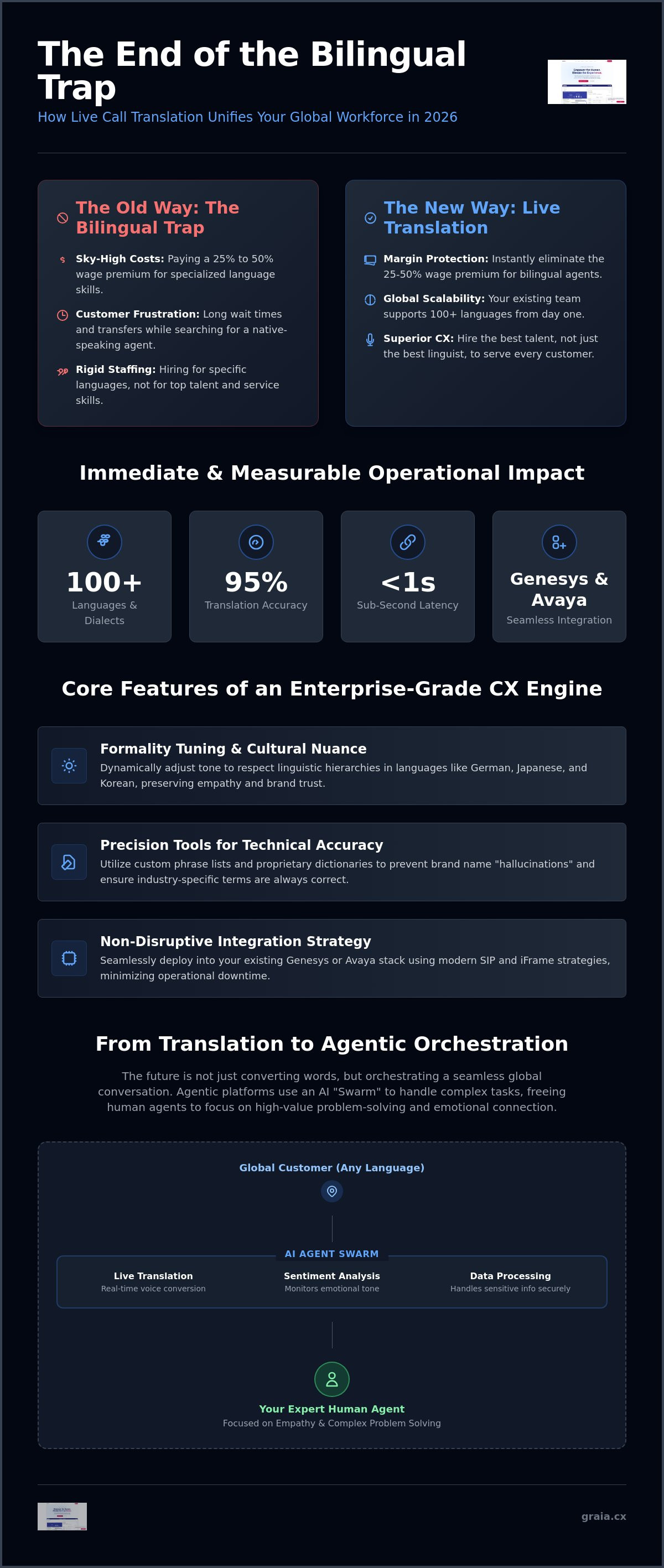
We understand that maintaining a genuine human connection is non-negotiable for your brand. This 2026 guide demonstrates how agentic live call translation software finally breaks this cycle, allowing your existing team to support over 100 languages with 95% translation accuracy. You will discover how to eliminate those 25% to 50% staffing premiums while simultaneously reducing your Average Handle Time through seamless workflow integration. We will examine the transition to low-latency speech-to-speech models and provide a clear roadmap for selecting a partner that protects both your margins and your customer relationships.
Key Takeaways
- Scale your global footprint without the burden of the "Bilingual Trap" by eliminating the 50% wage premium typically required for native-speaking agents.
- Evaluate the technical performance of live call translation software against 2026 industry standards for sub-second latency and 95% accuracy in complex technical support.
- Integrate advanced translation capabilities seamlessly into your current Genesys or Avaya stack using non-disruptive SIP and iFrame deployment strategies.
- Protect your brand’s emotional intelligence by utilising formality tuning to respect cultural nuances and maintain empathy across 100+ languages and dialects.
- Transform your customer experience from simple conversion to intelligent orchestration by combining live translation with agentic, autonomous support frameworks.
Beyond the Language Barrier: Why Enterprise Call Translation is Non-Negotiable in 2026
The era of the "Bilingual Trap" has reached its conclusion. For decades, global enterprises have been forced into a reactive cycle of hiring native speakers for every target market, only to find themselves burdened by rigid staffing models and soaring overheads. Live call translation software is a sophisticated multilingual CX engine that enables real-time voice-to-voice conversion across global enterprise networks. It's not just about swapping words; it's about preserving the human intent that drives brand loyalty. This technology transforms your existing workforce into a versatile, global team capable of communicating across borders with absolute clarity.
The operational impact of this shift is immediate and measurable. By removing the friction of "specialty" language transfers, organisations are seeing a dramatic reduction in Average Handle Time (AHT). Customers no longer languish in queues waiting for the one available native speaker who might be on a break or handling another complex case. Instead, they receive immediate support in their preferred tongue, which naturally boosts First Contact Resolution (FCR) rates and strengthens the overall customer experience. Unlike early Mobile translation applications that focused on simple phrase-swapping for travellers, modern enterprise systems are built for the high-stakes environment of the contact centre.
The Economic Shift in Multilingual Support
The financial reality of 2026 is stark. Industry data suggests that bilingual agents currently command a 25% to 50% wage premium compared to their monolingual counterparts. This creates a systemic inefficiency where you're paying for a linguistic skill rather than a service skill. By implementing agentic live call translation software, you eliminate the need for restrictive, language-specific queues. This allows for a unified agent pool that can handle 100+ languages dynamically. It's a fundamental shift from hiring for tongues to hiring for talent, ensuring your most empathetic agents can serve any customer regardless of their dialect or location.
From Translation to Agentic Orchestration
Enterprise requirements have evolved far beyond the basic capabilities of consumer-grade tools. Modern agentic platforms utilize a "Swarm" architecture to manage complex technical support, where AI agents handle the heavy lifting of real-time linguistic conversion and sentiment analysis. This frees your human agents to focus on high-stakes problem solving and emotional connection. When your support infrastructure is no longer bound by geography, global revenue expansion becomes a matter of strategy rather than a logistical nightmare. You're no longer just translating; you're orchestrating a seamless global conversation that respects cultural nuances while protecting your bottom line.
Core Features of Enterprise Live Call Translation Software
Enterprise requirements demand more than simple word substitution. True live call translation software must facilitate a fluid, bi-directional exchange that mirrors the natural cadence of human conversation across 100+ languages and dialects. Basic consumer tools offer utility. Enterprise platforms offer intelligence. While The Best Translator Apps for 2026 provide basic utility for general users, high-stakes customer experience requires a deeper understanding of cultural context. This involves formality tuning, which allows agents to adjust their tone dynamically to respect linguistic hierarchies in languages like German, Japanese, or Korean. By preserving the original audio in the background, the system ensures that the emotional weight and sentiment of the caller's voice aren't lost in the digital ether.
Precision Tools for Technical Accuracy
Accuracy is the foundation of trust. To reach 98% precision in technical support, enterprises must move beyond generic models and implement custom phrase lists. These proprietary dictionaries prevent brand name hallucinations and ensure that industry-specific terminology is rendered correctly every time. Dedicated speech correction nodes refine recognised speech before the translation engine even begins its work. This process includes strict reading rules for sensitive data such as account numbers or dates, which is essential for maintaining compliance within the UK's regulatory framework. You can explore more about these technical nuances on the Graia insights hub.
Agent-Centric Interface Design
Technology should empower the agent, not distract them. The modern translation widget lives directly within the CRM, allowing staff to manage bi-directional flows without switching windows. It's a seamless integration that preserves focus. Features like partial translation allow agents to see a transcript in progress, giving them a head start on processing requests before the caller even finishes speaking. Most importantly, cancel and edit windows provide a human-in-the-loop safety net. This allows agents to review and refine AI-generated responses in milliseconds, ensuring that every word delivered to the customer is accurate, empathetic, and on-brand. Implementing agentic live call translation software is about more than just language; it is about providing your team with the tools to excel in a global market.
The Evaluation Framework: Comparing Accuracy, Latency, and Empathy
Selecting the right live call translation software requires a shift in perspective. You aren't just buying a utility; you're investing in a sophisticated infrastructure that represents your brand's voice in dozens of languages simultaneously. In 2026, the standard for excellence is no longer just "getting the point across." It's about achieving sub-second latency while maintaining 95% accuracy in technical contexts. If a system introduces a two-second delay, the natural rhythm of human empathy is shattered. The conversation becomes a series of disjointed transmissions rather than a fluid exchange. You must evaluate potential partners based on their ability to balance the technical triad of speed, precision, and emotional resonance.
Solving the Latency Challenge
The "robotic delay" often found in consumer-grade tools is usually a symptom of poor connectivity architecture. Enterprise-grade solutions utilise SIP-based (Session Initiation Protocol) connectivity to create high-fidelity voice channels that bypass the congestion of standard web-based protocols. By leveraging regional hosting, data travels shorter distances, which drastically reduces the round-trip time for translation. This relentless pursuit of speed is a central pillar in the evolution of the ai customer service platform, which has transitioned from simple text-based interactions to sophisticated, low-latency voice orchestration. When latency drops below 700 milliseconds, the technology becomes invisible, allowing the agent's personality to shine through.
Accuracy Beyond the Basics
Standard translation models often struggle with the nuances of regional dialects. A "Standard Spanish" model might fail a customer in Mexico City just as a "Standard French" model could alienate a caller in Quebec. Grounding your live call translation software with Hybrid Search (RAG) ensures that translations are anchored in your specific knowledge base rather than generic training data. This prevents hallucinations and ensures that technical terminology is precise. Modern frameworks now employ "Judges"-specialised AI nodes that score translation quality and brand adherence in real time. This creates a self-correcting loop that guarantees your brand's voice remains consistent, whether the conversation is happening in London, Berlin, or Seoul.
Data sovereignty remains a non-negotiable requirement for the UK market. Any enterprise solution must offer robust PII (Personally Identifiable Information) protection to remain compliant with GDPR and industry-specific regulations. This means ensuring that sensitive data is redacted or encrypted before it ever reaches a translation engine. You aren't just protecting a conversation; you're protecting your customer's trust and your organisation's reputation. A truly sophisticated partner treats security not as a feature, but as the foundation upon which all multilingual communication is built.
Integration Strategy: SIP, iFrames, and the Modern CCaaS Stack
The transition to a multilingual contact centre should not necessitate a total overhaul of your existing infrastructure. Modern live call translation software utilises a "Drop-In" model, allowing you to augment established platforms like Genesys or Avaya without the disruption of a rip-and-replace project. By leveraging Session Initiation Protocol (SIP), the system taps directly into high-fidelity voice channels, ensuring the translation engine receives a clean signal for processing. This architectural choice is critical. It avoids the latency and quality degradation common in web-based consumer tools that rely on generic streaming protocols. You're not just adding a feature; you're enhancing your entire communication backbone.
For the agent, the experience remains unified. Translation widgets are embedded via iFrame directly into the existing CRM, providing a single pane of glass for all interactions. This prevents "toggle tax" and keeps the focus where it belongs: on the customer. Within this flow, sophisticated security guardrails operate silently. Prompt shields and PII masking automatically detect and redact sensitive data, ensuring that multilingual conversations remain fully compliant with UK GDPR requirements. It is a protective layer that empowers agents to communicate freely while safeguarding the organisation's reputation and customer trust.
CCaaS Compatibility Checklist
Your choice of translation partner must offer native compatibility with the heavyweights of the CCaaS stack, including NICE CXone, Five9, and Salesforce. Integration goes beyond voice. It involves managing the omnichannel context. Preserving translation history across chat and voice ensures that a customer never has to repeat themselves when moving between channels. Additionally, this data can trigger automated workflows, using translation results to initiate backend API calls or update customer records instantly. This creates a more responsive, intelligent service environment.
Deployment and Tuning
Implementation is a process of refinement, not a one-off event. A typical tuning cycle lasts 4 to 6 weeks, during which accuracy typically climbs from an initial 85% to a production-ready 98%. This phase involves training the AI on your specific industry terminology, proprietary scripts, and unique brand voice. The result is more than just a live tool; it is a repository of intelligence. Translated calls generate audit-ready transcripts, providing a goldmine of data for dispute resolution and quality assurance (QA) teams. To begin planning your deployment, explore our technical integration guides.
Graia: The Multilingual Customer Experience Engine
Graia represents the definitive shift from simple translation tools to a comprehensive agentic orchestration platform. While other solutions focus purely on word conversion, our live call translation software unifies real-time voice-to-voice communication with autonomous intelligence. It's about empowering your team to deliver world-class service without the friction of language barriers. By deploying an Agentic Omni-Channel Platform, you're not just solving a linguistic puzzle; you're building a scalable, future-proof infrastructure that supports 100+ languages from the moment of activation. This isn't just a tool for today. It is a foundation for global dominance.
The true power of Graia lies in our "Agent Assist" capability. This isn't a passive translation layer. It is an active partner that provides real-time suggestions grounded specifically in your proprietary knowledge base. When a customer in Berlin asks a complex technical question, your agent in London receives the translated query alongside a verified, brand-consistent solution. This preserves the human element by removing the cognitive load of searching for answers across multiple windows. It allows your staff to focus entirely on empathy and connection, ensuring that every global interaction feels personal and professional. We don't just translate words; we translate trust.
Why Graia is the Enterprise Choice
We've engineered Graia to meet the uncompromising standards of the modern corporate environment. Our hybrid deterministic and LLM flows ensure 100% process accuracy for critical tasks like identity verification or billing updates. Security is woven into our foundation. We provide a total data sovereignty guarantee, ensuring your sensitive customer data is never used to train external models. Through our unique Swarm architecture, we deploy specialised translation agents tailored for specific departments, such as technical support or financial services. This ensures that the nuance of every conversation is captured and respected across every dialect.
Ready to Transform Your Global CX?
The transition to agentic translation delivers immediate, measurable results. Organisations leveraging Graia report an average 25% gain in agent productivity and a 40% reduction in escalations. These aren't just metrics; they're the indicators of a more agile, responsive enterprise. If you're ready to eliminate the "Bilingual Trap" and unify your global support operations, we invite you to schedule a strategic consultation. Our team will help you map out a deployment that protects your margins while elevating your customer experience. You can also explore Graia's latest CX insights to see how we're redefining the future of global communication.
Unifying Your Workforce Across Every Border
The era of fragmented support queues and prohibitive bilingual premiums has ended. By implementing sophisticated live call translation software, you're no longer just managing a contact centre; you're orchestrating a global engine of human connection. We've explored how technical benchmarks like sub-second latency and custom brand vocabularies ensure that empathy is never sacrificed for efficiency. This transition allows your most talented agents to serve any customer, anywhere, without the friction of a language barrier. It's a fundamental shift from hiring for tongues to hiring for talent.
Graia provides the stable, secure foundation required for this evolution. With support for 100+ languages and dialects, our platform delivers a 25% improvement in agent productivity while maintaining 99.9% uptime and SOC2-aligned security. This is the moment to move beyond basic translation and embrace true agentic orchestration. You have the vision to lead your industry into a multilingual future, and we have the technology to make it a reality. The path to a unified global experience is clear, and the results are within your reach.
Explore the Graia Multilingual CX Engine and start your journey toward a borderless enterprise today.
Frequently Asked Questions
Is live call translation software accurate enough for technical support?
Professional-grade live call translation software achieves up to 98% accuracy by utilizing custom dictionaries and Hybrid Search (RAG) to ground the AI in your specific technical documentation. This ensures that complex terminology and proprietary processes are rendered with absolute precision. Unlike consumer apps, enterprise systems are tuned during a dedicated implementation cycle to eliminate hallucinations and respect industry-specific jargon.
How much latency should I expect with real-time voice translation?
You should expect sub-second latency, typically falling under 700 milliseconds, to maintain the natural cadence of human conversation. Speed is a non-negotiable requirement for empathy. By leveraging SIP-based connectivity and regional hosting, enterprise platforms bypass the congestion of standard web protocols. This eliminates the disjointed, robotic delays that often frustrate callers and agents alike in high-stakes environments.
Can I use live call translation with my existing Genesys or Avaya platform?
Integration is seamless through a "Drop-In" model that utilizes SIP and iFrame widgets to augment your current CCaaS stack. You don't need to perform a costly rip-and-replace of your Genesys or Avaya infrastructure. The translation interface lives directly within the agent's existing CRM or desktop environment, allowing them to manage multilingual flows without switching between disparate applications.
Does the software handle brand names and industry-specific jargon?
The system manages brand names and unique terminology through proprietary phrase lists and custom dictionaries tailored to your organisation. This prevents the AI from misinterpreting unique product names or industry shorthand as common words. During the initial tuning phase, your specific scripts and vocabulary are integrated into the model to ensure brand consistency across every language you support.
How does live translation software protect customer PII and data?
Data protection is enforced through automated PII masking and prompt shields that redact sensitive information before it ever reaches the translation engine. These systems are designed to be fully compliant with UK GDPR and other stringent regulatory frameworks. Your data remains encrypted at rest and in transit, and it is never utilised to train external, third-party models.
What happens if the translation makes a mistake during a call?
Agents maintain total control through a human-in-the-loop interface that includes "Cancel" and "Edit" windows for every response. If the AI-generated translation requires refinement, the agent can correct the text in milliseconds before it is converted to speech. This safety net ensures that your brand's voice remains accurate and empathetic, even in the most complex or sensitive interactions.
Do I need to hire native speakers to manage the translation software?
You don't need to hire native speakers for every market; the technology empowers your existing team to communicate fluently across linguistic borders. This shift allows you to recruit based on service skills and emotional intelligence rather than language ability. By removing the 50% wage premium for bilingual staff, you can scale your global support operations more efficiently.
How many languages can enterprise translation software support?
Modern enterprise platforms support over 100 languages and regional dialects from the first day of deployment. This extensive coverage includes formality tuning to respect the cultural nuances of markets such as Japan, Korea, and Germany. You can expand your footprint into new global territories instantly, providing high-quality support without the traditional logistical constraints of geographical recruitment.