
Enterprise AI Contact Center Solutions: The 2026 Guide to Agentic CX
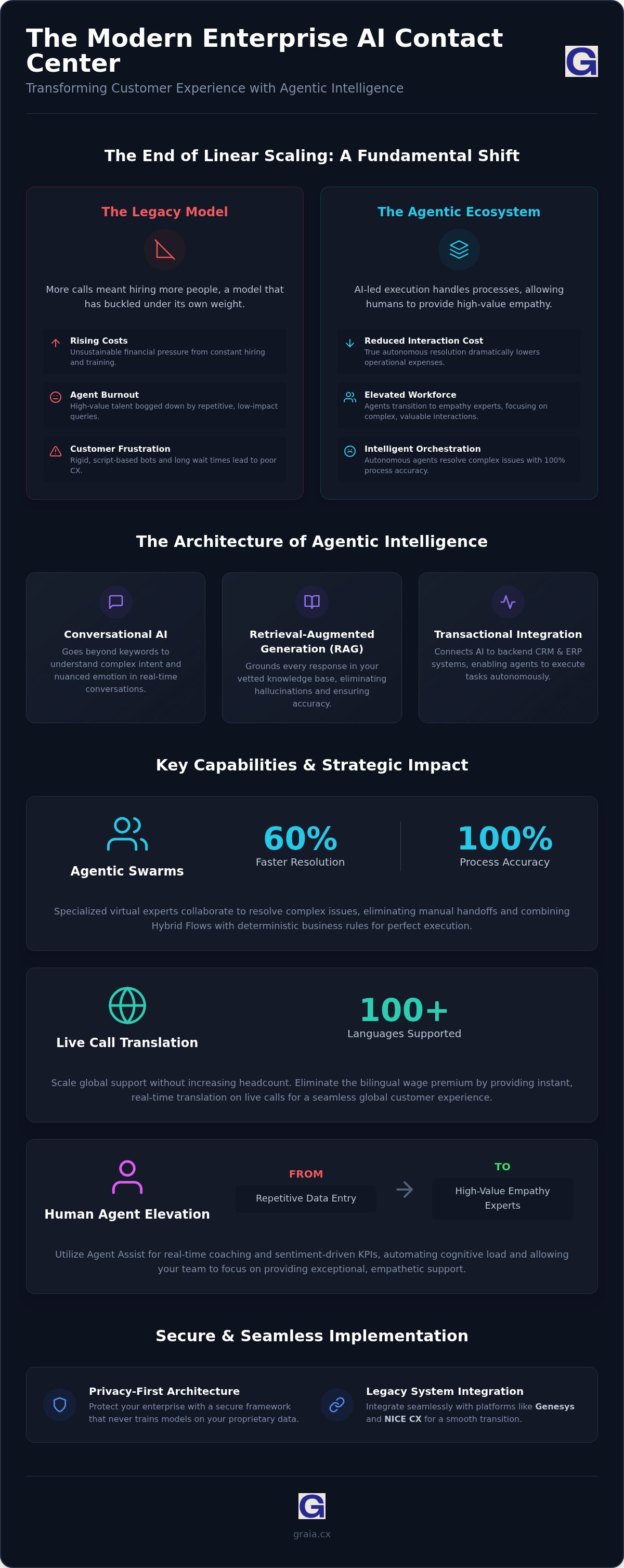
The era of linear scaling is over. For decades, the only way to handle more calls was to hire more people, but this model has finally buckled under the weight of rising costs and agent burnout. You know the frustration of watching high-value talent struggle with repetitive queries while your global customers wait for support in their native languages. Implementing a modern enterprise ai contact center isn't just about adding a layer of automation. It's about a fundamental transformation that replaces transactional friction with intelligent orchestration.
You've likely realized that traditional bots have failed the empathy test, often leaving customers more frustrated than they began. This guide demonstrates how agentic CX architecture replaces these rigid systems with intelligent, autonomous agents that achieve 100% process accuracy. We'll explore the transition from legacy infrastructure to an agentic ecosystem that scales your global reach and reduces cost per interaction through true autonomous resolution.
Key Takeaways
- Master the shift from reactive IVR to proactive Conversational Agents that resolve complex issues autonomously using Hybrid Flows and deterministic business rules.
- Discover how Agentic Swarms allow specialized virtual experts to collaborate, achieving up to 60% faster resolution times while maintaining 100% process accuracy.
- Eliminate the bilingual wage premium by deploying Live Call Translation that supports over 100 languages, allowing you to scale global support without increasing headcount.
- Secure your enterprise ai contact center with a privacy-first architecture that integrates seamlessly with legacy platforms like Genesys and NICE CX without training models on your data.
- Transition your human workforce from repetitive data entry to high-value empathy experts by utilizing Agent Assist for real-time coaching and sentiment-driven KPIs.
Defining the Modern Enterprise AI Contact Center Solution
The definition of excellence has shifted. Yesterday's success was measured by how quickly an agent could get a caller off the phone, but tomorrow's leaders focus on how effectively an issue is erased from existence. A modern enterprise ai contact center is no longer a reactive silo where customers wait in digital purgatory. It's a proactive, agentic hub that anticipates needs and executes complex workflows with surgical precision. This evolution moves beyond the limitations of the traditional contact center industry overview, where human-led service was the only path to resolution. We're now entering the era of AI-led execution, where the machine handles the process and the human provides the high-value empathy.
Distinguishing between a basic chatbot and an autonomous Conversational Agent is critical for strategic planning. Chatbots are rigid, script-based tools that often lead to dead ends. Conversational Agents are dynamic entities capable of reasoning, planning, and executing tasks. At the enterprise level, this requires a unified intelligence layer. Whether a customer reaches out via voice, chat, or email, the intelligence driving the resolution must be consistent. This move from human-led service to AI-led execution doesn't replace people; it elevates them by automating the cognitive load of data entry and process navigation.
From Fragmented Tools to Agentic Ecosystems
Siloed AI tools are the architects of friction. When a customer moves from a messaging app to a live voice call, they shouldn't have to start their story from the beginning. Fragmented systems fail to deliver ROI because they lack session continuity. An agentic ecosystem solves this by maintaining a unified intelligence layer across every touchpoint. It treats voice, chat, and email as a single, persistent conversation. This orchestration of human and digital workforces ensures that every interaction is informed, context-aware, and moving toward a definitive conclusion.
The Core Components of an Enterprise AI Stack
Building a resilient AI strategy requires more than just a large language model. It demands an integrated stack designed for high-stakes enterprise environments where accuracy is non-negotiable. This stack consists of three essential pillars:
- Conversational AI: Advanced engines that go beyond basic keyword matching to understand complex intent and nuanced emotion in real-time.
- Retrieval-Augmented Generation (RAG): A framework that ensures every response is grounded in your company's vetted knowledge base, effectively eliminating the risk of hallucinations.
- Transactional Integration: True intelligence requires action. By connecting AI directly to your CRM and ERP systems, agents can perform backend tasks without human intervention.
This architecture allows your enterprise ai contact center to scale without the traditional constraints of headcount or language barriers. It creates a stable foundation where technology handles the heavy lifting of data processing, allowing your human agents to step into their roles as high-value empathy experts.
The Architecture of Agentic Intelligence: RAG, Swarms, and Hybrid Flows
Intelligence isn't a monolith. In a high-functioning enterprise ai contact center, success depends on specialized collaboration rather than a single, all-purpose model. While general-purpose LLMs are impressive, they often lack the specific guardrails required for mission-critical operations. True agentic architecture utilizes Agentic Swarms, where multiple specialized virtual experts work in concert to resolve a single customer issue. One agent might handle billing authentication while another manages technical troubleshooting, all coordinated by an orchestrator that maintains perfect context throughout the journey. This approach delivers 60% faster average resolution times by eliminating the friction of manual handoffs.
The transition from simple automation to agentic intelligence requires a sophisticated AI governance and risk management framework. It's about more than just generating text; it's about executing processes with absolute certainty. By combining Retrieval-Augmented Generation (RAG) with deterministic business logic, enterprises can finally trust AI in regulated environments. If you're looking to deepen your understanding of these frameworks, exploring our latest insights on AI implementation can provide the technical roadmap your team needs.
Specialized Expertise via Multi-Agent Ecosystems
Siloed bots are a relic of the past. Modern ecosystems assign specific domains like billing, technical support, or sales to dedicated AI agents. These agents don't just "chat"; they possess specialized tools and permissions to execute tasks within their domain. When a customer moves from a billing query to a technical issue, the handoff is instantaneous and invisible. The system preserves the entire conversation history, ensuring the customer never has to repeat themselves. This coordination reduces the cognitive load on human agents, as the "Swarm" handles the complex data gathering and preliminary troubleshooting before a human ever needs to intervene.
Ensuring 100% Process Accuracy in Regulated Industries
Accuracy is a mandate, not an option. In highly regulated sectors, the "Hybrid Flow" model is the only viable path forward. This architecture allows LLMs to handle natural language understanding while keeping the actual business execution deterministic. You define the rules; the AI follows them. To prevent hallucinations, these systems employ prompt shields and real-time output scanning to ensure every response stays within brand and regulatory boundaries. Every reasoning step and knowledge base search is logged. This creates a transparent audit trail that is essential for compliance and continuous optimization of your enterprise ai contact center strategy.
Finally, future-proofing your stack requires an LLM-agnostic approach. The AI landscape moves fast, and being locked into a single provider is a strategic risk. A robust platform allows you to swap underlying models as better technology emerges, ensuring your contact center remains at the cutting edge without requiring a total infrastructure overhaul.
Strategic Impact: Scaling Empathy and Multilingual Operations
Efficiency is table stakes. While many organizations focus solely on the bottom line, a visionary enterprise ai contact center strategy recognizes that technology's highest calling is the restoration of human connection. By offloading the mechanical aspects of a call to intelligent systems, we create the space for empathy to thrive. This isn't just about saving money; it's about saving the agent's mental capacity. Tools like Agent Assist provide real-time coaching and automated summaries, which can reduce Average Handle Time (AHT) by 15% to 25%. This allows your team to focus on the person, not the process.
The most significant barrier to global scale has always been language. Traditionally, enterprises paid a "bilingual premium," struggling to hire and retain specialized staff for every market they entered. By integrating live call translation software, you effectively dissolve these borders. You can now support over 100 languages natively without the logistical nightmare of regional hiring or the high costs of external translation services. This shift transforms your support from a fragmented group of silos into a unified, global force.
The Empathy Engine: Human-AI Collaboration
Technology should be a shield, not a barrier. Sentiment analysis acts as a silent guardian, monitoring interactions for rising frustration or high-emotion triggers. When the system detects a situation that requires a human touch, it initiates a seamless escalation. This ensures your most skilled agents are only deployed where they are needed most. Because Agent Assist provides instant answers and next-best-actions, it significantly reduces the stress that leads to agent attrition. Consistency is maintained through AI-driven tuning, ensuring your brand's voice remains professional and empathetic regardless of the channel.
Global Reach Without the Hiring Headache
Scaling a global support team usually means scaling your headcount linearly. Agentic AI breaks this cycle. By removing language-based queues, you improve First Contact Resolution (FCR) because any agent can help any customer. A unified AI-powered workforce replaces the need for fragmented, language-specific teams, providing a massive ROI shift. You're no longer managing a dozen different regional silos; you're managing a single, intelligent ecosystem that speaks the language of every customer. This is the future of the enterprise ai contact center: a hub that is globally accessible, technically superior, and deeply human.
Implementation Essentials: Security, Integration, and Governance
Security is the bedrock of trust. In a high-stakes enterprise ai contact center, protecting customer data isn't just a compliance requirement; it's a moral imperative. We adopt a strict privacy-first approach, ensuring that your proprietary data and sensitive customer interactions are never used to train public models. This isolation is critical for maintaining a competitive edge and meeting the rigorous standards of regulated industries. By implementing advanced PII masking and end-to-end encryption for data both at rest and in transit, we provide a secure environment where innovation doesn't come at the cost of integrity.
Reliability requires rigorous validation. Before any agentic workflow goes live, it must survive a gauntlet of stress tests. We utilize specialized AI Judges and high-fidelity simulators to evaluate performance across thousands of edge cases. These simulators identify potential friction points and ensure that the system's reasoning remains sound under pressure. This commitment to deterministic outcomes allows leaders to deploy autonomous solutions with total confidence. To see how these principles apply to modern infrastructure, you can explore our latest resources on enterprise AI strategy.
Seamless Integration with Existing Architecture
Legacy systems shouldn't be a barrier to progress. Our architecture is designed to integrate seamlessly with established CCaaS platforms like Genesys, NICE CX, and Avaya through non-disruptive SIP connectivity and iframe widgets. This allows you to modernize your operations without a rip-and-replace overhaul. By layering cloud based ai call center modules onto your existing stack, you gain immediate access to agentic capabilities. These modules connect directly to your CRM and ERP systems, transforming AI from a passive listener into an active participant capable of executing real-time backend transactions.
Enterprise-Grade Governance and Guardrails
Control is the counterpart to autonomy. Protecting your brand requires more than just good intentions; it requires proactive guardrails. Prompt shields and toxicity detection engines act as a first line of defense, neutralizing malicious inputs before they can influence a response. We employ Role-Based Access Control (RBAC) and maintain full audit logging to ensure every decision is traceable and compliant with global standards. Automated testing continuously monitors for model hallucinations and weak confidence scores, allowing for immediate intervention. This multi-layered governance ensures your enterprise ai contact center remains a safe, stable, and highly effective extension of your brand identity.
Orchestrating the Future: Transitioning to an AI-Led Operating Model
The transition is final. We've moved beyond the era of incremental upgrades into a period of fundamental structural change. In a high-performing enterprise ai contact center, the human agent is no longer a data entry clerk or a process navigator. They've become empathy experts. By automating the mechanical aspects of resolution, you liberate your workforce to handle the nuanced, emotionally complex interactions that define your brand. This shift requires a total re-evaluation of how we measure success. Traditional metrics like Average Handle Time (AHT) are becoming obsolete. Instead, visionary leaders are prioritizing resolution accuracy and customer sentiment as the primary indicators of health.
The roadmap to full autonomous resolution isn't a leap; it's a calculated progression. Most organizations begin with "Draft Mode" or Agent Assist, where the AI suggests responses and handles documentation while the human remains the final decision-maker. This phase allows the system to learn from your best performers in real-time. As confidence scores rise, you can gradually enable autonomous resolution for high-volume, low-risk workflows. Achieving a sustainable contact center roi with ai depends entirely on this cycle of continuous learning and outcome optimization.
The Evolution of the Agent Desktop
The modern agent workspace is a unified intelligence hub. Rather than toggling between dozens of tabs, agents manage voice, chat, and social interactions within a single, intelligent flow. Real-time transcripts and automated wrap-ups have effectively eliminated manual after-call work, allowing agents to move immediately to the next high-value task. Furthermore, the deployment of ai agent assist tools has slashed onboarding time. New hires no longer need to memorize complex product manuals; they simply need to follow the intelligent, real-time guidance provided by their digital partner.
Building a Connected CX Hub
Data is the fuel for this transformation. By utilizing Power BI and OData feeds, your enterprise ai contact center becomes an engine of operational intelligence. You can identify churn risks and shifting customer satisfaction trends the moment they emerge, rather than weeks later in a monthly report. This level of visibility allows you to be proactive rather than reactive, resolving systemic issues before they impact your bottom line. The future of CX isn't just about answering calls; it's about orchestrating a seamless, intelligent journey for every customer. To see this ecosystem in action, your next step is booking a demo of the Graia Agentic CCaaS platform.
Leading the Evolution of Global Support
The transition to a modern enterprise ai contact center is no longer a strategic option; it's a requirement for survival in a borderless economy. By moving from rigid, reactive bots to an ecosystem of autonomous agents, you gain the ability to scale empathy alongside volume. We've explored how Hybrid Flow architecture guarantees 100% process accuracy while Agentic Swarms resolve complex issues without human intervention. This is the synthesis of technical superiority and human intelligence, designed to protect your brand and empower your workforce.
At Graia, we combine 25 years of CX expertise with Red Dot-level UI design to ensure your transition is as seamless as it is impactful. Our platform offers native integration with Salesforce, Microsoft Dynamics, and ServiceNow, allowing you to modernize your operations without disrupting existing workflows. It's time to move beyond the friction of legacy systems and embrace a future where every interaction is a masterpiece of precision and connection. Experience the future of agentic CX with a Graia platform demo and start your transformation today.
Common Questions About Agentic CX Transformation
What is the difference between a chatbot and an enterprise AI contact center agent?
Traditional chatbots follow rigid, script-based paths that often lead to dead ends and customer frustration. An autonomous Conversational Agent is a dynamic entity capable of reasoning, planning, and executing complex tasks across multiple systems. These agents use agentic swarms to collaborate on resolutions, ensuring they handle the entire customer journey rather than just answering simple questions. They represent the next evolution in the enterprise ai contact center landscape by providing true autonomous resolution.
How do enterprise AI solutions handle data privacy and PII?
We adopt a privacy-first architecture where your sensitive customer data is never used to train public models. This isolation ensures your proprietary information remains secure and compliant with global standards. Our platform implements advanced PII masking and end-to-end encryption for data both at rest and in transit. These guardrails allow you to innovate with confidence, knowing that your data integrity is protected by enterprise-grade security protocols.
Can AI contact center software integrate with my existing Genesys or Avaya system?
Yes, our platform integrates seamlessly with legacy CCaaS infrastructure including Genesys, NICE CX, and Avaya. We utilize non-disruptive SIP connectivity and iframe widgets to layer agentic capabilities directly onto your existing agent desktop. This allows you to modernize your operations and deploy intelligent automation without the risk or expense of a complete rip-and-replace overhaul. You gain cutting-edge functionality while maintaining your current infrastructure investments.
How does real-time call translation work for contact center agents?
Live Call Translation software captures audio in real-time and provides instant, high-fidelity translation for both the agent and the customer. This technology supports over 100 languages, allowing any agent to handle global calls natively regardless of their linguistic background. It effectively dissolves borders and eliminates the need for expensive, specialized bilingual staffing teams. This results in a unified, global workforce that can resolve issues in the customer's preferred language.
What is Retrieval-Augmented Generation (RAG) in the context of customer service?
Retrieval-Augmented Generation (RAG) is a framework that grounds AI responses in your company's specific, vetted knowledge base. Instead of relying on general training data that might lead to inaccuracies, the system retrieves relevant facts from your documentation before generating a response. This ensures every interaction is accurate, contextually relevant, and free from the risks of hallucinations. It provides a reliable foundation for high-stakes customer interactions in regulated industries.
Does implementing AI mean I can reduce my contact center headcount?
Implementing AI is primarily about breaking the cycle of linear scaling, where you must hire more people to handle more volume. While it automates repetitive tasks, it doesn't necessarily mean reducing your existing workforce. Instead, it elevates human agents into empathy experts who handle high-value, emotionally complex cases. This shift improves overall productivity and reduces the burnout that leads to high attrition, allowing you to scale global support without increasing headcount.
How do I prevent AI from 'hallucinating' or giving wrong information to customers?
We prevent hallucinations by utilizing a Hybrid Flow architecture that combines natural language understanding with deterministic business rules. This ensures the AI follows your specific process logic with absolute certainty. Additionally, we employ prompt shields and real-time output scanning to monitor every interaction for brand safety. Every reasoning step is logged, creating a transparent audit trail that is essential for maintaining process accuracy in mission-critical environments.
What are the typical ROI metrics for an enterprise AI contact center?
Success in a modern enterprise ai contact center is measured through a shift in KPIs from speed to quality. While you will see improvements in resolution speed and agent productivity, the most significant ROI comes from increased resolution accuracy and improved customer sentiment. By improving First Contact Resolution (FCR) and eliminating bilingual wage premiums, organizations achieve a sustainable, value-driven automation model. This transition transforms the contact center from a cost center into a strategic asset.