Upgrading Avaya with Conversational AI: The 2026 Technical Guide to Agentic CX
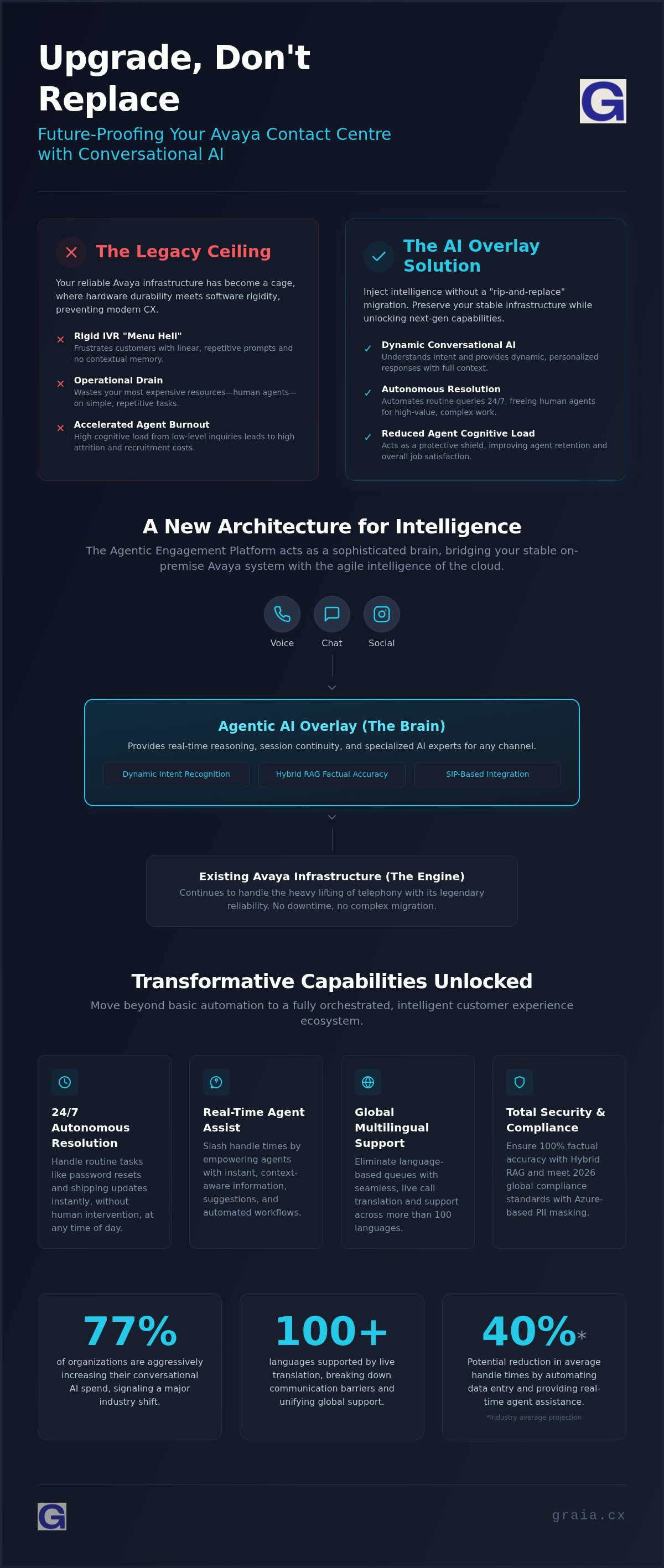
The most expensive mistake in 2026 isn't keeping your legacy infrastructure; it's failing to evolve it. While 77% of organizations are aggressively increasing their conversational AI spend, many remain paralyzed by the fear that modernizing their contact centre requires a catastrophic "rip-and-replace" of their trusted systems. You shouldn't have to choose between the reliability of your current setup and the intelligence of the future. We understand the pressure of managing rigid IVR trees that frustrate customers and the rising costs of maintaining a global, multilingual workforce.
This technical guide reveals how upgrading avaya with conversational ai allows you to bypass complex migrations by deploying a sophisticated agentic overlay. You'll discover how to transform your existing environment into a high-performance hub capable of 24/7 autonomous resolution and seamless live translation across 100 languages. By the end of this article, you'll have a clear roadmap for integrating real-time agent assist and automated workflows that slash handle times while preserving the human connection your brand depends on. We'll move from the vision of agentic CX to the practical steps of technical execution.
Key Takeaways
- Break through the legacy ceiling by replacing rigid IVR trees with dynamic, intent-driven conversational interfaces that respect your existing hardware investment.
- Learn why upgrading avaya with conversational ai via a modular overlay is significantly more efficient than a full platform migration, preserving stability while injecting intelligence.
- Master the technical requirements for SIP-based integration to deploy an "Agentic Swarm" of specialized AI experts across both voice and digital channels.
- Eliminate language-based queues and drastically reduce average handle times by implementing live call translation and real-time agent assist tools.
- Secure your digital transformation using hybrid RAG for total factual accuracy and Azure-based PII masking to meet 2026 global compliance standards.
Overcoming the Legacy Ceiling in Avaya Contact Centres
Enterprise leaders often face a frustrating paradox. Your Avaya infrastructure is legendary for its reliability; it simply doesn't fail. Yet, this very stability has created a "Legacy Ceiling." This is the precise point where hardware durability meets software rigidity, preventing your organization from evolving alongside modern consumer expectations. You possess a robust foundation, but it's currently a cage that limits your agility. upgrading avaya with conversational ai is the only way to shatter this ceiling without compromising the core systems that keep your business running.
The shift is fundamental. We're moving away from linear, frustrating IVR trees toward dynamic intent recognition. In 2026, customers no longer tolerate reactive service. They demand proactive, empathetic interactions that feel human even when they're automated. When your system forces a high-value human agent to handle a routine password reset or a shipping update, it isn't just an operational drain. It's a failure of vision. You're wasting your most expensive resources on tasks that an intelligent agentic layer can resolve in seconds.
Why Traditional IVR Fails the Modern Customer
Traditional "menu hell" is the primary driver of plummeting CSAT scores. Legacy systems treat every caller like a stranger, forcing them through repetitive prompts that ignore their history and current needs. These systems lack contextual memory. If a customer just failed to complete a transaction on your website, your IVR shouldn't ask them why they're calling; it should already know. Modern Conversational AI replaces static scripts with dynamic reasoning. It creates session continuity that makes the customer feel seen and understood, rather than processed.
The Economic Case for Conversational Upgrades
The financial reality of the UK contact centre market is stark. Agent attrition and the skyrocketing costs of recruitment are eating into margins. When you subject your staff to a relentless barrage of repetitive, low-level inquiries, you accelerate burnout. upgrading avaya with conversational ai serves as a protective shield for your workforce. By automating autonomous resolutions for routine queries, you reduce the cognitive load on your human agents. This doesn't just lower your cost-per-interaction; it improves retention by allowing your team to focus on complex, emotionally sensitive work that requires true human intelligence. The result is a leaner, more intelligent operation that scales without a linear increase in headcount.
- Autonomous Resolution: Handle routine tasks 24/7 without human intervention.
- Reduced Cognitive Load: Protect agents from burnout by automating repetitive data entry.
- Contextual Continuity: Ensure every interaction starts with the full history of the customer's journey.
The Architecture of an AI-Enhanced Avaya Ecosystem
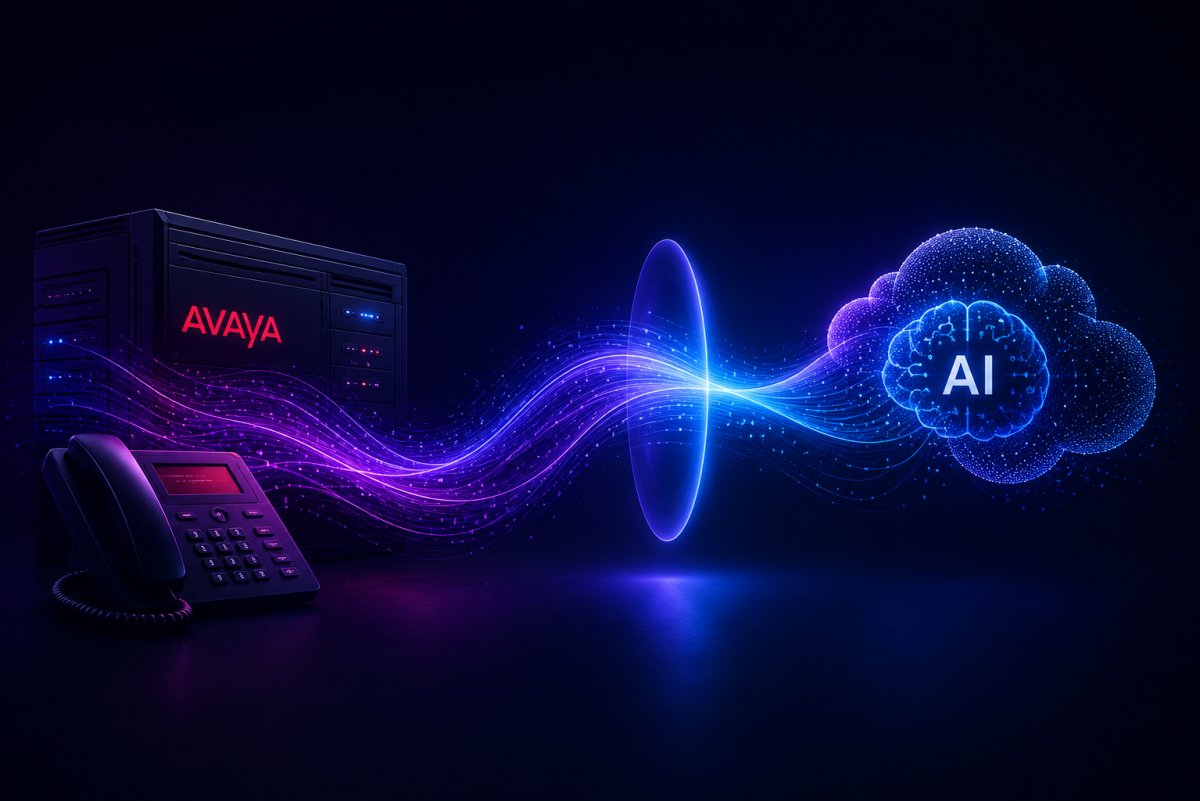
Modernizing your infrastructure doesn't require a total demolition of your existing investments. Instead, upgrading avaya with conversational ai involves deploying a unified Agentic Engagement Platform as a sophisticated overlay. This architectural approach creates a bridge between your stable on-premise PBX and the agile intelligence of the cloud. By utilizing GenAI fixes for legacy contact centers, you can inject real-time reasoning into every interaction without the downtime of a full migration. This layer ensures session continuity across voice, chat, and social messaging, allowing a customer to start a conversation on WhatsApp and finish it on a voice call without losing a single shred of context.
The core of this transformation is the move toward a cloud based ai call center model. This isn't just about moving servers; it's about shifting from a reactive queue to an orchestrated intelligence. By using Hybrid RAG (Retrieval-Augmented Generation), the system ensures 100% factual accuracy by grounding AI responses in your specific enterprise data. Your legacy Avaya system continues to handle the heavy lifting of telephony, while the agentic layer provides the "brain" that understands intent, sentiment, and complex customer journeys.
Agentic Swarms vs. Linear Chatbots
The era of the monolithic, linear chatbot is over. We've entered the age of the "Agentic Swarm." In this ecosystem, multiple specialized AI agents—experts in Billing, Technical Support, or Sales—collaborate in real-time. When a customer's inquiry shifts from a payment issue to a technical fault, the Billing agent hands off the context to the Technical agent seamlessly. To ensure brand safety, "Judges"—autonomous monitoring agents—evaluate these interactions in real-time, checking for brand alignment and factual accuracy before a response ever reaches the customer. This collaborative intelligence ensures that no customer is ever "stuck" in a loop.
Hybrid Flows: Balancing LLM Naturalism with Rule-Based Precision
Enterprises in regulated sectors can't afford the "hallucinations" often associated with generic LLMs. 100% process accuracy is non-negotiable. GraiaCX achieves this through Hybrid Flows, combining the natural reasoning of GPT-4o with deterministic business logic. This ensures that while the AI sounds human, its actions are strictly governed by your enterprise's specific protocols. We also implement robust prompt shields and Azure-based PII masking to neutralize injection attacks and protect sensitive data. You can explore more about these transformative strategies in our CX innovation resources.
- Agentic Swarm: Specialized experts working in tandem to solve complex problems.
- Hybrid RAG: Grounding AI in your private data for total factual reliability.
- Session Continuity: Maintaining context across voice and digital channels effortlessly.
- Prompt Shields: Protecting your brand from adversarial attacks and toxic inputs.
Evaluating Upgrade Paths: Native Avaya AI vs. Third-Party Layers
Choosing the right trajectory for your digital transformation is a high-stakes decision that defines your operational agility for years to come. When upgrading avaya with conversational ai, many enterprises feel pressured toward native modules like the Avaya Infinity platform. While these offer deep integration, they often come with the heavy burden of vendor lock-in and a "rip-and-replace" mentality that risks operational stability. A modular overlay approach, by contrast, preserves your core telephony while injecting a layer of intelligence that remains LLM-agnostic. This ensures you aren't tied to a single model or provider; it future-proofs your stack against the rapid shifts in the AI landscape.
This flexibility extends to your global footprint and your ability to scale without friction. Implementing live call translation software within a third-party layer allows you to dissolve language-based queues instantly. Instead of recruiting expensive bilingual staff for every region, a single agentic platform empowers your existing team to support customers in 100+ languages in real-time. It's a strategic shift from managing headcount to managing intelligence. This approach bypasses the 60% failure rate Gartner predicts for AI projects that lack AI-ready data, as the overlay focuses on the intelligence layer rather than the underlying hardware.
The modularity advantage
The most effective upgrades are those that agents actually use. By utilizing an iframe-based widget, new AI capabilities appear directly within the existing Avaya workspace. This minimizes the friction of switching tabs. It slashes training time because the AI assists the agent's current workflow rather than forcing them to learn a new one. This no-code deployment model delivers Day-1 automation, providing immediate speed-to-value that traditional migrations simply cannot match. Upgrading avaya with conversational ai through this modular lens allows for incremental growth without the trauma of a total system overhaul.
Security and Data Sovereignty
In 2026, trust is your most valuable currency. A privacy-first architecture is essential, ensuring that your enterprise data is never used to train external models. High-level corporate environments require regional hosting and SOC2-aligned standards to maintain compliance with evolving regulations like the EU AI Act. Our approach utilizes Azure-based security with PII masking and end-to-end encryption. This protects data both in transit and at rest, ensuring that sensitive customer information remains within your controlled environment. We prioritize factual accuracy through Hybrid RAG, preventing the hallucinations that often plague generic AI implementations.
- LLM Agnosticism: Switch between models like GPT-4o or specialized enterprise LLMs without re-engineering your stack.
- Regional Hosting: Maintain data sovereignty by hosting your AI layer in specific geographical regions.
- PII Masking: Automatically redact sensitive customer data before it reaches the AI processing layer.
- Zero Training Data Usage: Guarantee that your proprietary business logic stays yours and isn't leaked into public models.
Technical Guide: Integrating Conversational AI with Avaya
Executing a successful transition requires a shift from viewing your PBX as a closed loop to seeing it as an open, intelligent node. To begin upgrading Avaya with conversational ai, your infrastructure must meet specific prerequisites, typically requiring Avaya Aura Release 10.1 or higher, or a contemporary IP Office deployment with active SIP trunking capabilities. The integration isn't a "rip-and-replace" operation but a strategic overlay. SIP integration functions as the high-bandwidth bridge for real-time voice data, enabling the bi-directional flow of audio streams between the Avaya Session Manager and the agentic AI layer. This connection allows the AI to "listen" and "speak" with sub-second latency, ensuring the customer experience remains fluid and natural.
While the voice channel is managed via SIP, the agent's visual workspace is transformed through a non-disruptive iframe integration. We embed the AI Agent Widget directly into the existing omnichannel desktop, providing real-time assistance without forcing agents to abandon their familiar environment. This frontend layer is supported by a robust backend orchestration where the AI connects to your CRM, ERP, and RPA systems via secure RESTful APIs. This ensures that the AI doesn't just talk; it acts. It can pull billing data, update shipping statuses, or trigger automated workflows in your legacy systems, turning the conversational interface into a powerful execution engine.
Connecting the Voice Channel via SIP
The routing of voice traffic is the most critical technical hurdle. By forking the media stream at the Session Border Controller (SBC), we direct a copy of the "Original Audio" to the AI engine. Preserving this raw audio is essential for high-fidelity human sentiment detection, which compressed streams often lose. This audio is then processed by elite STT (Speech-to-Text) providers like Azure or Speechmatics, converting spoken words into actionable data for the LLM. This real-time analysis allows the system to identify customer frustration or urgency instantly, triggering an immediate escalation or providing the agent with a tailored response suggestion. You can find more detailed documentation on these workflows in our technical integration resources.
Grounding the AI with Knowledge Bases
An AI is only as reliable as the data it accesses. We ground the agentic layer by ingesting your vetted enterprise documents—manuals, FAQs, and policy guides—into a hybrid search database. This setup utilizes Retrieval-Augmented Generation (RAG) to ensure every response is factually grounded in your specific business logic, effectively preventing model hallucinations. By combining vector matching for semantic meaning with lexical matching for keyword precision, the system achieves maximum retrieval accuracy. This dual-layered approach ensures the AI provides the right answer even when a customer uses non-standard terminology or industry jargon.
- SIP Connectivity: Establish a secure, low-latency bridge for real-time voice data.
- Iframe Embedding: Deliver AI insights directly to the agent's existing desktop.
- API Orchestration: Connect the AI to CRM and ERP systems for autonomous task execution.
- Hybrid Search: Use RAG to guarantee 100% factual accuracy in every interaction.
Scaling Multilingual Support and Agent Productivity
The final stage of evolution is about scale. By dissolving the barriers of language and manual data entry, you transform your existing infrastructure into a global powerhouse. When you commit to upgrading avaya with conversational ai, you aren't just improving a single metric; you're redefining the limits of what your human workforce can achieve. Integrating live translation allows for the immediate dissolution of language-specific silos, ensuring that any agent can support any customer, regardless of geography. This shift moves your operation away from the logistical nightmare of managing fragmented regional queues and toward a unified, high-performance environment.
True productivity is born from the elimination of friction. We achieve this by deploying ai agent assist tools that act as a digital co-pilot for every member of your team. These tools do more than just provide information; they automate the silent killers of efficiency, such as post-call summaries and CRM wrap-ups. By capturing the essence of a conversation and updating records in real-time, you allow your agents to move instantly to the next high-value interaction. This orchestrated approach marks the transition to a fully realized enterprise ai contact center, where technology serves as the ultimate amplifier for human empathy.
Eliminating the Bilingual Staffing Premium
Recruiting and retaining specialized bilingual staff is a significant financial drain. Industry data indicates that organizations typically pay a 25-50% wage premium for agents with secondary language skills. Upgrading avaya with conversational ai allows you to reclaim these margins by providing live translation in 100+ languages. This isn't a generic translation; we utilize formality tuning to ensure that interactions in languages like German, Japanese, or Korean adhere to strict cultural and brand standards. To maintain total quality control, agents utilize a "Cancel Agent Message" window, allowing them to verify or adjust the AI's translation before it is transmitted to the customer.
Real-Time Coaching and Next Best Action
Empowerment requires more than just access to data; it requires actionable intelligence at the moment of need. Our agent assist layer provides real-time response suggestions grounded in your specific enterprise knowledge base, ensuring agents never have to put a customer on hold to search for an answer. This leads to a documented 60% improvement in resolution speed. By utilizing sentiment analysis, the system also provides live supervisor coaching, flagging interactions where a customer's frustration is rising before it reaches a boiling point. This proactive oversight ensures that every interaction remains aligned with your brand's commitment to excellence.
- Language Agnosticism: Dissolve regional silos and support 100+ languages through a single agent pool.
- Automated Wrap-ups: Save minutes on every call by automating summaries and CRM data entry.
- Sentiment-Driven Coaching: Identify high-stakes moments in real-time to provide immediate supervisor support.
- Formality Tuning: Maintain sophisticated brand standards across diverse linguistic and cultural contexts.
Orchestrating the Future of Your Enterprise Intelligence
The era of rigid, linear customer service is ending. You've seen how bridging the gap between legacy reliability and agentic intelligence doesn't require a total platform overhaul. By upgrading Avaya with conversational ai, you empower your workforce to transcend the legacy ceiling and deliver empathetic, multilingual support at scale. This transition isn't just about technical integration; it's about reclaiming your operational agility and protecting your most valuable human assets from burnout. It's time to move beyond the constraints of traditional IVR into a world of orchestrated, autonomous resolution.
The results are transformative. Organizations adopting this modular overlay approach report a 25% improvement in agent productivity and 60% faster average resolution times. By resolving routine inquiries autonomously, you can achieve 40% fewer escalations and repeat contacts, ensuring every customer interaction is precise and purposeful. You have the foundation. Now, it's time to build the intelligence. Book an Agentic CX Workshop to Audit Your Avaya Stack and begin your journey toward a high-performance agentic contact centre. The future of your customer experience is ready for activation.
Frequently Asked Questions
Can I upgrade my Avaya system with AI without moving to the cloud?
Yes, you can maintain your on-premise Avaya core while utilizing a cloud-based AI overlay. This hybrid approach allows you to keep your hardware stable while accessing advanced computational power via secure SIP and API connections. You don't have to choose between the reliability of your current setup and the intelligence of the future; you can have both through a strategic integration layer.
Does adding conversational AI to Avaya require a "rip and replace" of my current hardware?
No, a "rip and replace" is not necessary. Upgrading Avaya with conversational ai is achieved through a non-disruptive modular overlay that integrates with your current infrastructure via SIP and iframe technology. This method preserves your capital investment while injecting modern intelligence. It allows you to bypass the risks of a full migration while delivering immediate value to your agents and customers.
How does the AI handle brand-specific terminology and industry jargon?
We use Hybrid RAG to ground the AI in your specific enterprise data. By ingesting your proprietary manuals, FAQs, and product guides, the system masters your unique brand voice and industry jargon. This ensures 100% factual accuracy in every interaction. The AI doesn't guess; it retrieves the exact information required to resolve the inquiry based on your vetted business logic.
What happens if the AI translation or response is incorrect during a live call?
Human agents remain in the loop for quality control. During live translation, agents use a "Cancel Agent Message" window to review and adjust responses before they reach the customer. This ensures that the human element always has final authority. If the AI detects rising frustration or complex sentiment, it triggers an immediate escalation to a human supervisor for real-time coaching or intervention.
Is customer data used to train the public AI models used in the upgrade?
No, your customer data is never used to train public AI models. We employ a privacy-first architecture with Azure-based security and PII masking to ensure total data sovereignty. This ensures your proprietary business logic and sensitive customer information remain strictly within your controlled environment. You maintain full ownership of your data while benefiting from the power of advanced large language models.
How long does it take to see a reduction in Average Handle Time (AHT) after the upgrade?
You will see immediate improvements in Average Handle Time (AHT) from Day-1 of deployment. As the system automates routine inquiries and wrap-up tasks, agents reclaim significant portions of their day. The full impact of upgrading Avaya with conversational ai typically matures within the first month as the agentic swarm optimizes its workflows. This leads to a documented 60% improvement in resolution speed.
Can the conversational AI take actual actions like processing refunds or rescheduling deliveries?
Yes, the AI can execute complex tasks like processing refunds or rescheduling deliveries. By connecting to your CRM and ERP systems through secure APIs, the conversational agent moves beyond simple chat to perform actual business operations. This turns your contact centre into a proactive resolution engine. It allows the AI to close the loop on customer inquiries without requiring human intervention for routine transactions.
Does the system support GDPR and Ofcom compliance for UK-based contact centres?
Yes, the platform is designed to meet strict GDPR and Ofcom standards for UK-based contact centres. We utilize regional hosting and PII masking to ensure data sovereignty and consumer protection. This compliance-first approach allows you to innovate without risking your regulatory standing. You can deploy advanced agentic CX with the confidence that your operations remain fully aligned with global and local legal requirements.