
Contact Centre ROI with AI: The 2026 Guide to Value-Driven Automation
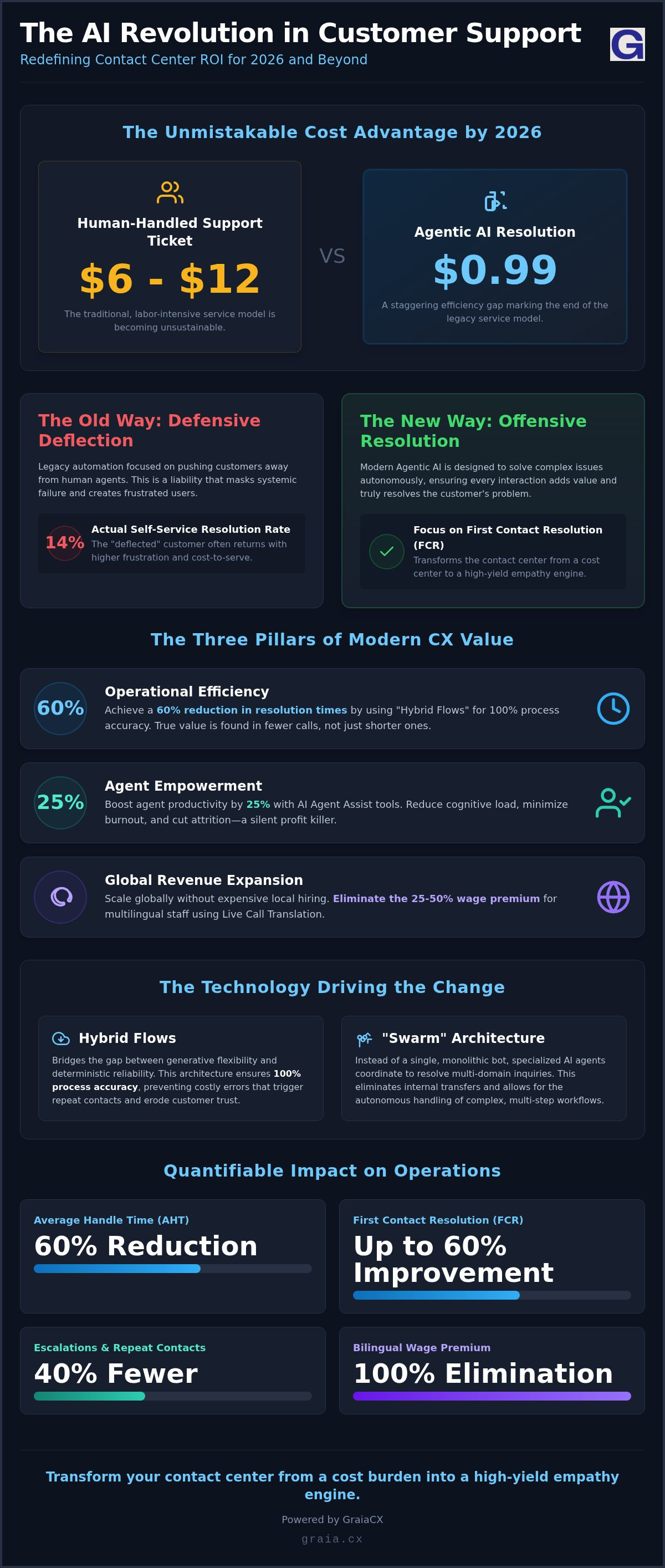
By the end of 2026, the average cost of a human-handled support ticket will remain between $6 and $12, while agentic AI resolutions have plummeted to as low as $0.99. This staggering gap represents more than just a line item; it marks the definitive end of the traditional, labor-heavy service model. You've likely felt the weight of the 91% of customer service leaders who are under intense executive pressure to implement automation. It's a high-stakes transition where the fear of frustrating customers with legacy IVR systems often clashes with the urgent need to scale. Proving your contact center roi with ai requires a shift from simple deflection to a strategy of agentic empathy.
We recognize the exhaustion of managing 25 to 50% bilingual wage premiums and the relentless cycle of agent attrition. You need a system that scales globally without a linear increase in cost. This guide reveals how to transform your operations from a cost burden into a high-yield empathy engine using Live Call Translation and Conversational Agents. You'll discover a framework to reduce Average Handle Time (AHT) and improve First Contact Resolution (FCR) by as much as 60% without adding a single headcount. We'll show you how technical precision and human connection can finally coexist to drive measurable, sustainable growth.
Key Takeaways
- Shift your strategy from defensive deflection to offensive resolution, ensuring every automated interaction solves the customer’s problem rather than just closing a ticket.
- Discover how "Hybrid Flows" and agentic architectures deliver 100% process accuracy, allowing you to reduce Average Handle Time by 60% through autonomous routine handling.
- Build a definitive business case for contact center roi with ai by quantifying the financial impact of reduced agent burnout and lower recruitment costs.
- Eliminate the 25-50% bilingual wage premium and scale your support globally using real-time Live Call Translation that removes the need for language-specific queues.
- Follow a structured framework to audit your current operational costs and identify the high-volume, low-complexity intents that will yield the fastest financial returns.
Beyond Cost-Cutting: Redefining Contact Centre ROI with AI in 2026
The era of defensive automation has ended. In 2026, simply pushing customers away from human agents isn't a strategy; it's a liability. Traditional models that prioritized deflection often ignored the "Empathy Gap," the hidden cost of a customer who feels ignored, misunderstood, or trapped in a loop. To achieve a true contact center roi with ai, leaders must pivot toward offensive automation. This means deploying systems designed to resolve complex issues autonomously rather than just shielding the workforce from volume.
The financial stakes are absolute. With the average cost per human-handled ticket hovering between $6 and $12, while AI-powered resolutions cost as little as $0.99, the margin for error has vanished. Gartner projections suggest that conversational AI will save $80 billion in labor costs by the end of this year. However, these savings only manifest for organizations that move beyond basic chatbots. You must embrace "Agentic ROI," the financial value generated when AI manages multi-step, cross-departmental workflows with the same nuance as your best human agent.
The Three Pillars of Modern CX Value
- Operational Efficiency: True value isn't found in shorter calls, but in fewer calls. By utilizing "Hybrid Flows" to ensure 100% process accuracy, businesses are seeing a 60% reduction in resolution times.
- Agent Empowerment: High attrition is a silent profit killer. AI Agent Assist tools reduce the cognitive load on your staff, leading to a documented 25% improvement in productivity and a significant drop in burnout-related turnover.
- Revenue Expansion: Scaling into new markets traditionally required expensive local hiring. Live Call Translation now allows you to support global customers instantly, eliminating the 25-50% wage premiums typically paid for multilingual staff.
Why 'Deflection' is a Dead Metric
Deflection is a vanity metric that often masks systemic failure. If an automated system "deflects" a customer but fails to solve their problem, that customer will eventually return, often with increased frustration and a higher cost to serve. Current data shows that while many organizations attempt self-service, the actual resolution rate sits at a mere 14%. This gap represents a massive drain on resources.
Agentic AI solves this by focusing on resolution. Instead of identifying keywords, these systems use "Swarm" architecture to coordinate between different data points and execute actual tasks. It's the difference between telling a customer where their package is and actually rerouting that package in real-time. Agentic ROI is the net gain from AI-driven resolution minus implementation costs. By focusing on this metric, you transform your contact centre from a necessary expense into a high-yield engine for customer lifetime value.
Operational Efficiency: Quantifying the Impact of Agentic Automation
Precision is the new currency of the contact centre. When you deploy "Hybrid Flows," you bridge the gap between generative flexibility and deterministic reliability. This architecture ensures 100% process accuracy, a critical factor when calculating contact center roi with ai. One single error in a billing or technical workflow can trigger a cascade of repeat contacts, inflating costs and eroding trust. By automating routine inquiries through specialized agents, enterprises are witnessing a 60% reduction in Average Handle Time (AHT).
The "Swarm" effect takes this a step further. Instead of a monolithic bot, specialized AI agents coordinate to resolve multi-domain inquiries. This eliminates the need for expensive internal transfers that traditionally bleed time and resources. When your system can handle the heavy lifting autonomously, you see 40% fewer escalations and repeat contacts. This allows your human team to dedicate their energy to high-value, emotionally complex interactions that require a human touch.
Comparing Legacy IVR vs. Agentic AI
The cost of "Press 1 for Sales" is higher than most realize. Legacy IVR systems are rigid, forcing customers into pre-defined boxes that rarely match their actual needs. Natural language intent detection saves 30 to 60 seconds per call by identifying the customer's goal instantly. To visualize the shift, consider these operational differences:
Legacy IVR Systems:
- Interaction Style: Rigid, DTMF-based menus that frustrate users.
- Time to Intent: 30 to 90 seconds of navigation before reaching a queue.
- Accuracy: Limited by menu depth and prone to misrouting.
GraiaCX Conversational Agents:
- Interaction Style: Fluid, natural language conversations.
- Time to Intent: Less than 5 seconds to identify and act on customer needs.
- Accuracy: 100% via Hybrid Flows and real-time data integration.
Improving First Contact Resolution (FCR)
Every resolved ticket on the first attempt is a victory for your bottom line. There is a direct, quantifiable correlation between FCR and customer acquisition costs. When a customer's issue is resolved immediately, their lifetime value increases, and the need for expensive re-engagement marketing decreases. Proving a contact center roi with ai becomes significantly easier when you can point to a 10-point jump in FCR.
Using self-service customer support ai can achieve this by automating the "Next Best Action." This ensures that the AI doesn't just answer a question; it proactively closes the loop on the entire customer journey. To explore more strategies for operational excellence, you can browse our latest insights on modern CX transformation. By closing tickets on the first attempt, you don't just save money; you build a reputation for effortless service.
The Human Multiplier: Improving Agent Productivity and Retention
High attrition is a silent profit killer. Recruitment and training for a single agent can cost thousands, a loss that compounds when burnout triggers a revolving door of talent. In 2026, the contact centre is no longer a factory of repetitive tasks; it's a hub for high-stakes problem solving. When you bridge the gap between technical complexity and human capability, you stop the financial leak caused by turnover. AI Agent Assist tools serve as a cognitive safety net, reducing the mental strain of toggling between legacy systems and complex knowledge bases. This support allows new hires to reach peak performance faster, effectively slashing onboarding time by 50% through real-time coaching. When AI handles the mechanical tasks, your staff evolves into an "Empathy Engine." They finally have the bandwidth to manage high-value, emotional cases that require genuine human connection. This shift is fundamental to achieving a sustainable contact center roi with ai.
Real-Time Support and Next Best Action
Precision guidance from next best action customer service tools prevents expensive agent errors before they happen. By automating wrap-ups and summaries, you save 3 to 5 minutes per interaction, time that previously vanished into administrative overhead. This autonomy reduces the need for constant supervisor intervention, allowing managers to focus on strategic growth rather than micro-management. It creates a workplace where agents feel empowered rather than monitored, which is a critical component of long-term productivity.
AI-Driven Quality Assurance and Coaching
Traditional quality assurance is often reactive and slow, relying on small sample sizes that miss the bigger picture. By integrating contact center emotion detection ai, you gain real-time visibility into the sentiment of every call. This data allows for proactive coaching, which is especially vital for maintaining culture and standards in remote teams. Evidence shows that providing agents with this level of consistent, AI-driven coaching reduces attrition by 15%. This retention alone significantly bolsters your contact center roi with ai by preserving institutional knowledge and avoiding the high costs of backfilling roles. You aren't just automating calls; you're protecting your most valuable human assets.
Global Expansion ROI: Scaling Support Without the Wage Premium
Scaling a global enterprise has traditionally been tethered to a massive recruitment overhead. To support a diverse customer base, organizations have long accepted the "Bilingual Tax," a 25 to 50% wage premium paid for multilingual staff. This financial burden is compounded by the operational nightmare of fragmented, language-based queues. When your workforce is siloed by dialect, you lose the ability to balance loads effectively, leading to high wait times in one region while agents sit idle in another. Breaking these silos is the most direct path to maximizing your contact center roi with ai. By deploying Live Call Translation, you move away from hiring for language and start hiring for talent. You can scale into 100 or more languages overnight, ensuring that every customer receives the same high standard of care regardless of their native tongue.
Brand consistency often suffers during rapid international expansion. Local teams might use varying terminology or miss subtle nuances of your corporate voice. Custom phrase lists within an agentic platform solve this by ensuring that technical terms and brand slogans are translated with 100% accuracy every time. This precision protects your reputation while allowing you to maintain a lean, centralized operation that serves the world from a single hub.
Live Call Translation vs. Bilingual Hiring
The financial reality of a 24/7 multilingual desk is often the primary barrier to market entry. Hiring native speakers for every time zone requires a massive capital injection and months of training. In contrast, live call translation software enables a "follow-the-sun" model using your existing, high-performing staff. You can route a call from Tokyo to an agent in London, and the system handles the linguistic bridge in real-time. Script-locked suggestions further ensure compliance, providing agents with the exact translated phrasing needed to handle regulated industries safely and effectively.
Operational Flexibility and Market Entry
Removing language barriers drastically reduces the risk of entering new territories. You can test a market's viability without the long-term commitment of local BPO contracts or physical office space. This flexibility improves CSAT scores by meeting customers where they are, offering them the comfort of their native language. To maintain deep human empathy, the best systems preserve the "Original Audio" in the background. This allows the customer to hear the agent's tone and emotion while the translated text or synthesized voice provides the clarity they need. Learn how to build your global business case by exploring our latest CX strategy guides. By prioritizing connection over translation, you turn global support into a competitive advantage rather than a logistical hurdle.
The GraiaCX Framework: Building Your AI Business Case
Building a definitive business case for contact center roi with ai requires the precision of an architect and the foresight of a visionary leader. It's not enough to simply deploy technology; you must orchestrate it within a framework that guarantees measurable, compounding gains. This transition from legacy systems to an agentic future begins with a rigorous audit of your baseline metrics. You must first quantify your specific AHT and FCR benchmarks, alongside the financial drain of agent turnover. These figures represent the ground truth of your current operational efficiency. Without this baseline, you can't accurately project the transformative impact of automation on your unique environment.
Once your data audit is complete, the next phase involves identifying high-volume, low-complexity intents. These are the repetitive tasks that currently clog your human queues and drive up costs without adding significant value. Integration doesn't require a total "rip-and-replace" of your existing infrastructure. Instead, you can weave specialized modules like Agent Assist and Live Call Translation directly into your established CCaaS platforms, such as Genesys or NICE. This modular strategy allows for a rapid deployment, often achieving Day-1 automation with minimal disruption. Finally, you must move into a cycle of continuous optimization. By measuring and tuning your "Agentic Swarm," you allow specialized AI agents to handle increasingly complex workflows with the 100% process accuracy that only a "Hybrid Flow" architecture can provide.
Security and Compliance as ROI Protectors
Privacy is a financial necessity. A single data breach can instantly erase years of operational savings and permanently damage your brand's reputation. GraiaCX’s Azure-backed trust framework incorporates robust PII masking, ensuring that sensitive customer information remains protected at every touchpoint. This security-first approach provides you with audit-ready transcripts for every interaction, which is vital for dispute resolution and maintaining compliance in highly regulated industries. You aren't just saving money; you're de-risking your entire customer service operation.
Future-Proofing Your Investment
The technological landscape of 2026 is fluid, making flexibility your greatest asset. To avoid the expensive trap of vendor lock-in, you need an LLM-agnostic platform that can adapt as underlying models evolve and improve. Our no-code setup empowers your team to manage sophisticated automation without a massive engineering overhead, ensuring your system remains at the cutting edge. The opportunity to evolve is here. You can calculate your potential ROI with a GraiaCX consultation and begin the journey of turning your contact centre into a high-yield empathy engine today.
The Future of the High-Yield Contact Centre
The transition from a cost centre to a value-driven empathy engine isn't just an operational upgrade; it's a strategic imperative. By shifting your focus from simple deflection to autonomous resolution, you unlock a level of contact center roi with ai that traditional models simply cannot match. You've seen how Hybrid Flows eliminate the errors of legacy systems and how Live Call Translation removes the financial weight of the bilingual wage premium. This evolution protects your most valuable assets by reducing agent burnout and allowing your team to focus on the high-value interactions that truly define your brand.
With 25 years of CX innovation and a SOC2-aligned Azure trust framework, we provide the stability you need to innovate with confidence. Our 99.9% uptime guarantee ensures your global support remains resilient and responsive at every scale. It's time to move beyond the frustrations of the past and embrace a future where technology and humanity work in perfect concert. Book a demo to see how GraiaCX delivers 25% productivity gains and begin your transformation today. Your path to a more efficient, empathetic, and profitable operation is ready for you to take the first step.
Frequently Asked Questions
How do I calculate the ROI of AI in a contact centre?
ROI is calculated by measuring the net gain from AI-driven resolutions against the total cost of implementation and licensing. You must factor in the reduction in cost-per-interaction, which drops from an average of $6 to $12 for human agents to as low as $0.99 for AI. A comprehensive contact center roi with ai framework also accounts for "Soft ROI," such as reduced recruitment costs from lower agent attrition and the elimination of expensive language-based wage premiums.
Can AI really reduce my Average Handle Time (AHT)?
Yes, agentic AI can reduce AHT by as much as 60% by handling routine inquiries autonomously. Unlike traditional bots that only deflect, Conversational Agents use Hybrid Flows to execute multi-step processes with 100% accuracy. This speed isn't just about cutting calls short; it's about providing instant, precise resolutions that prevent the need for time-consuming internal transfers and repetitive follow-up interactions.
Does AI automation improve or hurt customer satisfaction (CSAT)?
Automation improves CSAT when it prioritizes resolution over simple deflection. While 79% of users still prefer humans for complex issues, they value the speed and 24/7 availability of AI for routine tasks. Current data shows AI-handled tickets maintain a strong CSAT of 4.10/5. By resolving issues on the first contact, you remove the friction that typically erodes customer loyalty and lifetime value.
What is the cost of implementing agentic AI compared to hiring more agents?
Implementing agentic AI is significantly more cost-effective than scaling through headcount alone. Industry data shows that an AI-powered resolution costs between $0.99 and $2.00, whereas a human-handled ticket averages $6 to $12. This shift allows you to scale your support volume globally without a linear increase in labor costs, effectively breaking the traditional link between growth and expense.
How does real-time translation impact call centre operational costs?
Real-time translation drastically lowers costs by eliminating the 25 to 50% wage premium typically paid for bilingual staff. It removes the need for fragmented, language-specific queues that cause operational bottlenecks. By using Live Call Translation, you can centralize your workforce and route any call to any available agent, maximizing staff utilization and reducing the overhead of managing multiple regional desks.
Will AI replace my human agents or assist them?
The modern model is collaborative rather than competitive. AI handles high-volume, repetitive tasks, which frees your human agents to focus on complex, emotionally sensitive cases that require deep empathy. This partnership improves contact center roi with ai by reducing the cognitive load on your staff. It transforms the agent role from a data-entry clerk into a high-value problem solver, which naturally boosts retention and productivity.
What are the hidden costs of contact centre AI implementation?
Hidden costs often lie in the quality of your existing knowledge base and the complexity of integrating with legacy CCaaS systems. You must account for the initial time required to clean training data and the ongoing need for process optimization. However, using no-code, agentic platforms can mitigate these expenses by allowing your existing team to manage the system without requiring a massive, specialized engineering headcount.
How long does it take to see a return on investment from CCaaS AI?
Organizations typically see an average first-year ROI of 41% upon deployment. This return is not static; it grows as the system learns and optimizes, often doubling to 87% in the second year and exceeding 124% by the third. The key to rapid returns is identifying high-volume intents for early automation, allowing you to capture immediate labor savings while building a foundation for long-term strategic growth.