
The Rise of the Cloud Based AI Call Center: Orchestrating the Future of CX
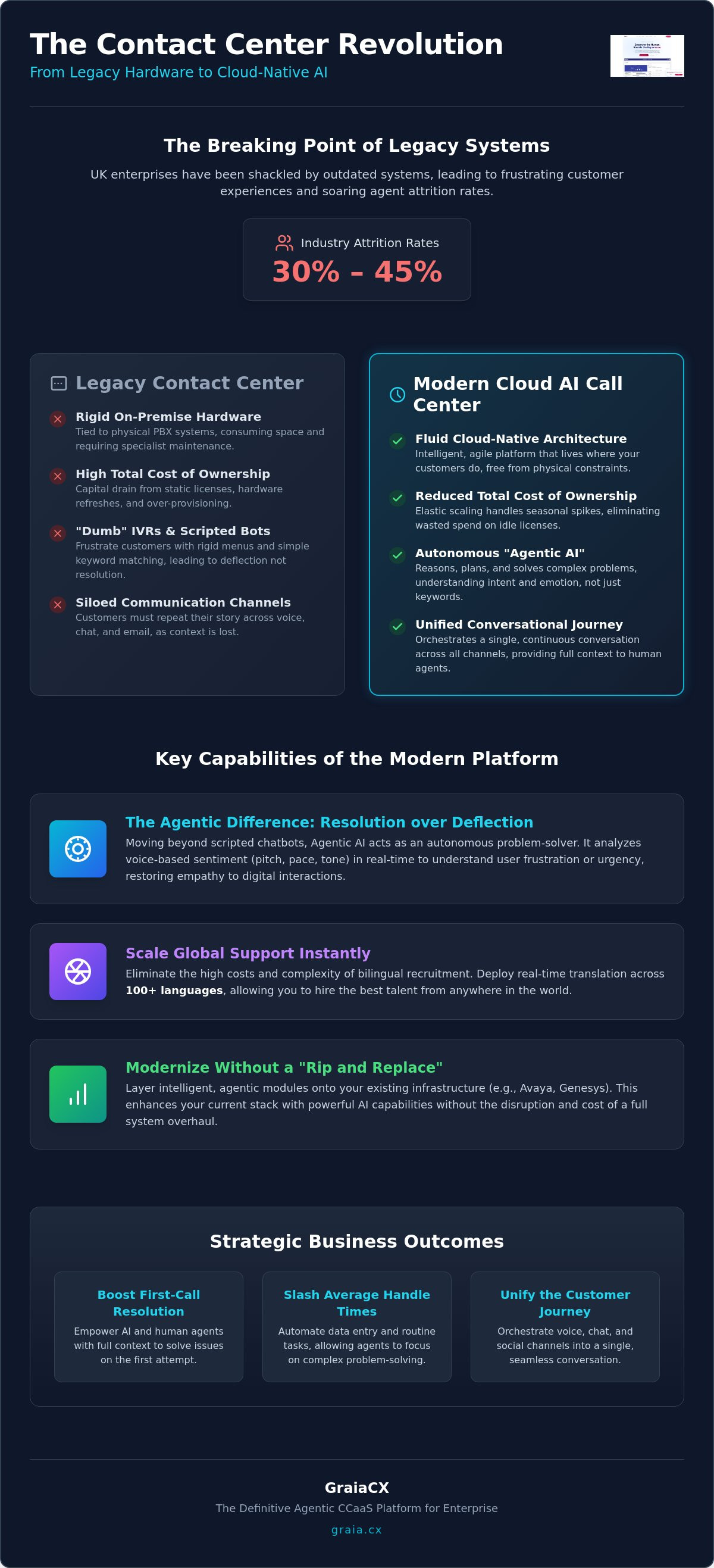
The era of the rigid, hardware-heavy contact centre is finally over. For too long, UK enterprises have been shackled by legacy systems that move at the speed of a dial-up modem while customers demand instant, empathetic resolutions. You've likely felt the sting of rising attrition rates, currently hovering between 30% and 45% across the industry, while your teams struggle with "dumb" IVRs that frustrate more than they facilitate. Adopting a cloud based ai call center isn't just an IT upgrade; it's a strategic imperative to reclaim operational control and humanise every digital touchpoint.
We understand the pressure to scale global support without the prohibitive costs of massive recruitment drives or the complexity of multilingual staffing. This article explores how agentic AI and cloud-native architecture are finally dismantling the barriers built by outdated infrastructure. You'll discover how to slash average handle times and boost first-call resolution by deploying a unified platform that orchestrates voice, chat, and social media with surgical precision. We'll examine the shift from scripted bots to autonomous agents that reason, plan, and execute, ensuring your customer experience remains sophisticated, scalable, and deeply personal.
Key Takeaways
- Transition from restrictive legacy hardware to a cloud based ai call center that serves as the intelligent architect of your customer journey.
- Understand the "Agentic Difference" and how moving beyond scripted chatbots to autonomous problem-solvers can restore empathy to every interaction.
- Scale your global support instantly and eliminate the premium costs of bilingual recruitment by utilising real-time translation across 100+ languages.
- Discover how to layer agentic modules onto existing stacks like Avaya or Genesys to modernise your infrastructure without a disruptive "rip and replace" cycle.
- Optimise your operational metrics by unifying voice, chat, and social channels into a single platform designed to increase first call resolution.
Beyond the PBX: The Evolution of the Cloud Based AI Call Center
The physical Private Branch Exchange (PBX) has become a technical anchor. It drags down innovation, consumes expensive floor space, and requires an army of specialists to maintain. In the current enterprise environment, the cloud based ai call center represents more than a simple shift in hosting. It is a fundamental re-engineering of how businesses connect with people. We are moving away from rows of server racks toward fluid, cloud-native intelligence that lives where your customers do.
Legacy systems served their purpose in a world of static demand. However, 2026 has seen a mass exodus from on-premise hardware as leaders recognise the limitations of rigid infrastructure. The economic imperative is clear. Maintaining physical servers is a drain on capital that should be redirected toward customer experience. Traditional IVRs are also facing a quiet death. The era of "press one for sales" is being replaced by intent-based conversational entry, where the system understands why a customer is calling before they've even finished their first sentence.
The Infrastructure of Agility
Static licensing models are a relic of the past. Modern platforms offer elastic scaling, allowing enterprises to handle seasonal spikes, such as the Christmas retail rush or sudden market shifts, without over-provisioning expensive licenses that sit idle for the rest of the year. This shift drastically reduces the Total Cost of Ownership (TCO). By eliminating the need for physical server maintenance and constant hardware refreshes, you can redirect funds into high-tier talent acquisition. Geography is no longer a constraint. You can now recruit the best specialists from a wider talent pool, unburdened by the limitations of local office infrastructure.
The Intelligence Layer
Cloud is the foundation, but AI is the architect of the modern experience. Reactive routing is too slow for the modern consumer. A sophisticated cloud based ai call center moves toward proactive intent recognition. It doesn't just listen; it perceives. These systems process emotion and sentiment in real-time, detecting subtle vocal cues that indicate frustration or urgency. This intelligence layer enables agentic workflows that unify voice and digital channels. Instead of a customer repeating their story across chat and phone, the AI orchestrates a single, continuous conversation. It ensures that the human agent has the full context, allowing them to focus on empathy rather than data entry.
The Agentic Difference: How AI Understands Intent and Emotion
Automation used to be a wall between the business and the customer. Traditional systems were designed to deflect, pushing users toward FAQs to protect human agents from high call volumes. This created a profound empathy gap. In a modern cloud based ai call center, the strategy has shifted from deflection to resolution. We are no longer building walls; we are deploying "Agentic AI" that acts as an autonomous problem-solver, capable of reasoning through complex tasks rather than just reciting a script.
The true power of this evolution lies in the psychology of sound. Agentic systems don't just process words. They analyse the acoustic properties of a caller's voice in real-time. By detecting subtle changes in pitch, pace, and tone, the AI identifies rising frustration or genuine urgency before the customer explicitly states it. This allows the system to adjust its own persona or instantly route the call to a human specialist. It ensures that technology serves the human experience, restoring the connection that legacy "dumb" bots destroyed.
Conversational Agents vs. Legacy Chatbots
Legacy chatbots failed because they relied on rigid keyword matching. If a customer didn't use the exact phrase programmed into the system, the interaction collapsed. Modern conversational agents, powered by Large Language Models (LLMs), understand nuance and intent. They maintain a single conversation thread across voice, email, and social media. If a customer starts an enquiry on WhatsApp and follows up with a phone call, the agentic system remembers the context. This continuity is the hallmark of a sophisticated cloud based ai call center, where the primary KPI is no longer how many calls were avoided, but how many were successfully resolved without human intervention.
Real-Time Agent Assistance
AI doesn't just replace tasks; it empowers people. For complex enquiries that require a human touch, Agent Assist modules provide a live safety net. As the conversation unfolds, the AI feeds the agent Next-Best-Action (NBA) suggestions and real-time data from the CRM. This eliminates the frantic search through multiple tabs. Once the call ends, automated summarisation handles the "after-call work," allowing the agent to move to the next customer immediately. By removing the mechanical burden of data entry, you allow your team to focus entirely on the person on the other end of the line. You can explore how these agentic omni-channel platforms are redefining the role of the modern agent.
Dismantling the Language Barrier: Scaling Support Globally
Recruiting for linguistic diversity has traditionally been one of the most expensive and volatile aspects of contact centre management. In the UK, the premium for native European or Asian language speakers can add thousands of pounds to an annual salary package, yet retention remains notoriously low. When you rely on a small pool of bilingual agents, your operation becomes fragile. A single resignation can leave a massive gap in your ability to serve a specific market, forcing you back into a costly and time-consuming recruitment cycle.
The cloud based ai call center has fundamentally changed this dynamic by decoupling language skills from service excellence. We are no longer limited by the linguistic profile of the local talent pool. By integrating sophisticated translation layers directly into the communication flow, your most experienced monolingual agents can now support customers in over 100 languages. This isn't just about translating words; it's about preserving the emotional intelligence and brand authority that your best people already possess.
Live Call Translation Technology
The technical hurdles that once made voice translation feel clunky have been overcome. In 2026, AI translation engines have reached human-parity, processing speech-to-speech interactions in under 200 milliseconds. This near-instantaneous speed ensures that the natural rhythm of conversation remains intact, preventing the awkward pauses that used to plague digital translation. The system maintains your specific brand voice across different dialects, ensuring that a customer in Tokyo receives the same sophisticated experience as one in London. This technology enables a "Follow the Sun" model where a centralised team in the UK can provide 24/7 global support without the logistical nightmare of managing multiple international BPO partners.
ROI of Multilingual AI
The financial argument for linguistic automation is undeniable. When you compare the cost of a cloud based ai call center against traditional BPO staffing, the savings are immediate. You eliminate the "linguistic tax" associated with bilingual recruitment and the high overheads of training specialists in multiple regions. Beyond direct cost savings, you'll see a marked improvement in First Call Resolution (FCR) within non-native markets. Customers feel heard and understood in their primary language, which naturally reduces frustration and builds long-term loyalty. By automating the linguistic layer, you transform a massive operational headache into a scalable, predictable competitive advantage.
Modernizing Legacy Architecture: A Framework for Integration
The "rip and replace" philosophy is a dangerous myth that often stalls enterprise innovation. Many vendors insist that you must abandon your existing investments in Avaya, Genesys, or NICE before you can even think about a cloud based ai call center. This all-or-nothing approach ignores the reality of multi-year contracts and complex data dependencies. In reality, the most successful transformations are modular. By layering agentic modules onto your current stack, you can inject intelligence into your operations without the catastrophic downtime or the capital expenditure of a total overhaul.
Integrating advanced AI into a legacy environment is about building bridges, not burning them. We focus on enhancing what works while replacing what doesn't. This hybrid strategy allows you to maintain the stability of your core systems while gaining the agility of cloud-native intelligence. As you transition, navigating GDPR and SOC2 compliance remains paramount. In the UK, data residency and processing transparency aren't just legal boxes to tick; they are the foundation of customer trust. A secure, cloud based ai call center ensures that every interaction is encrypted and compliant, protecting both your brand and your customers' privacy. This isn't just about technical encryption; it's about the ethical handling of voiceprints and biometric data, ensuring your AI implementation respects the latest UK regulatory standards.
Steps to a Unified Agentic Platform
- Audit your data silos: Identify where fragmented information is slowing down resolutions. AI has the most immediate impact when it can bridge the gap between your ticketing system and live voice data.
- API-first integration: Connect your CRM, such as Salesforce or HubSpot, directly to the AI voice layer. This ensures that every conversational agent has real-time access to the customer's history.
- Pilot programs: Start small. Deploying AI on a single digital channel like chat allows you to refine your workflows and logic before moving to full voice automation.
Measuring Success in the AI Era
The metrics of the past are no longer sufficient. While Average Handle Time (AHT) still matters, it doesn't capture the quality of the interaction. In 2026, we prioritise the Sentiment Score and the Autonomous Resolution Rate. These metrics tell you if the customer left happy and if the AI actually solved the problem. This shift also has a profound impact on your team. By automating repetitive, soul-crushing tasks, you improve job satisfaction and reduce agent churn. When your agents see AI as a partner that handles the drudgery, they can focus on the complex, high-value work they were hired to do. Continuous learning is the final piece of the puzzle. The AI improves itself by analysing successful human interactions, turning your top-performing agents into the blueprints for your automation strategy. You can see how this works in practice by exploring our Agentic Omni-Channel Platform.
GraiaCX: The Definitive Agentic CCaaS Platform for Enterprise
GraiaCX is the definitive response to the systemic failures of traditional contact centre architecture. It is an Agentic Omni-Channel Platform that unifies voice, digital, and agentic intelligence within a single, cloud-native framework. While other vendors focus on simple connectivity, we prioritise orchestration. By deploying this sophisticated cloud based ai call center, you move beyond the limitations of legacy hardware and enter a state of continuous operational evolution. It integrates seamlessly with your existing Genesys or NICE CX setup, ensuring that you can modernise without the risk of service disruption or data loss.
The platform’s core strength lies in its ability to amplify human capability rather than merely replacing tasks. Our unique approach to Live Call Translation empowers your existing team to speak over 100 languages with native-level fluency and near-zero latency. This is complemented by Agent Assist, a digital co-pilot that provides real-time data and guidance during live interactions. It doesn't just provide answers; it provides context. This ensures that every agent, regardless of their tenure, performs with the precision of your most seasoned specialist, effectively turning your entire workforce into high-performers from day one.
Empowering Your Human Potential
GraiaCX views AI as a catalyst for human empathy, not a replacement for it. We recognise that the human element is your most valuable asset in complex or high-emotion scenarios. Our unified desktop simplifies the agent experience by consolidating disparate tools into a single, intuitive interface. This reduction in cognitive load allows your team to focus entirely on the customer’s needs. Real-time coaching modules further elevate performance by providing live, AI-driven guidance based on the sentiment and flow of the conversation. It turns every call into a training opportunity, building a culture of excellence and reducing the stress that leads to high turnover.
Ready for the Future of CX?
Waiting to modernise is no longer a neutral choice; it is a significant risk to your brand loyalty. In an era where customers expect instant, accurate, and empathetic resolutions, sticking with rigid legacy systems is a recipe for obsolescence. GraiaCX delivers immediate ROI by slashing average handle times and dramatically improving first-call resolution rates. By automating routine inquiries through our Conversational Agent, you allow your human staff to handle the interactions that truly define your brand. The transition to a cloud based ai call center is the only way to scale global support while maintaining a lean, efficient operation. Experience the power of GraiaCX with a tailored demonstration.
Reclaiming the Human Element through Intelligent Automation
The transition to a cloud based ai call center is no longer a luxury for the forward-thinking; it's a fundamental requirement for survival in a competitive global market. We've explored how agentic AI moves beyond the frustration of scripted bots to understand genuine intent and emotion. By integrating live call translation in over 100 languages, you remove the fragile dependency on local bilingual recruitment and open your brand to the world instantly.
You don't have to sacrifice your current investments to achieve this level of sophistication. Our platform offers seamless integration with Genesys and NICE CX, allowing you to layer intelligence onto your existing infrastructure. This is your opportunity to turn every agent into a top performer while restoring the empathy that legacy systems often strip away. The future of customer experience is orchestrating a perfect harmony between human intuition and machine precision.
Request a GraiaCX Demo: Transform Your Legacy Contact Center
We're ready to help you lead that revolution and build a contact centre that truly understands its customers. Let's start the journey toward a more intelligent and empathetic future together.
Frequently Asked Questions
What is a cloud-based AI call center and how does it differ from traditional systems?
A cloud based ai call center is a virtualised communication hub that replaces physical PBX hardware with elastic, cloud-native intelligence. Unlike traditional systems that rely on rigid on-premise servers and static routing, these platforms use agentic AI to understand customer intent in real-time. This allows for seamless scaling and deeper analytical insights that legacy hardware simply cannot provide. It transforms your operation from a cost centre into a strategic engine for customer loyalty.
How does real-time call translation work for enterprise support teams?
Real-time call translation utilises advanced neural networks to process speech-to-speech interactions in under 200 milliseconds. As a customer speaks in their native tongue, the AI instantly translates the audio into the agent's primary language. The agent's response is then converted back, allowing a monolingual team to support over 100 languages. This eliminates the need for expensive bilingual recruitment or external BPO partners while maintaining a consistent brand voice.
Can I integrate AI modules with my existing Genesys or Avaya platform?
Yes, you can integrate sophisticated AI modules into your current Genesys, NICE, or Avaya stack through an API-first approach. This hybrid strategy allows you to modernise your customer experience without the disruption of a total "rip and replace" overhaul. By layering agentic modules onto your established infrastructure, you gain immediate access to advanced automation. It ensures you maintain the stability of your core systems while gaining the agility of the cloud.
Is AI translation accurate enough for professional customer service?
AI translation has finally reached the "human-parity" threshold, providing the precision required for high-stakes professional service. Modern engines go beyond literal word-for-word conversion; they understand cultural nuance, technical jargon, and emotional tone. This ensures that every interaction remains respectful and contextually aware. It protects your brand reputation by ensuring that global customers feel truly understood rather than just processed by a machine.
How does an agentic CCaaS platform improve agent productivity?
An agentic CCaaS platform acts as a digital co-pilot that automates the mechanical drudgery of the role. By providing real-time data suggestions and automated call summarisation, the system eliminates traditional "after-call work." This allows agents to focus entirely on human connection and complex problem-solving. It effectively reduces average handle times while increasing first call resolution, turning every team member into a top performer from their first day.
What are the security considerations for moving a call center to the cloud?
Moving to a cloud based ai call center requires a rigorous focus on data residency and encryption standards. In the UK, compliance with GDPR and SOC2 is mandatory to protect sensitive customer interactions and biometric voice data. Leading platforms ensure that all processed data is encrypted both in transit and at rest. This provides a secure environment that meets the highest enterprise-grade reliability and regulatory requirements for modern data protection.
Will AI replace human call center agents in the near future?
AI is a catalyst for human empathy, not a replacement for the human element. While agentic systems handle routine, high-volume inquiries with autonomous precision, they empower human agents to focus on high-emotion cases that require genuine psychological insight. The future belongs to the augmented agent who uses AI to deliver a more personalised service. It's about removing the robotic tasks from humans so they can be more human.
How do I measure the ROI of a cloud-based AI call center migration?
ROI is measured through a combination of reduced Total Cost of Ownership (TCO) and improved customer outcomes. By eliminating physical server maintenance and the premium costs of bilingual staffing, you see immediate operational savings. Beyond the balance sheet, you should track the increase in First Call Resolution (FCR) and Sentiment Scores. These metrics directly correlate with long-term brand loyalty and a significant reduction in expensive agent churn.