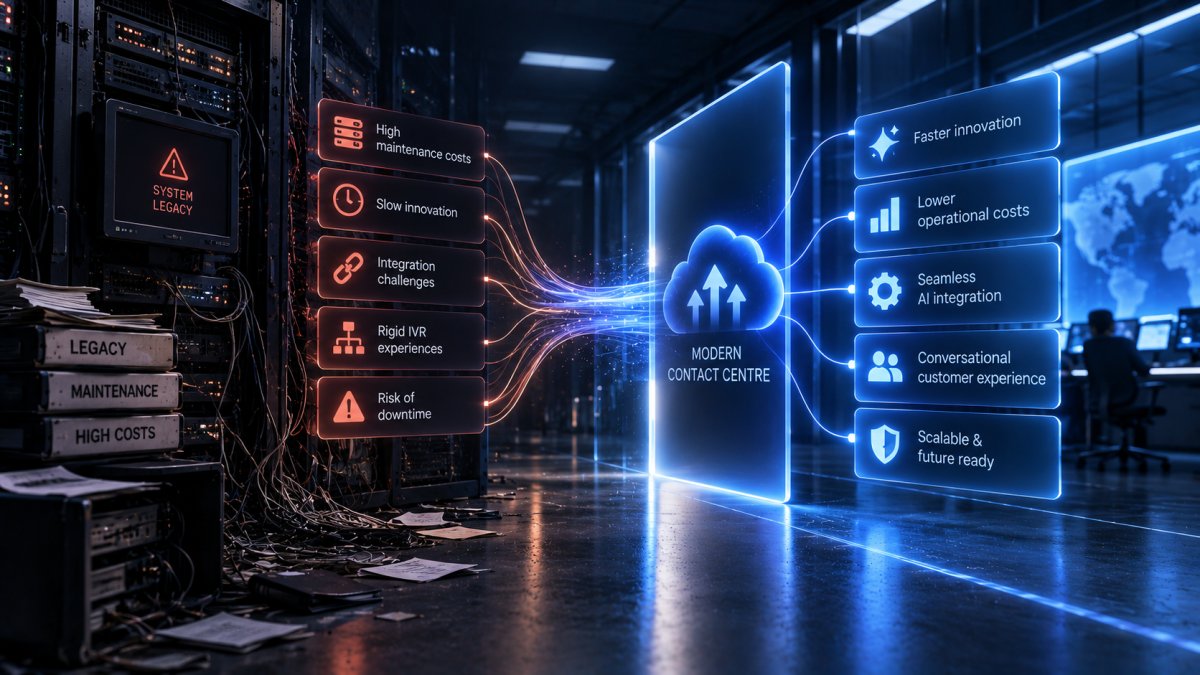
Navigating the Challenges with On-Premise Contact Centres in 2026
Is your server room quietly becoming a graveyard for your customer experience strategy? You likely invested heavily in physical infrastructure to ensure total control and data sovereignty, yet that same hardware now tethers your team to the past. The mounting challenges with on-premise contact centre architecture have shifted from simple maintenance tasks to a systemic failure to keep pace with consumer expectations. Rigid IVR trees frustrate your callers; meanwhile, the lack of native AI integration leaves your agents struggling with manual workflows that should have been automated years ago.
You recognise that the gap between your current capabilities and the potential of agentic AI is widening every day. It's a high-stakes tension between maintaining stability and embracing the future. This article reveals how to bridge this divide without the financial pain of a total rip-and-replace. We will outline a strategic roadmap to modernise your existing environment, reducing operational overhead and deploying sophisticated agent assist tools. You'll discover how to transform your legacy setup into a high-performance ecosystem where human empathy and machine intelligence work in perfect harmony to drive productivity.
Key Takeaways
- Identify why physical infrastructure has evolved from a stable asset into a strategic bottleneck that prevents the adoption of fluid, agentic AI.
- Uncover the critical technical challenges with on-premise contact centre environments, specifically focusing on the latency and integration gaps inherent in legacy hardware.
- Recognise how rigid IVR structures erode customer empathy and learn the methods for transitioning to an intelligent, conversational interface.
- Explore the hybrid modernisation model that allows you to integrate cutting-edge automation without the risk of a total system overhaul.
- Gain a roadmap for elevating agent productivity by 25% through the seamless fusion of human intuition and agentic swarm architecture.
The Hidden Erosion: Why On-Premise Contact Centres Struggle in 2026
The server room was once a symbol of corporate control. In 2026, it's a financial drain. Maintaining physical infrastructure requires a level of capital expenditure that modern cloud-native competitors simply don't face. While cloud users scale up instantly to meet peak demand, you're stuck with depreciating assets and rising electricity bills. The primary challenges with on-premise contact centre models stem from this fundamental mismatch between rigid hardware and the fluid needs of the modern market. You aren't just paying for the servers; you're paying for the specialized IT staff needed to keep legacy PBX systems on life support. This hidden drain on resources diverts your best minds away from innovation and toward mere survival.
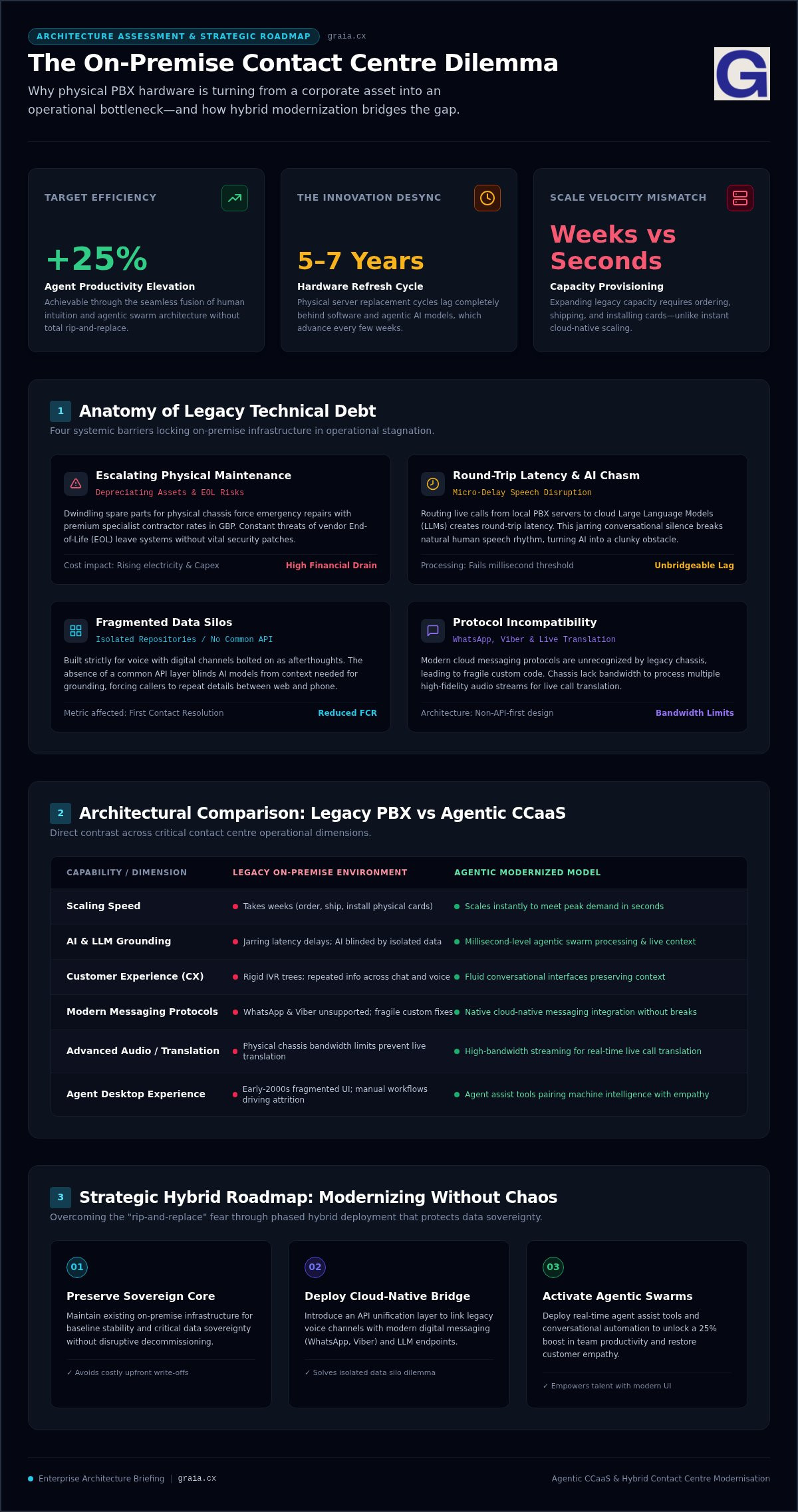
Innovation stagnation is the silent killer of the enterprise. Hardware refresh cycles typically span five to seven years, yet the software landscape, particularly regarding agentic AI, evolves every few weeks. This gap creates a technological debt that's impossible to settle. It also impacts your recruitment. Top-tier talent won't settle for fragmented, antiquated agent desktops that feel like relics of the early 2000s. They want tools that empower them, not systems that constrain them. When your technology feels like a hurdle rather than a help, your best agents will look for opportunities elsewhere.
The Escalating Cost of Physical Maintenance
Legacy hardware doesn't just age; it becomes a liability. As vendors move toward software-as-a-service models, the availability of spare parts for physical chassis dwindles. Emergency repairs now come with a premium price tag in GBP, often requiring specialist contractors who charge significantly more than standard IT rates. You're also facing the constant threat of end-of-life (EOL) announcements. When a major vendor pulls support for your specific hardware version, you're left with two choices: an expensive, rushed upgrade or a dangerous lack of security patches. Scalability is equally painful. Adding capacity means ordering, shipping, and installing physical cards, a process that takes weeks rather than seconds.
Fragmented Data Silos and the CX Gap
Legacy systems were never designed for a 360-degree customer view. They were built for voice, with digital channels bolted on as afterthoughts. This fragmentation creates data silos. In a legacy context, data silos are isolated repositories of interaction history that exist without a common API layer, effectively blinding AI models from the context needed for accurate grounding. Solving the challenges with on-premise contact centre data management requires a fundamental shift in how information flows through your organisation. When your data is trapped, your First Contact Resolution (FCR) suffers. Customers are forced to repeat their details as they move from a web chat to a voice call, eroding trust and destroying the interpersonal experience you've worked so hard to build.
Innovation Paralysis: The Technical Debt of Legacy Hardware
Innovation paralysis isn't a choice; it's a mechanical destiny for businesses tethered to physical server racks. In 2026, the gap between traditional PBX capabilities and Large Language Model (LLM) requirements has become an unbridgeable chasm for most. These challenges with on-premise contact centre infrastructure manifest as a structural inability to support conversational agents that require millisecond-level processing. When you attempt to route a live call from a local server to a cloud-based AI module, the round-trip latency creates a jarring silence. This micro-delay destroys the natural rhythm of human speech, making even the most advanced AI feel like a clunky machine rather than a helpful partner.
Modern communication channels like WhatsApp or Viber operate on cloud-native protocols that your legacy hardware simply doesn't recognise. Attempting to force these integrations often results in fragile custom code that breaks with every minor software update. Similarly, deploying live call translation software is frequently impossible because the physical chassis lacks the bandwidth to process multiple high-fidelity audio streams simultaneously. You're left with a system that's stable but stagnant, unable to evolve alongside your customers. Solving the challenges with on-premise contact centre integration means acknowledging that legacy hardware was never built for an API-first world.
The Barrier to Agentic AI Deployment
Real-time emotion and intent detection demand massive computational power that traditional on-premise servers cannot provide. Beyond raw compute, there's the issue of grounding. Retrieval-Augmented Generation (RAG) requires seamless access to your knowledge base, yet legacy databases often act as impenetrable fortresses rather than accessible resources. GraiaCX's hybrid flows offer a vital bridge here. They allow you to maintain your core telephony while layering on an agentic swarm architecture that handles complex tasks with 100% process accuracy. It's about elevating your human potential by removing the mechanical constraints of the past.
Integration Nightmares: The API Gap
Older architectures were built in an era of proprietary silos, not open ecosystems. They lack the modern webhooks and REST APIs necessary to communicate with contemporary CRM platforms like Salesforce or Dynamics 365. Connecting these systems becomes a manual, labour-intensive chore for your IT team, draining their time on maintenance rather than strategic growth. Instead of a unified flow, you end up with a Frankenstein system held together by brittle patches. If you're ready to move beyond these technical bottlenecks, you can explore our latest modernisation guides to see how a unified platform restores agility to your operations.
The Empathy Gap: How Rigid Systems Fail the Modern Customer
Technology should act as an invisible facilitator of human connection. In many UK enterprises, however, legacy hardware has become a physical barrier to rapport. The persistent challenges with on-premise contact centre deployments are most visible in the erosion of the customer-agent bond. When your infrastructure relies on rigid, linear logic, every interaction becomes a battle against the machine. This friction doesn't just slow down resolutions; it signals to your customers that their time and emotional context are secondary to your system's limitations. A sophisticated brand cannot afford to project this mechanical indifference.
Rigid IVR trees represent the front line of this failure. "Press 1 for Sales" is a relic of a bygone era that ignores the complexity of modern consumer needs. If a customer has already interacted with your brand via social media or web chat, being forced into a generic phone menu feels like a regression. They expect continuity, yet legacy PBX systems frequently fail to pass context between channels. This forces customers to repeat their story, a process that destroys trust and increases frustration before an agent even says hello.
The Failure of Traditional IVR
Modern consumers demand a conversational experience that mirrors natural human dialogue. We have moved beyond the era of simple automated responses, witnessing the evolution of the AI customer service platform from basic chatbots to true agentic intelligence. While agentic AI interprets complex human intent through natural language processing, legacy systems are restricted to the binary logic of dual-tone multi-frequency (DTMF) digits. By embracing empathy-driven automation, you remove the routine friction that clogs your phone lines, allowing your human staff to focus on high-value, emotionally sensitive interactions that require a genuine touch.
Agent Burnout and Retention Challenges
The psychological toll of antiquated technology on your workforce is immense. High contact centre turnover in the UK is often a direct result of "tool fatigue," where agents are forced to navigate dozens of disconnected windows to find a single answer. Deploying AI agent assist tools changes this dynamic by providing real-time coaching and next-best-action suggestions directly within the workflow. This reduces the cognitive load on your team, lowering stress levels and significantly improving Average Handle Time (AHT). A unified desktop doesn't just increase efficiency; it empowers your agents to feel like experts rather than data entry clerks, fostering a culture of professional pride and long-term retention.
Beyond the "Rip and Replace" Fear: Modernising Without Chaos
Fear often freezes progress. The thought of a total infrastructure overhaul feels like performing open-heart surgery on your business while it's running a marathon. It's risky, expensive, and disruptive. This leads to analysis paralysis, where you stay tethered to your current hardware despite the growing challenges with on-premise contact centre environments. You don't need to destroy what you've built to embrace what's next. Evolution doesn't require destruction; it requires a strategic bridge. A hybrid model allows you to maintain your stable telephony core while layering on the intelligence of agentic AI.
Modern SIP-enabled platforms act as this bridge. They integrate seamlessly with your existing Avaya or Genesys stacks, allowing you to inject new capabilities without a massive capital expenditure. The key is a "Day-1" automation strategy. By identifying high-volume, low-complexity tasks, you can show immediate ROI and build internal confidence. You start by solving specific pain points rather than trying to boil the ocean. This measured approach turns a daunting digital transformation into a series of manageable, high-impact victories.
The Hybrid Modernisation Strategy
A hybrid approach lets you play to the strengths of both worlds. You can deploy an agentic swarm to manage digital channels like WhatsApp and web chat, while your legacy hardware continues to handle traditional voice traffic. This phased transition allows you to introduce enterprise ai contact center modules at your own pace. It ensures that your human agents aren't overwhelmed by a sudden shift in their workflow. Instead, they see the AI as a helpful assistant that arrives gradually, proving its worth by removing the drudgery from their daily tasks.
Security and Sovereignty in the Cloud Era
Is your data actually safer on-premise? For many UK organisations, this is the primary objection to modernisation. The reality is that physical servers often lack the rapid, automated patching cycles found in sophisticated cloud environments. Graia addresses these concerns by utilising Azure-hosted regional infrastructure, ensuring full compliance with GDPR and Ofcom regulations. Your data remains within the UK. We also guarantee that your proprietary interaction data is never used to train third-party models. You maintain total sovereignty over your information while gaining the agility of a cloud-native platform. If you want to start your transition today, you can explore our hybrid modernisation roadmap to see how we secure your future.
Transitioning to the Future: The Graia Agentic CCaaS Advantage
The shift from legacy hardware to an agentic CCaaS platform isn't just a technical upgrade; it's a strategic rebirth. By moving beyond the challenges with on-premise contact centre environments, you unify voice, chat, and email into a single, intelligent flow. This isn't about simply adding new channels. It's about creating a cohesive ecosystem where every interaction is informed by a 360-degree view of the customer journey. Graia leverages hybrid RAG retrieval and deterministic logic to ensure 100% process accuracy, removing the risks of error often associated with ungrounded AI. You're no longer just managing calls; you're orchestrating outcomes.
Your agents deserve tools that match their potential. With live call translation in over 100 languages and real-time next-best-action coaching, your team can handle complex, multi-lingual queries with unprecedented confidence. This leads to a measurable impact on your bottom line. You'll see significant contact center ROI with AI through reduced escalation rates and faster resolution times. When the machine handles the routine, the human is free to excel in the exceptional.
A Unified Ecosystem for Human-AI Collaboration
The Graia platform introduces a unified ecosystem where specialized digital agents work in tandem with your human staff. Our Intelligent Routing Brain doesn't just look at availability; it analyzes customer sentiment in real-time to match the right caller with the right resource. This ensures that high-stakes, emotionally charged situations always reach a compassionate human ear, while routine tasks are resolved instantly by the agentic swarm. Explore the Graia Blog for more CX insights to see how this synergy transforms the interpersonal experience.
Proven Results for the Modern Enterprise
Results define the value of any transformation. Enterprises adopting agentic automation report up to 60% faster resolution times, a leap that legacy systems simply cannot replicate. This efficiency is coupled with the ability to expand into new markets overnight, supported by 100+ language capabilities that break down traditional geographic barriers. Overcoming the challenges with on-premise contact centre infrastructure is the first step toward this global agility. Ultimately, empathy-driven automation is the ultimate competitive advantage in a world where genuine connection is everything.
Reclaiming Your Strategic Agility
The era of allowing physical hardware to dictate your customer experience strategy must end. We've explored how the structural challenges with on-premise contact centre environments create an innovation bottleneck that stifles both agent potential and customer satisfaction. By shifting toward a hybrid, agentic model, you move from reactive maintenance to proactive orchestration. You aren't just updating software; you're restoring empathy to every interaction while securing your data sovereignty within the UK. This isn't a mere technical swap, but a fundamental elevation of your brand's ability to connect with the modern consumer.
The transition delivers immediate, tangible results. Organisations embracing this evolution see a 25% improvement in agent productivity and 60% faster average resolution times. With support for 100+ languages through Live Call Translation, your brand can finally speak the language of every customer with precision and warmth. It's time to stop managing limitations and start leading with intelligence. Discover the future of CX on the Graia Blog and begin your journey toward a more resilient, human-plus-AI ecosystem today. Your future as a CX leader is waiting.
Frequently Asked Questions
What are the main challenges with on-premise contact centres in 2026?
The primary challenges with on-premise contact centre infrastructure include escalating maintenance costs for physical servers and a fundamental inability to support modern, compute-heavy AI modules. Legacy hardware often creates innovation paralysis, where rigid IVR trees and fragmented data silos prevent a unified customer view. You're also likely to face difficulties in attracting top-tier talent who prefer working with intuitive, cloud-native tools rather than antiquated, siloed agent desktops.
Can I integrate AI with my existing Avaya or Genesys on-premise system?
Yes, you can modernise your existing environment without a total rip-and-replace. Graia integrates with major legacy providers like Avaya and Genesys through SIP-enabled connectivity and embeddable widgets. This hybrid approach allows you to maintain your stable telephony core while layering on agentic AI capabilities for digital channels. It effectively bridges the gap between your physical hardware and the latest automation tools without disrupting your current operations.
Is a cloud-based contact centre more secure than on-premise?
Modern cloud platforms often provide superior security through automated patching and sophisticated encryption that physical servers may lack. Graia utilises Azure-hosted regional infrastructure in the UK to ensure full compliance with GDPR and Ofcom regulations. We guarantee that your proprietary data is never shared or used to train third-party AI models. This privacy-first architecture provides the data sovereignty you require while delivering the agility of a cloud-native environment.
How does an agentic CCaaS platform improve agent productivity?
An agentic CCaaS platform drives a 25% improvement in agent productivity by automating routine inquiries and providing real-time support. Tools like Agent Assist offer next-best-action coaching and automated summaries, which significantly reduce the cognitive load on your human staff. By removing the drudgery of manual data entry and navigation across disconnected windows, your team can focus on resolving complex, high-value customer issues that require genuine human empathy.
Will I need to hire bilingual agents if I switch to an AI-powered platform?
You no longer need to hire expensive bilingual staff or manage complex language-based queues. Our platform supports live call translation in over 100 languages, allowing your existing agents to communicate fluently with global customers in real-time. This capability eliminates the 25-50% wage premiums typically associated with multilingual agents. It ensures that every customer receives high-quality support in their preferred language, regardless of your team's native linguistic skills.
What is the typical ROI when moving from on-premise to agentic AI?
Overcoming the challenges with on-premise contact centre infrastructure typically results in 60% faster average resolution times and a 40% reduction in escalations. The ROI is further bolstered by the elimination of high capital expenditure on physical hardware and reduced operational overhead. By resolving more queries at the first point of contact, you lower your cost per interaction while simultaneously improving customer satisfaction scores and reducing agent attrition rates.
How long does it take to modernise a legacy contact centre?
Modernisation doesn't have to be a multi-year project; you can achieve Day-1 automation by targeting specific high-volume workflows. While a full transition depends on your complexity, a hybrid model allows for the gradual deployment of AI modules within weeks. This phased approach ensures you see immediate value while your IT team manages the integration with legacy systems at a sustainable pace, avoiding the chaos of a total overhaul.
Can AI agents actually take action in my backend systems?
Yes, our conversational agents are action-oriented and can execute tasks by connecting directly to your CRM, ERP, and ticketing systems. They can process refunds, schedule deliveries, or update account details autonomously using secure API integrations. By combining natural language understanding with deterministic rule-based logic, the platform ensures 100% process accuracy. This allows the AI to handle end-to-end resolutions without requiring constant human intervention or oversight.