
The Evolution of the AI Customer Service Platform: From Chatbots to Agentic Intelligence
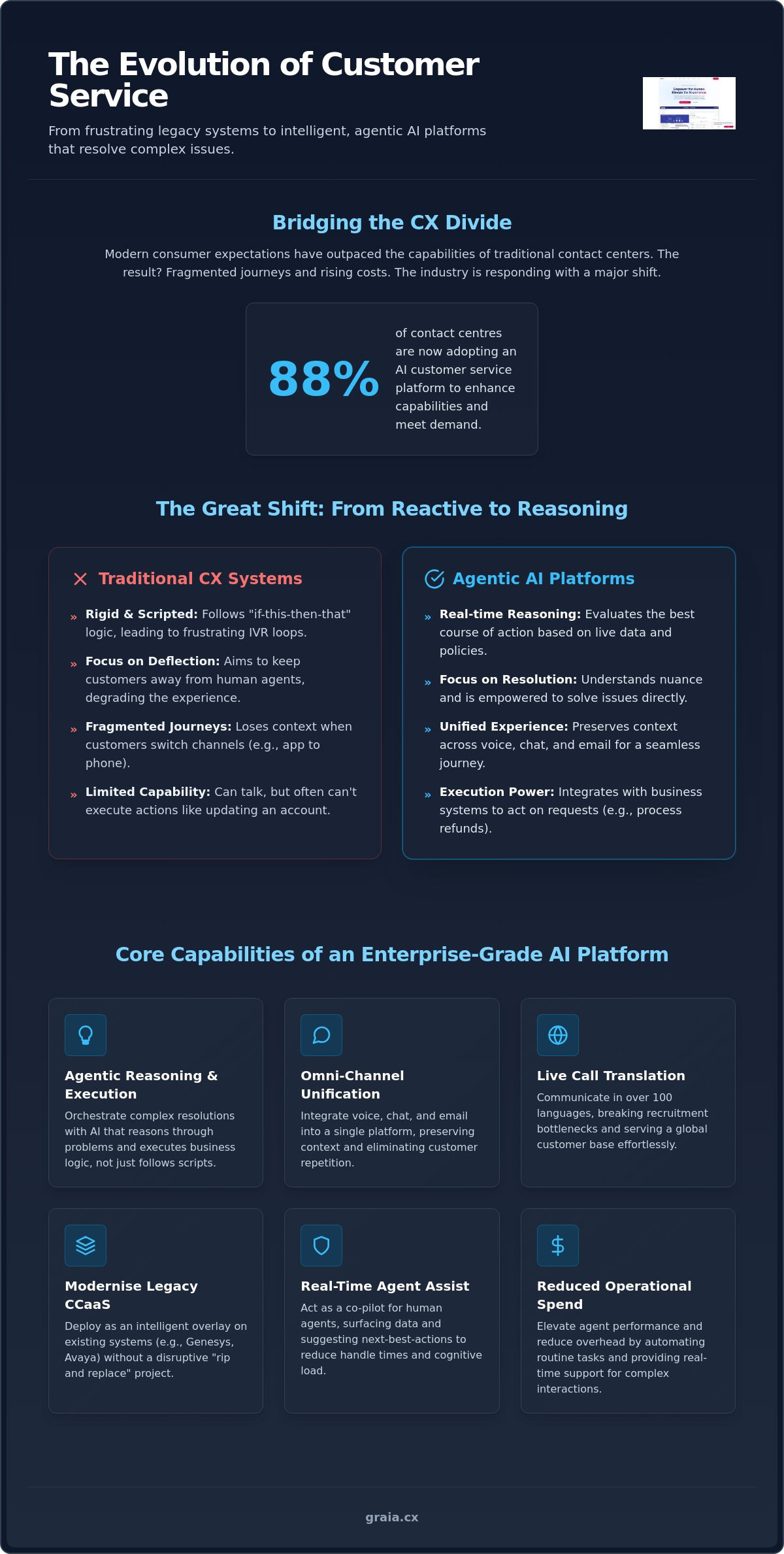
What if your contact centre could finally stop apologising for its technology? For many UK enterprises, the reality is a frustrating gap between modern consumer expectations and legacy infrastructure that feels increasingly obsolete. You've likely felt the pressure of rising costs for recruitment and the friction of fragmented customer journeys, yet 88% of contact centres are now adopting an ai customer service platform to bridge this divide. It's time to move beyond the limitations of "dumb" automated menus that alienate the very people you aim to serve.
We know you're seeking a way to reduce operational spend while deepening the empathetic connection with your customers. This guide details the transition from basic chatbots to agentic intelligence, showcasing how real-time reasoning and live voice translation are redefining the standard for enterprise CX. We'll examine how these platforms integrate with your current systems to provide a unified experience across voice, chat, and email, ensuring your agents have the support they need to resolve complex issues with confidence.
Key Takeaways
- Orchestrate complex customer resolutions through agentic systems that reason and execute business logic rather than just following rigid scripts.
- Unify your digital and voice interactions into a single ai customer service platform that preserves context and prevents journey fragmentation.
- Break the bottleneck of bilingual recruitment with live call translation capabilities that empower your team to communicate in over 100 languages.
- Modernise legacy CCaaS infrastructure by deploying an intelligent overlay, enhancing systems like Genesys or Avaya without the disruption of a total replacement.
- Elevate agent performance and reduce operational overhead by providing real-time assistance during high-stakes, complex customer interactions.
The Shift from Reactive Chatbots to Agentic AI Customer Service Platforms
The industry is witnessing a fundamental transformation in how enterprises interact with their customers. For years, businesses relied on static, rule-based systems that often felt more like barriers than bridges. The Shift from Reactive Chatbots toward sophisticated, autonomous agents marks the end of the "press one for sales" era. Modern customers expect immediate, intelligent, and empathetic resolutions, not just a digital version of a paper manual. An ai customer service platform today isn't a mere FAQ bot. It's a reasoning engine that understands context, identifies nuance, and possesses the authority to act on behalf of the brand.
Traditional systems were built for deflection. They aimed to keep customers away from human agents to save costs, often resulting in a degraded experience that eroded brand loyalty. Agentic intelligence flips this script. Instead of simply deflecting tickets, these systems focus on resolving moments. They don't just recognise keywords like "refund" or "status"; they interpret the frustration in a caller's voice and the specific history of their journey. This level of emotional intelligence allows the platform to decide whether to process a return immediately or escalate the call to a specialist with a full briefing already prepared.
Why Traditional CX Systems are Failing Modern Expectations
Legacy infrastructure often traps users in repetitive IVR loops that feel disconnected from their digital counterparts. When a customer moves from a mobile app to a phone call, they shouldn't have to start their story from the beginning. Many "Generative-only" AI tools also fall short here; they can talk beautifully but lack the integration to actually change a booking or update a billing address. This creates a trust gap. In a 24/7 global economy, relying solely on human staff is no longer sustainable, especially when the cost of hiring and retaining skilled agents continues to climb.
The Definition of an Agentic Workflow
Reasoning is the heartbeat of the modern ai customer service platform. Unlike traditional bots that follow a linear "if-this-then-that" path, an agentic system evaluates the best course of action based on real-time data and business policies. Agentic AI is a system that bridges the gap between understanding a query and executing the solution. By utilising Retrieval-Augmented Generation (RAG), the platform ensures every response is grounded in your specific enterprise data. This guarantees that the AI remains brand-safe and accurate, providing resolutions that are both technically sound and emotionally resonant.
Core Capabilities of an Enterprise-Grade AI Service Platform
A superior customer experience is no longer defined solely by the speed of an answer, but by the intelligence of the resolution. To achieve this, a modern ai customer service platform must act as a unified nervous system across your entire enterprise. It's not enough to have a bot on your website and a separate IVR for your phone lines; true omni-channel unity requires a seamless flow where context is preserved as a customer moves from a social media message to a live voice call. This continuity removes the exhaustion of repetition for the customer and provides the agent with a comprehensive narrative of the issue before the first word is even spoken.
Beyond simple connectivity, the platform must deploy autonomous conversational agents capable of handling routine inquiries in over 100 languages. These aren't the rigid scripts of the past. They are reasoning entities that can process complex workflows, such as managing technical troubleshooting or issuing refunds according to specific company policy. When the complexity exceeds the agent's parameters or sentiment analysis detects rising frustration, the system triggers an immediate, graceful handoff to a human specialist, ensuring that empathy is always available when it matters most.
Agent Assist: Empowering Your Human Workforce
Technology should elevate human potential, not replace it. Agent Assist functionality acts as a real-time co-pilot, surfacing relevant data and suggesting the "next-best-action" during live interactions. By removing the need to manually search through legacy databases, these desktop assistants significantly reduce handle times and cognitive load. This is particularly vital for remote or newly recruited staff who require consistent coaching and guidance. Reducing the burden of repetitive, transactional tasks allows your team to focus on high-value, empathetic problem-solving, which directly combats the industry-wide issue of agent burnout.
Autonomous Resolution vs. Simple Deflection
For too long, contact centres measured success by how many people they could prevent from speaking to a human. This "deflection" mindset is a relic. The future lies in autonomous resolution. While 74% of consumers prefer chatbots for simple, routine questions, they expect those bots to actually solve the problem. Whether it's a complex booking change or a multi-step refund process, an agentic omni-channel platform ensures that every automated interaction maintains your unique brand voice and empathetic tone. It's about closing the loop, ensuring the customer leaves the interaction with a result, not just a reference number.
Breaking the Language Barrier: The Power of Live Call Translation
The "Bilingual Hiring Trap" has long stifled the growth of UK enterprises with global ambitions. Traditionally, expanding into new territories meant embarking on expensive, time-consuming recruitment drives to find staff who possess both technical expertise and specific linguistic fluency. This creates a rigid bottleneck. If your best technical engineer only speaks English, they are effectively invisible to your Spanish or Mandarin-speaking customers. A modern ai customer service platform dismantles this barrier by decoupling language skills from subject matter expertise, allowing your most capable agents to serve any customer, anywhere in the world.
Live Call Translation represents a quantum leap beyond the simple text-based translation found in basic chat tools. It enables a single contact centre to operate in over 100 languages simultaneously without hiring a single additional polyglot. By providing real-time, voice-to-voice translation, the technology ensures that the human element of the conversation remains intact. This isn't just about translating words; it's about preserving the flow of a natural conversation while maintaining the authority and empathy required to resolve complex enterprise issues.
How Real-Time Voice Translation Works
The process is a sophisticated technical journey that happens in milliseconds to ensure low latency. It begins with high-fidelity speech-to-text, followed by neural machine translation that accounts for cultural nuance and industry-specific jargon, before finally synthesising the result into natural-sounding speech for the listener. Accuracy in 2026 translation platforms now rivals human interpretation for technical support. This level of precision ensures that subtle emotional cues and technical instructions aren't lost in the digital handoff, maintaining a high standard of service regardless of the tongue being spoken.
Operational Impact: Scaling Without the Hiring Headache
Recruitment lead times for international markets often span months, yet an ai customer service platform with integrated translation modules allows you to switch on new markets in days. You can consolidate fragmented regional hubs into a single, unified global operation, significantly reducing the overhead of maintaining multiple physical offices. This consolidation doesn't just save on rent and utilities; it allows you to standardise your training and quality assurance programmes. By removing the need for premium bilingual salaries, enterprises can reduce the cost-per-interaction significantly while actually improving the availability of support for their global customer base.
Integration Strategy: Modernising Legacy CCaaS without the "Rip and Replace"
The fear of a "rip and replace" operation often paralyses enterprise decision-making. You've spent years perfecting your routing logic in Genesys, NICE, or Avaya; tearing that down feels like a risk too great to take. Yet, the cost of doing nothing is the slow decay of your customer experience as competitors embrace more agile systems. The solution isn't to discard your foundational telephony, but to deploy an ai customer service platform as an intelligence layer that sits directly on top of your existing infrastructure. This approach allows you to inject modern reasoning and automation into your legacy environment without the catastrophic downtime of a total system overhaul.
Fragmented point solutions often exacerbate the very problems they claim to solve. When you add a standalone bot here and a separate analytics tool there, you create data silos that frustrate both agents and customers alike. A unified agentic platform provides a cohesive brain for your entire operation. By using API-first architectures, these modern modules integrate seamlessly with your current desktop environment. This ensures your team doesn't have to toggle between multiple tabs to find a simple answer, creating a friction-free workspace that promotes efficiency.
Enhancing Genesys, NICE, and Avaya with Agentic AI
Adding Agent Assist to your legacy desktop environment transforms how your staff interacts with information. Instead of digging through outdated knowledge bases, your agents receive real-time guidance based on the live conversation. You can also upgrade traditional phone queues with conversational AI that handles routine queries before they ever reach a human. This hybrid approach keeps your core telephony stable while radically upgrading the "brain" of your contact centre. It's about evolution, not destruction, allowing you to leverage previous investments while moving toward an ai customer service platform that is truly future-proof.
Calculating ROI: Productivity, Retention, and Resolution
The financial argument for modernisation is undeniable. By improving First Contact Resolution (FCR), you directly reduce the volume of repeat calls that clog your queues. Reducing Average Handle Time (AHT) through automated summaries and instant data retrieval correlates directly to the value of your platform licensing. Beyond the balance sheet, there's the "Empathy Metric." When your customers feel understood because the system remembers their history and intent, your CSAT scores rise. Agents who feel supported by intelligent tools are also more likely to stay, reducing the significant costs associated with recruitment and training in the UK market.
Ready to see how an agentic omni-channel platform integrates with your current setup?
GraiaCX: The Agentic CCaaS Platform for the Global Enterprise
GraiaCX represents the definitive response to the systemic failures of traditional contact centres. It is the culmination of technical superiority and deep human empathy, providing the unified future of customer communications that UK enterprises have long awaited. By weaving together voice, digital channels, and live translation into a single, cohesive ai customer service platform, we eliminate the friction that defines legacy systems. We've built this system to act as a protective guide for your workforce, ensuring that technology serves the human element rather than complicating it. This integration allows you to move away from fragmented point solutions toward a future where every interaction is an opportunity for genuine connection.
Our philosophy centres on a sophisticated "human-in-the-loop" model. We believe that AI shouldn't operate in a vacuum; it should empower your agents by handling the cognitive heavy lifting of data retrieval and real-time translation. This approach protects your staff from burnout by removing repetitive, transactional burdens, allowing them to focus on providing the high-stakes empathy that machines cannot replicate. For UK enterprises seeking global reach, GraiaCX provides the strategic advantage that turns a local operation into a worldwide presence, all while maintaining the stable and reassuring presence your customers expect.
A Unified Platform for Every Moment
In 2026, the distinction between "customer service" and "customer experience" has never been more critical. GraiaCX provides the agentic omni-channel capabilities required to understand intent and emotion across more than 100 languages. It's no longer enough to merely answer a query. You must anticipate the customer's needs and resolve them proactively. Moving to an agentic model ensures that your brand remains relevant in a market where immediate, intelligent resolution is the new baseline. This transformation allows you to elevate human potential, ensuring your team is equipped to handle the most complex emotional landscapes with ease.
Next Steps for Your CX Transformation
Evolution doesn't have to be disruptive. You can begin your transformation with a focused proof of concept that targets your most significant pain points without disturbing your core telephony or digital operations. We work with you to customise the AI, ensuring it reflects your specific business policies and unique brand voice with absolute precision. This methodical approach builds trust through transparency and demonstrates tangible ROI before you commit to a wider rollout. It's time to stop settling for "dumb" infrastructure and start building a partnership that values both performance and connection. Experience the future of Agentic CX with GraiaCX.
Redefining the Standard of Global Enterprise CX
The era of passive automation is over. To thrive in a competitive global market, your organisation must move beyond the limitations of reactive chatbots toward a truly agentic ai customer service platform. We've explored how reasoning engines now bridge the gap between understanding a query and executing a resolution, ensuring that every interaction adds value rather than friction. By integrating live call translation in over 100 languages, you can finally dismantle the hiring bottlenecks that have historically restricted your international growth.
Modernisation doesn't require the chaos of a "rip and replace" strategy. You can elevate your existing Genesys, NICE, or Avaya infrastructure by deploying an intelligence layer that empowers your agents with real-time support and autonomous workflows. This shift from simple service to sophisticated experience is the definitive path to lowering operational costs while deepening human connection. It's time to lead your contact centre into a future where technology protects your staff and delights your customers. Book a demo of the GraiaCX Agentic Platform to witness how agentic AI reasons and resolves in real-time. We're ready to help you transform your vision into a practical, high-performance reality.
Frequently Asked Questions
What is the difference between an AI chatbot and an agentic AI platform?
An AI chatbot typically follows a linear, pre-defined path to answer simple queries, whereas an agentic ai customer service platform uses reasoning to execute complex business policies. It's the difference between a digital FAQ and an autonomous agent that can actually resolve a billing dispute or process a return. These platforms evaluate intent and context to decide the best course of action dynamically.
Can an AI customer service platform integrate with my existing Genesys or Avaya system?
You don't need to replace your existing Genesys, NICE, or Avaya infrastructure to benefit from modern intelligence. These systems act as a sophisticated overlay, integrating via API to add capabilities like real-time agent assistance and live translation to your current environment. This prevents the disruption of a "rip and replace" cycle while instantly upgrading your contact centre's capabilities.
How accurate is live call translation for technical or industry-specific jargon?
Modern translation engines are engineered to handle industry-specific jargon and technical terminology with high precision. By 2026, neural translation has reached a level that rivals human interpretation for technical support. The system accounts for cultural nuances and specific vocabulary, ensuring that complex instructions remain clear and accurate during live voice interactions.
Will using an AI customer service agent negatively affect my CSAT scores?
Implementing an ai customer service platform typically boosts CSAT scores by providing faster, more accurate resolutions. While 51% of consumers prefer bots for immediate service, the key is the quality of the interaction. When the system reasons through problems and provides a clear path to a human for complex issues, customers feel valued rather than ignored.
How much can I expect to save by automating routine inquiries with AI?
Automating routine inquiries can dramatically lower operational overhead by reducing the volume of calls handled by human staff. Industry data suggests that conversational AI is projected to reduce contact centre labour costs by approximately £60 billion globally in 2026. This allows you to reallocate your budget toward high-value human interactions that require deep empathy.
Do I still need to hire bilingual agents if I use live call translation software?
Live call translation removes the "bilingual hiring trap" by allowing your most skilled technical agents to support customers in over 100 languages. You no longer need to maintain expensive regional hubs or pay premiums for linguistic skills. Instead, you can focus on hiring for technical expertise and empathy, letting the software handle the linguistic bridge.
How long does it take to deploy an agentic AI platform in a large contact centre?
Initial proof-of-concept deployments can often be established within weeks to demonstrate immediate value without disrupting core operations. A full enterprise-wide rollout for a large contact centre typically takes a few months to ensure complete integration with legacy systems. This phased approach allows for rigorous testing and customisation to your specific brand voice.
Is my customer data secure when using a cloud-based AI customer service platform?
Security is the foundation of any enterprise-grade cloud platform. These systems are built to comply with stringent regulations like UK GDPR and the EU AI Act, which mandates strict requirements for data quality and transparency. Your customer data is protected through advanced encryption and rigorous human oversight, ensuring that sensitive information remains secure throughout every interaction.