
Modernize Legacy Contact Centers with AI: A 2026 Strategic How-To Guide
The multi-million dollar "rip-and-replace" mandate is a relic of the past. For too long, enterprise leaders have been told that true innovation requires the total destruction of their existing infrastructure. It's a costly, high-risk cycle that ignores the latent value within your current systems. You can modernize legacy contact center with ai without the systemic shock of a complete overhaul. We understand the weight of this transition. You see the toll on your teams as they struggle with high cognitive loads, and you hear the frustration of customers repeating their details across disjointed channels. It is time to move beyond these rigid, legacy constraints.
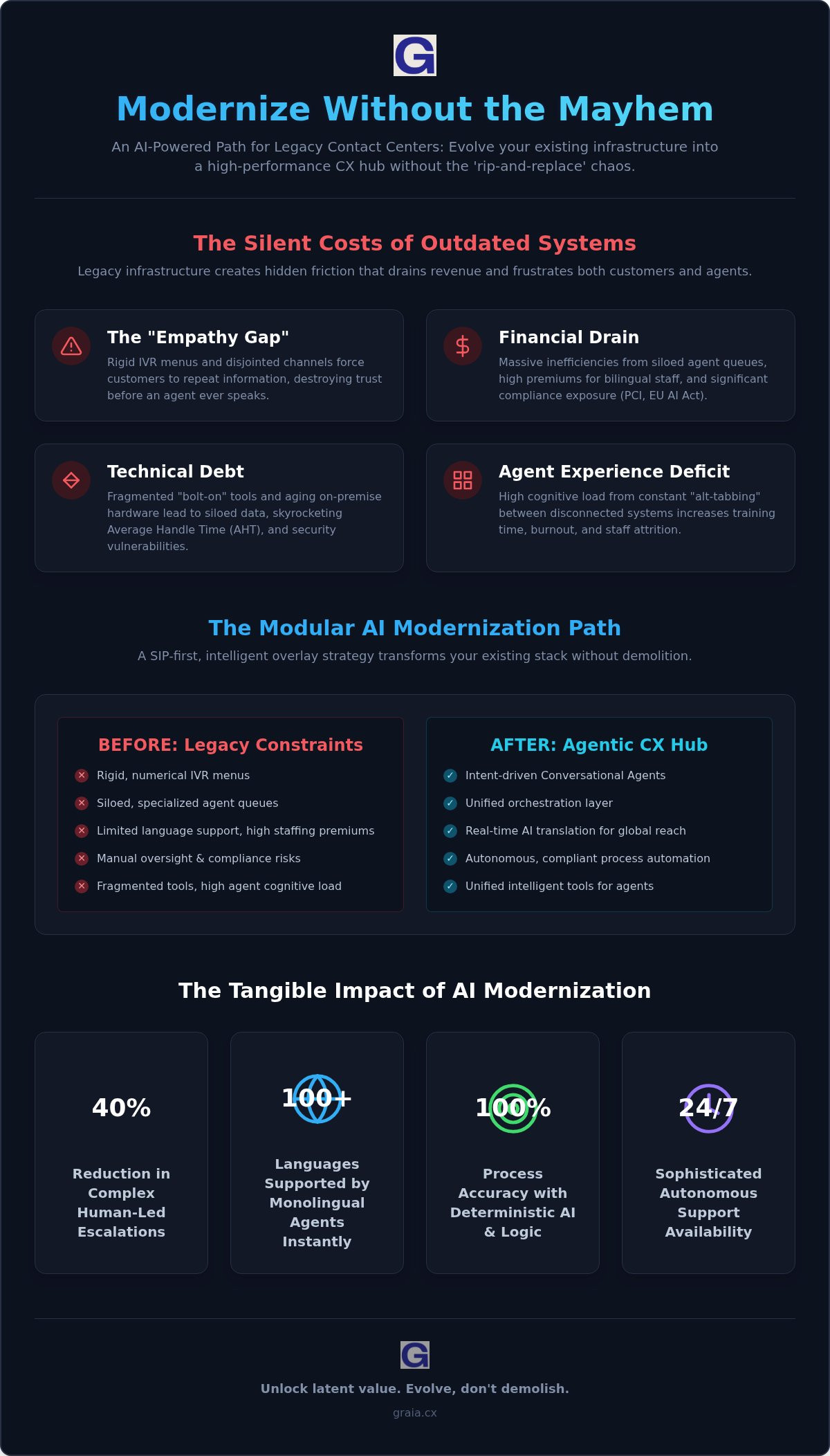
This strategic guide promises a new path. You'll learn how to transform your aging infrastructure into a high-performance agentic CX hub that prioritizes both precision and empathy. We will detail how to achieve 100% process accuracy and seamless global support through modular AI overlays that work with your current stack. By the end of this article, you'll have a clear roadmap for integrating live call translation and autonomous orchestration into your environment, effectively slashing average handle times while elevating the human potential of your workforce.
Key Takeaways
- Discover how to modernize legacy contact center with ai using a modular SIP-first approach. This strategy protects your existing infrastructure while enabling immediate innovation.
- Audit the hidden costs of the "empathy gap." You'll learn to eliminate the financial burden of bilingual staffing premiums through intelligent, agentic automation.
- Evolve from rigid IVR menus to intent-driven Conversational Agents. These systems combine natural language with deterministic logic to ensure 100% process accuracy.
- Empower monolingual agents to resolve inquiries in 100+ languages. Real-time AI translation removes traditional queue silos and expands your global reach instantly.
- Architect a future-ready agentic environment. This transition provides sophisticated 24/7 support and reduces complex human-led escalations by up to 40%.
Auditing the Hidden Costs of Legacy Contact Center Infrastructure
The "Empathy Gap" is a silent revenue killer. It begins the moment a customer encounters a rigid, non-conversational IVR system that demands they fit their complex human problem into a pre-defined numerical menu. This friction isn't just an annoyance; it's a structural failure that forces customers to repeat information multiple times. When you modernize legacy contact center with ai, you recognize that these mechanical barriers destroy trust before a human agent ever speaks. Beyond the emotional toll, the financial burden of maintaining these systems is staggering. Traditional queue silos, where specialized agents sit idle while other lines overflow, represent a massive inefficiency in resource allocation that modern enterprises can no longer afford.
Manual oversight is another ticking time bomb in your infrastructure audit. In legacy environments, unmonitored interactions create significant compliance risks. As global regulations like the EU AI Act and PCI DSS 4.0 demand stricter transparency and data protection, relying on random spot-checks of call recordings is insufficient. This lack of visibility leaves your organization vulnerable to systemic errors, legal exposure, and the high costs of bilingual staffing premiums required to bridge language gaps manually.
- Staffing Premiums: The high cost of hiring native speakers for every supported language rather than utilizing translation technology.
- Silo Inefficiency: Lost productivity when agents are locked into specific queues, unable to assist with fluctuating volumes in other channels.
- Compliance Exposure: The risk of non-documented or incorrectly handled data in manual legacy interactions.
The Technical Debt of Siloed Channels
"Bolt-on" digital tools are often sold as quick fixes, yet they frequently exacerbate data fragmentation. When chat, email, and voice systems don't communicate, the customer journey becomes a series of disjointed restarts. This lack of context during human handoffs sends Average Handle Time (AHT) skyrocketing. Agents spend precious minutes digging for history that should be at their fingertips. Beyond the user experience, aging on-premise PBX hardware presents growing security vulnerabilities. These systems often lack the modern encryption and AI in the customer experience frameworks required to defend against sophisticated social engineering and data breaches in 2026.
Mapping the Agent Experience (AX) Deficit
Legacy interfaces are cognitive minefields. We often see agents forced into a relentless cycle of "alt-tabbing" between CRM, ERP, and telephony windows just to resolve a single inquiry. This fragmented workflow increases training times for new hires and accelerates attrition among seasoned staff who grow weary of fighting their tools. The mental exhaustion of navigating a dozen disconnected tabs isn't just a productivity issue; it's a morale crisis that directly impacts your bottom line.
Superior employee experience is the prerequisite for modern customer satisfaction. When agents are supported by unified, intelligent tools, their cognitive load drops, allowing them to focus on high-value empathy rather than data entry. To truly modernize legacy contact center with ai, an enterprise must first solve the AX deficit that keeps its most valuable human assets stuck in a loop of mechanical frustration.
Designing a Modular AI Modernization Roadmap
Modernization is a surgical strike. It isn't a demolition. For many enterprise leaders, the fear of architectural paralysis often stalls progress. They believe that to modernize legacy contact center with ai, they must first dismantle everything they've built over the last decade. This is a misconception. By adopting a "SIP-first" approach, you can overlay sophisticated intelligence directly onto your signaling layer, bypassing the need for a total hardware overhaul. This modular strategy allows you to inject agentic capabilities into your existing environment, starting with high-volume, routine inquiries that currently clog your queues and drain your resources.
Phase 1: The Intelligent Overlay
The first step focuses on creating a unified orchestration layer. You don't need to replace your core PBX to gain modern advantages. Instead, you can integrate ai with existing ccaas platforms to bridge the gap between legacy reliability and future-state intelligence. This phase introduces an Omnichannel Desktop that unifies voice, chat, and social messaging into a single pane of glass. By establishing an "Intelligent Routing Brain," you can direct inquiries based on historical data and real-time sentiment, ensuring that the most complex issues reach your most skilled human advocates while routine tasks are handled autonomously.
Phase 2: Empowering the Human-AI Partnership
Once the foundation is set, the focus shifts to the synergy between your people and your technology. Deploying ai agent assist tools provides your team with real-time coaching and deterministic logic during live calls. This partnership yields immediate results. Automating post-call summaries and wrap-up tasks can boost agent productivity by 25%, reclaiming hours of lost time every week. We also implement seamless handoff protocols. When a conversational agent transfers a call to a human, the full context, transcript, and sentiment history move with it, eliminating the need for the customer to repeat their story.
Success in this roadmap is measured by more than just cost reduction. While lowering AHT is vital, we prioritize First Contact Resolution (FCR), positive sentiment shifts, and measurable increases in agent satisfaction. To protect your reputation, we establish rigorous "AI Guardrails" and prompt shields. These safety layers ensure every interaction remains brand-safe and compliant with evolving 2026 regulations. If you're ready to explore how these modular steps apply to your specific infrastructure, you can find more technical deep dives on our CX innovation blog. Evolution is a journey of precision, and it begins by choosing the right bridge to the future.
Implementing Agentic Workflows: From IVR to Conversational Agents
The era of "Press 1 for Sales" is officially a fossil. Customers in 2026 no longer tolerate the linear, frustrating paths of traditional IVR trees. They demand immediate, intent-driven interactions that feel human even when they are digital. When you modernize legacy contact center with ai, the first major shift is the transition to Conversational Agents. These aren't simple chatbots. They are sophisticated entities capable of understanding nuance, sentiment, and complex intent. By utilizing Hybrid Flows, you can combine the natural language flexibility of Large Language Models (LLMs) with the rigid, deterministic logic required for business compliance. This ensures that while the conversation feels fluid, the outcome remains strictly within your operational guardrails.
We achieve this through a Swarm architecture. Instead of a single, over-burdened bot trying to handle every inquiry, we deploy a network of specialized AI experts. One agent might be a master of technical troubleshooting, while another is deeply integrated into your billing systems. This modularity ensures that the customer is always speaking to a specialist that has been grounded in a vetted Knowledge Base via Hybrid RAG. This approach guarantees 100% process accuracy, eliminating the hallucinations that plague standard AI implementations and providing a stable foundation for high-stakes enterprise interactions.
Building Action-Oriented AI Agents
True automation occurs when AI moves from answering questions to executing complex backend tasks. This is the heart of Agentic CX. By integrating your Conversational Agent directly with CRM and ERP systems, the AI can perform real-time actions like processing refunds, updating shipping addresses, or booking service appointments. We use Decision Nodes to create structured routing based on real-time data. If a high-value customer calls with an urgent issue, the system recognizes their status instantly and adjusts the workflow to prioritize their specific needs, ensuring a premium experience without manual intervention.
Testing for Accuracy and Brand Voice
Reliability is non-negotiable. Before any workflow goes live, we subject it to rigorous stress-testing using bot-to-bot simulators. This allows us to run thousands of permutations of a conversation in minutes, identifying edge cases that a human tester might miss. We also employ AI Judges to score these interactions against strict policy adherence and brand-specific tones. This refinement process tunes the Empathy Engine, ensuring that every response feels authentic to your brand voice. To modernize legacy contact center with ai successfully, you must prove that your digital agents can handle the pressure of live interactions with the same poise and precision as your best human advocates.
Scaling Global Support with Real-Time AI Translation
Language-based queues are a structural bottleneck. They create artificial silos that leave some agents overwhelmed while others remain idle, simply because of the dialect on the other end of the line. To truly modernize legacy contact center with ai, you must break these barriers. By implementing live call translation software, you empower your existing workforce to handle inquiries in 100+ languages and dialects. This shift fundamentally changes your recruitment strategy. You can now hire for problem-solving ability and technical expertise rather than linguistic proximity, ensuring your best talent is available to every customer, regardless of where they are calling from.
The financial implications are immediate and significant. Bilingual staffing often carries wage premiums between 25% and 50%. By enabling monolingual agents to communicate across borders, you reduce these overheads while simultaneously expanding your global footprint. Crucially, this technology preserves the human element that pure machine translation often loses. Agents hear the original sentiment, mood, and urgency in the caller's voice; they read the translated text but react to the human emotion. This synergy allows them to respond with genuine empathy even as the AI handles the linguistic heavy lifting.
Optimizing Multilingual Accuracy
Precision is the difference between a resolution and a misunderstanding. We configure custom phrase lists to ensure that brand names, industry-specific terminology, and technical jargon are translated with total accuracy. To maintain a natural conversational flow, we utilize partial translation to minimize latency. This ensures the dialogue remains brisk and engaging rather than feeling like a series of disjointed pauses. For culturally sensitive markets like Japan or Germany, our "Formality Tuning" adjusts the output to match local expectations, protecting your brand reputation in every region you serve.
Compliance and Quality in Translated Calls
Global operations demand rigorous oversight and transparent records. Our platform generates audit-ready transcripts in both the original and translated languages, providing a clear trail for every interaction. For mandatory legal disclosures, we use script-locked messaging that ensures the AI never deviates from approved compliance text. Agents also maintain ultimate control through "Cancel Message" windows. These allow them to pause or refine AI-generated responses before they are delivered, ensuring that as you modernize legacy contact center with ai, your quality standards remain uncompromised. Explore how we are redefining the global customer journey on our CX innovation blog.
The Future State: Transitioning to an Agentic CCaaS Environment
The final stage of evolution is the complete liberation from hardware. For decades, the contact center has been tethered to physical PBX systems, creating a rigid environment that resists change. When you modernize legacy contact center with ai, you eventually move beyond simple overlays toward a fully integrated, cloud based ai call center. This transition is not merely a technical migration; it is a strategic repositioning. You are transforming a traditional cost center into a proactive value hub where every interaction generates data-driven insights. By achieving 24/7 self-service through agentic orchestration, organizations can reduce escalations by up to 40%, allowing human agents to focus exclusively on high-stakes, high-empathy engagements.
Proving the value of this evolution is critical for enterprise buy-in. We leverage Power BI integrations to provide deep, granular reporting on AI ROI, moving beyond surface-level metrics like AHT. You can now see the direct correlation between automated resolutions and customer lifetime value. This transparency builds the trust necessary to continue pushing the boundaries of what your CX infrastructure can achieve. It turns the contact center from a defensive necessity into an offensive advantage.
Continuous Optimization and the Roadmap to 2027
Evolution requires constant vigilance. We implement Automated Quality Management (AQM) to monitor every digital interaction, instantly identifying hallucinations or instances of low confidence. This self-healing architecture uses automated prompt optimization to rectify workflow inefficiencies in real time. For ultra-complex task execution, we utilize a "Step-by-Step" node architecture. This allows the AI to break down multi-stage processes into manageable segments, ensuring that even the most intricate customer journeys are handled with surgical precision and 100% accuracy.
Finalizing the Modernization Strategy
The journey to modernize legacy contact center with ai is defined by modularity. Whether you are upgrading avaya with conversational ai or integrating with Genesys, the goal remains the same: protect the investment while embracing the future. Selecting an LLM-agnostic platform is the ultimate form of future-proofing. It ensures that as new, more powerful models emerge, your infrastructure remains ready to adopt them without another rip-and-replace cycle. The bridge to an agentic future is already built. Schedule a strategy session with GraiaCX to audit your legacy stack and begin your transition to an intelligent, high-performance CX hub today.
Commanding the Agentic Future of Customer Experience
We've detailed how a modular, SIP-first roadmap allows you to modernize legacy contact center with ai without the inherent risks of a total infrastructure replacement. By transitioning from stagnant IVR menus to intent-driven Conversational Agents and dismantling language barriers through real-time translation, you elevate the customer journey while restoring your agents' professional focus. This strategy prioritizes the human element within a technically superior framework, ensuring your systems adapt to your people rather than the other end of the spectrum.
These transformations yield immediate, enterprise-grade results. Organizations utilizing these agentic workflows report a 25% improvement in agent productivity and 60% faster average resolution times, all while maintaining a 99.9% uptime guarantee. You don't have to wait for a hardware refresh cycle to begin your evolution or resolve the systemic frustrations of your workforce. Ready to bridge the gap between legacy hardware and agentic CX? Explore GraiaCX today. The future of connection is built on a sophisticated blend of intelligence and empathy; we're ready to help you command it.
Frequently Asked Questions
How can I modernize my contact center without a full rip-and-replace?
You can modernize your infrastructure by implementing a modular overlay strategy that sits on top of your existing signaling layer. This "SIP-first" approach allows you to inject advanced intelligence into your current stack without the risk of a total system teardown. It's a surgical evolution that protects your capital investment while enabling immediate access to agentic orchestration and automated workflows.
What is the difference between a traditional chatbot and an Agentic AI Agent?
Traditional chatbots rely on pre-defined retrieval patterns and static scripts to answer simple questions. In contrast, an Agentic AI Agent is an autonomous entity capable of reasoning, planning, and executing multi-step tasks. These agents don't just talk; they act. They use sophisticated logic to navigate complex customer journeys and resolve issues from start to finish without requiring constant human supervision.
Can AI agents actually take actions like processing refunds or rescheduling deliveries?
Yes, modern AI agents execute complex backend tasks by integrating directly with your CRM and ERP systems. They can verify customer identities, check inventory levels, and process financial transactions like refunds or rescheduling. This capability transforms the AI from a simple information booth into a high-performance digital advocate that drives real-world outcomes and reduces the burden on your human staff.
Is it possible to integrate AI with legacy systems like Avaya or Genesys on-prem?
It is entirely possible to modernize legacy contact center with ai by integrating with on-premise hardware from providers like Avaya and Genesys. Specialized platforms act as an intelligent bridge, overlaying voice and digital channels with automation while maintaining the reliability of your core PBX. This allows you to scale global support and implement live translation without abandoning your existing hardware investments.
How does real-time call translation impact Average Handle Time (AHT)?
Real-time translation significantly reduces Average Handle Time by eliminating the need for language-based transfers and repeat explanations. When agents can communicate instantly in over 100 languages, the friction of language barriers vanishes. This leads to faster resolutions and higher first-contact resolution rates, as customers are no longer stuck in specialized queues waiting for a native speaker to become available.
Will using AI in my contact center compromise customer data privacy?
Customer data privacy is protected through the implementation of privacy-first AI guardrails and strict data-handling protocols. Modern agentic platforms are designed to comply with evolving 2026 regulations like the EU AI Act and PCI DSS 4.0. We use secure encryption and PII redacting to ensure that sensitive information is never exposed or used to train public models, maintaining the highest standards of enterprise security.
How do Hybrid Flows prevent AI hallucinations in regulated industries?
Hybrid Flows prevent hallucinations by anchoring the flexibility of Large Language Models within strict, deterministic business logic. This architecture ensures that the AI can only provide answers grounded in your vetted Knowledge Base or follow pre-approved process maps. By combining natural language understanding with deterministic decision nodes, you maintain 100% process accuracy, which is essential for compliance in regulated sectors.
What ROI can I expect from modernizing with Agentic CCaaS?
Enterprises that modernize legacy contact center with ai typically see a 25% increase in agent productivity and a 60% reduction in average resolution times. Beyond these efficiency gains, the ROI is found in the elimination of bilingual staffing premiums and the reduction of customer churn caused by poor IVR experiences. You're not just saving money; you're building a more resilient, scalable, and empathetic customer experience engine.