Enterprise Conversational Automation: The 2026 Guide to Agentic CX
The era of the "helpful" but helpless chatbot has ended. In its place, a new generation of autonomous agents has emerged, capable of navigating complex ERP systems and resolving intricate customer demands with 100% process accuracy. If you're still relying on rigid IVR trees and expensive, outsourced bilingual teams, you're not just falling behind; you're actively eroding customer trust. Adopting a unified conversational ai platform for enterprise is no longer a luxury for the innovative few. It's a strategic necessity for any UK business aiming to survive the strict enforcement of the EU AI Act and the soaring expectations of a global market.
You know that scaling support across 100+ languages shouldn't require a proportional increase in headcount or a sacrifice in empathy. We promise to guide you through the shift from legacy automation to agentic CX that delivers human-level connection at scale. This guide breaks down the architecture of the modern empathy engine, revealing how to slash Average Handle Time by 20% while ensuring your customer data remains shielded from external training models. We're moving beyond simple deflection toward a future of total, autonomous resolution.
Key Takeaways
- Understand the shift from simple inquiry deflection to autonomous resolution, where AI agents manage complex workflows without human intervention.
- Discover how a unified conversational ai platform for enterprise utilises Hybrid Flows to guarantee 100% process accuracy in highly regulated environments.
- Learn to bridge the empathy gap by scaling personalised support across 100+ languages while maintaining a sophisticated, human-centric tone.
- Explore the technical architecture of multi-agent swarms and Hybrid RAG that allows for grounded, hallucination-free interactions across all channels.
- Establish clear benchmarks for success, targeting a 25% increase in agent productivity and 60% faster resolution times across your entire operation.
Beyond Deflection: The Evolution of Enterprise Conversational Automation
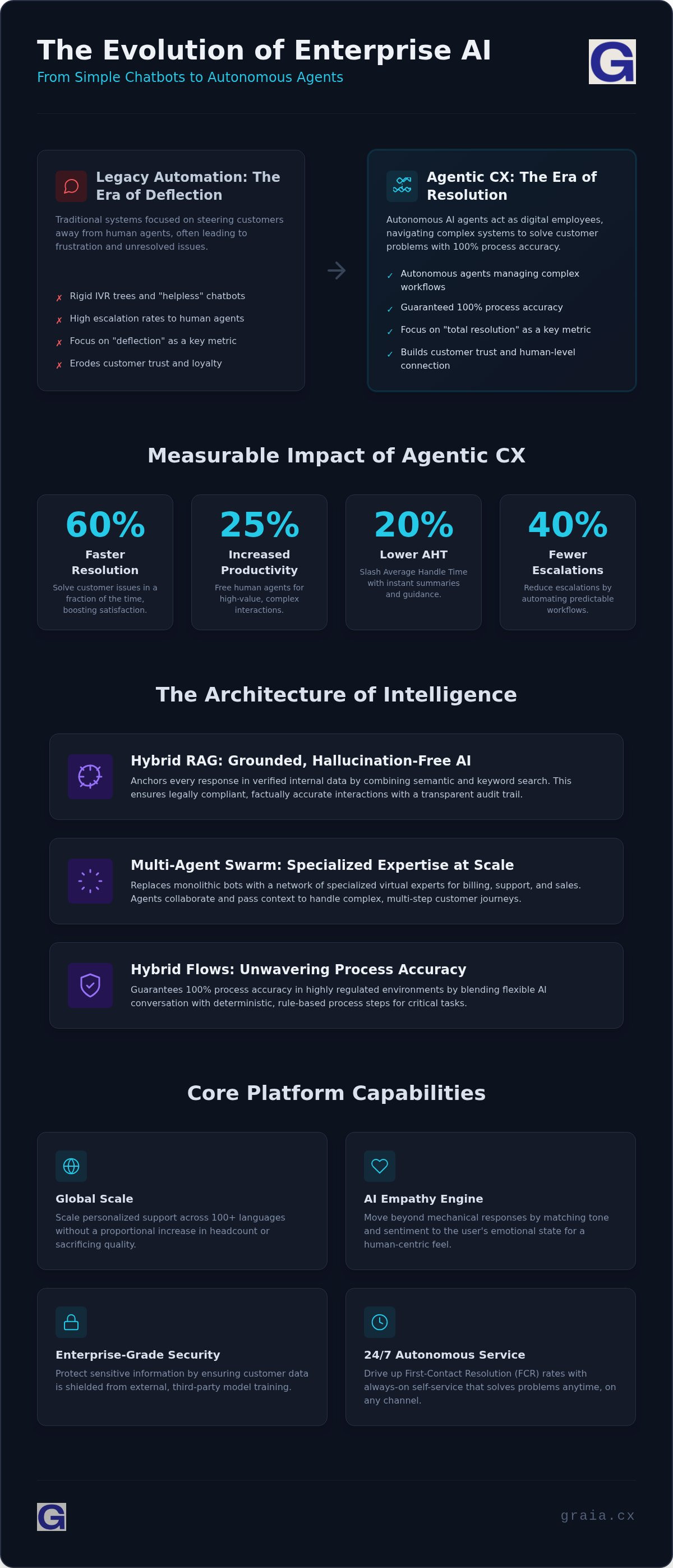
Traditional customer service models are breaking under the weight of modern expectations. For decades, the strategic goal was deflection, using a basic conversational AI interface to steer customers toward FAQs or static help pages. In 2026, this approach is no longer sufficient. Customers don't want to be deflected; they want their problems solved. A unified conversational ai platform for enterprise shifts the focus from simple information collection to autonomous resolution. This evolution, known as Agentic CX, empowers AI to act as a digital employee rather than a mere gatekeeper.
Brand perception is fragile. If automation feels mechanical or detached, customers feel undervalued. Integrating AI empathy into these autonomous flows ensures that tone and sentiment are matched to the user's emotional state. It's the difference between a cold error message and a reassuring, proactive resolution. By moving beyond rigid IVR trees, businesses can maintain a sophisticated presence that protects the human element within a digital framework.
The Shift from Chatbots to Autonomous Agents
Deflection is a failing metric. When a bot successfully "deflects" a query but leaves the customer frustrated, brand loyalty suffers. The transition to agentic ccaas platforms marks a fundamental change in how we view automation. These systems don't just talk. They act. An autonomous agent can verify a customer's identity, access a secure ERP system, process a refund, or reschedule a delivery in real-time. It's about moving from "I can find that for you" to "I have done that for you." This action-oriented intelligence ensures that 100% process accuracy is maintained while freeing human agents for high-value, complex interactions.
The Economic Imperative for Enterprise Automation
Rising support volumes in the UK market often outpace the ability to hire and train skilled staff. Scaling headcount is expensive and slow. Implementing a unified conversational ai platform for enterprise allows organisations to handle massive spikes in volume without increasing operational costs. By automating predictable workflows, businesses can reduce escalation rates by up to 40%. This directly impacts the bottom line. Average Handle Time (AHT) drops as AI provides instant summaries and next-best-action guidance. Simultaneously, 24/7 self-service availability drives up First-Contact Resolution (FCR) rates, ensuring that UK enterprises remain competitive and responsive in a high-stakes global economy.
The Architecture of Intelligence: Multi-Agent Swarms and Hybrid RAG
Building a sophisticated customer experience requires more than a single Large Language Model (LLM). It demands a structural blueprint that balances creative intelligence with unwavering accuracy. A unified conversational ai platform for enterprise achieves this through three critical architectural pillars. It's not just about chat; it's about engineering trust. By moving away from monolithic bots, organisations can finally deliver the precision that high-stakes industries demand.
Hybrid RAG: Grounding AI in Enterprise Truth
Model hallucinations are the primary fear for UK enterprises operating in regulated sectors. Hybrid Retrieval-Augmented Generation (RAG) solves this by anchoring every response in verified internal data. By combining dense vector search for semantic meaning with lexical matching for keyword precision, the system ensures that AI doesn't "invent" answers. It retrieves the exact clause from your technical manual or the specific policy from your compliance docs. This creates a transparent audit trail. Every decision made by the AI can be traced back to a specific, vetted knowledge source, ensuring your responses remain legally and technically compliant with UK standards.
The Multi-Agent Swarm: Specialized Expertise at Scale
A single bot often collapses under the weight of diverse enterprise needs. It tries to be everything to everyone and ends up failing at both billing inquiries and technical troubleshooting. The multi-agent swarm approach replaces this "jack-of-all-trades" model with a network of specialized virtual experts. One agent masters billing and payments. Another focuses on complex technical support. A third handles outbound sales. These agents communicate seamlessly, passing the full customer context between them without the user ever feeling a "handoff." This structure mirrors a high-performing human team, delivering precision that a single model simply cannot replicate.
In high-stakes environments like finance or healthcare, "close enough" is a liability. Hybrid Flows bridge the gap between LLM-driven conversation and deterministic logic. While the AI manages the natural flow of human speech, the underlying system enforces mission-critical rules that cannot be circumvented. This ensures 100% process accuracy. Whether you're processing a sensitive insurance claim or handling a complex GDPR data request, the architecture guarantees that every step follows your exact business logic. You can explore more about these architectural shifts on our resource hub to see how they apply to your specific industry.
Balancing Process Accuracy with Conversational Empathy
The "uncanny valley" of customer service is a cold, mechanical place. When a customer reaches out in frustration, they don't want a script; they want to be heard. Yet, in the pursuit of efficiency, many organisations sacrifice the human element for raw processing power. A unified conversational ai platform for enterprise must bridge this gap, ensuring that every interaction feels genuinely supportive while remaining technically flawless. We believe that growth is rooted in AI empathy, a philosophy where technology elevates rather than replaces the interpersonal experience. Achieving this requires a sophisticated blend of flexible language and rigid logic.
Deterministic Logic for Mission-Critical Tasks
Process accuracy isn't optional. In regulated UK industries, a single misstep in a financial transaction or a PII update can lead to significant compliance risks. Hybrid Flows provide the necessary guardrails. While the LLM handles the conversational nuance, the underlying deterministic logic manages the actual execution. This defines hard boundaries for tasks like account updates or processing a refund of £50. It ensures mission-critical rules are never circumvented by the unpredictability of generative AI. This balance is central to the evolution of the ai customer service platform, moving from simple text generation to secure, rule-based action that prioritises safety alongside speed.
Infusing Empathy into Automated Responses
Empathy isn't just a buzzword. It's a technical requirement. Modern unified conversational ai platform for enterprise deployments use real-time sentiment analysis to detect frustration, confusion, or urgency. If a customer's tone shifts, the AI adjusts its conversational style immediately. It can pivot from a concise, professional tone to a more supportive, reassuring one based on the brand's configured personality. Whether your brand voice is strictly professional or warmly friendly, the AI maintains that consistency across every touchpoint.
When a situation exceeds the AI's emotional scope, the system triggers a seamless human escalation. This ensures that high-stakes emotional moments are handled by skilled agents who receive the full context of the automated interaction. By integrating enterprise ai contact center solutions, businesses create a collaborative environment where AI handles the precision and humans handle the complex emotional work. This synergy doesn't just resolve tickets. It builds lasting loyalty by proving to the customer that they aren't just another number in a database.
A Step-by-Step Roadmap for Enterprise Implementation
A successful transition to an agentic enterprise requires a methodical strategy. It isn't about replacing your entire stack overnight. Instead, it's about surgical implementation. Step 1 involves identifying high-volume, predictable workflows. These are the repetitive tasks that drain your resources but require 100% process accuracy. By automating these on day one, you build immediate momentum. Step 2 focuses on technical synergy. A unified conversational ai platform for enterprise must integrate directly with your existing CCaaS infrastructure via SIP and APIs, whether you use Genesys, NICE CX, or Avaya.
Seamless Integration with Legacy Infrastructure
Legacy systems shouldn't be a barrier to innovation. You must avoid the rip-and-replace trap by deploying modular AI components that sit alongside your current tools. Connecting these agents to your CRM and ERP systems, such as Salesforce or Dynamics 365, transforms them into action-oriented entities. During this transition, leveraging ai agent assist tools ensures your human staff are supported with real-time guidance and automated summaries. This maintains high service standards while the system matures.
Step 3 addresses the language barrier. Real-time translation eliminates the need for siloed language queues. This allows you to serve a global audience from a single UK-based hub. Step 4 introduces continuous optimization. By using AI Judges to score every conversation against your specific quality standards, you ensure the system evolves with every interaction.
Global Expansion via Live Call Translation
Hiring bilingual agents in the UK often carries a 25% to 50% wage premium. This cost is no longer sustainable. By implementing live call translation software, you can support over 100 languages without increasing your headcount. Custom vocabulary lists ensure that your specific brand terms and industry jargon are translated with technical precision. This isn't just about cost reduction; it's about democratising access to your services globally.
Step 5 is the final expansion. You scale this proven strategy across voice, chat, email, and social messaging to create a truly omnichannel experience. This methodical progression ensures that your evolution is stable, measurable, and profoundly impactful. To see how these steps align with your specific business goals, explore our comprehensive implementation resources.
Measuring Success: KPIs for the Agentic Enterprise
Success in the agentic era isn't measured by how many chats you start. It's defined by how many problems you solve. While traditional metrics focus on volume, a unified conversational ai platform for enterprise prioritises outcomes. We move away from the vanity of automation rates to the reality of resolution. By targeting a 60% faster resolution time through autonomous agents, UK businesses can finally meet the pace of modern demand. This isn't just about speed; it's about the 25% uplift in human agent efficiency that occurs when your team is liberated from the mundane. Tracking contact center roi with ai requires more than a spreadsheet. It demands deep integration with business intelligence tools like Power BI to visualise the tangible value of every automated interaction.
Advanced Analytics and Conversation Insights
Data is the lifeblood of the evolving enterprise. Using OData feeds allows for enterprise-grade reporting that goes beyond surface-level CSAT scores. You can audit AI reasoning paths to identify exactly where a customer journey stalls. This transparency allows you to fix friction points before they impact your bottom line. Sentiment analysis acts as a critical lead indicator. By detecting frustration early, you can predict churn and intervene with human empathy before a customer decides to leave. These insights transform raw data into a strategic roadmap for service excellence.
The Future-Proof Enterprise: Continuous AI Learning
Static systems are obsolete. To maintain 100% process accuracy, you must implement automated testing and quality management to prevent model drift. This ensures that as your business evolves, your AI agents evolve with it. Automated knowledge extraction allows you to identify new automation opportunities from the very conversations your agents are having. It's a cycle of constant refinement. Your contact centre shouldn't just be a cost centre. It must become a proactive experience hub that drives growth and builds lasting connection. The transition to an agentic model is the final step in protecting your brand’s future while elevating the human potential within your organisation.
Architecting the Future of Enterprise Engagement
The transition from passive deflection to autonomous resolution isn't just a technical upgrade; it's a fundamental shift in how UK enterprises value their customers. By deploying a unified conversational ai platform for enterprise, organisations move beyond the limitations of rigid IVR trees and mechanical bots. You've seen how the synergy of multi-agent swarms and Hybrid RAG creates a framework where 100% process accuracy and human-level empathy coexist. This architecture ensures that mission-critical workflows remain deterministic while the conversational experience feels fluid and supportive.
Security and reliability are the cornerstones of this evolution. We maintain SOC2-aligned security standards and a 99.9% uptime guarantee, ensuring your operations remain resilient and compliant. Our privacy-first AI commitment means your customer data is never shared for external model training. It's time to elevate your contact centre from a cost centre to a proactive experience hub that drives genuine growth. Discover how GraiaCX Agentic CCaaS transforms enterprise customer journeys. The tools for this transformation are ready. Your path to agentic excellence starts today.
Frequently Asked Questions
What is the difference between conversational AI and agentic automation?
Conversational AI focuses primarily on dialogue and information retrieval, mimicking human speech to answer queries. Agentic automation goes further by performing multi-step tasks and making autonomous decisions within defined workflows. While traditional chatbots might simply answer a question, an agentic system acts as a digital employee. It navigates ERP systems to resolve issues end-to-end without human intervention, marking the shift from passive deflection to active resolution.
How does an enterprise ensure AI agents do not hallucinate?
We eliminate hallucinations through Hybrid Retrieval-Augmented Generation (RAG) and deterministic Hybrid Flows. By grounding every response in vetted enterprise knowledge bases, the AI is restricted from inventing facts. If a query falls outside the ground truth of your documentation, the system follows a pre-defined logic path to escalate rather than guessing. This dual-layered approach ensures 100% process accuracy in mission-critical environments where errors are not an option.
Can conversational automation integrate with legacy CCaaS platforms like Genesys or Avaya?
Yes, a unified conversational ai platform for enterprise is designed for modular integration with established infrastructure via SIP and robust APIs. You don't need to rip and replace your existing Genesys, NICE CX, or Avaya stacks. Instead, the AI agents sit alongside your current tools, enriching them with agentic capabilities. This allows for a phased transition that protects your historical investment while modernising your customer experience with minimal disruption.
Is customer data used to train public AI models in an enterprise strategy?
No, we maintain a strict privacy-first architecture where customer data is never shared or used to train external, public models. All interactions occur within a secure, SOC2-aligned environment tailored specifically for your organisation. This is non-negotiable for UK enterprises operating under GDPR. Your proprietary data and customer interactions remain entirely within your control, ensuring that your competitive advantages and user privacy are never compromised by external training cycles.
How does real-time voice translation impact average handle time (AHT)?
Real-time voice translation significantly reduces AHT by eliminating the need for language-specific queues and manual transfers to bilingual staff. Agents can resolve queries in 100+ languages instantly, ensuring that non-English speakers receive immediate support. This streamlined workflow contributes to a projected 60% faster resolution time. It removes the friction of waiting for specialised agents, allowing your existing team to handle a global volume with technical precision and human-level empathy.
What are the primary KPIs for measuring conversational automation success?
Beyond simple deflection, a unified conversational ai platform for enterprise focuses on Resolution Speed and the uplift in human agent productivity. Key metrics include the Resolution Rate, which tracks issues settled autonomously, and First-Contact Resolution (FCR). We also monitor Sentiment Shift to measure emotional improvement during sessions. These outcomes contribute to the projected £80 billion reduction in global contact centre labour costs expected by the end of 2026.
Can AI agents take actual actions like processing refunds or updating CRM records?
Absolutely, the defining trait of agentic CX is its ability to perform cross-system actions. By integrating with your CRM and ERP systems, AI agents can autonomously process a refund, update a billing address, or schedule a delivery. These actions are governed by deterministic Hybrid Flows to ensure they follow your exact business rules. This provides the same level of reliability as a human employee while operating at a much higher scale.
How does a multi-agent swarm architecture improve customer resolution?
A multi-agent swarm improves resolution by assigning specialised virtual experts to specific functional domains. Instead of a single bot struggling with diverse topics, dedicated agents handle billing, technical support, or sales separately. These agents collaborate in the background, sharing customer context seamlessly. This architecture ensures that a user's complex, multi-part query is handled by the most qualified expert agent, leading to higher accuracy and a more sophisticated interpersonal experience.