Best AI Agents for Customer Support: 2026 Enterprise Review & Rankings
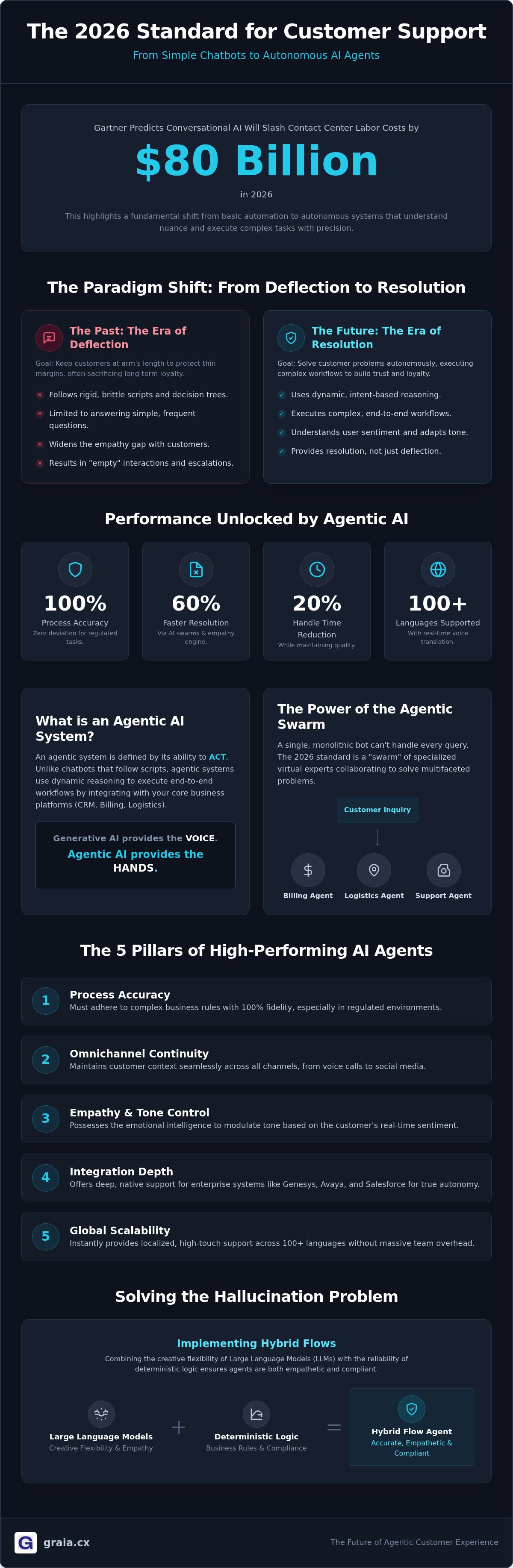
Gartner predicts that conversational AI will slash contact center labor costs by $80 billion in 2026. This massive figure highlights a fundamental shift, yet many enterprises remain trapped by brittle chatbots that fail the moment a customer deviates from a rigid script. Searching for the best ai agents for customer support is no longer about finding a faster bot; it's about deploying an autonomous system that understands nuance and executes with surgical precision. You need a solution that doesn't just talk. You need a partner that acts.
We recognize the exhaustion of managing teams drained by routine inquiries while automated tools only widen the empathy gap. With new regulations like the EU AI Act taking full effect on August 2, 2026, the demand for transparency and accuracy has never been more urgent. This review promises to reveal the leading agentic platforms that bridge the gap between technical logic and human connection. We'll explore how specialized AI swarms and live translation can reduce your average handle time by 20% while maintaining 100% process accuracy for your most regulated tasks.
Key Takeaways
- Transition from deflection to resolution. Modern enterprise ROI depends on autonomous agents that execute complex workflows rather than simply answering frequently asked questions.
- Evaluate performance through five critical pillars. We rank the best ai agents for customer support based on their process accuracy, omnichannel continuity, and ability to maintain context across 100% of interactions.
- Eliminate hallucinations with Hybrid Flows. Combining the creative flexibility of Large Language Models with deterministic logic ensures your agents remain both empathetic and compliant with regulated business rules.
- Scale global support instantly. Real-time voice translation across more than 100 languages allows you to provide a localized, high-touch experience without the overhead of massive multilingual teams.
- Drive a 60% faster resolution time. Deploying specialized AI swarms and an advanced empathy engine can dramatically reduce average handle time while simultaneously increasing customer trust.
Beyond the Chatbot: Defining the 2026 Standard for AI Support Agents
The age of the "deflection chatbot" has reached its end. Organizations once prioritized keeping customers at arm's length to protect thin margins, often sacrificing long-term loyalty for short-term efficiency. In 2026, that paradigm has fundamentally shifted. We have entered the era of autonomous resolution. This evolution defines the Agentic Customer Experience (Agentic CX) philosophy. It's a world where systems don't just mimic human speech; they execute human intent. To find the best ai agents for customer support, you must look beyond the surface level of Beyond the Chatbot: Defining the 2026 Standard and focus on platforms that prioritize both technical IQ and emotional EQ. High-level intelligence is useless if the agent lacks the empathy to handle a frustrated user or the authority to resolve a complex billing error.
Empathy is not a luxury; it's a functional requirement. When an automated system fails to recognize the stress in a customer's voice or text, the interaction becomes a brand liability. The best ai agents for customer support in 2026 utilize advanced sentiment analysis to pivot their tone in real-time. This ensures the customer feels heard while their problem is being solved through backend execution. Autonomous execution is now the baseline for ROI because it eliminates the "empty" interaction where a bot simply tells a customer to wait for a human.
What is an Agentic AI Support System?
An agentic system is defined by its ability to act. Traditional chatbots follow rigid decision trees; agentic systems utilize dynamic, intent-based reasoning. They don't just retrieve information. They integrate with your CRM, your billing software, and your logistics platform via secure APIs to complete end-to-end workflows. Generative AI provides the voice, but Agentic AI provides the hands. This distinction is vital for enterprise leaders who demand 100% accuracy in regulated environments. By moving from static scripts to dynamic reasoning, agents can navigate the messy reality of customer interactions without hallucinating or losing the thread of the conversation.
The Rise of the Agentic Swarm
Relying on a single, monolithic bot to handle every customer query is a strategy destined for failure. The 2026 standard involves a "swarm" of specialized virtual experts. Imagine a single customer thread where a Billing Agent, a Technical Support Agent, and a Logistics Agent collaborate seamlessly to solve a multifaceted problem. This architecture ensures that the most qualified "mind" is always leading the conversation. This collaborative model is driving the rise of autonomous customer service resolution in 2026, allowing businesses to scale without losing the precision that only specialized expertise provides.
The Evaluation Framework: 5 Pillars of the Best AI Agents
Identifying the best ai agents for customer support requires a departure from traditional software procurement metrics. In 2026, the focus has pivoted from simple uptime to "execution reliability." You aren't just buying a communication interface; you're hiring a digital workforce that must perform with the same accountability as your top human talent. To distinguish between high-performing agents and glorified chatbots, enterprises must evaluate platforms against five non-negotiable pillars. These pillars ensure that your automation strategy remains a driver of growth rather than a source of liability.
- Process Accuracy: The system must adhere to complex business rules with 100% fidelity. There is zero room for deviation in regulated environments.
- Omnichannel Continuity: Customer context must remain intact as the interaction moves from a voice call to a social media thread. Fragmented data leads to frustrated users.
- Empathy and Tone Control: Agents must possess the emotional intelligence to modulate their formality and resonance based on the customer's real-time sentiment.
- Integration Depth: Native, deep-level support for legacy systems like Genesys, Avaya, and Salesforce is essential for true autonomous action.
- Security and Sovereignty: Enterprise data must remain private. The best platforms guarantee that your proprietary customer interactions never train public models.
Process Accuracy vs. LLM Creativity
Pure Large Language Models are inherently creative, which is a significant risk for mission-critical tasks. In 2026, relying on a standard LLM for medical triage or financial refunds is reckless. The industry has moved toward "Hybrid Flows," where deterministic logic provides the guardrails for generative flexibility. This approach is central to Solving the Hallucination Problem within the enterprise. By implementing "Prompt Shields" and real-time toxicity detection, the best ai agents for customer support ensure that every response is both helpful and compliant with internal brand standards. If you're curious about how these logic layers work in practice, you might find our latest GraiaCX insights particularly useful.
Multilingual Capability as a Revenue Driver
Language should never be a barrier to resolution. Basic text translation is no longer sufficient for global enterprises. The 2026 standard demands real-time voice translation across more than 100 languages, allowing you to serve a global audience without the massive overhead of localized hiring. This capability transforms support from a cost center into a global revenue driver. When your agent can handle a complex technical query in Mandarin as effectively as in English, you eliminate the bilingual hiring premium entirely. For a deeper look at how to implement these systems, consult our Live call translation software guide.
The Best AI Agents for Customer Support in 2026: Head-to-Head Review
The enterprise landscape of 2026 demands more than responsive text. It requires digital entities that can act, translate, and empathize in real-time across every conceivable channel. Finding the best ai agents for customer support is no longer a matter of comparing simple feature lists; it's about evaluating operational autonomy and the ability to handle high-stakes resolutions without human intervention. As highlighted in recent industry analysis on how The Evaluation Framework: 5 Pillars of the Best AI Agents defines success, the shift toward resolution-centric models is now absolute. Enterprises are moving away from fragmented tools toward unified platforms that offer a cohesive, agentic strategy.
Today's market leaders are distinguished by their integration depth and their commitment to process accuracy. While many platforms claim to offer "AI," only a few provide the deterministic logic required for regulated industries. We've evaluated the top contenders based on their autonomy levels, voice-native capabilities, and their ability to maintain brand-safe interactions in 100% of customer encounters. The results reveal a clear divide between legacy helpdesks and the new generation of agentic-first platforms.
GraiaCX: The Enterprise Choice for Agentic CX
GraiaCX stands as the definitive leader for organizations that view customer support as a mission-critical function. It's built specifically for high-volume centers that cannot afford the "hallucination tax" associated with standard LLMs. By utilizing a unique Agentic Swarm architecture, GraiaCX allows specialized virtual experts to collaborate on complex tickets, ensuring that technical, billing, and logistical queries are handled with surgical precision. Its native Live Call Translation supports over 100 languages, providing a seamless experience for global customers without the need for massive multilingual staffing. For enterprises already invested in Genesys, NICE, or Avaya, GraiaCX offers a "drop-in" integration that transforms legacy infrastructure into a modern agentic powerhouse.
Zendesk & Intercom: The Support Giants
Zendesk AI remains the reliable incumbent for teams deeply embedded in its massive ticketing ecosystem. It excels at providing a unified view of the customer, though it often lacks the deep, autonomous agency required for complex backend executions. Intercom Fin is the frontrunner for web-first, high-growth startups that prioritize conversational chat. While Intercom is excellent for digital-only interactions, it remains limited in its voice-native agency compared to more robust CCaaS-integrated competitors. Finally, Ada continues to be a strong contender for automated messaging, offering high levels of brand-specific customization for companies focused primarily on text-based engagement. Each of these platforms serves a specific niche, but the best ai agents for customer support in 2026 are those that bridge the gap between digital chat and real-time voice resolution.
Solving the Hallucination Problem: Implementing Hybrid Flows and RAG
Hallucinations represent a fundamental trust gap in automated service. While Retrieval-Augmented Generation (RAG) was the breakthrough of the previous year, 2026 enterprises have learned that context alone isn't a safeguard against inaccuracy. If an LLM decides to ignore its retrieved data in favor of its training weights, the system fails. The best ai agents for customer support solve this by moving beyond simple RAG to embrace "Hybrid Flows." This architecture combines the fluid, conversational intelligence of an LLM with the deterministic, rule-based logic of traditional software. It ensures that when a customer asks about a specific refund policy, the agent doesn't just guess. It follows a hard-coded process path while maintaining a natural, empathetic tone.
Accountability is the cornerstone of this new standard. Every autonomous decision must be backed by a transparent audit trail. Managers need to see exactly which document was cited and what logic path was followed to reach a conclusion. This transparency is critical for compliance and continuous optimization. To understand the technical requirements of this setup, you can explore our guide on how to deploy agentic RAG for customer service automation. By layering deterministic constraints over generative potential, you protect your brand from the unpredictability of pure AI models.
Grounding AI in Fact-Based Knowledge
Precision starts with retrieval. Modern agents utilize Hybrid Search, combining dense and sparse vector methods to achieve 98%+ retrieval accuracy even within massive, complex datasets. This allows businesses to manage rapidly evolving product catalogs without the need for constant, expensive model retraining. Security remains paramount. Your internal knowledge base is a proprietary asset. The best ai agents for customer support ensure that your data is used only for grounding, never for training public models. This maintains your data sovereignty while delivering hyper-accurate responses to your users.
Human-in-the-Loop: Seamless Handoffs
True intelligence includes knowing when to step aside. The most sophisticated agents recognize the limits of their own autonomy and trigger a seamless handoff when they detect high emotional distress or complex edge cases. Context preservation is non-negotiable. When a human agent takes over, they receive a full summary of the AI’s reasoning and the customer’s history. Tools like "Email Draft Mode" act as a bridge, where the AI prepares a resolution for human review rather than sending it directly. This keeps your team in control while still realizing massive efficiency gains. Learn more about our latest CX strategies at our resource center.
Elevating Enterprise CX: Why GraiaCX Leads the Agentic Revolution
GraiaCX represents the culmination of 25 years of relentless CX innovation. We didn't build our platform overnight to chase a trend; we engineered it to solve the fundamental flaws in traditional service models. Today, we offer the only agentic CCaaS platform that successfully bridges the gap between high-level computational intelligence and deep human empathy. When searching for the best ai agents for customer support, enterprises must look for systems that don't just process data but understand the person behind the query. Our 'Empathy Engine' does exactly that. It enables businesses to achieve a 60% faster resolution time by identifying the emotional context of a conversation and executing the most effective path forward.
This shift has a profound operational impact. High turnover rates in contact centers are often driven by the mental exhaustion of handling repetitive, low-value tasks. By automating these workflows with surgical precision, you empower your human staff to focus on complex, high-value interactions. You also eliminate the staggering costs of specialized bilingual hiring. Our platform handles the heavy lifting, allowing your team to thrive in an environment designed for growth rather than survival. The result is a more resilient, more capable workforce that's focused on building loyalty rather than simply closing tickets.
Unifying the Agentic Contact Centre
Fragmentation is the enemy of efficiency. We consolidate voice, chat, and email into a single, intelligent flow where context is never lost. Our Agent Assist technology provides real-time coaching and suggests the 'Next Best Action' for live staff, ensuring that every interaction meets your brand’s highest standards. This is not just an upgrade. It’s a total reimagining of the service environment. To understand how we reached this point, you can read about The Evolution of the AI Customer Service Platform and the journey from simple chatbots to true agentic intelligence.
Global Expansion Without Borders
Language should be a bridge, not a barrier. With our native Live Call Translation, your enterprise can scale to over 100 languages overnight. You can provide a localized, high-touch experience in any market without the logistical nightmare of building regional teams. This capability ensures your brand remains consistent across every cultural profile. In an increasingly automated world, empathy remains the ultimate competitive advantage. It’s the difference between a transaction and a relationship. We invite you to Explore the GraiaCX Agentic Platform and start your transformation today to see how the best ai agents for customer support can redefine your enterprise’s future.
Mastering the Future of Autonomous Resolution
The transition from passive deflection to active resolution is the defining movement of this decade. Deploying the best ai agents for customer support requires a commitment to both technical precision and human empathy. You've seen how Hybrid Flows eliminate the hallucination risk while specialized swarms deliver surgical accuracy across every channel. This isn't just about efficiency. It's about building a resilient, global support ecosystem that speaks more than 100 languages in real-time through advanced voice translation. The era of the frustrated customer waiting for a human handoff has ended.
The operational impact of this evolution is undeniable. Partners who embrace agentic intelligence report a 40% reduction in escalations and a 25% improvement in agent productivity. These results transform the contact center from a cost center into a high-performance engine for brand loyalty. Now's the time to move beyond the limitations of legacy systems and embrace a platform built for the complexities of tomorrow. Scale your customer support with GraiaCX Agentic AI and lead your industry into a new era of connection. The future of customer experience is here, and it's waiting for your command.
Frequently Asked Questions
What is the difference between an AI chatbot and an AI agent in 2026?
The distinction lies in the transition from conversation to execution. While traditional chatbots are designed for deflection and simple information retrieval, 2026 AI agents possess the autonomy to perform complex tasks. Agents utilize intent-based reasoning and secure API integrations to resolve issues end-to-end, such as processing a warranty claim or re-routing a shipment, rather than merely providing a link to a help article.
Can AI agents for customer support integrate with legacy systems like Avaya or Genesys?
Modern agentic platforms are engineered for deep compatibility with existing infrastructure. The most sophisticated solutions offer "drop-in" integrations for legacy CCaaS providers like Genesys, NICE, and Avaya. This allows enterprises to layer advanced intelligence over their current telephony and routing stacks without the operational risk of a full system replacement.
How do AI agents handle sensitive customer data and PII?
Security is maintained through strict data sovereignty protocols and SOC2-aligned frameworks. Enterprise-grade agents employ real-time PII masking and ensure that proprietary customer interactions are used only for grounding responses through RAG. Your data is never used to train public models, ensuring that sensitive information remains entirely within your private, secure environment.
What are 'Hybrid Flows' and why are they important for accuracy?
Hybrid Flows represent the essential fusion of generative flexibility and deterministic logic. They provide the rigid guardrails necessary to ensure 100% process accuracy in regulated industries like finance or healthcare. By combining the creative intelligence of an LLM with hard-coded business rules, the agent remains conversational while never deviating from your mandatory compliance paths.
Is it possible for an AI agent to handle voice calls as well as chat?
The best ai agents for customer support are natively omnichannel, treating voice as a primary interaction tier. These systems process real-time verbal nuances with the same precision as text. Leading platforms even offer live call translation in more than 100 languages, allowing a single agentic deployment to serve a diverse global audience across both phone and digital channels.
How much can an enterprise save by deploying agentic AI for customer support?
Financial impact is driven by a massive reduction in labor costs and increased operational velocity. Gartner estimates that conversational AI will slash contact center labor expenses by $80 billion in 2026. Beyond direct labor, businesses save by reducing average handle time (AHT) and eliminating the high premiums associated with recruiting and maintaining specialized multilingual support teams.
What happens if an AI agent cannot resolve a customer's issue?
The system initiates a seamless, context-aware escalation to a human specialist. This isn't a simple transfer; the agent provides the human representative with a comprehensive summary of the interaction and the reasoning behind its attempted solutions. This ensures the customer experiences a smooth transition without the frustration of repeating their problem to a new person.
Do AI agents require a complete replacement of my current contact centre software?
Complete replacement is unnecessary because agentic platforms are designed to act as an intelligent orchestration layer. They sit atop your current ticketing and CRM systems, enhancing your existing tools rather than making them obsolete. This modular approach allows you to modernize your CX strategy incrementally, protecting your previous technology investments while immediately elevating your service capabilities.