
Beyond Chatbots: The Rise of Autonomous Customer Service Resolution in 2026
By 2026, the era of the "deflection bot" hasn't just faded; it has failed. While conversational AI is projected to reduce contact centre labour costs by £62.5 billion this year, the true enterprise victory isn't found in avoiding customers. It's found in finally serving them. You've likely felt the mounting friction of rigid IVRs and the spiralling costs of sourcing specialised, bilingual agents in a tightening market. It's a systemic exhaustion born from tools that can talk, but simply cannot act. When a customer pays for a premium experience, they shouldn't be met with a digital dead end.
We understand that the status quo is no longer sustainable for leaders who value both precision and human connection. You need a system that doesn't just pass the buck to a human agent after three failed attempts. This is where autonomous customer service resolution changes the narrative. In this article, you'll discover how agentic AI is moving beyond basic chat to deliver full, end-to-end resolution of complex issues. We'll explore the shift from passive deflection to active execution, where AI handles backend tasks like refunds and bookings with 100% accuracy. You will learn how to scale your multilingual support and slash average handle times without the traditional burden of massive recruitment drives.
Key Takeaways
- Move beyond deflection. Define resolution as the end-to-end execution of a request rather than simply preventing a human contact.
- Master the architecture of agency. Use an "Agentic Swarm" of specialised AI agents to resolve complex billing and technical support cases autonomously.
- Bridge the empathy gap. Implement real-time emotion detection to ensure that digital interactions feel personal, sophisticated, and emotionally intelligent.
- Build a roadmap for autonomous customer service resolution. Audit your routine enquiries and integrate AI with your current CCaaS stack via SIP or APIs.
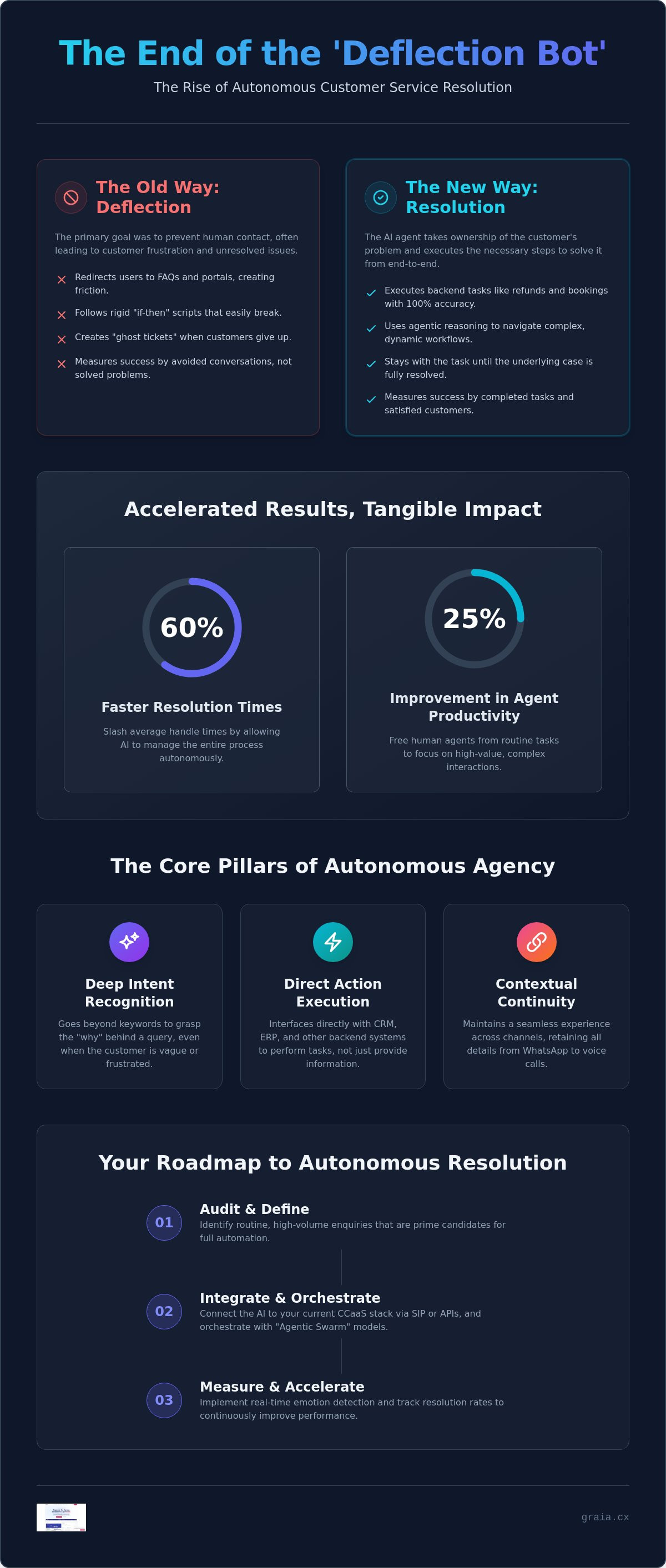
- Accelerate your results. Realise a 25% improvement in agent productivity and 60% faster resolution times through a unified agentic platform.
Defining Autonomous Customer Service Resolution: More Than Just a Better Chatbot
The distinction between a chatbot that talks and an agent that acts is the defining boundary of modern customer service. For years, enterprises settled for "deflection" as their primary success metric. They built barriers of rigid logic designed to keep customers away from human agents. This approach failed because it ignored the fundamental goal: the resolution of the problem. Autonomous customer service resolution represents a paradigm shift where AI doesn't just manage a conversation; it completes the underlying business process from start to finish.
We're witnessing the death of the deterministic "if-then" flow. In the 2026 landscape, customers expect 100% process accuracy, especially in high-stakes UK environments like fintech or insurance. Traditional bots rely on pre-written scripts that break the moment a query deviates from the path. Agentic reasoning, however, uses Large Language Models to navigate complex workflows dynamically. It understands the objective, evaluates the available tools, and executes the necessary steps without human intervention. This isn't just a better interface; it's a new layer of operational intelligence.
Deflection vs. Resolution: The Fundamental Shift
Standard bots are designed to redirect. They point users toward FAQ pages or self-service portals, effectively "deflecting" the cost of a human interaction. This often creates "ghost" tickets, where a customer gives up in frustration only to churn or complain on social media later. An ai customer service platform focuses on resolution instead. It solves the underlying case. Whether it's processing a £50 refund for a delayed delivery or rebooking a service during a rail strike, the agent stays with the task until it's finished.
The Core Pillars of Autonomous Agency
True agency rests on three technical and psychological pillars. First, intent recognition must go deeper than simple keywords. It must grasp the "why" behind a query, even when the customer is frustrated or vague. Second, action execution allows the system to interface directly with your CRM and ERP systems. It doesn't just tell the customer their order status; it updates the database and issues the tracking code. Finally, contextual continuity ensures the experience remains seamless across every touchpoint. If a user starts a query on WhatsApp and finishes it via a voice call, the system maintains autonomous customer service resolution by retaining every detail, preventing the repetitive cycles that erode trust.
The Architecture of Agency: How Conversational AI Resolves Cases
The transition from scripted interactions to autonomous customer service resolution requires more than just a model update. It demands a sophisticated orchestration of Large Language Models (LLMs), Retrieval-Augmented Generation (RAG), and Hybrid Flows. Static code is dead. We have entered the era of the dynamic orchestrator, where the technology stack doesn't just predict the next word in a sentence; it determines the next logical step in a business process. A 2026 study on customer service in the age of AI reveals that the most successful enterprises are those moving beyond simple text generation toward actual task execution.
Agency is defined by action. In 2026, AI must possess the "hands" to work within your existing ecosystem, connecting seamlessly to platforms like Salesforce, HubSpot, or Google Calendar. If a customer needs to reschedule a premium service appointment at a specific location, the AI shouldn't just offer sympathy. It should check real-time availability, update the CRM, and send a confirmation via the customer's preferred channel. This level of integration ensures that the digital agent acts as a true extension of your workforce. As you look to evolve your stack, exploring the latest insights on agentic intelligence can help you stay ahead of the competition.
Security remains the cornerstone of this architecture. For UK-based enterprises operating under strict regulatory frameworks, data sovereignty is a non-negotiable priority. Your proprietary customer data and internal process logic are your competitive advantages; they should never be used to train public models. The modern architecture of autonomous customer service resolution utilizes private, secure environments where intelligence is applied to your data without ever leaking into the public domain.
Agentic Swarms and Specialized Nodes
Monolithic bots are often too slow or too vague for complex enterprise needs. The solution is the "Agentic Swarm," a collection of specialized virtual experts that handle specific domains like billing, technical troubleshooting, or sales. These nodes hand off conversations while preserving full context, ensuring the customer never has to repeat themselves. Decision nodes provide structured routing, allowing the system to determine instantly whether a query requires a specialized technical agent or a high-empathy human intervention.
Hybrid Flows: Balancing LLM Naturalness with Rule-Based Logic
Process accuracy is vital in regulated environments. While LLMs provide conversational fluidity and human-like warmth, "Hybrid Flows" ensure that mission-critical processes follow your rigid business rules without deviation. Retrieval-Augmented Generation (RAG) grounds the AI in vetted, internal facts, preventing the "hallucinations" that plague consumer-grade tools. This balance allows for a natural dialogue that remains strictly within the bounds of your company policy and UK compliance standards.
Automation vs. Agency: Why Traditional CX Fails the Empathy Test
Efficiency without empathy is just high-speed alienation. Most traditional IVRs and rigid chatbots treat every enquiry as a data point to be processed rather than a human need to be met. This creates a profound "Empathy Gap" where the customer feels unheard and undervalued. When a system fails to recognise the mounting frustration in a caller's voice, it doesn't just lose a sale; it destroys a hard-won relationship. True agency requires the ability to sense and respond to the emotional state of the user in real time.
Modern emotion detection allows the system to adjust its pace, tone, and priority level based on the customer's sentiment. This is the psychological foundation of autonomous customer service resolution. By moving beyond simple keyword matching, AI can now identify the subtle nuances of urgency or disappointment that previously required a human ear. By embedding this emotional intelligence into the core of your strategy, your brand can finally move past the transactional coldness of early-generation automation.
We must also consider the impact on the human workforce. By delegating the repetitive "emotional labour" of routine enquiries to an intelligent agent, you significantly reduce the cognitive load on your human staff. Recent academic analysis of AI implementation in customer support demonstrates that when AI handles high-volume, low-complexity tasks, human agents are free to focus on high-stakes interactions that require genuine creativity and deep connection. This human-AI collaboration is the new gold standard for enterprise CX.
The High Cost of Friction-Filled Service
Repetitive interactions don't just waste time; they actively damage brand perception. When a customer has to repeat their £200 billing issue to three different departments, their loyalty evaporates. Poor automation is also a primary driver of agent attrition, as staff grow weary of managing the fallout from broken digital tools. AI empathy restores customer trust through faster, more accurate resolutions. By eliminating the friction of "dead-end" bots, you protect both your customer base and your internal talent.
Original Audio and Sentiment: Keeping the Human Element
Maintaining the human element doesn't mean forcing a human into every loop. It means preserving the authenticity of the interaction. Advanced platforms now allow for the retention of original voice tones even during live translation, ensuring that the customer's personality isn't lost in the digital ether. Whether the AI tone is professional, friendly, or concise, it remains configurable to align with your specific brand values. Detecting a spike in frustration triggers a seamless handoff, ensuring that autonomous customer service resolution always maintains a safety net of human expertise.
Implementing Autonomous Resolution: A Roadmap for Enterprise CX Leaders
Achieving autonomous customer service resolution is a strategic evolution, not a rip-and-replace project. We recognise the immense investment you've already made in your current infrastructure. The path forward involves a methodical four-phase roadmap designed to transition from human-heavy deflection to AI-driven resolution without disrupting your core operations. It's about building a bridge between your legacy reliability and the future of agentic intelligence.
Phase 1 begins with a forensic audit of your routine enquiries. You must identify high-volume resolution candidates, those repetitive tasks like address changes or order tracking that consume your agents' cognitive energy but require minimal creative empathy. Phase 2 focuses on technical synergy. Rather than migrating to an entirely new cloud ecosystem, you integrate agentic AI with your existing CCaaS platforms, such as Genesys, Avaya, or NICE CX, via SIP or robust APIs. Phase 3 introduces the necessary safeguards. Deploying "Prompt Shields" and toxicity guardrails ensures your AI remains professional, accurate, and aligned with your brand values. Finally, Phase 4 utilises high-fidelity simulators to stress-test every workflow before a single customer interacts with the live system.
Integrating with Legacy Infrastructure
Modernising a legacy contact centre shouldn't feel like an architectural crisis. You can add sophisticated agentic capabilities to Avaya or Genesys environments by leveraging SIP-enabled platforms that bridge the gap between old and new. This allows for the deployment of iframe widgets that provide real-time agent assist and live call translation directly within the existing workspace. It's about empowering your current setup rather than abandoning it. To see how these integrations function in real-world UK enterprise scenarios, explore our latest implementation guides.
Security, Compliance, and Guardrails
In the UK's stringent regulatory landscape, trust is built on a foundation of rigorous data protection. Implementing PII masking is essential to ensure that sensitive customer information, like credit card details or National Insurance numbers, never reaches the AI's processing layer. Prompt Shields act as a defensive perimeter, blocking malicious input and injection attacks that seek to compromise the system's integrity. For industries like banking or healthcare, maintaining audit-ready transcripts is a non-negotiable requirement for compliance. Every interaction must be documented with precision, providing a transparent record that ensures autonomous customer service resolution satisfies both internal stakeholders and external regulators.
The Graia Advantage: Engineering Empathy and Accuracy into Autonomous CX
GraiaCX’s Agentic CCaaS represents a fundamental departure from the fragmented tools of the past. It's the unified future of customer engagement. By integrating intelligence directly into the communication layer, we enable enterprises to transcend the limitations of traditional support models. Our partners see a 25% improvement in agent productivity and 60% faster resolution times. These aren't just marginal gains; they're transformative shifts in operational capacity. Our philosophy of "Growth through AI empathy" recognizes that ROI isn't just about cutting costs. It's about deepening the connection between your brand and your customers through precision and care.
The transition between AI and human remains the most sensitive touchpoint in the customer journey. We've engineered a seamless handoff process that ensures full context is preserved without a single second of repetition. When a complex case requires a human's unique perspective, the agent receives a comprehensive brief of the interaction so far. This eliminates the "start-again" frustration that plagues legacy systems. It's a sophisticated partnership where autonomous customer service resolution handles the heavy lifting, allowing your human talent to shine in high-stakes moments.
Action-Oriented AI for Global Brands
GraiaCX doesn't just talk; it executes. Our platform possesses the agency to perform tasks like processing refunds and scheduling deliveries natively within your existing workflows. For global brands, we provide multilingual support across more than 100 languages, bolstered by live voice translation that retains the speaker's original intent. We understand that industry-specific terminology is vital for accuracy. That's why we utilize custom vocabulary and phrase lists to ensure that your technical or regulated language is handled with absolute fidelity, maintaining 100% process accuracy across every border.
Transforming Your Contact Centre into a Value Hub
We're helping leaders move from cost-centre metrics to revenue-driving CX. When you automate routine customer inquiries without sacrificing quality, you turn every interaction into an opportunity for loyalty. Your contact centre is no longer a drain on resources; it becomes a hub of customer insight and satisfaction. We invite you to explore the next generation of autonomous customer service resolution and discover how agentic intelligence can protect your margins while elevating your brand. The evolution of service is here, and it's built on a foundation of technical superiority and deep human empathy.
The Mandate for Agentic Transformation
The boundary between a passive interface and an active partner has been crossed. You've seen how the shift from mere deflection to autonomous customer service resolution isn't just a technical upgrade; it's a fundamental restoration of the customer relationship. By moving beyond rigid scripts and embracing agentic swarms, your organisation can finally deliver on the promise of end-to-end execution. We've established that the future of CX lies in the intersection of deep human empathy and technical precision. This isn't a distant vision. It is the new standard of enterprise performance.
Graia stands ready to lead this evolution with a platform that delivers 60% faster resolution times and a 99.9% uptime guarantee. Security remains our priority, evidenced by our SOC2-aligned Azure OpenAI trust framework. You don't have to choose between speed and safety. It's time to transform your contact centre from a cost-driven necessity into a value-generating engine of growth. Explore the Graia Blog to see the future of Agentic CX. The path to superior engagement is open, and the results are within your reach.
Frequently Asked Questions
What is the difference between an AI chatbot and an autonomous customer service agent?
Chatbots are conversational interfaces; autonomous agents are functional executors. While a traditional bot might point a customer toward a refund policy or FAQ page, an autonomous agent possesses the agency to actually process the refund. It moves beyond simple text generation to complete the underlying business task by interacting directly with your backend systems. This shift from talk to action is the defining characteristic of modern agency.
Can autonomous AI agents actually process refunds or change bookings?
Yes, they can execute complex backend tasks with precision. By interfacing with your CRM or ERP via secure APIs, these agents can perform actions like issuing a £40 refund or rescheduling a delivery in Manchester without human oversight. They don't just simulate a conversation. They navigate the necessary technical workflows to ensure the customer’s request is fulfilled from start to finish.
How does agentic AI ensure it doesn’t make mistakes or "hallucinate"?
Process accuracy is engineered through Retrieval-Augmented Generation (RAG) and Hybrid Flows. RAG grounds the AI in your vetted, internal facts, while Hybrid Flows enforce your rigid business rules for sensitive tasks. This combination prevents the "hallucinations" common in consumer-grade tools. It ensures that every interaction remains within the bounds of your company policy and UK regulatory requirements.
What happens if the autonomous AI agent cannot resolve a customer’s issue?
A seamless human handoff occurs the moment the system detects a need for high-level empathy or complex problem-solving. The human agent receives a complete transcript and a concise summary of the interaction so far. This ensures the customer never has to repeat themselves. It maintains a sophisticated partnership where the AI handles routine tasks while the human focuses on high-stakes connection.
Is my customer data used to train the AI models?
No, your proprietary data remains entirely private and secure. In an enterprise-grade framework, data sovereignty is a non-negotiable priority. We utilise private environments where your information is used solely to serve your customers. Your data is never leaked into public models or used to train third-party systems, ensuring you remain fully compliant with UK data protection standards.
How long does it take to implement autonomous customer service resolution in an existing contact centre?
Implementation typically follows a structured four-phase roadmap that delivers results in weeks rather than months. We begin with a forensic audit of your routine enquiries to identify the best candidates for automation. Because the system integrates with your existing infrastructure, you can begin scaling your autonomous customer service resolution capabilities without the delays associated with a total platform overhaul.
Can autonomous service agents handle voice calls as well as chat?
Absolutely. An Agentic Omni-Channel Platform delivers autonomous customer service resolution across voice calls, web chat, and messaging apps like WhatsApp. The intelligence remains consistent regardless of the channel. Whether a customer calls to check an order status or sends an email about a billing error, the agent retains the context and the ability to act across every touchpoint.
Does autonomous resolution require a complete replacement of my current CCaaS platform?
No replacement is necessary. Our technology is designed to integrate with legacy systems like Avaya, Genesys, or NICE CX via SIP or robust APIs. This allows you to modernise your legacy contact centre and add agentic capabilities without a "rip-and-replace" approach. You protect your existing investments while simultaneously elevating your service capacity to meet 2026 standards.