
How to Deploy Agentic RAG for Customer Service Automation: A 2026 Strategy
If 88% of AI agents fail to reach production, then the legacy approach to customer service automation isn't just flawed; it's broken. You've likely felt the frustration of a chatbot that hallucinates or hits a wall when a customer asks for a simple refund. It's exhausting to watch your human teams spend their day on routine tickets that should have been resolved by a machine hours ago. Understanding how to deploy agentic rag for customer service automation is the only way to escape this cycle of disconnected silos and high escalation costs. We're moving beyond simple search toward a 2026 reality where autonomous agents use Agentic RAG to verify facts and execute backend tasks with 100% accuracy.
You're about to master the transition from reactive bots to proactive, autonomous agents that resolve complex inquiries while grounding every interaction in verified enterprise data. We'll show you how to build a system that doesn't just "know" the answer but possesses the agency to act on it. This guide provides a methodical breakdown of the multi-agent orchestration and hybrid-flow frameworks required to achieve higher First Contact Resolution and lower Average Handle Time. Let's bridge the gap between your legacy CCaaS and a truly intelligent, empathetic service ecosystem.
Key Takeaways
- Transition from passive, search-based bots to autonomous agents that plan, use tools, and access real-time knowledge to resolve complex customer issues.
- Build a sophisticated "Brain and Memory" architecture by pairing LLM reasoning engines with high-performance vector databases for precise semantic search.
- Protect your brand from AI hallucinations by adopting Hybrid Flows that combine natural language flexibility with deterministic, rule-based process logic.
- Learn how to deploy agentic rag for customer service automation through a structured roadmap that unifies data silos and prioritises process accuracy.
- Integrate agentic intelligence into your existing CCaaS stack using SIP and iFrames, eliminating the need for a costly and disruptive system overhaul.
What is Agentic RAG for Customer Service?
Most customer-facing bots are little more than glorified search engines. They find an answer, summarise it, and leave the customer to do the actual work. This is the limitation of traditional Retrieval-augmented generation (RAG). While it solved the problem of static knowledge, it failed to bridge the gap between knowing and doing. Agentic RAG is the evolution of this technology; it combines a Large Language Model (LLM) execution engine with the sophisticated ability to plan, use enterprise tools, and access live external knowledge bases. It doesn't just answer a query about a return policy; it initiates the return process itself.
Agentic RAG is the synergy of factual grounding and autonomous action execution. Mastering how to deploy agentic rag for customer service automation requires a shift in perspective. You aren't just building a repository of answers. You are engineering a digital workforce that interprets intent, verifies facts, and resolves issues without human intervention. By 2026, the global agentic AI market is projected to reach £5.8 billion (approx. $7.6 billion), driven by this very need for systems that move beyond passive conversation toward active resolution.
Vanilla RAG vs. Agentic RAG: The Critical Difference
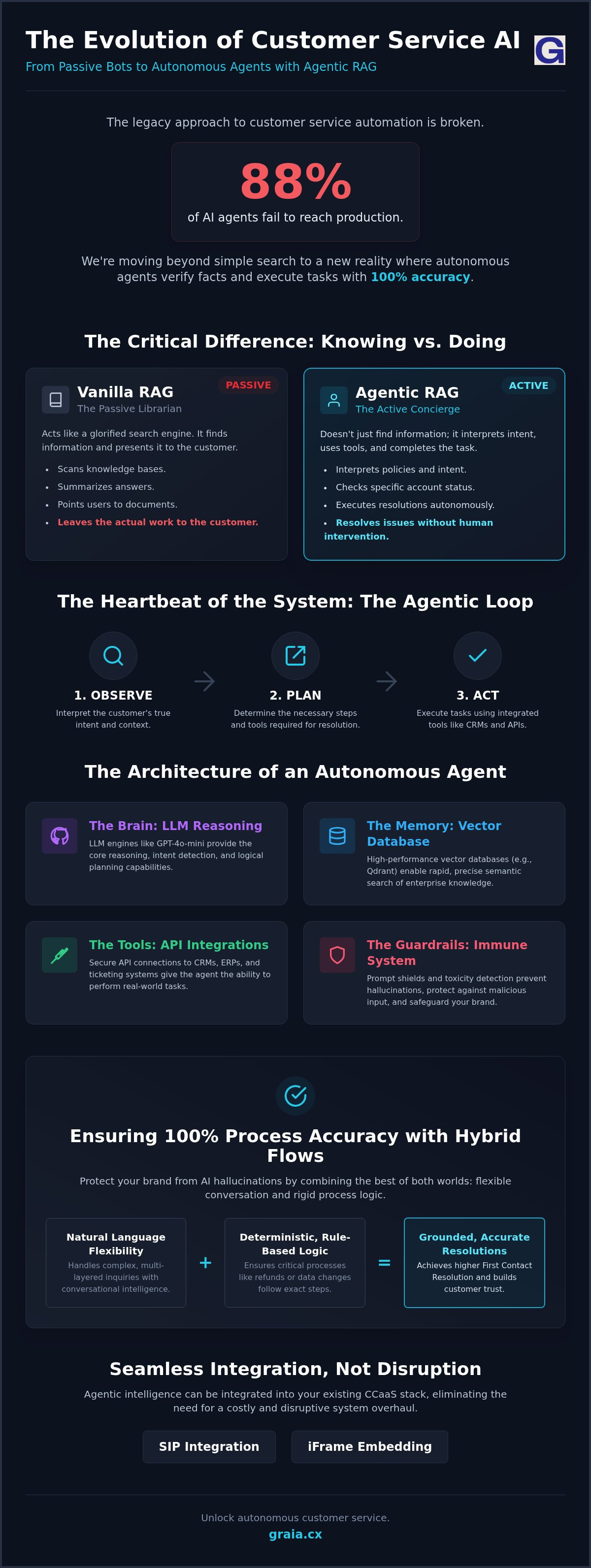
The distinction between these two architectures is the difference between a librarian and a concierge. Vanilla RAG acts as the librarian; it scans your knowledge base and points the customer toward the right document. It's helpful, but it's passive. Agentic RAG is the active concierge. It doesn't just find the information; it interprets the policy, checks the customer's specific account status, and executes the resolution. The "Agentic Loop" is the heartbeat of this system. It follows a relentless cycle: Observe the customer's intent, Plan the necessary steps, and Act using integrated tools. This loop ensures that the AI isn't just talking; it's performing.
The Role of Grounding in AI Empathy
True empathy in customer service isn't about flowery language; it's about accuracy and efficiency. When a bot provides a wrong answer, it breaks the bond of trust. Grounding your AI in 100% verified facts is the only way to maintain a high-quality interpersonal experience. By using real-time context to drive autonomous customer service resolution, you ensure the AI remains helpful without losing the human touch. We are moving away from rigid, scripted menus toward true conversational intelligence. This shift allows the agent to handle complex, multi-layered inquiries with a level of precision that was previously reserved for your most experienced human staff. When you understand how to deploy agentic rag for customer service automation, you turn your support centre into a stable, reassuring presence for every customer.
The Architecture of an Agentic RAG System
Building a system that actually resolves issues requires a sophisticated stack of integrated technologies. It is not enough to simply connect an LLM to a PDF. To understand how to deploy agentic rag for customer service automation, you must view the architecture as a living organism. The "Brain" consists of reasoning models like GPT-4o-mini, which excel at intent detection and logical planning. This brain is supported by a "Memory" layer, typically a high-performance vector database like Qdrant, which allows for rapid semantic retrieval of enterprise knowledge. However, knowledge without action is useless. The "Tools" layer consists of secure API integrations that connect your agent to CRMs, ERPs, and ticketing systems, giving the AI the hands it needs to perform tasks. Finally, "Guardrails" act as the immune system, using prompt shields and toxicity detection to prevent hallucinations and protect your brand from malicious inputs.
Hybrid Search: Combining Vector and Lexical Matching
Semantic vector search is brilliant at understanding intent, but it often lacks the surgical precision required for specific SKU numbers or unique UK industry terminology. This is why a hybrid approach is non-negotiable. By pairing vector search with BM25 lexical matching, you ensure the agent finds the exact technical document needed while still grasping the customer's emotional context. This dual-path retrieval is the foundation of a scalable customer support AI. It ensures that your data indexing remains efficient even as your knowledge base grows into millions of data points.
Agentic Swarms and Multi-Agent Orchestration
The days of the monolithic, "do-it-all" chatbot are over. Modern enterprises are adopting "Agentic Swarms," where a collection of specialised virtual experts work in tandem. Imagine a scenario where a customer asks about a late delivery and a billing discrepancy in the same breath. In a swarm architecture, an Orchestrator Agent identifies these distinct intents and routes them to a specialized Logistics Agent and a Billing Agent. These agents communicate behind the scenes to resolve the query. Because they share a unified memory, session continuity is preserved. The customer experiences a single, fluid conversation, which is a proven way to improve customer experience without increasing human workload. If you are looking to refine your technical roadmap, you can find more expert resources on agentic orchestration in our latest industry deep dives.
Ensuring 100% Process Accuracy with Hybrid Flows
Trust is the currency of the enterprise. While generative models offer unprecedented conversational fluidity, they lack the innate boundaries required for mission-critical financial or legal transactions. This is the "Black Box" problem. Enterprises often fear that an unconstrained LLM might issue an unauthorised refund or deviate from strict regulatory scripts. To solve this, how to deploy agentic rag for customer service automation effectively requires the implementation of Hybrid Flows. This architecture represents the marriage of LLM natural language and deterministic rule-based logic. It allows the AI to converse freely while "locking" specific high-stakes processes into a rigid framework that cannot be circumvented by the model's creative reasoning.
By defining these boundaries, you ensure that the AI acts as a disciplined representative of your brand. For instance, when an agent identifies a refund request, it can retrieve the relevant policy via RAG but must hand off the actual execution to a hard-coded logic gate. This gate verifies the customer's eligibility against your ERP data before any money moves. Hybrid Flows provide the granular audit trail necessary for UK regulated industries by logging every decision node transition alongside the LLM's conversational output. This technical rigour is a cornerstone of a modern AI-Powered Customer Service Automation Architecture, ensuring that every autonomous action is both compliant and transparent.
Deterministic Routing and Decision Nodes
Precision requires more than just good prompts. Using "Decision Nodes" allows you to route inquiries based on real-time sentiment or the urgency of the request. If the system detects a high level of frustration, it can immediately bypass the autonomous loop and escalate to a human specialist. We use Regex validation for data collection, such as UK account numbers or postcodes, to ensure that the inputs entering your backend systems are clean and formatted correctly. This balances the flexibility of a natural conversation with the absolute rigidity required for backend execution. It turns the AI from a simple talker into a reliable doer.
PII Masking and Data Sovereignty
Security is not an afterthought; it is the foundation. When you consider how to deploy agentic rag for customer service automation, you must prioritise the protection of sensitive customer data. Our framework utilizes automated PII masking to ensure that names, addresses, and financial details are redacted before they ever reach an external model for processing. By leveraging the Azure OpenAI Trust Framework, we guarantee that your proprietary data is never used for training third-party models. This ensures total compliance with GDPR and Ofcom regulations, maintaining data sovereignty while still benefiting from the world's most advanced reasoning engines. You can innovate with confidence, knowing your customers' privacy is protected by an invisible, impenetrable shield.
5 Steps to Deploy Agentic RAG in Your Contact Center
Deployment isn't a "big bang" event. It's a structured journey toward ai customer service platform maturity. Rushing into production without a clear roadmap is why 88% of AI projects fail to reach a live environment. To avoid this, you must adopt a methodical approach that prioritises stability and factual grounding. Mastering how to deploy agentic rag for customer service automation requires moving from fragmented experimentation to a unified, production-ready ecosystem that respects both your company policy and the customer's time.
- Step 1: Audit Knowledge Sources. Unify fragmented data silos and clean your existing documentation to ensure the agent has a "single source of truth."
- Step 2: Map Actionable Integrations. Identify the specific CRM, ERP, and billing systems the agent must access to move from "talking" to "doing."
- Step 3: Design Hybrid Flows. Build deterministic logic gates for your top 20% most frequent inquiries to ensure the AI never deviates from established business rules.
- Step 4: Stress-Test the System. Use "Bot-to-Bot" simulators to throw edge cases at your agent and identify potential failure points before customers do.
- Step 5: Implement Human-in-the-Loop. Establish a seamless fallback mechanism where the AI provides a full context summary to a human agent for complex escalations.
Knowledge Extraction and Grounding
Success begins with the quality of your data. We automate knowledge extraction from your existing PDFs, help centre articles, and internal wikis to build a robust retrieval layer. By setting up a sophisticated grounding layer, you eliminate hallucinations and ensure the agent only speaks from verified facts. This allows you to automate routine customer inquiries by precisely mapping customer intent to specific, high-confidence knowledge base articles. It turns your static documents into a dynamic, conversational resource.
Simulation and Quality Management
You cannot manage what you cannot measure. Simulator tools are essential for testing thousands of permutations of a conversation before a single customer interacts with the bot. We use AI "Judges" to score these simulated interactions on brand voice, empathy, and policy compliance. This process identifies "weak confidence" responses, allowing your team to perform manual prompt optimisation where it matters most. It's about creating a protective shield around your customer experience. If you're ready to refine your technical roadmap, you can optimise your agentic deployment strategy by exploring our latest technical deep dives.
Following these steps ensures that when you finalise how to deploy agentic rag for customer service automation, you aren't just launching a tool; you're deploying a reliable, autonomous workforce.
Integrating Agentic AI with Existing CCaaS Architecture
The belief that you must scrap your entire legacy contact centre infrastructure to embrace AI is a costly myth. Modern enterprise evolution does not require a "rip-and-replace" strategy; instead, it demands a sophisticated layering of intelligence. Understanding how to deploy agentic rag for customer service automation means learning how to integrate autonomous capabilities directly into the tools your team already uses. By leveraging SIP for voice and iFrames for the agent desktop, GraiaCX allows you to drop agentic intelligence into legacy environments without disrupting established workflows. This approach ensures that your investment in platforms like Genesys, NICE CXone, or Avaya remains protected while your capabilities move into the future.
Agentic RAG does more than just power customer-facing bots. It serves as the backbone for Agent Assist, supporting human staff in real-time. When a complex call reaches a human, the system uses the same retrieval-augmented logic to provide immediate suggestions and factual grounding. This reduces the cognitive load on your team. It turns every agent into an expert by placing the entirety of your corporate knowledge at their fingertips. This integrated approach acts as the bridge between legacy CCaaS and an agentic future, ensuring a stable transition rather than a disruptive overhaul.
Seamless Human Handoff with Context
The transition from AI to human should be invisible to the customer. When a Conversational Agent identifies an inquiry that requires high-level empathy or complex problem-solving, it passes the torch along with a full context summary. This allows your live agents to catch up in seconds, eliminating the need for the customer to repeat their story. We maintain the "Empathy Gap" by letting AI handle the repetitive, data-heavy routine while humans handle the complex. For global support teams, Live Call Translation acts as a vital bridge, allowing a UK-based agent to support a customer in their native tongue without the friction of a traditional interpreter.
Measuring ROI and Operational Impact
Success in 2026 is measured by the tangible elevation of human potential and the bottom line. Key performance indicators have shifted from simple deflection to nuanced metrics like autonomous Resolution Rate, AHT reduction, and CSAT uplift. By deploying multilingual agentic support, you can drastically reduce the high costs associated with bilingual staffing, which often commands a premium in the UK market. You are no longer just managing a cost centre; you are orchestrating a high-performance intelligence ecosystem. Ready to evolve? Explore the GraiaCX Agentic CCaaS platform today and redefine what your contact centre can achieve.
Orchestrating Your Agentic Future
The era of the static chatbot has ended. You now possess the strategic blueprint to move beyond simple FAQ deflection toward a reality where AI doesn't just talk; it acts. By mastering how to deploy agentic rag for customer service automation, you've discovered how to bridge the gap between fragmented enterprise knowledge and autonomous task execution. This journey requires a sophisticated blend of hybrid flows for total process accuracy and a swarm architecture that ensures every customer inquiry is handled by a virtual specialist. It is no longer about simply answering questions; it is about resolving issues with surgical precision.
The results of this technological evolution are transformative. Early adopters of the GraiaCX ecosystem are already achieving 60% faster resolution times and a 25% improvement in agent productivity. By grounding your intelligence in a SOC2-aligned Azure OpenAI security framework, you protect your brand integrity while elevating the potential of your human workforce. It's time to stop managing systemic frustrations and start orchestrating a superior service experience. Transform your contact center with GraiaCX's Agentic AI solutions today. The future of customer connection is autonomous, empathetic, and ready for you to lead.
Frequently Asked Questions
What is the difference between standard RAG and Agentic RAG?
Standard RAG is a passive retrieval system that finds information to answer questions. Agentic RAG is an active execution engine that uses that information to plan and perform tasks. It moves beyond simple "search and summarise" by integrating a reasoning layer that allows the agent to use external tools autonomously to solve problems.
How does Agentic RAG prevent AI hallucinations in customer service?
Hallucinations are prevented by grounding the LLM in 100% verified enterprise data and using Hybrid Flows to enforce business rules. The agent doesn't guess; it verifies the retrieved data against your specific policies before responding. This factual rigour is central to how to deploy agentic rag for customer service automation with total brand safety.
Can Agentic RAG actually process refunds or change bookings?
Yes, the agent uses "Tools" to execute backend tasks like issuing refunds or modifying bookings within your ERP or CRM. It doesn't just tell the customer how to do it; it performs the action itself after verifying eligibility through retrieved policy data. This turns the conversation into a complete resolution rather than just a support ticket.
Do I need to replace my existing CCaaS platform like Genesys to use this?
No system overhaul is required. You can drop agentic intelligence into legacy environments like Genesys, NICE CXone, or Avaya using SIP and iFrames. This allows you to evolve your capabilities and improve agent productivity without the risk or expense of a "rip-and-replace" project.
How do you ensure AI agents follow company compliance and business rules?
Compliance is enforced through Hybrid Flows that marry natural language fluidity with deterministic logic. High-stakes processes are locked into rule-based gates, ensuring the AI never deviates from Ofcom or GDPR requirements. This provides a clear audit trail that is essential for regulated UK industries.
Is my customer data used to train public AI models like ChatGPT?
Your data remains entirely private and secure. By leveraging the Azure OpenAI Trust Framework and automated PII masking, we ensure that sensitive customer data is redacted and never used to train public models. You maintain total data sovereignty while benefiting from the world's most advanced reasoning engines.
What happens if the AI agent cannot find the answer in the knowledge base?
If the knowledge base lacks a definitive answer, the agent initiates a seamless human handoff. It provides the live agent with a full context summary and a list of attempted steps, ensuring the customer never has to repeat themselves. This maintains the "Empathy Gap" by letting humans handle the most complex inquiries.
How long does it typically take to deploy an Agentic RAG solution?
Deployment is a structured progression rather than a single event. While the timeline varies based on your data maturity and integration complexity, most enterprises see high-impact "actionable" workflows live within a few months. Understanding how to deploy agentic rag for customer service automation involves a phased roadmap that prioritises your most frequent inquiries first.