
Scalable Customer Support AI: The 2026 Enterprise Architecture Guide
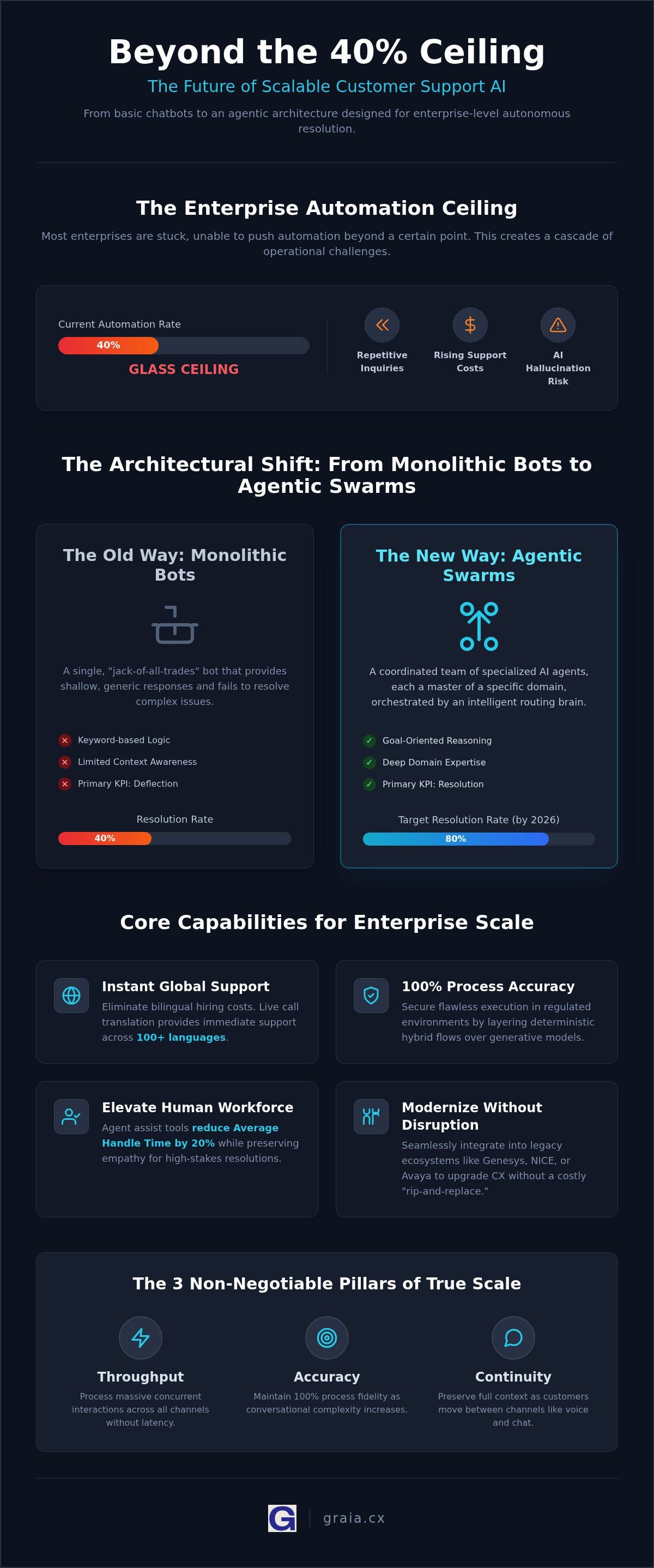
Most enterprises are hitting a glass ceiling where automation rates stall at 40 percent, leaving human agents buried under the weight of repetitive, high-volume inquiries. You've likely felt the tension of rising costs for bilingual support and the persistent fear of technical hallucinations in regulated environments. It's time to move beyond these limitations. Implementing a truly scalable customer support ai requires more than just incremental updates. It demands a sophisticated shift toward an agentic architecture that balances high-stakes enterprise authority with deep human empathy.
We believe that scale should never come at the cost of accuracy or connection. With 80 percent of routine interactions projected to be fully handled by AI by the end of 2026, the question is no longer if you should automate, but how to do so while protecting your customer relationships. This guide reveals how to move beyond basic chatbots to an agentic framework that scales to millions of interactions without sacrificing precision. We will explore the path to achieving 80 percent autonomous resolution and reducing your Average Handle Time by 20 percent through unified omnichannel management and hybrid intelligence flows.
Key Takeaways
- Break through the 40 percent automation ceiling by deploying an agentic swarm architecture designed to handle millions of interactions with specialized precision.
- Eliminate the burden of bilingual hiring costs by utilizing live call translation to scale your global support presence instantly across 100+ languages.
- Secure 100 percent process accuracy in regulated environments by layering deterministic hybrid flows over generative models for flawless billing and refund management.
- Seamlessly integrate scalable customer support ai into your legacy Genesys, NICE, or Avaya ecosystems to modernize your CX without a disruptive rip-and-replace.
- Elevate your human workforce with agent assist tools that reduce handle times by 20 percent while preserving the empathy required for high-stakes resolutions.
The Architecture of Scale: Why Traditional Chatbots Fail at Enterprise Volume
True scalable customer support ai isn't measured by how many FAQs a bot can answer. It's defined by an architecture's ability to handle over one million monthly interactions while maintaining absolute precision. Most enterprises currently face an "automation ceiling" where LLM-only solutions fail at complex reasoning, leaving teams stuck at a 40 percent resolution rate. Legacy IVR systems relied on brittle decision-tree logic that forced customers into frustrating loops. In contrast, modern agentic CCaaS platforms operate on fluid, goal-oriented reasoning that adapts to the user's unique needs in real-time.
Scaling in 2026 rests on three non-negotiable pillars:
- Throughput: The capacity to process massive concurrent interaction spikes across every channel without latency.
- Accuracy: Maintaining 100 percent process fidelity even as conversation complexity increases.
- Omnichannel Continuity: Preserving full context as a customer moves from a voice call to a chat window.
The Production Gap: Why Pilots Fail to Scale
Many organizations find that a successful pilot doesn't guarantee enterprise-wide success. Hallucination drift often remains hidden during small-scale testing, only to emerge as a systemic risk when the model processes massive datasets and diverse customer inputs. Integration bottlenecks also become apparent in high-traffic environments, where legacy back-ends struggle to feed data to the AI at the required speed. Throughput collapse occurs when API latency spikes under heavy concurrent loads, causing the AI to time out and abandon the customer mid-resolution. This failure not only destroys the customer experience but also forces a sudden, expensive surge of traffic back to human agents.
Moving from Chatbots to Agentic Intelligence
The industry is rapidly pivoting toward autonomous customer service resolution. Unlike traditional chatbots that rely on keyword matching, sophisticated agentic AI systems perceive intent and emotional nuance. They don't just talk; they act. These systems can navigate internal databases, update records, and execute multi-step workflows across disparate software silos. This shift fundamentally changes the primary KPI from "deflection" to "resolution." We are no longer trying to keep customers away from human agents. We are empowering scalable customer support ai to solve their problems entirely, freeing your human team to handle the rare, high-empathy cases that require a personal touch.
Agentic Swarms vs. Monolithic Bots: Orchestrating Millions of Interactions
Monolithic bots are inherently limited. They attempt to be everything to everyone, yet they often end up providing shallow, generic responses that fail to resolve complex issues. For enterprises managing millions of interactions, this jack-of-all-trades approach is a liability. True scalable customer support ai utilizes an Agentic Swarm architecture. This multi-agent system replaces the single, heavy bot with a coordinated team of specialized agents. Each agent acts as a master of a specific domain, ensuring that every customer interaction is handled with the depth of a human expert.
Orchestrating this swarm requires an Intelligent Routing Brain. This central logic layer evaluates every incoming request for intent, emotional state, and technical requirement. It doesn't just route; it matches. By directing a billing inquiry to a Billing Agent and a complex setup issue to a Tech Agent, the system preserves context with surgical precision. Session continuity remains unbroken across voice, email, and social messaging. Your customers don't have to repeat themselves, and your scalable customer support ai maintains a single, unified narrative across the entire customer journey.
The Virtual Expert Model
Assigning specialized agents to distinct business domains allows for deeper mastery and 100 percent process accuracy. A multi-agent ecosystem enables large-scale enterprises to automate intricate workflows that were previously impossible. This architecture performs the heavy lifting of data retrieval and intent verification. It significantly reduces the cognitive load for human agents through AI-led pre-processing. When a human eventually steps in, they aren't starting from scratch. They are stepping into a warm, fully-contextualized conversation. This model is a primary driver behind achieving 60 percent faster resolution times for high-volume support centers.
Contextual Retrieval with Hybrid RAG
Accuracy is the cornerstone of trust in an enterprise-grade AI architecture. We achieve this through Retrieval-Augmented Generation (RAG). Unlike standard models that may hallucinate under pressure, this approach grounds every response in your vetted, brand-approved documentation. It utilizes a hybrid of vector search for semantic understanding and lexical matching for exact terminology. This ensures the AI remains factually anchored and compliant even during massive traffic spikes. To see how these architectures transform modern operations, explore our latest insights on the evolution of agentic platforms.
Solving the Multilingual Scale Problem Without Bilingual Hiring
Global expansion often carries a hidden tax. Enterprises typically pay a 25 to 50 percent wage premium to recruit and retain bilingual agents; this financial burden creates rigid "language silos" where customers in specific regions suffer through extended wait times. True scalable customer support ai eliminates this friction by decoupling language proficiency from technical expertise. By deploying live call translation software, you empower your most experienced agents to serve any customer, anywhere, regardless of the tongue they speak.
This approach moves beyond simple text-based chat. It addresses the voice channel, which remains the preferred medium for complex or high-stakes resolutions. When integrating AI into enterprise workflows, the focus must remain on augmenting human capability. The "Original Audio" feature is a cornerstone of this philosophy. It allows the agent to hear the customer's raw tone and emotional subtext while receiving a real-time translated transcription. This ensures that empathy isn't lost in translation, even when the participants speak different languages.
Real-Time Voice Translation for 100+ Languages
In 2026, the technical standard for voice translation requires sub-100ms latency to maintain a natural conversational flow. It's not enough to just translate words; the system must respect cultural nuances. Formality tuning is essential for languages like German or Japanese, where the distinction between formal and informal address defines brand consistency. By utilizing custom vocabulary phrase lists, the AI accurately handles industry-specific terminology, ensuring that complex medical or financial jargon is never misinterpreted during a live call.
The Financial Impact of Language Globalisation
The ROI of AI-driven translation is immediate and profound. Replacing aggressive bilingual recruitment with a unified scalable customer support ai framework slashes overhead costs while expanding your reach. You don't just save on wages; you reduce Average Handle Time (AHT) through real-time transcriptions that eliminate the "pardon me?" moments caused by language barriers. This allows you to scale global support 24/7 without the geographic staffing constraints that previously dictated your service hours. You can finally offer premium, localized support to every market simultaneously.
Hybrid Flows: Ensuring 100% Process Accuracy in Regulated Environments
Creativity is a virtue in marketing, but it is a liability in compliance. When managing millions of interactions, a scalable customer support ai must be more than just articulate; it must be disciplined. Purely generative models often struggle with the rigid boundaries required for billing, refunds, or medical advice. Hybrid flows solve this by anchoring the flexibility of Large Language Models (LLMs) within a framework of rule-based, deterministic logic. This ensures that while the AI remains conversational, it never deviates from your established business protocols or regulatory requirements.
Deterministic paths are non-negotiable for high-stakes processes. You cannot risk a model "negotiating" a refund amount or misinterpreting a contract clause. To prevent these errors, we utilize Prompt Shields and sophisticated guardrails that filter malicious inputs and preemptively block hallucinations. Data sovereignty also remains a top priority in this architecture. By utilizing privacy-first AI models that keep sensitive information within your secure perimeter, you meet the stringent requirements of the EU AI Act and CCPA without sacrificing performance.
Grounding AI in Business Rules
The secret to successful automation lies in control. You can automate routine customer inquiries with absolute confidence by using "Step-by-Step" nodes for complex task execution. These nodes act as hard stops, requiring the AI to verify specific data points before moving to the next phase of a transaction. This prevents the system from circumventing mission-critical compliance rules, ensuring 100 percent process fidelity regardless of interaction volume. If you are ready to see this level of precision in action, check out our latest resources on implementing secure AI architectures.
Action-Oriented AI: Beyond Conversation
The next evolution of scalable customer support ai moves beyond the interface and into the infrastructure. It is no longer enough for AI to simply talk; it must do. By integrating directly with your CRM, ERP, and RPA systems, agentic models execute end-to-end resolutions autonomously. Whether it is processing a complex transaction, updating a flight booking, or reconciling a ledger, the AI handles the backend labor. This transition from "conversational" to "action-oriented" turns your support center into a high-efficiency engine that delivers results, not just responses.
The Future of Scalable CX: Integrating Agentic AI into Legacy Ecosystems
Modernizing an enterprise contact center doesn't require destroying what already works. Many leaders fear a "rip-and-replace" cycle when adopting scalable customer support ai, but the reality is more elegant. You can layer agentic intelligence directly onto existing Genesys, NICE, or Avaya ecosystems through native SIP integrations or secure iframes. This allows you to modernize your infrastructure without the catastrophic downtime of a total overhaul. No-code setups further accelerate this transformation, enabling your team to deploy sophisticated workflows in days rather than months. Legacy systems are foundations, not anchors. We view your existing infrastructure as the starting point for a total CX transformation.
The roadmap for 2026 marks a fundamental shift from reactive support to proactive experience hubs. Instead of waiting for a customer to report a failure, your scalable customer support ai identifies friction points in real-time and intervenes before a ticket is even created. Bridging this gap requires ai agent assist tools that empower your workforce to handle the transition. These tools act as a cognitive exoskeleton, providing agents with the data and suggestions they need to resolve high-complexity issues with unprecedented speed.
Seamless Human-AI Collaboration
True scale is achieved through a "Human-in-the-loop" model where AI handles the volume and humans handle the nuance. When an agentic system encounters a scenario outside its deterministic guardrails, it doesn't just drop the call. It generates a structured summary for a live agent, highlighting the customer's intent and emotional state. Features like "Email Draft Mode" further scale high-quality written support by allowing AI to craft 90 percent of a response, leaving only the final empathetic polish to the human expert. This synergy ensures that your brand voice remains consistent even during massive traffic spikes.
Measuring Success in the Agentic Era
Legacy metrics like First Contact Resolution (FCR) are becoming secondary to the "Autonomous Resolution Rate." This new KPI measures the percentage of interactions solved entirely by the AI without human intervention. Shifting your focus to this metric reveals the true impact of agentic orchestration on your bottom line. Beyond the numbers, this technology significantly reduces agent attrition and stress by removing the "digital assembly line" of repetitive tasks. Your team is finally free to do what they do best: build genuine connections with your customers. To begin your journey toward this future, explore the evolution of the AI customer service platform and discover how to lead your organization into the next era of enterprise CX.
Leading the Agentic Revolution in Enterprise CX
The transition from basic deflection to autonomous resolution is no longer a distant goal; it is the current standard for industry leaders. You now understand how an agentic swarm architecture breaks the 40 percent automation ceiling, while hybrid flows ensure every transaction remains grounded in absolute process accuracy. By embracing real-time translation and seamless legacy integration, you transform your support center into a proactive growth engine. Implementing a scalable customer support ai is the definitive step toward future-proofing your operations against rising volumes and complex global demands.
We provide the stability your enterprise requires through SOC2-aligned security standards and a 99.9% uptime guarantee. Trusted by enterprise contact centres globally, our platform is designed to elevate human potential while maintaining technical superiority. Book a demo of the GraiaCX Agentic CCaaS Platform to witness how sophisticated intelligence redefines your customer experience. The era of the frustrated customer is over. Your journey toward effortless, high-stakes resolution begins today.
Frequently Asked Questions
What makes customer support AI "scalable" compared to a standard chatbot?
Scalability is defined by an architecture's ability to maintain precision and empathy while handling millions of monthly interactions. Standard chatbots often rely on rigid decision trees that collapse under the weight of complex, high-volume inquiries. A truly scalable customer support ai utilizes agentic reasoning to adapt to traffic spikes without increasing human overhead. It ensures that performance remains consistent regardless of whether you're processing ten or ten thousand concurrent sessions.
Can scalable AI handle complex technical support or billing queries?
Yes, it can resolve intricate technical and financial issues by utilizing deterministic hybrid flows. Unlike generic models that might speculate or hallucinate, our architecture grounds the AI in your specific business rules and backend systems. This ensures that a billing query results in an accurate transaction update rather than a vague suggestion. The system executes multi-step tasks across your CRM and ERP with 100 percent process accuracy.
How does an agentic swarm architecture improve contact centre efficiency?
An agentic swarm architecture replaces the monolithic bot with a coordinated team of specialized virtual experts. Each agent focuses on a specific domain, such as technical troubleshooting or sales, which leads to 60 percent faster resolution times. This specialization ensures that the Intelligent Routing Brain always matches the customer with the most capable agent. It eliminates the friction of internal transfers and significantly reduces the cognitive load on your human workforce.
Is it possible to scale support across multiple languages without hiring more staff?
Absolutely, we enable global scaling through live call translation for over 100 languages. This technology allows your existing agents to communicate fluently with customers worldwide in real-time. It removes the need for expensive bilingual recruitment and effectively eliminates language-based queues. You can finally offer high-quality, localized support 24/7 without expanding your geographic footprint or increasing your headcount.
How does GraiaCX ensure 100% process accuracy in regulated industries?
We achieve absolute fidelity by layering generative flexibility over deterministic hybrid flows. In regulated environments, the AI is restricted to pre-approved logic paths for sensitive actions like refunds or data updates. This prevents hallucinations and ensures that every interaction complies with industry standards. Our SOC2-aligned security and PII masking protocols further protect sensitive data, making the platform safe for the most demanding sectors.
Will integrating scalable AI require us to replace our existing CCaaS platform?
No, you don't need to engage in a costly rip-and-replace project. Our scalable customer support ai integrates seamlessly with legacy systems like Genesys, NICE, and Avaya through native SIP and secure iframes. This allows you to modernize your customer experience while leveraging your current infrastructure investments. You gain the power of agentic intelligence without the operational risk of a total platform migration.
How do you prevent AI hallucinations in high-volume enterprise environments?
Hallucinations are prevented through a combination of Hybrid RAG and sophisticated prompt shields. The AI is grounded in your vetted, brand-approved documentation; this ensures it only provides factual information. We use lexical matching and vector search to verify every response against your unique source of truth. This multi-layered approach ensures that accuracy remains constant even during massive surges in interaction volume.
What are the primary security guardrails for enterprise-grade customer support AI?
Security is built into the core architecture through data sovereignty, PII masking, and strict compliance alignment. We adhere to the EU AI Act and CCPA requirements to ensure that customer privacy is never compromised. Guardrails also include real-time monitoring to block malicious inputs and prevent the AI from circumventing mission-critical safety protocols. Our platform provides a stable, protective environment that handles high-stakes data with total integrity.