Reducing Contact Center Handle Time with AI: The 2026 Agentic Strategy
The era of "talking faster" to hit performance targets is officially over. In 2026, forcing agents to race against the clock only fuels the burnout and turnover that cripple enterprise growth. You've likely felt the frustration of stagnant metrics despite investing in traditional automation. To truly reduce contact center handle time ai must move beyond simple deflection and toward active, intelligent execution. We recognize the immense pressure of managing high bilingual staffing premiums and the exhaustion of long after-call work cycles that keep your best people tethered to their screens.
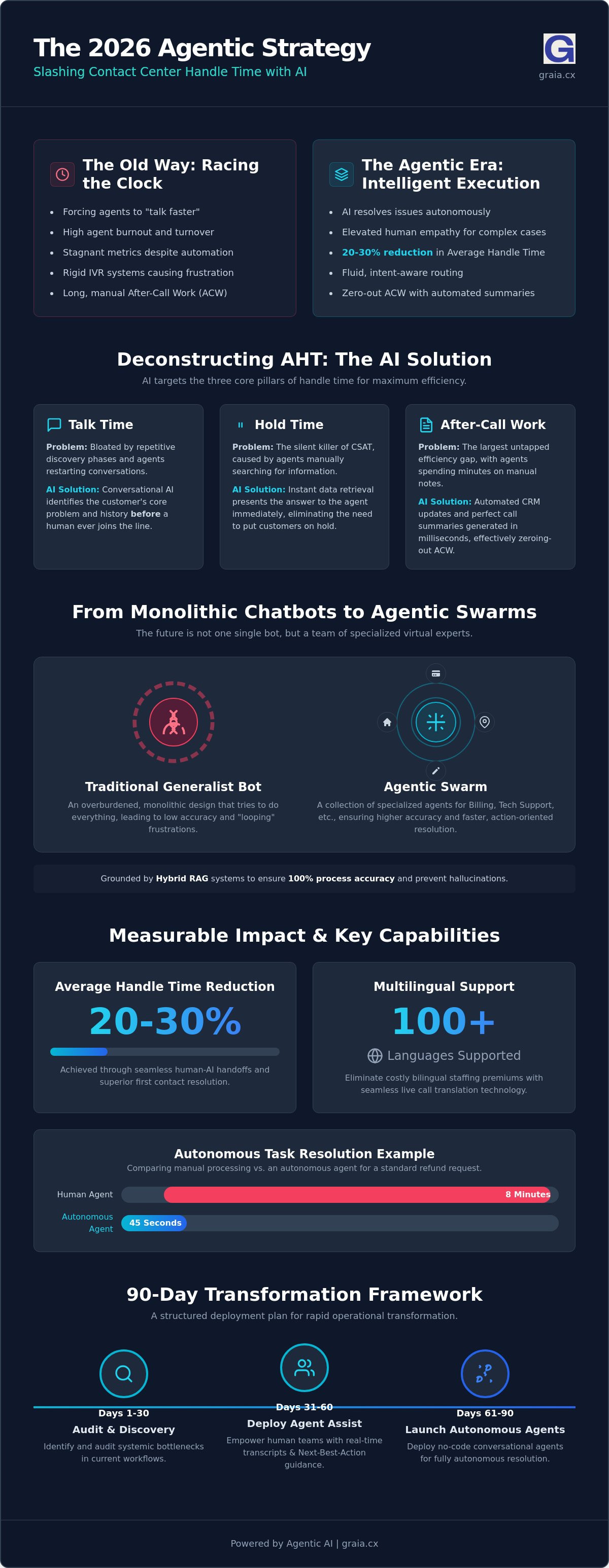
This article provides a definitive look at the 2026 agentic strategy. It demonstrates how real-time assist tools and agentic AI slash average handle time by 25% while simultaneously elevating the quality of human empathy. We will explore the shift toward agentic swarms and the implementation of hybrid RAG systems that ensure total process accuracy. By the end, you'll understand how to achieve a 20 to 30% reduction in AHT through seamless human-AI handoffs and superior first contact resolution.
Key Takeaways
- Redefine your performance metrics by understanding how autonomous virtual experts now integrate directly into the 2026 handle time equation.
- Implement specialized agentic swarms to reduce contact center handle time ai by resolving routine billing and technical inquiries with total process accuracy.
- Empower your human teams with real-time transcripts and Next-Best-Action guidance to eliminate dead air and significantly accelerate after-call work.
- Eliminate the costly translation penalty by enabling any agent to support 100+ languages through seamless live call translation technology.
- Execute a structured 90-day deployment plan to audit systemic bottlenecks and launch no-code conversational agents for rapid operational transformation.
What is Average Handle Time in the AI Era?
Average Handle Time (AHT) remains the heartbeat of the modern call centre, but the metric itself has undergone a fundamental transformation. Historically, it was a simple sum of talk time, hold time, and after-call work (ACW). In 2026, this definition is too narrow. High-performing organizations now integrate AI-led interactions into the equation, acknowledging that a "handle" can be entirely autonomous. This shift introduces the concept of Resolution Velocity. It's no longer just about how fast a human can talk. It's about how effectively an integrated system can resolve a query without friction. Resolution Velocity measures the speed at which a customer's problem is actually solved, regardless of whether a human or an agentic swarm performed the task.
Legacy IVR systems are often the primary culprits behind inflated metrics. They fail to capture intent, forcing agents to restart the discovery process from scratch. To reduce contact center handle time ai must replace these rigid menus with fluid, intent-aware routing that carries context across every touchpoint. When an agent receives a call, they should already have the customer's history, intent, and a suggested resolution on their screen. This eliminates the "discovery tax" that adds minutes to every interaction.
The Three Pillars of Handle Time
Talk time is often bloated by repetitive discovery phases. Conversational AI reduces this by identifying the customer's core problem before a human ever joins the line. Hold time, the silent killer of customer satisfaction, is eliminated through instant data retrieval. Instead of an agent saying "let me check our system," the system presents the answer instantly. Finally, after-call work (ACW) is the largest untapped opportunity for efficiency. By automating CRM updates and call summaries, we can effectively zero out the time spent on post-call administration. Instead of agents spending three minutes typing notes, the platform generates a perfect summary in milliseconds.
Why Traditional Automation Often Fails AHT
Many organizations struggle with the "Looping Bot" problem. This occurs when low-quality AI traps customers in repetitive cycles, eventually leading to a frustrated escalation. These escalated calls often take twice as long to resolve because the agent must first manage the customer's emotional distress. To truly reduce contact center handle time ai needs to maintain context during every handoff. GraiaCX solves this through Hybrid Flows and a Swarm architecture. We ensure 100% process accuracy, meaning the AI never loses the thread of the conversation. Our platform bridges the gap between digital self-service and human expertise, creating a seamless narrative that respects the customer's time and the agent's cognitive load.
Agentic Swarms: Resolving Routine Inquiries Autonomously
The traditional approach to automation relied on a single, overburdened chatbot attempting to be everything to everyone. This monolithic design is why so many deployments fail to actually reduce contact center handle time ai. Instead of one bot, we deploy an agentic swarm: a collection of specialized virtual experts tailored for billing, technical support, and sales. By narrowing the intent-recognition scope for each specialized agent, we achieve higher accuracy and faster resolution. When an AI only needs to understand the nuances of invoice disputes, its path to resolution is significantly shorter than a generalist bot.
These aren't just knowledge bots that recite FAQ pages. They are action-oriented entities capable of executing refunds, rescheduling deliveries, and updating ERP data without human intervention. This capability is rooted in Contact center AI that prioritizes execution over mere conversation. To ensure these agents don't wander into "circular" logic or hallucinate, we utilize Hybrid RAG. This grounds every response in vetted enterprise documents, ensuring that the AI remains a precise and protective extension of your brand. It's about moving from "I can find that for you" to "I have finished that for you."
From Chatbots to Autonomous Agents
Moving beyond basic keyword matching, modern agents understand intent and emotion. This nuance is the secret to shorter digital interactions. When an agent senses frustration, it shifts its tone or fast-tracks the resolution. For example, we've seen refund processing handle times plummet from 8 minutes with a human agent to just 45 seconds with an autonomous agent. By integrating directly with CRMs like Salesforce and Dynamics 365, these agents perform real-time task execution that previously required multiple screen-swaps. This level of autonomy allows your human team to focus on high-value, emotionally complex cases that require a deeper connection.
Seamless Human Escalation
Not every interaction can or should be automated. When a complex issue requires the human touch, the transition must be invisible to the customer. Our "Recap" feature provides live agents with structured, bulleted summaries of the AI's previous interaction. This eliminates the discovery phase, shaving up to 90 seconds off every escalated call. Agents no longer ask, "How can I help you today?" Instead, they say, "I see you've already discussed the billing discrepancy; let's resolve that now." This shift marks a significant milestone in the evolution of the AI customer service platform from chatbots to agentic intelligence. If you're ready to see how these swarms can transform your operations, you can explore our latest research on agentic workflows.
Agent Assist: Shrinking Talk and Hold Time for Human Teams
The cognitive burden placed on modern agents is a silent productivity killer. When an agent is forced to juggle CRM windows, knowledge bases, and manual note-taking, the customer experience suffers and metrics suffer. To effectively reduce contact center handle time ai must act as a sophisticated co-pilot that offloads this administrative weight. Real-time transcripts liberate your team from the distraction of documentation. They allow agents to remain entirely present and empathetic; the AI handles the capture of critical data points in the background. By the time the call reaches its conclusion, the system has already synthesized the interaction into a structured summary.
Next-Best-Action (NBA) suggestions eliminate the "dead air" that often inflates hold times during complex workflows. Instead of an agent hunting through disparate systems, the platform surfaces the exact resolution path based on the live dialogue. This is supported by sentiment analysis that monitors the emotional temperature of the call. If an interaction begins to spiral into a long-duration conflict, the system alerts a supervisor to intervene proactively. This prevents a difficult call from becoming a thirty-minute drain on your resources. Automated wrap-ups then use advanced LLMs to generate CRM-ready notes in milliseconds, effectively zeroing out the time spent on post-call administrative work.
The Power of Real-Time Guidance
Consistency is the foundation of trust. Smart response suggestions provide "script-locked" disclosures, ensuring that agents in compliant industries never miss a legal requirement. This level of real-time support drastically reduces onboarding time. New hires no longer need months of training to master complex product catalogs; they can reach "expert" handle times within their first week of production. The AI acts as a protective guide, shielding the agent from error while accelerating their path to resolution. For a comprehensive roadmap on these deployments, explore our guide on How to Improve FCR with Agent Assist: A 2026 Enterprise Implementation Guide.
Eliminating the "Search" Penalty
The "search penalty" is a systemic flaw where agents spend up to two minutes searching for a single policy. We rectify this through Hybrid Search, which combines vector and lexical retrieval to find the correct answer in under 200ms. Our data shows a 25% improvement in agent productivity when knowledge retrieval is fully automated. A built-in writing assistant further refines the experience by ensuring brand consistency and perfect grammar in every digital response. This doesn't just save time; it elevates the professional quality of every interaction, turning every agent into a high-performing brand ambassador.
Eliminating the Translation Penalty in Multilingual Centers
Traditional multilingual support models are built on a fundamental inefficiency: the language queue. When a customer speaks a language your primary agent doesn't, the result is a transfer, a wait, and a duplicated discovery phase. This "translation penalty" is a primary driver of operational friction. To reduce contact center handle time ai must dismantle these silos by enabling every agent to communicate in every language. By removing the need for specialized bilingual queues, you stabilize your routing and prevent the massive AHT spikes associated with transfers and repeat explanations.
Live Call Translation transforms any agent into a global communicator. Our platform supports over 100 languages in real-time, but speed is only half the battle. We utilize formality tuning and custom vocabulary to ensure that technical industry terms are translated with 100% accuracy. A mistranslated account term or medical phrase doesn't just confuse; it leads to circular conversations that bloat handle time. We also implement "Reading Rules" that intelligently slow down the delivery of account numbers or dates. This ensures first-time accuracy, eliminating the need for customers to repeat sensitive data and further streamlining the interaction.
Real-Time Voice Translation for Enterprise
Graia Live Call Translation functions as an invisible, intelligent bridge. Unlike legacy tools that require a "push to talk" delay, our system features partial translation. This allows agents to begin processing a request while the customer is still speaking, effectively overlapping the comprehension and execution phases. This capability is essential for organizations looking to scale global operations without the premium cost of localized staffing. For a deeper dive into selecting the right infrastructure, consult our Live Call Translation Software: The 2026 Enterprise Buying Guide.
The Empathy Factor in Translation
True connection requires more than just words; it requires tone. Our interface allows agents to hear the original audio of the customer's voice while simultaneously reading the translated text. This prevents misunderstandings by preserving the emotional context of the interaction. When an agent can hear the customer's urgency or relief, they respond with greater precision and empathy. This reduces agent stress and the cognitive load of managing a language barrier. Our global support hubs have documented a 15 to 25% AHT reduction simply by eliminating transfers and improving first-time clarity. If you are ready to modernize your multilingual strategy, view our latest performance benchmarks.
Implementation Framework: Slashing AHT in 90 Days
Transformation is not a vague aspiration. It's a 90-day execution cycle designed to dismantle systemic friction. To reduce contact center handle time ai must be implemented through a clinical, four-stage framework: Audit, Deploy, Tune, and Scale. We begin with an exhaustive audit to identify the specific AHT culprits, whether they are routine inquiries that should never reach a human or slow data retrieval processes that force agents into long hold cycles. By pinpointing where time is leaking, we create a targeted strike zone for automation.
Deployment follows immediately. We utilize no-code conversational agents to achieve Day-1 automation for high-volume, low-complexity tasks. This isn't a months-long development project; it's a rapid injection of intelligence into your existing workflow. Once live, we employ AI "Judges" to score simulated and real conversations. These judges identify bottlenecks in reasoning paths and pinpoint where the AI or the human agent might be stalling. Finally, we scale the solution by integrating with your legacy CCaaS infrastructure, including Genesys, Avaya, or NICE, to unify the agent desktop and ensure a single, streamlined source of truth.
Phase 1: Automating the Low-Hanging Fruit
The first 30 days focus on the "low-hanging fruit" of customer service. By targeting routine inquiries like order status or password resets, we achieve up to a 40% reduction in human escalations. We also implement "Email Draft Mode" for digital channels. This feature provides agents with pre-composed, context-aware responses that they can review and send in seconds. Security remains paramount during this phase. We establish rigorous AI guardrails and prompt shields to ensure every interaction remains compliant and protective of customer data.
Phase 2: Optimizing Human-AI Collaboration
The final 60 days focus on the synergy between your team and the technology. We deploy Agent Assist to provide real-time coaching and ensure 100% compliance during every call. This phase is characterized by enterprise-grade reporting. We integrate Power BI to track AHT reduction ROI with granular precision, giving leadership clear visibility into the platform's impact. Continuous optimization is built into the architecture. We use detailed audit trails to refine AI reasoning paths, ensuring that your contact center evolves as quickly as the needs of your customers. The result is 60% faster resolution times and a workforce empowered to deliver deep, human connection.
Leading the Evolution of Resolution Velocity
The path to operational excellence no longer requires a choice between speed and human connection. By deploying agentic swarms to handle routine execution and empowering human teams with real-time assistance, you fundamentally redefine what it means to resolve a query. We've explored how a structured 90-day framework can dismantle systemic friction and how live translation removes the costly penalty of language silos. To truly reduce contact center handle time ai must be treated as a catalyst for human potential rather than a mere replacement for it.
GraiaCX delivers this transformation through a Red Dot Design Award winning interface that supports over 100 languages. Our platform provides a documented 25% agent productivity boost, ensuring your team remains focused on high-value interactions that drive brand loyalty. The era of the "script-reader" is ending; the era of the "problem-solver" has arrived. It's time to move beyond the limitations of legacy systems and embrace a future where every interaction is a seamless, intelligent resolution.
Transform your contact center AHT with GraiaCX Agentic AI
The future of your customer experience is waiting for those bold enough to lead it.
Frequently Asked Questions
How does AI reduce average handle time without hurting customer satisfaction?
AI reduces handle time by surgically removing friction from the interaction rather than rushing the dialogue. By automating discovery and providing agents with instant data, customers receive faster resolutions without the frustration of long holds. This approach improves satisfaction because it respects the customer's time while ensuring their problem is solved with total precision on the first attempt.
Can agentic AI actually take actions like processing refunds?
Yes, agentic AI is engineered for execution rather than mere conversation. Unlike traditional bots that only recite FAQ pages, our conversational agents integrate with your ERP and CRM systems to perform complex tasks. They can process refunds, reschedule deliveries, or update account details autonomously. This level of autonomy ensures the interaction concludes with a completed task instead of a human escalation.
What is the difference between a chatbot and a conversational agent in terms of AHT?
A chatbot typically follows rigid, scripted paths and often fails to resolve nuanced issues, which ultimately inflates handle time through forced escalations. A conversational agent uses agentic intelligence to understand complex intent and execute multi-step workflows. This sophisticated autonomy is what allows organizations to truly reduce contact center handle time ai by resolving inquiries without human intervention.
Does live call translation increase or decrease handle time?
Live call translation significantly decreases handle time by dismantling the traditional language queue. By enabling any agent to support 100+ languages in real-time, you eliminate the need for specialized transfers and the duplicated discovery phases they cause. Removing these silos prevents the massive AHT spikes associated with waiting for a bilingual specialist and ensures immediate comprehension.
How long does it take to see a reduction in AHT after implementing AI?
Most enterprises observe measurable performance gains within the first 30 to 90 days of deployment. By targeting routine inquiries like order status or billing questions in the first phase, you can achieve a rapid reduction in human escalations. Full optimization of the human-AI partnership typically matures within a single quarter as the system refines its reasoning paths.
Will AI replace human agents or just make them faster?
AI acts as a catalyst for human potential that offloads the mechanical to elevate the interpersonal. It automates the routine, repetitive tasks that drain agent productivity, allowing your team to focus on high-stakes, emotionally complex interactions. The result is a workforce that is faster because they're no longer burdened by the administrative weight of discovery and documentation.
Can I integrate GraiaCX with my existing Genesys or Avaya platform?
Absolutely, our agentic omni-channel platform is designed for seamless integration with legacy CCaaS infrastructures like Genesys, Avaya, and NICE CX. This unification ensures your agents don't have to switch between disparate windows, which is a primary driver of high handle times. We provide a streamlined, single source of truth that enhances your existing technology investment.
How does AI help with after-call work (ACW)?
AI effectively zeros out post-call administrative time by automating call summaries and CRM updates in real-time. Instead of an agent spending several minutes typing manual notes, the system synthesizes the interaction into a structured, CRM-ready format in milliseconds. This allows your team to move immediately to the next customer, which is essential to reduce contact center handle time ai across the entire organization.