
How to Improve FCR with Agent Assist: A 2026 Enterprise Implementation Guide
Why are your most seasoned agents still failing to resolve complex inquiries on the first attempt? It isn't a training deficit. It's an information-access crisis. You've felt the tension of high-stakes interactions where a single compliance error or a lost thread of context triggers a costly repeat contact. In an era where the Colorado AI Act and EU AI Act now mandate strict transparency and impact assessments, the margin for error has vanished. To improve fcr with agent assist in this demanding landscape, you need more than a digital handbook. You need a real-time cognitive partner that bridges the gap between raw data and human empathy.
We understand the exhaustion of managing high turnover and the systemic knowledge loss that follows. This guide provides the definitive 2026 framework for leveraging Agentic Swarm architecture to eliminate repeat contacts and elevate your first-contact resolution by up to 10 points. You'll discover how to integrate Live Call Translation and Agent Assist to accelerate onboarding and ensure every interaction is precise. We'll break down the transition from fragmented support to a unified, agentic platform that protects your brand and empowers your people.
Key Takeaways
- Address the "Hidden Cost" of repeat contacts by resolving the specific technical and emotional intent behind every customer inquiry on the first attempt.
- Transition from static knowledge bases to proactive Agentic AI that interprets complex requests using high-performance execution engines.
- Learn how to improve fcr with agent assist by leveraging real-time next-best-action guidance to effectively eliminate the traditional "hold" button.
- Follow a strategic implementation roadmap that audits repeat contact triggers and grounds AI in your unique enterprise knowledge via hybrid search.
- Leverage an empathy-driven platform that unifies human intelligence with automated precision to drive a sustainable 10-point boost in resolution rates.
The First Contact Resolution (FCR) Gap: Why Traditional Centers Struggle
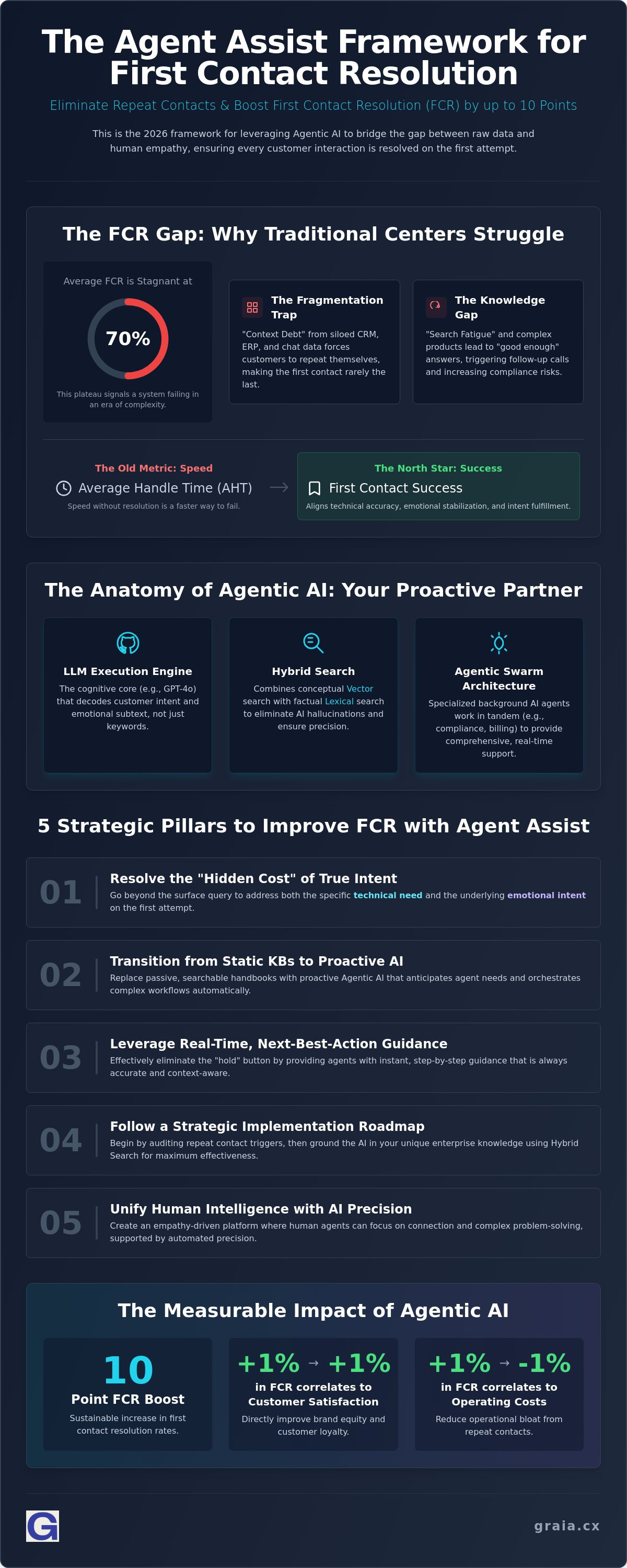
Legacy infrastructure is a silent anchor. While enterprise leaders chase digital transformation, the average First Contact Resolution (FCR) remains stagnant at approximately 70%. This isn't just a statistical plateau; it's a symptom of a system designed for a simpler era. In 2026, resolution isn't defined by a closed ticket. It's the simultaneous alignment of technical accuracy, emotional stabilization, and intent fulfillment. When these three pillars don't converge on the first attempt, the result is operational bloat. Every repeat contact erodes brand equity and inflates costs, creating a cycle of frustration that traditional tools can't break. To truly improve fcr with agent assist, organizations must first acknowledge that static knowledge bases and rigid IVRs have become the primary enemies of the customer experience.
The industry is witnessing a fundamental pivot in how we measure success. For decades, Average Handle Time (AHT) was the metric of choice, rewarding agents for speed rather than depth. This was a mistake. Speed without resolution is just a faster way to fail. We're now shifting toward First Contact Success as the definitive north star. This metric recognizes that a 1% improvement in FCR correlates directly to a 1% increase in customer satisfaction and a 1% decrease in operating costs. Achieving this requires moving beyond the "hold" button and embracing a framework where information finds the agent, rather than the agent hunting for information.
The Fragmentation Trap: Disconnected Data and Lost Context
Context Debt is the invisible tax on every customer interaction. When CRM, ERP, and chat data live in isolated silos, the customer is forced into a repetitive loop of re-explanation. It's an exhausting experience. Agents frequently start from zero on transferred calls because legacy systems fail to surface relevant history within the critical first 10 seconds. This lack of continuity ensures that the first contact is rarely the last.
The Knowledge Gap: When Training Can't Keep Up with Complexity
Product catalogs now evolve faster than any human can memorize. This creates "Search Fatigue," where agents, overwhelmed by complex workflows, settle for "good enough" answers that inevitably trigger follow-up calls. In the current regulatory environment, including the mandatory compliance requirements of the EU AI Act, a simple knowledge error isn't just a nuisance. It's a liability. When agents lack real-time guidance, compliance errors skyrocket, necessitating corrective second contacts that could have been avoided. You cannot solve a 2026 information problem with 2010 training methods. Just as proactive professionals visit IAB Academy to master the intersection of AI and financial literacy, you must improve fcr with agent assist by providing a real-time cognitive partner that eliminates the guesswork entirely.
The Anatomy of Agent Assist: How AI Empowers Real-Time Resolution
Complexity is the enemy of resolution. To improve fcr with agent assist, enterprise leaders must look beyond the limitations of traditional chatbots. We have entered the era of Agentic AI. Unlike passive tools that wait for a query, agentic systems act as proactive partners. They anticipate needs. They orchestrate workflows. At the heart of this transformation lies the LLM Execution Engine, such as GPT-4o, which serves as a sophisticated central nervous system. This engine doesn't just match keywords; it decodes the intricate nuances of customer intent and emotional subtext, allowing the system to provide guidance that is both technically accurate and psychologically resonant.
Precision is non-negotiable in a high-stakes environment. Relying solely on vector search often leads to "hallucinations" where the AI provides a confident but incorrect answer. The solution is a Hybrid Search architecture that combines the conceptual understanding of Vector search with the rigid accuracy of Lexical search. This ensures that when an agent asks for a specific policy or technical specification, they receive the exact factual data required to close the case. Modern strategies to improve fcr with agent assist further utilize an "Agentic Swarm" architecture. This involves specialized background AI agents working in tandem; one might monitor compliance in real-time while another retrieves billing data, allowing the human agent to focus entirely on the customer connection. For more insights on the evolution of AI in the contact center, explore our latest industry analysis.
Grounded Intelligence: The Power of Agentic RAG
Retrieval-Augmented Generation (RAG) is the cognitive engine that prevents AI from drifting into fiction. By grounding the LLM in your vetted enterprise documents, Agentic RAG ensures that every suggestion is anchored in reality. The AI extracts facts from your specific product manuals and legal policies rather than its general training data. This level of grounding is essential for maintaining 100% process accuracy, transforming the AI into a reliable real-time coach that agents can trust without hesitation.
Contextual Continuity and Seamless Handoffs
The transition from a Conversational Agent to a human representative is often where resolution fails. Contextual continuity fixes this. Instead of a blank screen, the human agent receives a concise summary of the prior interaction along with the AI’s "Reasoning Trail." This transparency allows the agent to see exactly why the AI suggested a specific path. By maintaining this session continuity across voice, chat, and social channels, you eliminate the "Context Debt" that forces customers to repeat themselves, ensuring the human agent is ready to resolve the issue the moment they say hello.
5 Strategic Ways to Improve FCR with Agent Assist AI
Resolution is an active pursuit, not a reactive response. To truly improve fcr with agent assist, enterprises must move beyond the era of "let me check on that for you." True transformation occurs when the technology transitions from a background library to a real-time orchestrator. By empowering agents with instantaneous intelligence, you don't just shorten the call; you ensure it never needs to happen again. Modern agent assist solutions act as a persistent coach, providing the clarity required to handle complex inquiries without hesitation.
- Instant Knowledge Surfacing: The "hold" button is a resolution killer. Agent assist identifies the customer's intent in real-time and surfaces the exact documentation needed, allowing the agent to stay present and engaged throughout the dialogue.
- Proactive Next-Best-Action (NBA): Complexity often leads to hesitation. NBA suggestions act as a digital compass, guiding agents through intricate workflows and ensuring every necessary step is completed during the initial interaction.
- Real-Time Compliance Guardrails: Misinformation is a primary driver of repeat contacts. Script-locking and automated compliance checks prevent agents from providing "good enough" answers that fail to meet strict regulatory standards.
- Sentiment and Emotion Detection: Catching frustration before it boils over is critical. By monitoring customer sentiment, the AI can alert the agent to pivot their tone or escalate the issue before the customer hangs up unsatisfied.
- Multilingual Resolution: Language should never be a barrier to clarity. Solving problems in a customer's native tongue ensures that technical nuances aren't lost in translation, significantly reducing the likelihood of follow-up inquiries.
Breaking the Language Barrier with Live Translation
Transfers are the graveyard of FCR. When a customer is moved to a specialized language queue, the risk of dropped calls or lost context skyrockets. Utilizing live call translation software allows any agent to resolve issues in over 100 languages. This approach preserves the "Original Audio" of the customer, allowing the agent to hear emotional cues while reading perfectly translated text. By applying custom vocabularies, you ensure that brand-specific terminology remains accurate across every global interaction, fostering a sense of genuine connection and immediate resolution.
Action-Oriented AI: Executing Tasks via API
The most effective way to improve fcr with agent assist is to move from providing advice to executing actions. Modern systems integrate directly with your tech stack to handle refunds, booking updates, or account resets within the call window. Hybrid Flows provide the necessary structure, ensuring that while the AI assists with execution, it adheres strictly to your defined business rules. This eliminates the dreaded "I'll have to call you back" promise, closing the loop immediately and protecting the customer's time.
Implementation Roadmap: Deploying Agent Assist for Maximum FCR
Transformation is a deliberate orchestration. To effectively improve fcr with agent assist, enterprise leaders must transition from experimental pilots to a structured, evidence-based deployment. This roadmap isn't merely about software installation; it's about re-engineering the cognitive environment of your contact center. Success requires a methodical progression that respects the complexity of human interaction while leveraging the precision of agentic intelligence. By following a rigorous implementation framework, you ensure that every technological layer directly contributes to the elimination of repeat contacts.
- Step 1: Audit Repeat Triggers. Utilize conversation intelligence to identify your top 10 "Repeat Contact" reasons. Understanding where clarity fails is the first step toward fixing it.
- Step 2: Ground the Intelligence. Implement a Hybrid Search architecture to anchor the AI in your specific knowledge base. This ensures suggestions are factual, not just probable.
- Step 3: Define Hybrid Flows. Map out rigid business rules for high-stakes processes like billing and technical support. These flows ensure the AI operates within your defined safety and compliance parameters.
- Step 4: Execute Shadow Mode. Deploy the system in a "Shadow Mode" where it generates suggestions in the background. This allows you to validate accuracy and latency before any agent sees a prompt.
- Step 5: Scale Omnichannel Consistency. Move the validated assist layer across voice, chat, and email. Consistency across channels is the only way to prevent customers from switching platforms to find a different answer.
Modernizing the Tech Stack: Genesys, Avaya, and Beyond
Integration shouldn't require a "rip-and-replace" of your existing infrastructure. Modern agentic platforms connect to legacy systems like Genesys or Avaya via SIP and iframe overlays, providing a sophisticated intelligence layer without disrupting established workflows. By linking the AI directly to your CRM, such as Salesforce or Microsoft Dynamics, you provide agents with a real-time view of customer history and intent. To protect your enterprise, implement "Prompt Shields" and robust AI guardrails. these security layers ensure that the AI remains a protective guide rather than a liability. For a deeper look at secure integration strategies, visit our latest technical briefings.
Training the 'Swarm': Customizing AI Response Styles
Precision requires nuance. Selecting the right Speech-to-Text (STT) and Text-to-Speech (TTS) providers is critical for maintaining a natural conversational rhythm. You must also configure formality tuning to respect regional market expectations; a formal tone in one territory may feel cold in another. Use the "Simulator" tool to stress-test your assist suggestions against thousands of historical call transcripts. This proactive testing ensures that when you finally go live, your agents are supported by a refined, high-performance cognitive partner that is ready to improve fcr with agent assist from the first hello.
The GraiaCX Advantage: Why Agentic AI is the Future of FCR
Technology is only as effective as the connection it fosters. While many providers offer fragmented tools that require complex stitching, GraiaCX provides a unified, agentic platform designed to harmonize human intuition with computational precision. We function as an empathy-driven engine. Our architecture doesn't seek to replace the agent; it seeks to protect their time and mental energy by handling the cognitive heavy lifting of data retrieval and process adherence. Organizations that choose to improve fcr with agent assist through our ecosystem see more than just marginal gains. They experience a fundamental shift in operational health, evidenced by a 40% reduction in escalations and resolution times that are 60% faster than legacy benchmarks.
Our commitment to innovation is anchored in end-to-end IP ownership. Because we own the entire stack, from the Agentic Swarm architecture to the Live Call Translation engines, we provide a level of integration and speed that third-party "wrappers" simply cannot match. This ownership allows us to deploy updates faster and ensure that every component of your AI customer service platform is optimized for the specific demands of 2026. You aren't just buying a tool; you're partnering with a visionary leader dedicated to elevating human potential through superior intelligence.
Privacy-First AI: Your Data, Your Control
In a regulated landscape, trust is the only currency that matters. Your enterprise data is your legacy, and we ensure it remains exclusively yours. GraiaCX mandates that customer data is never used to train external or public models. We utilize PII masking and AES256 encryption to maintain total compliance in even the most sensitive industries. Transparency is built into every suggestion. Our system provides clear audit trails, allowing supervisors to see exactly why the AI suggested a specific action, ensuring that your path to improve fcr with agent assist is always visible and verifiable.
Ready to Transform Your First Contact Resolution?
The journey from an information gap to an empowered workforce is a strategic necessity. You've seen the roadmap; now it's time to experience the execution. We invite you to utilize the GraiaCX Simulator to conduct a bot-to-bot stress test, allowing you to witness how our Agentic Swarm handles your most complex historical inquiries before you ever go live. The future of the contact center isn't found in more automation, but in better intelligence. It's time to embrace growth through AI empathy and redefine what is possible for your agents and your customers alike.
Redefining Resolution for the Agentic Era
The 70% First Contact Resolution plateau isn't a permanent fixture of the contact center. It's a legacy constraint waiting to be dismantled. By bridging the information-access gap with grounded, real-time intelligence, you empower your workforce to resolve technical and emotional needs in a single, seamless interaction. You've seen the roadmap; now it's time to execute. To truly improve fcr with agent assist, you must move beyond passive tools and adopt a proactive cognitive partner that safeguards both your brand and your agents.
GraiaCX brings 25 years of CX innovation to this transformation, offering a 99.9% uptime guarantee on SOC2-aligned Azure infrastructure. This isn't just about operational efficiency; it's about building a foundation of trust and precision that scales with your enterprise. The future of customer connection belongs to those who prioritize the human element within a high-performance digital framework. Your agents are ready for a partner that works as hard as they do.
Take the first step toward a more empowered, high-resolution future. Book a demo of the GraiaCX Agentic Platform today and witness the evolution of resolution in real-time.
Frequently Asked Questions
How does agent assist actually improve First Contact Resolution (FCR)?
Agent assist improves FCR by acting as a real-time coach that surfaces vetted documentation and compliance guardrails during the live interaction. This eliminates the information gap that typically forces a second contact. By providing proactive next-best-action suggestions, you can improve fcr with agent assist because agents no longer settle for "good enough" answers when they're under pressure. Accuracy becomes the default state of every conversation.
Can agent assist AI integrate with my existing Genesys or Avaya platform?
Seamless integration is achieved through SIP and iframe overlays that sit on top of your existing Genesys or Avaya desktop. You don't need a costly rip-and-replace of your telephony infrastructure to modernize your operations. This architecture allows the agentic platform to listen to the audio stream or monitor text interactions, providing intelligence without disrupting the established workflows your team relies on every day.
Will agent assist technology increase my Average Handle Time (AHT)?
Implementing this technology usually leads to a reduction in handle time rather than an increase. While the AI provides additional information, it does so instantaneously, which removes the need for long hold times or manual searches through disconnected PDFs. Speed and accuracy are finally aligned. Agents resolve inquiries faster because they're guided by a system that handles the cognitive heavy lifting in the background.
How do you ensure the AI doesn't give incorrect information to agents?
Accuracy is maintained through a combination of Hybrid Search and Agentic RAG, which grounds the LLM in your specific, vetted enterprise knowledge. Unlike public AI models that predict the next likely word, our system extracts facts directly from your internal policies and product manuals. This rigorous grounding ensures that the AI functions as a reliable partner, preventing hallucinations and maintaining high process accuracy across all interactions.
Does agent assist work for voice calls as well as chat and email?
The platform is built for a true omni-channel experience, supporting voice, chat, and email with equal precision. High-performance Speech-to-Text (STT) engines transcribe live calls in real-time, allowing the AI to analyze intent and emotion just as it would with text-based chat. This ensures that your resolution strategy remains consistent regardless of the channel your customer chooses, providing agents with a unified interface for every interaction.
Is my customer data used to train the AI models in GraiaCX?
Your customer data remains strictly within your control and is never used to train external or public AI models. We utilize PII masking and AES256 encryption to ensure total compliance with regulated industry standards. This privacy-first approach provides a transparent audit trail, allowing you to see exactly how the AI arrives at its suggestions without compromising the security or integrity of your proprietary information.
What is the typical ROI for implementing agent assist in an enterprise contact center?
Enterprises typically see a significant return on investment through a 25% improvement in agent productivity and a 5 to 10 point increase in First Contact Resolution. By reducing the volume of repeat contacts, you lower the overall cost per resolution while simultaneously improving customer satisfaction scores. The stability of our infrastructure further protects your investment by ensuring a 99.9% uptime for all critical agentic operations.
How long does it take to see an improvement in FCR after deployment?
Improvements in individual agent performance are often visible immediately, while enterprise-level gains to improve fcr with agent assist typically stabilize within 30 to 90 days. This period allows the system to refine its Automated Prompt Optimization based on real-world interactions within your specific environment. As agents become more comfortable with their real-time coach, the cumulative effect on your resolution metrics becomes increasingly pronounced and sustainable.