
Reducing Agent Burnout with AI: The 2026 Guide to Agentic CX Orchestration
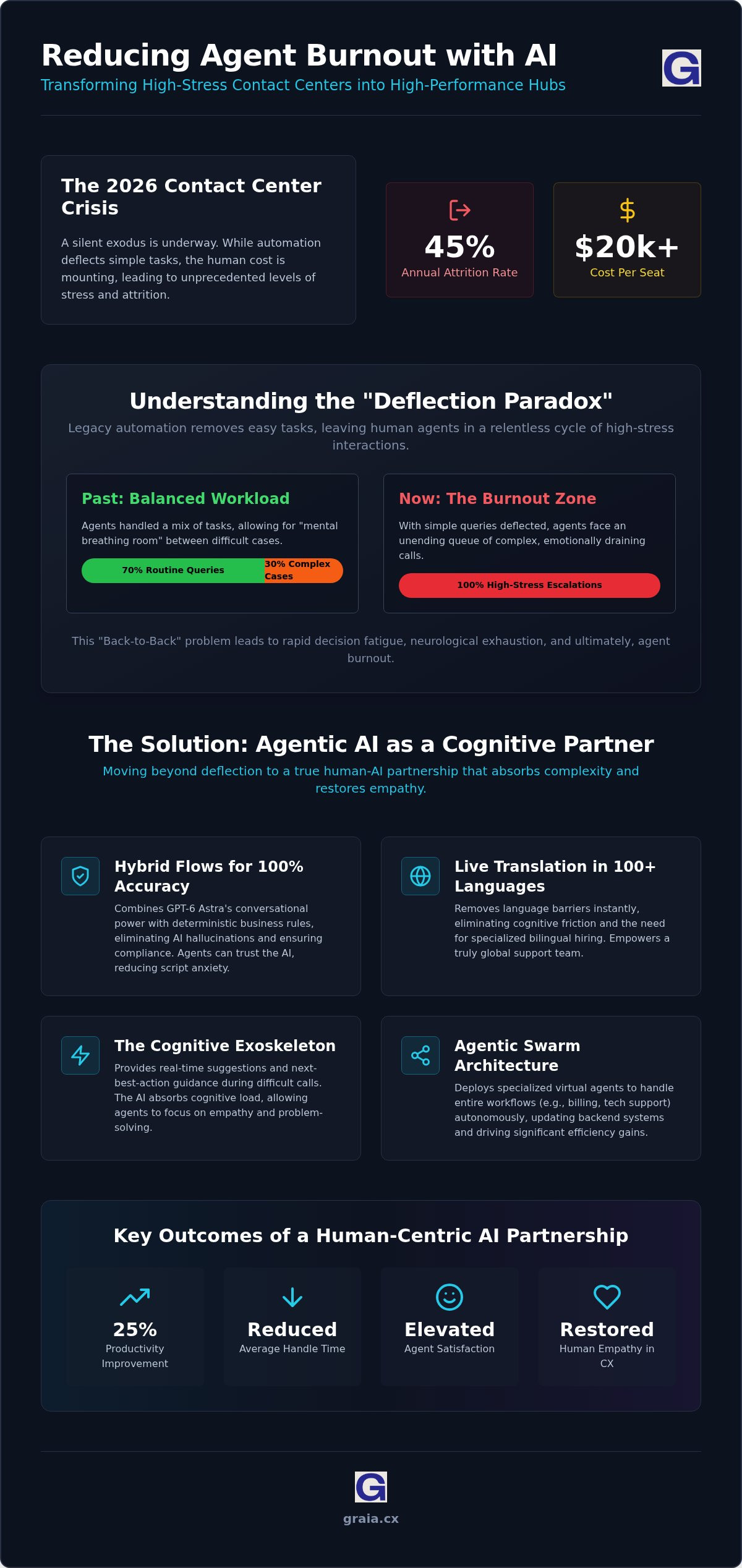
In 2026, the average contact centre loses up to 45% of its workforce annually, a staggering attrition rate that costs enterprises over $20,000 per seat in recruitment and lost productivity. While standard automation promised a cure, it often leaves human agents trapped in a deflection paradox. They are now tasked exclusively with the most complex, emotionally exhausting escalations. You likely feel the strain of this reality as your top performers buckle under the weight of back-to-back difficult interactions. Reducing agent burnout with ai is no longer a luxury for the forward-thinking; it's a fundamental requirement for operational survival.
We recognize that your agents are the heart of your brand, yet they currently act as the shock absorbers for every systemic friction point. This guide reveals how enterprise-grade agentic CX orchestration transforms these high-stress environments into high-performance hubs by deploying intelligent assistants that actually share the work. You'll discover how the latest GPT-6 Astra models and swarm architecture absorb cognitive load, while live translation in 100+ languages removes the barriers that silo global support. We'll explore how to reduce average handle time and elevate agent satisfaction through a sophisticated, human-centric AI partnership.
Key Takeaways
- Identify the "Deflection Paradox" and why traditional automation often increases workplace stress by leaving agents with only the most complex, high-stakes interactions.
- Master the use of Hybrid Flows within Agentic CCaaS to guarantee 100% process accuracy, providing a reliable safety net that eliminates the fear of AI hallucinations.
- Eliminate the cognitive friction of language barriers through Live Call Translation, empowering your global team to support 100+ languages without the need for bilingual hiring.
- Discover how to implement a "cognitive exoskeleton" for reducing agent burnout with ai by providing real-time suggestions and next-best-action guidance during difficult calls.
- Learn how transitioning to a swarm architecture can drive a 25% productivity improvement while restoring the human empathy essential for high-performance CX.
The 2026 Contact Centre Crisis: Understanding the Deflection Paradox
The contact centre of 2026 is facing a silent exodus. While automation dashboards show record-high deflection rates, the human reality behind the screen tells a different story. Reducing agent burnout with ai requires more than just diverting tickets; it demands a fundamental shift in how we value human cognitive limits. Today, the most skilled agents are leaving the industry at an alarming rate because they've become the shock absorbers for every failed automated interaction. The World Health Organization recognizes Occupational burnout as a clinical phenomenon resulting from chronic workplace stress, and in the modern contact centre, this stress is being amplified by the very tools meant to alleviate it.
We see the signals in 2026 through rising Average Handle Time (AHT) on even simple calls and a sharp spike in absenteeism. When an agent is pushed to their limit, the cost of attrition is devastating. Replacing a burned-out professional now costs roughly 1.5x their annual salary when you factor in recruitment, intensive training, and the productivity vacuum left in their wake. This isn't just an HR problem. It's a structural failure of legacy automation.
Why Traditional IVR and Chatbots Failed Agents
Legacy systems were designed for deflection, not resolution. Rigid scripts and circular IVR menus create a "frustration debt" that the customer carries directly into the live conversation. By the time an agent connects, they aren't just solving a technical issue; they're managing an emotional crisis. These older bots often fail to pass context during handoffs, forcing agents to act as overqualified data entry clerks. This empathy gap turns every shift into a series of apologies rather than a sequence of solutions.
The Cognitive Load of High-Complexity Interactions
The "Back-to-Back" problem is the most visible symptom of the crisis. In the past, routine queries like password resets provided "mental breathing room" between difficult cases. Now, 100% "complex only" queues lead to rapid decision fatigue and neurological exhaustion. Without the occasional easy win, agents remain in a state of high-cortisol arousal for eight hours straight. The Deflection Paradox is the unintended consequence of surface-level automation where the removal of routine tasks leaves agents trapped in an unrelenting cycle of high-complexity, high-stress interactions without respite. To move forward, we must transition to Agentic CCaaS models that prioritize the agent's mental health as much as the customer's satisfaction.
Absorbing Complexity: How Agentic AI Restores Human Empathy
The transition from reactive chatbots to proactive virtual partners marks a definitive shift in the contact centre. Traditional bots wait for a trigger, often failing when the conversation deviates from a linear path. In contrast, Agentic AI acts as a sophisticated partner that understands intent and executes complex workflows. This technology is vital for reducing agent burnout with ai because it absorbs the cognitive heavy lifting that previously exhausted human teams. By deploying an Agentic Swarm architecture, enterprises can assign specialized virtual agents to handle specific domains like billing disputes, technical troubleshooting, or sales inquiries. These virtual specialists resolve issues end to end, updating ERP and CRM systems autonomously without human intervention.
Hybrid Flows and the End of Script Anxiety
One of the primary drivers of workplace stress is the fear of inaccuracy or non-compliance. Hybrid Flows solve this by combining the natural language capabilities of the latest GPT-6 Astra models with deterministic business rules. This dual layered approach ensures 100% process accuracy. While the AI remains conversational and fluid, it is grounded in your specific Knowledge Base through Retrieval-Augmented Generation (RAG). It cannot "hallucinate" or provide off-script promises in regulated environments. This reliability allows your human agents to step into a conversation with total confidence, knowing the foundational data is correct. They are no longer policing the AI; they are empowered by it.
Seamless Human Handoffs with Full Context
Nothing erodes agent morale faster than a frustrated customer forced to repeat their story for the third time. Agentic CCaaS eliminates this friction entirely. When a complex case requires human intervention, the AI provides a comprehensive summary of the interaction, including the customer's emotional state and the steps already taken. The agent receives a concise brief in seconds, allowing them to lead with empathy rather than interrogation. This shift represents the evolution of the AI customer service platform from a simple deflection tool to a high performance engine for human connection. By removing the clerical burden of manual summaries and data entry, you give your team the space to do what they do best: solve problems with a human touch. For more insights on optimizing these digital workflows, explore our latest CX research.
Removing the Language Barrier: Live Translation as a Burnout Cure
The mental toll of bilingual support is a frequently overlooked catalyst for systemic turnover. Bilingual agents often face a 50% higher risk of exhaustion compared to their monolingual peers because of the intense cognitive switching required to navigate complex technical issues in a second language. This linguistic friction creates a "language queue" pressure where specific agents are bombarded with back-to-back calls, effectively punishing them for their specialized skills. Reducing agent burnout with ai means democratizing these interactions. By implementing Live Call Translation, enterprises can empower their entire workforce to support 100+ languages in their native tongue. This shift provides immediate psychological safety; agents no longer fear the moment a call arrives in a language they haven't mastered. They can focus on the solution rather than the syntax.
When language barriers are removed, the "Language Queue" disappears. Calls are spread evenly across the entire workforce, preventing the bottlenecking that leads to high-stress spikes for specific team members. This balanced distribution is a core pillar of reducing agent burnout with ai, as it restores the "mental breathing room" discussed earlier in this guide. Agents feel more confident and capable when they are supported by a system that speaks every language as fluently as they do. It transforms a global support operation from a series of isolated silos into a unified, high-performance hub.
Real-Time Voice Translation for Global Teams
Preserving human sentiment is paramount for a genuine connection. Modern translation technology maintains the original audio's pitch and cadence, ensuring that tone and empathy aren't lost in the digital process. Formality tuning is equally critical. Literal translation often fails in cultures like Japan or Germany where honorifics and professional registers define the customer experience. Custom vocabularies further protect the agent, preventing technical errors in specialized sectors like fintech or healthcare by ensuring industry-specific terms are translated with 100% accuracy every time.
The ROI of Language Flexibility
The financial impact of this technology is as compelling as the human one. Organizations can eliminate the 25-50% wage premium typically required for bilingual staff while simultaneously improving First Contact Resolution (FCR) by 5-10 points. When agents fully understand the nuance of a query without the stress of translation, they resolve it faster and with greater accuracy. This efficiency allows for a more agile, globalized support model that scales without traditional hiring constraints. For a detailed breakdown on implementing these tools, see our live call translation software guide.
From Scripts to Suggestions: Implementing AI Agent Assist
The modern contact centre requires more than just deflection; it needs a cognitive exoskeleton. Reducing agent burnout with ai is achieved by surrounding the human professional with a layer of real-time intelligence that handles the mental heavy lifting. Instead of forcing agents to juggle multiple tabs while a customer waits, Agent Assist provides live transcripts and smart response suggestions directly within the interface. This immediate support is particularly vital during complex billing disputes where the stress of decision-making can be overwhelming. By leveraging Next-Best-Action (NBA) frameworks, the system guides the agent through the most compliant and empathetic path, removing the debilitating "what do I do next?" anxiety that often leads to errors.
Beyond the live interaction, the AI addresses the exhaustion of administrative tasks. Automated wrap-ups and documentation save between 3 and 5 minutes of post-call stress per interaction, allowing agents to transition between cases without a mountain of clerical debt. This isn't just about speed. It's about protecting the agent's mental energy for the next human connection. Real-time emotion detection acts as an additional safety net, alerting supervisors to escalating tension before a situation becomes abusive or unmanageable. This proactive protection is a cornerstone of our Agentic CCaaS philosophy, ensuring that technology serves the human, not the other way around.
Empowering Agents with Real-Time Knowledge
Retrieval-Augmented Generation (RAG) ensures that every suggestion is vetted, accurate, and current. New hires no longer face a steep six-month learning curve; they are guided by AI that serves the right answer from the knowledge base at the exact moment it's needed. By providing these instantaneous knowledge injections, AI Agent Assist reduces Average Handle Time by 15-25% without sacrificing the quality of the service. This efficiency creates a more sustainable pace of work, where expertise is accessible rather than elusive, directly reducing agent burnout with ai across the entire floor.
The 'Draft Mode' for Email and Messaging
Written support often carries its own unique pressure. The "blank page" anxiety of drafting complex emails can lead to significant delays and brand voice inconsistency. AI-driven "Draft Mode" composes high-quality responses for human approval, ensuring that every message remains professional and empathetic. This collaborative approach allows agents to focus on the final review and personal touch rather than the initial construction. To see how these features integrate into your current workflow, explore our AI agent assist tools guide. For a deeper look at the future of CX, check out our latest industry insights.
Building a Resilient CX Culture with GraiaCX
GraiaCX envisions a future where technology protects the human spirit rather than exhausting it. We position ourselves as the definitive partner for enterprises seeking a balance between high-level operational excellence and deep human empathy. Our Agentic CCaaS platform acts as an Empathy Engine, shielding your team from the systemic friction of modern support. By ensuring 100% process accuracy through Hybrid Flows, we provide the stability required for regulated industries. Enterprise leaders trust GraiaCX because we remove the risk of AI hallucinations while enabling 24/7 global support using your existing workforce. You can now scale your operations without a massive recruitment drive by leveraging our Swarm architecture to handle specialized tasks autonomously.
Security remains at the core of our digital framework. We utilize advanced PII masking and maintain strict data sovereignty within the Microsoft Azure ecosystem. This ensures that while your agents are supported by cutting-edge intelligence, your customer data remains protected and compliant with evolving global standards. We don't just provide a tool; we provide a secure partnership that values both performance and privacy.
Measurable Impact on Agent Retention
Data from our implementations shows a transformative shift in the workplace. We consistently see a 40% reduction in escalations and a 25% improvement in agent productivity across the board. These aren't just technical metrics. They are indicators of a healthier, more engaged workforce. When agents experience higher First Contact Resolution (FCR), their morale improves because they feel effective and valued in their roles. They are no longer drowning in unresolved tickets or repetitive queries. This success is a primary driver in reducing agent burnout with ai, as it restores the sense of purpose that traditional automation often erodes. To understand the financial logic behind these human-centric improvements, explore our guide on contact centre ROI with AI.
Getting Started with Agentic CCaaS
Evolution shouldn't be gated by technical complexity. Our "No-Code" setup allows for Day-1 automation, ensuring you see value immediately without months of development. GraiaCX integrates seamlessly with your legacy systems, whether you're running Avaya, Genesys, or NICE CX. We don't ask you to rip and replace your infrastructure; we ask you to elevate what you already have. The path to a resilient, high-performance contact centre is clear and accessible. It's time to move beyond deflection and toward genuine resolution. Schedule a demo of the GraiaCX empathy engine today and discover how we can transform your CX culture together.
Empowering the Human Element in an Agentic Future
The contact centre of 2026 requires a definitive shift from simple automation to deep orchestration. We've explored how transitioning to a swarm architecture and hybrid flows moves your team from the front lines of frustration to the heights of high-performance problem solving. By adopting these strategies, you are not just optimizing a queue; you are actively reducing agent burnout with ai. You restore the mental breathing room your top performers need to deliver genuine empathy while the technology handles the complex logic and backend updates.
Implementing live translation in 100+ languages and real-time assist tools drives a proven 25% improvement in agent productivity. These systems, built on a secure Microsoft Azure infrastructure, ensure that your evolution is both rapid and resilient. The technology is ready to act as the protective guide your workforce deserves. It's time to transform your contact centre into an environment where human potential is elevated, not exhausted. Your team is your most valuable asset. Protect them with the intelligence they need to thrive.
Empower your agents and reduce attrition with GraiaCX Agentic AI
Frequently Asked Questions
How does AI actually reduce agent burnout in 2026?
AI reduces burnout by acting as a virtual partner that absorbs repetitive tasks and complex data retrieval. In 2026, the GraiaCX platform uses a swarm architecture to handle routine billing and technical queries autonomously. This allows human agents to focus on high-value interactions without being overwhelmed by volume. By reducing cognitive load and providing a 25% improvement in productivity, we ensure that staff remain engaged rather than exhausted by administrative debt.
What is the deflection trap and how do I avoid it?
The deflection trap occurs when simple queries are automated, leaving human agents with a constant stream of high-stress, complex escalations. You avoid this by implementing Agentic CCaaS that supports the agent during these difficult calls. GraiaCX uses Hybrid Flows to ensure 100% process accuracy, giving agents the mental breathing room they need. Instead of just deflecting, our system shares the workload, preventing the unrelenting pressure of a "complex-only" queue.
Can AI translation really replace the need for bilingual agents?
Yes, Live Call Translation in over 100 languages allows your existing workforce to handle global queries in their native tongue. This eliminates the need for expensive bilingual hiring and the 25-50% wage premiums typically associated with those roles. By removing language barriers, you democratize the workload and ensure that no single agent is overwhelmed by a specific language queue. It transforms your contact centre into a unified, multilingual engine without the traditional staffing friction.
Does implementing AI lead to job losses for human agents?
Implementing Agentic AI is about elevation, not replacement. The goal is to create a human-AI collaboration where technology handles the clerical burden so people can focus on empathy and resolution. In 2026, the most successful enterprises use Agent Assist to empower their teams, not downsize them. By reducing attrition and improving agent satisfaction, you create a more stable, high-performance environment where human expertise remains the most critical component of the customer journey.
How does real-time agent assist improve mental health for staff?
Real-time agent assist improves mental health by providing a "cognitive exoskeleton" that reduces decision fatigue. The system offers smart response suggestions and next-best-action guidance, removing the stress of navigating complex billing or technical disputes. Additionally, real-time emotion detection can alert supervisors to escalating tension, ensuring agents feel protected. Reducing agent burnout with ai involves giving staff the tools to feel confident and supported during every interaction, regardless of its difficulty.
Is my customer data safe when using conversational AI?
Security is our primary mandate. GraiaCX is built on the secure Microsoft Azure infrastructure, utilizing PII masking and encryption to protect data both in transit and at rest. We maintain strict data sovereignty, ensuring that your customer information is never used to train external or third-party AI models. This privacy-first approach allows you to deploy advanced conversational agents while remaining fully compliant with global regulations like GDPR, providing peace of mind for both your team and your customers.
What are the most common signs of burnout in contact centres?
In 2026, common signs of burnout include rising Average Handle Time (AHT) on routine queries and a noticeable spike in employee absenteeism. You might also observe "empathy fatigue," where agents become clinical or detached during high-stakes calls. Identifying these signals early is crucial for reducing agent burnout with ai. When top performers begin to struggle with decision fatigue or show signs of administrative exhaustion, it's a clear indicator that your current automation strategy is lacking the necessary agentic support.
How long does it take to see a reduction in burnout after deploying AI?
Most enterprises see an immediate improvement in agent sentiment due to the "No-Code" setup and the removal of clerical tasks. However, a measurable reduction in burnout typically stabilizes after 4 to 6 weeks of system tuning. During this period, Average Handle Time usually drops by 15-25% as the AI Agent Assist becomes fully grounded in your specific knowledge base. This steady progress builds long-term resilience, leading to a 40% reduction in escalations and significantly higher staff retention rates.