Omnichannel Customer Service Software: The 2026 Enterprise Comparison Guide
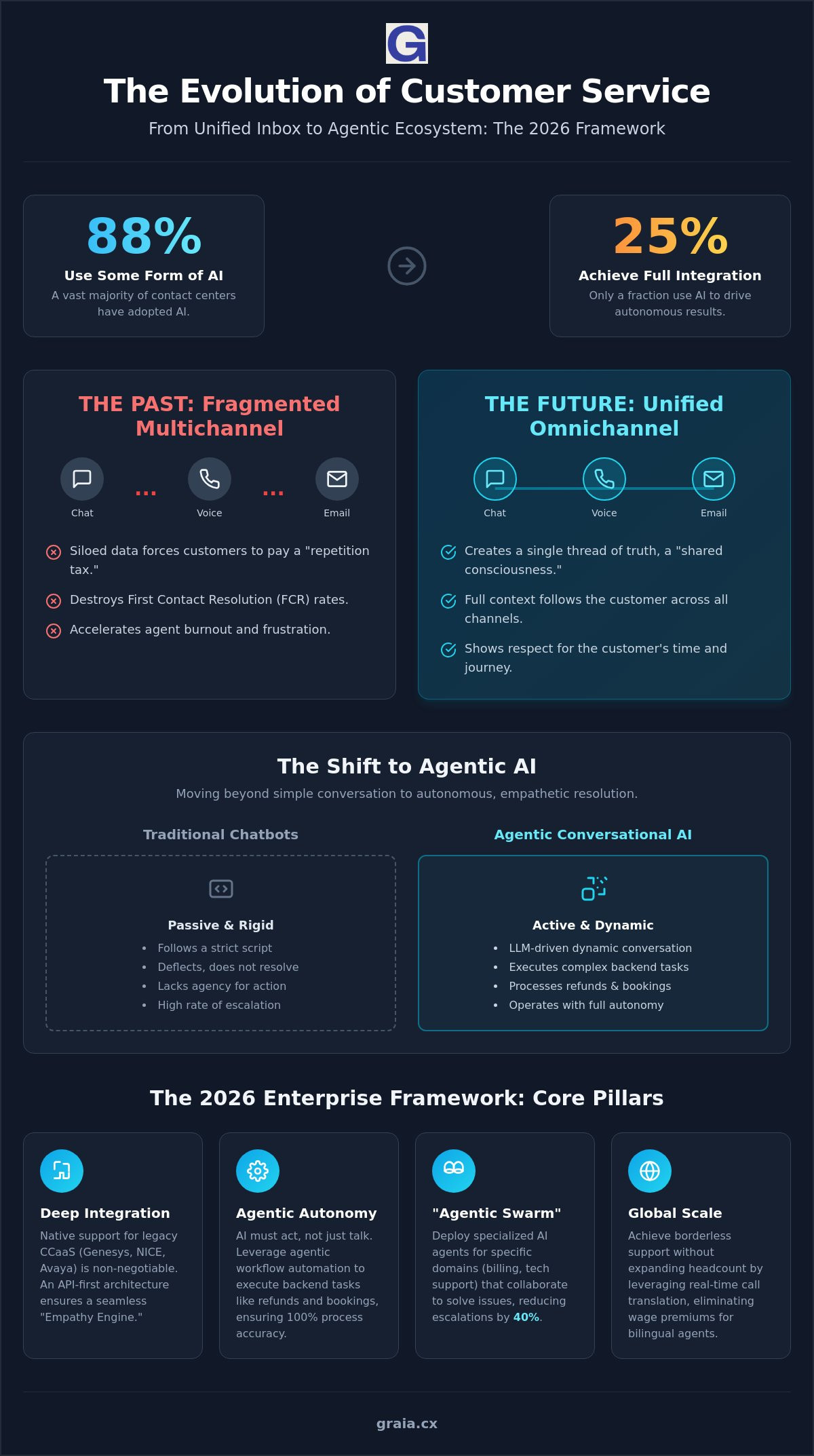
The era of the "unified inbox" is over. In 2026, mere connectivity is no longer a competitive advantage; it's the baseline. While 88% of contact centers utilize some form of AI, only 25% have fully integrated these tools to drive meaningful, autonomous results. Your choice of omnichannel customer service software now determines whether your brand remains trapped in a cycle of fragmented context or evolves into an ecosystem where AI doesn't just talk, it acts.
You've likely felt the friction of a customer repeating their story as they move from a chat bot to a voice call, or the staggering costs of hiring specialized bilingual agents for global support. It's frustrating to manage AI assistants that lack the agency to execute backend tasks like refunds or bookings. This guide promises to show you how to transition to a unified, agentic ecosystem that drives both resolution and empathy. We'll explore how to reduce average handle time through AI assistance, implement seamless human-AI handoffs with full context, and achieve global support capability without expanding your headcount.
Key Takeaways
- Shift from passive messaging to agentic AI that executes complex backend tasks like bookings and refunds autonomously.
- Understand why deep native integration with legacy systems like Genesys and Avaya is essential for preserving context across every touchpoint.
- Eliminate the significant wage premiums for bilingual agents by leveraging real-time call translation for a truly borderless support team.
- Identify the critical pillars of modern omnichannel customer service software that bridge the gap between technical efficiency and human empathy.
- Optimize your operational efficiency with an "Agentic Swarm" architecture designed to reduce escalations by 40% and accelerate resolution times.
Beyond the Unified Inbox: The Shift to Agentic Omnichannel Service
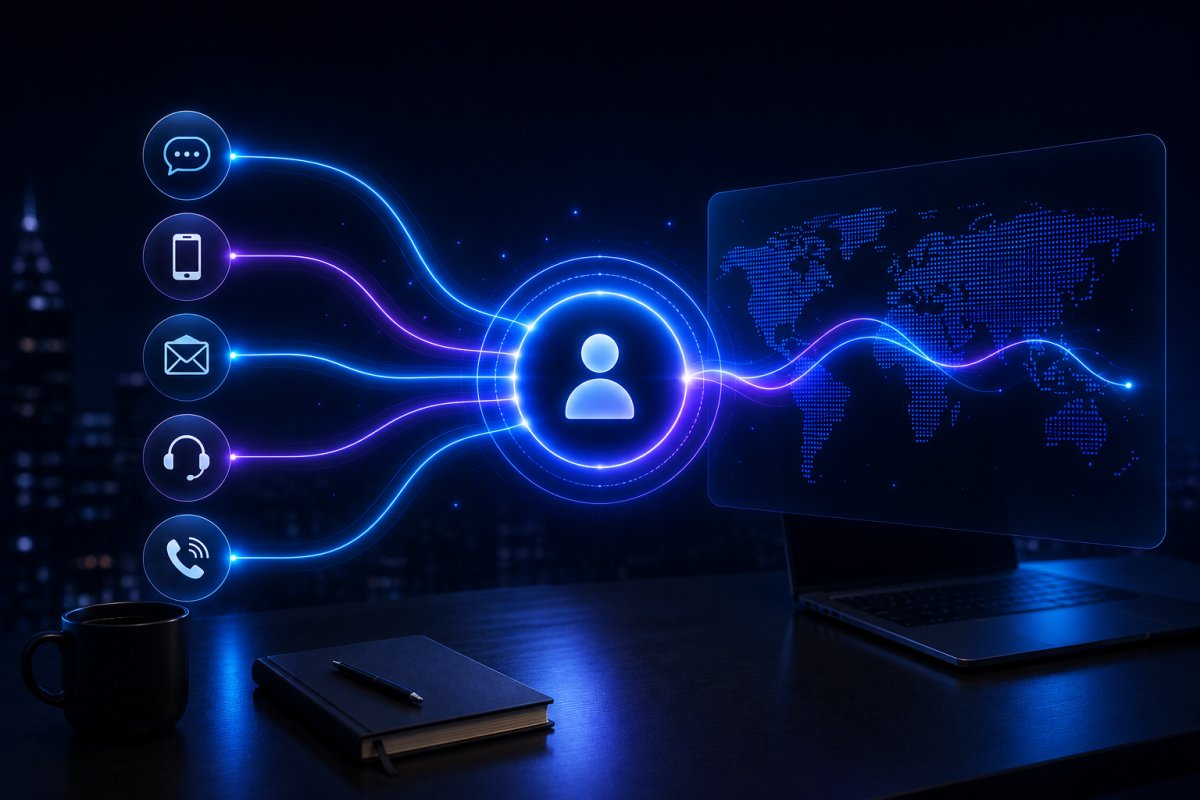
Connectivity is a solved problem. In 2026, simply appearing on every platform is the bare minimum. The real challenge lies in intelligence. Legacy systems often masquerade as modern solutions, but they fail the moment a customer switches channels. True omnichannel business strategy requires more than just a shared inbox. It demands a shared consciousness. To lead in this environment, your organization must transition from fragmented support to a unified, agentic ecosystem that prioritizes both resolution and empathy.
Multichannel vs. Omnichannel: The 2026 Distinction
Multichannel is a collection of silos. You have a presence on chat, voice, and social, but the data lives in isolation. This fragmentation forces customers to pay a "repetition tax" every time they are handed off to a new agent or channel. It’s a drain on your resources. Siloed data doesn't just frustrate customers; it destroys First Contact Resolution (FCR) rates and accelerates agent burnout. Modern omnichannel customer service software solves this by creating a single thread of truth. Voice, social, and email share a persistent memory. When an interaction moves from a WhatsApp chat to a live call, the context follows. The agent sees the full history instantly. This isn't just about convenience. It’s about respect for the customer's time.
The Rise of the Conversational AI Agent
The era of the "if-then" chatbot is dead. These rigid systems only serve to deflect, not resolve. In 2026, the industry has shifted toward dynamic, LLM-driven conversational agents. These aren't passive tools. They are active participants in the service ecosystem. By leveraging agentic workflow automation, these systems can now execute complex backend tasks like processing refunds or modifying flight bookings without human intervention. They operate with a level of agency that was previously reserved for human staff.
To maintain 100% process accuracy, these agents use Retrieval-Augmented Generation (RAG). This grounds the AI in your specific knowledge base, preventing the hallucinations that plague standard models. It ensures brand alignment across every touchpoint. This transition from a "unified inbox" to an "agentic ecosystem" is what defines the next generation of omnichannel customer service software. It’s about moving beyond simple conversation and focusing entirely on autonomous, empathetic resolution.
Evaluating Enterprise Omnichannel Software: The 2026 Framework
The selection process for omnichannel customer service software has undergone a fundamental transformation. Procurement teams no longer prioritize channel breadth alone. Today, the focus has shifted toward integration depth and agentic autonomy. Connectivity is the baseline. Intelligence is the differentiator. To build a resilient service ecosystem, enterprises must evaluate solutions through a lens that balances high-stakes technical performance with deep human empathy.
Native CCaaS support is non-negotiable. If your chosen platform doesn't integrate natively with legacy giants like Genesys, NICE CX, or Avaya, you're building on sand. A bolt-on solution creates lag and data fragmentation. A native integration preserves the "Empathy Engine" by ensuring that every whisper of customer context is available to both human agents and AI assistants in real time. Recent analysis in the Forrester Wave for Customer Service Solutions underscores that the most successful enterprises are those moving away from standalone tools toward deeply integrated, outcome-based platforms.
Core Selection Criteria: Integration and Intelligence
An API-first architecture is the backbone of modern service. Your software must connect seamlessly to your CRM, ERP, and RPA systems to trigger actions, not just words. Top-tier platforms utilize Hybrid Flows. This approach combines the creative flexibility of Large Language Models (LLMs) with deterministic, rule-based logic to ensure 100% process accuracy for regulated tasks.
The most significant advancement in 2026 is the "Swarm" architecture. Unlike traditional, monolithic bots, a swarm assigns specialized agents to specific domains. One agent handles billing. Another manages technical troubleshooting. A third focuses on sales conversion. They collaborate. They share context. They ensure the customer never feels the friction of a departmental handoff. To stay ahead of these architectural shifts, you can explore more about the future of automated resolution at our latest industry insights.
Security and Governance for Regulated Industries
Compliance is no longer a secondary concern. As of March 31, 2025, PCI DSS 4.0 requirements became mandatory, stating that disk-level encryption is no longer sufficient for protecting cardholder data. Modern omnichannel customer service software must provide data-level redaction and PII masking within the stream itself.
- Prompt Shields: These protect your brand by detecting and neutralizing malicious inputs or "jailbreak" attempts in real time.
- Data Sovereignty: Enterprise-grade solutions ensure your proprietary customer data is never used to train external, third-party models.
- Transparent Audit Trails: Every AI-driven decision and API call must be logged with clear reasoning to satisfy internal governance and external regulators.
Scalability must not come at the cost of reasoning speed. As ticket volumes spike, your AI must maintain its cognitive load without degrading the quality of the interpersonal experience. This is the hallmark of a truly enterprise-ready partner.
Agentic Capabilities vs. Standard Messaging: A Solution Breakdown
Most omnichannel customer service software marketed today is merely a digital switchboard. It routes messages. It displays text. But it rarely solves problems. The defining shift of 2026 is the move from passive communication to agentic intelligence. Achieving omnichannel excellence in contact centers now requires systems that can autonomously navigate internal databases and execute business logic without human supervision. If your software can't take action, it's not a solution; it's just another channel for customer frustration.
The Power of Action-Driven Support
Standard messaging tools often stop at "Draft Mode" for emails or basic canned responses for chat. Agentic systems go much deeper. They don't just suggest words; they perform actions. Consider a social messaging bot that doesn't just apologize for a late delivery but actually interfaces with your ERP to reschedule it instantly. This level of autonomy is what separates a legacy tool from a modern ai customer service platform. By fetching real-time data from internal systems during a live conversation, these agents ensure the customer receives a resolution rather than a promise. They can even generate structured summaries for human agents, providing a crystal-clear narrative of the automated interaction to accelerate handoffs and eliminate any lingering context gaps.
Empowering Humans with AI Agent Assist
Not every issue can be fully automated. High-complexity or high-emotion cases still require the irreplaceable nuance of the human touch. This is where ai agent assist tools transform the agent experience from the inside out. Instead of forcing agents to hunt through disparate PDFs for compliance scripts or product updates, the AI provides real-time response suggestions grounded in vetted company data. It acts as a silent, real-time coach. It guides them toward the next-best-action, whether that's a specific technical fix, a regulatory disclaimer, or an empathetic upselling opportunity that aligns with the customer's current intent.
This collaboration reduces cognitive load for your staff. It slashes onboarding times from months to weeks. It ensures that even a new hire can perform with the proficiency of a seasoned expert. When your omnichannel customer service software unifies these agentic capabilities with human empathy, it becomes an engine of growth rather than a cost center. You're no longer just managing tickets; you're orchestrating outcomes.
Solving the Multilingual and High-Volume Scale Challenge
Scaling a global enterprise used to require a massive physical footprint and a fragmented web of regional BPOs. It was an expensive, slow, and often inconsistent approach to customer care. In 2026, the barrier to global entry isn't geography; it's language. For UK-based enterprises, the struggle is particularly acute. Bilingual agents often command wage premiums between 25% and 50% compared to their monolingual peers. This "language tax" makes localized support cost-prohibitive for many, yet ignoring non-native speakers is a guaranteed way to erode market share. Modern omnichannel customer service software must do more than route tickets. It must dissolve the linguistic silos that drive up costs and drive down satisfaction.
Real-Time Voice Translation for Global Contact Centres
The most significant breakthrough in recent years is the transition from basic chat translation to real-time voice synthesis. Your agents can now support over 100 languages and dialects natively within the call flow. This isn't a robotic, detached experience. Sophisticated systems now include formality tuning. This allows the AI to adjust its register based on cultural norms, ensuring that a conversation in German or Japanese maintains the appropriate level of professional respect.
Accuracy is maintained through custom vocabulary training. You can ground the translation engine in your specific brand names, industry jargon, and technical terminology. This prevents the "lost in translation" moments that occur with generic consumer apps. Crucially, the agent hears the original audio’s sentiment, pitch, and volume in the background while reading the translated text. This ensures that the human element, the "Empathy Engine," remains at the heart of the interaction.
Operational Impact of Live Call Translation Software
The efficiency gains are measurable and immediate. By eliminating the need for language-based queues and external interpreters, enterprises are seeing a significant transformation in their core metrics. Integrating live call translation software into your stack can reduce Average Handle Time (AHT) by 15% to 25% by streamlining the communication process.
- Improved FCR: Non-native speakers receive immediate, accurate resolutions without being transferred to specialized departments.
- Audit-Ready Transcripts: Every interaction generates a dual-language transcript, providing a transparent record for dispute resolution and compliance.
- Headcount Optimization: You can scale your global support capability without expanding your physical office footprint or paying exorbitant recruitment premiums.
When your omnichannel customer service software empowers a single agent to handle inquiries from Tokyo, Berlin, and London in a single shift, you've moved beyond mere support. You've achieved operational freedom. To see how these tools can redefine your global strategy, explore our guide to borderless enterprise support.
GraiaCX: The Agentic CCaaS Ecosystem for Global Enterprises
Complexity is the enemy of connection. For the modern enterprise, managing a sprawling network of communication channels often leads to a diluted brand voice and frustrated customers. GraiaCX redefines the category of omnichannel customer service software by moving beyond simple aggregation. It functions as an "Empathy Engine," unifying voice, chat, email, and social messaging into a single, cohesive intelligence. This isn't just about presence. It’s about performance. By orchestrating a multi-agent swarm that understands the nuance of every interaction, GraiaCX ensures that your brand remains both technically superior and deeply human.
The architecture of the future is not monolithic. GraiaCX’s multi-agent swarm architecture represents a paradigm shift in specialized support. Instead of a single, overburdened AI trying to solve every problem, the swarm utilizes specialized agents for distinct domains like billing, technical troubleshooting, or sales. These agents collaborate in real time. They share context seamlessly. This approach has already demonstrated a 40% reduction in escalations and a 60% increase in resolution speed. It allows your human agents to focus on the high-value, high-emotion cases that truly define your brand’s reputation.
The GraiaCX Differentiator: Growth Through Empathy
Speed of deployment is a critical competitive advantage. GraiaCX offers a no-code setup that allows for the rapid deployment of conversational automation across your entire ecosystem. You don't need a massive engineering team to launch sophisticated workflows. By utilizing hybrid RAG retrieval, the platform achieves 100% process accuracy, grounding every AI response in your proprietary knowledge base to eliminate hallucinations.
Security remains the foundation of our partnership. In an era of increasing regulation, we maintain a strict commitment to privacy. Your data stays yours, always. Our platform integrates natively with your existing tech stack, including Genesys, Avaya, and NICE CX. This ensures that your transition to a modern omnichannel customer service software ecosystem is a transformation, not a disruption. The result is a measurable 25% productivity uplift that turns your contact center from a cost center into a primary driver of ROI.
Next Steps for Enterprise Transformation
Evolution requires a roadmap. The first step is assessing your current AI maturity and identifying the specific automation gaps that are hindering your growth. Most enterprises find that piloting agentic workflows in high-volume, low-complexity domains provides the fastest path to proof of value.
- Audit Your Context: Identify where customer data is currently being lost between channels.
- Map Your Swarm: Define the specialized roles your AI agents will need to play.
- Deploy and Refine: Use real-time analytics to tune the "Empathy Engine" for maximum impact.
The transition from fragmented support to a unified, agentic ecosystem is no longer optional. It’s the price of entry for the 2026 market. Request a tailored demo today to see the Swarm architecture in action and discover how GraiaCX can elevate your customer experience to a new standard of excellence.
The Future of Agentic Empathy
The landscape of customer support has fundamentally shifted. Success in 2026 is no longer measured by how many channels you offer, but by how intelligently you unify them. By embracing agentic omnichannel customer service software, you move beyond simple communication and enter a world of autonomous resolution. You've seen how specialized agent swarms can reduce escalations by 40% and how real-time translation can eliminate the language tax that hampers global growth. The technology exists to turn every interaction into a moment of genuine connection.
Security and reliability remain the bedrock of this transformation. GraiaCX delivers this through SOC2-aligned standards and a 99.9% uptime guarantee, ensuring your operations remain resilient and compliant. With native Power BI integration, your enterprise reporting becomes as sophisticated as your customer interactions. The path to a more empathetic, efficient contact center is clear. It requires a partner that values human potential as much as technical precision.
Transform your contact centre with GraiaCX and book your demo today.
Your journey toward operational excellence and deeper customer loyalty starts with a single, decisive step. We look forward to building the future of service alongside you.
Frequently Asked Questions
What is the difference between multichannel and omnichannel customer service software?
Multichannel software provides presence across various platforms but lacks a shared memory, leading to fragmented data. Omnichannel customer service software creates a single thread of truth where every channel shares context in real time. This prevents the "repetition tax" that frustrates customers. It ensures that an agent on a voice call knows exactly what happened in a previous chat session, moving your operation from a collection of silos to a unified, intelligent ecosystem.
Can omnichannel software integrate with my existing CRM like Salesforce or Dynamics 365?
Yes, modern platforms utilize an API-first architecture to connect seamlessly with Salesforce, Dynamics 365, and other enterprise ERPs. This bi-directional integration allows the software to pull customer history and push interaction data back into your system of record. It ensures your CRM remains the definitive source of truth while empowering your service platform with the real-time data needed for autonomous resolution and deep personalization.
How does agentic AI differ from a standard chatbot?
Standard chatbots rely on rigid "if-then" logic to deflect inquiries and often fail at complex tasks. Agentic AI operates with autonomy and purpose. It understands intent, reasons through complex problems, and executes backend tasks without human supervision. By leveraging Retrieval-Augmented Generation (RAG), these agents provide 100% process accuracy. They don't just answer questions; they solve problems by acting as a digital, action-oriented extension of your workforce.
Is real-time voice translation accurate enough for professional customer service?
Real-time voice translation is now a mission-critical tool for global enterprises, supporting over 100 languages with high fidelity. It preserves the original speaker's sentiment and pitch while providing accurate text or voice synthesis. Custom vocabulary training ensures the AI correctly translates brand names and industry jargon. This eliminates the need for expensive bilingual recruitment and allows your existing team to support a borderless customer base without compromising on empathy or quality.
How does omnichannel software handle customer data privacy and GDPR?
Enterprise-grade omnichannel customer service software prioritizes data sovereignty and regional compliance through SOC2-aligned standards. It includes built-in PII masking and data-level redaction to meet PCI DSS 4.0 and GDPR requirements. Your proprietary data is never used to train external, third-party models. Transparent audit trails log every decision and API call, ensuring your operations remain fully compliant with both internal governance and international regulations.
Can AI agents take actual actions, like processing a refund or booking a slot?
Yes, agentic AI is designed to take specific actions by interfacing directly with your internal backend systems. It can process refunds, reschedule deliveries, or update account details autonomously without human intervention. This capability transforms omnichannel customer service software from a simple messaging tool into a powerful engine of resolution. By automating these routine tasks, you reduce average handle times and allow human agents to focus on high-emotion interactions.
Does omnichannel software require a complete "rip-and-replace" of my current contact centre tech?
You don't need a "rip-and-replace" strategy to modernize your contact centre. Leading platforms integrate natively with legacy systems like Genesys, Avaya, and NICE CX. This allows you to layer agentic intelligence over your existing infrastructure without disrupting current operations. It's an evolution, not a replacement. You gain the benefits of modern AI while preserving the stability and investment of your established enterprise communication stack.
How does the software ensure a seamless handoff from AI to a human agent?
The handoff is governed by unified context and structured summaries that appear instantly on the agent's screen. When an interaction escalates, the human agent receives a concise narrative of the AI's previous steps and the customer's intent. They don't have to hunt for information. Every transcript, sentiment analysis, and attempted resolution is visible, ensuring a seamless transition that respects the customer's time and allows for immediate, informed support.