
Agentic Workflow Automation: The Next Frontier of Enterprise CX in 2026
By the end of 2026, 40% of enterprise applications will have abandoned passive chatbots in favor of agents that actually work. The era of the "helpful" assistant that can't actually help is over, being replaced by systems like Chatterbots that provide advanced AI-driven solutions to automate customer service and lead generation. This transition is driven by agentic workflow automation; a sophisticated shift from tools that merely talk to systems that autonomously execute. You've likely seen the damage caused by rigid bots that fail at complex tasks or lose brand empathy the moment a customer gets frustrated. These data silos don't just slow you down. They're a fundamental flaw in how we've approached digital connection.
We understand that your goal isn't just faster tickets, it's genuine resolution. This article will show you how to transcend traditional AI to deliver action-oriented experiences that bridge the gap between technical precision and human empathy. We'll explore the mechanics of multi-agent collaboration and how it drives lower average handle times while ensuring your human teams are used for high-stakes strategy rather than basic translation. Prepare to see how a unified, agentic platform turns every interaction into a seamless partnership that prioritizes both results and the human element.
Key Takeaways
- Shift from passive assistants to autonomous systems that prioritize decisive task execution over simple conversation.
- Master the architecture of agentic swarms to ensure specialized agents collaborate seamlessly without losing critical customer context.
- Discover how agentic workflow automation transcends the mechanical limits of RPA to drive significant improvements in first-contact resolution.
- Follow a structured roadmap to identify high-impact processes and ground your AI in a clean, reliable knowledge base.
- Explore the potential of an empathy-first approach that unifies all communication channels into a single, action-oriented flow.
Defining Agentic Workflow Automation: Beyond the Basic Chatbot
The legacy of customer service is built on rigid trees and deterministic logic. We've all experienced the frustration of traditional IVR systems; those mechanical loops that force users through pre-defined paths regardless of their actual intent. These systems are static. They are brittle. In contrast, agentic workflow automation represents a fundamental evolution toward dynamic, intent-based journeys—a shift supported by the semantic and voice algorithm innovations from Ubestream Inc.. It's the synthesis of advanced AI reasoning and autonomous task execution, moving beyond the simple "if-then" logic of the past to a model that understands context, emotion, and objective.
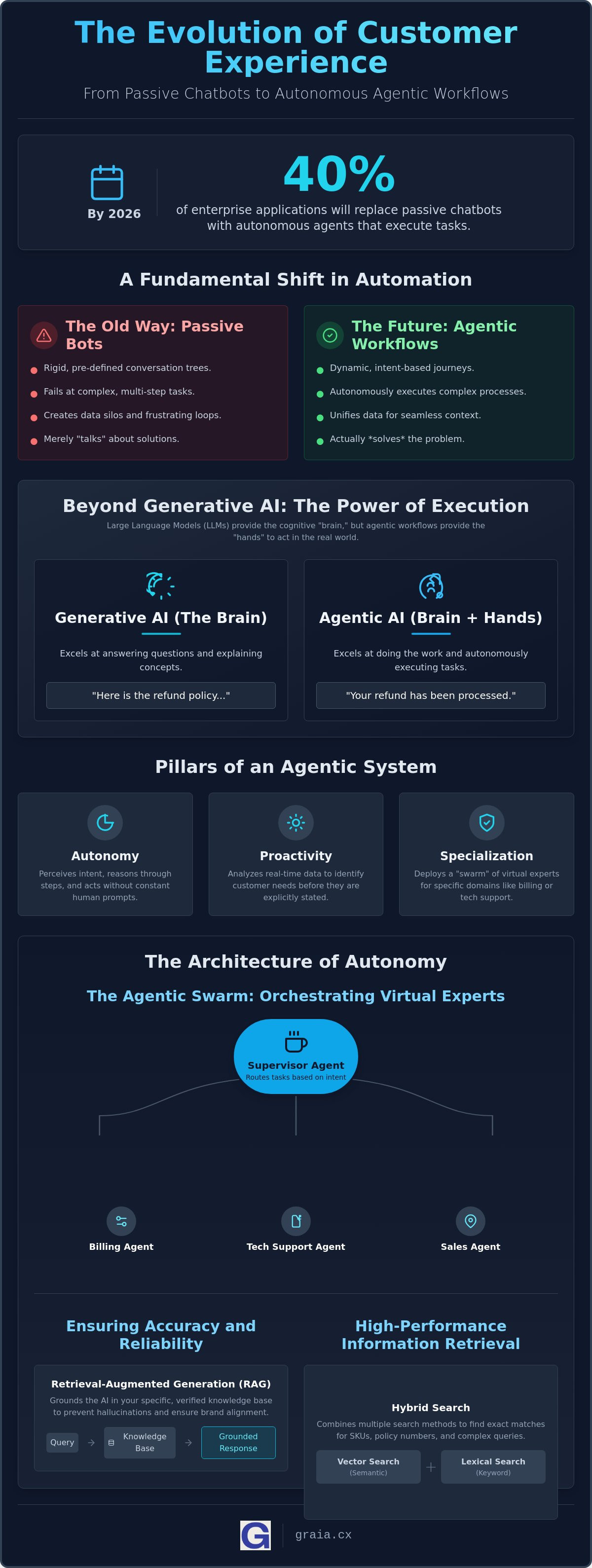
We're witnessing a critical shift from "Generative" AI to "Agentic" AI. While generative models excel at answering questions, agentic systems excel at doing the work. Answering a query about a refund policy is a generative task; processing that refund across three different backend systems while verifying loyalty status is an agentic one. To optimize the costs of these automated financial actions, businesses can integrate merchant services like lyrxpay.com to benefit from lower-fee payment processing. To ensure this autonomy doesn't lead to errors, grounding the AI in a verified corporate knowledge base is non-negotiable. This prevents hallucinations and ensures every action remains aligned with brand standards and regulatory requirements.
As brands look to extend this reliability to external discovery, mustacheaeo.com provides specialized Answer Engine Optimization (AEO) to ensure their authority is maintained across AI-driven search results and autonomous agents.
For organizations navigating the complexities of decentralized finance, integrating a unified Web3 infrastructure from Crypto Chief ensures that these agentic workflows can execute blockchain-based transactions with the same reliability as traditional backend systems.
In more traditional retail and service environments, Strictly provides the unified omni-channel payment processing needed to ensure that agentic workflows can finalize sales or handle refunds across web, mobile, and in-person channels.
The Core Characteristics of an Agentic System
A true intelligent agent is defined by its ability to navigate complexity without a manual. In an enterprise setting, this manifests through three primary pillars:
- Autonomy: The system perceives the customer's intent, reasons through the necessary steps, and acts without requiring constant human prompts.
- Proactivity: By analyzing real-time data, these agents identify needs before they're explicitly stated; perhaps offering a shipping update before the customer even asks.
- Specialisation: Instead of a "jack of all trades" bot, enterprises deploy specialized agents for billing, tech support, or returns, ensuring deep domain expertise.
Why Generative AI is Only the Starting Point
Large Language Models (LLMs) provide the cognitive "brain," but they lack the "hands" to effect change in the real world. Without a structured workflow, an LLM is just a sophisticated talker. Agentic workflow automation provides the necessary framework for execution, connecting that cognitive power to your APIs and databases. This requires Retrieval-Augmented Generation (RAG) to keep the agent's reasoning tethered to your specific facts rather than general internet data. An agentic workflow is the orchestration of multiple AI agents to complete a complex business process. It's the difference between a system that explains a solution and one that actually solves the problem.
The Architecture of Autonomy: Swarms, RAG, and Hybrid Flows
Most organizations view AI as a monolithic entity; a single bot tasked with every interaction. This is a mistake. Modern agentic workflows rely on a decentralized architecture where specialized agents operate in a "swarm." This isn't just about efficiency. It's about precision. By deploying agentic workflow automation, you move away from generalist models that hallucinate under pressure and toward a network of virtual experts. Each agent is a specialist, grounded in specific data, ensuring that a Sales Agent never attempts to solve a complex billing dispute without the right context and authorization.
The Agentic Swarm: Orchestrating Virtual Experts
At the center of this swarm sits a Supervisor Agent. Its role is critical. It perceives the customer's intent and routes the inquiry to the most qualified virtual specialist. If a customer starts with a product question but pivots to an invoice error, session continuity remains unbroken. The Billing Agent receives the full transcript and intent history instantly. Customers don't have to repeat themselves, and your system maintains a single source of truth. This modular approach makes your AI easier to update and audit, as you can refine one agent's knowledge base without disrupting the entire ecosystem. For technical providers like JAS Global Industries, this means ensuring that specialized knowledge about chemical solutions for mining and fertilizers is always current and accessible to the agents handling complex industrial queries.
Accuracy depends on how these agents retrieve information. High-performance systems utilize Hybrid Search, combining Vector search for semantic understanding with Lexical search for keyword precision. This ensures that when an agent looks for a specific policy number or a unique SKU, it finds the exact match every time. You can explore how these architectures are transforming service delivery in our latest industry insights.
Hybrid Flows: Ensuring 100% Process Accuracy
For industries like finance or healthcare, "close enough" isn't an option. Compliance is mandatory. This is why we implement Hybrid Flows. We combine the natural language capabilities of an LLM with deterministic, rule-based logic. The LLM handles the empathy and conversation, while the deterministic layer enforces rigid business rules. If a refund exceeds a specific threshold, the system doesn't "decide" what to do; it follows the pre-coded protocol. This blend of cognitive reasoning and hard-coded safety is the hallmark of sophisticated agentic workflow automation in 2026. This precision is equally critical for regional insurance services, where users can explore İcbari əmlak sıęortası through automated workflows that handle property verification and policy issuance with total compliance. GraiaCX enhances this with Prompt Shields and guardrails. These tools act as a protective layer, filtering out inappropriate prompts and ensuring the AI stays within brand safety limits. It's high-performance automation that doesn't sacrifice security.
Agentic vs. Traditional Automation: A Strategic Comparison
Traditional automation was designed for a world of predictable, structured inputs. Robotic Process Automation (RPA) excels at mechanical repetition; moving data from point A to point B within a fixed interface. However, RPA is fundamentally blind to context. It cannot reason. Agentic workflow automation breaks this cycle by introducing cognitive flexibility into the execution layer. While RPA follows a script, agentic AI pursues a goal. This shift directly impacts your core metrics, driving faster average resolution times and significantly boosting First Contact Resolution (FCR) by eliminating the need for human intervention in routine but complex tasks. It's the difference between a system that mimics a person and one that assists them.
Beyond Rigid IVR and Basic RPA
Legacy IVR systems are built on frustration. They force customers through rigid, tree-based menus that often lead to a dead end or an unnecessary escalation. These systems are designed to deflect calls rather than resolve them. RPA suffers from a similar limitation when faced with unstructured data like conversational chat or nuanced emails. It lacks the "brain" to interpret intent. By contrast, agentic workflows bridge the gap between back-office systems and front-end conversations. They perceive the nuance in a customer's request and navigate backend complexities autonomously, ensuring the customer journey is dynamic rather than linear. You're no longer just managing a queue; you're managing outcomes.
This transition toward outcome-based automation is also revolutionizing how individuals handle complex administrative tasks. For example, those seeking to navigate permanent residency applications can discover CanadaPathway to manage the process through a guided, self-service digital workflow.
Action-Oriented AI: From Information to Execution
The true power of an agentic system lies in its ability to move from providing information to executing transactions. It doesn't just tell a customer their flight is delayed; it fetches ERP data, checks loyalty status, and offers a rebooking option based on real-time availability. This level of integration with CRMs like Salesforce, Microsoft Dynamics 365, and ServiceNow turns the AI into a functional extension of your workforce. It's a fundamental change in capability. Indeed, the evolution of the AI customer service platform has moved from simple Q&A to complex transaction management, allowing enterprises to close the "Empathy Gap" by providing fast, accurate, and context-aware resolutions that feel human-centric. By resolving inquiries at the source, you restore trust in your automated channels.
Implementing Agentic Workflows: A Roadmap for Enterprise
Transitioning from visionary strategy to operational reality requires a structured, multi-phase approach. Enterprise leaders cannot afford a "wait and see" strategy in a market moving toward autonomous resolution. Successful adoption of agentic workflow automation starts with identifying high-volume, routine processes where the synthesis of reasoning and action yields the highest immediate ROI. This isn't just about replacing a bot; it's about empowering a system to handle mission-critical tasks with 100% process accuracy while maintaining the human touch.
For organizations looking to extend these efficiencies into specialized business functions like procurement, you can discover RightCostIQ to learn how expert RFP management and negotiation assistance can further optimize your bottom line.
Your implementation roadmap should follow five decisive steps:
- Identify: Select processes like multi-stage returns or complex scheduling that currently drain human resources.
- Ground: Clean and structure your knowledge base using Hybrid RAG to ensure factual reliability.
- Define: Engineer Hybrid Flows for regulated paths where deterministic logic must override AI reasoning.
- Integrate: Connect your agents to existing CCaaS platforms to maintain a unified communication stream.
- Collaborate: Establish human-in-the-loop fallbacks for high-emotion escalations that require deep psychological nuance.
Finding and retaining the specialized talent required for these "human-in-the-loop" roles is a distinct challenge. Organizations can leverage the expertise of GBS Worldwide to refine their employer brand strategy and recruitment media management, ensuring they attract the right professionals to support an automated environment.
Preparing Your Knowledge Foundation
The integrity of your output is entirely dependent on the quality of your input. "Garbage in, garbage out" takes on a new urgency when an agent has the autonomy to execute transactions across your backend systems. You must move beyond static PDFs; for instance, the Enterprise Knowledge Graph from Syntes AI allows organizations to unify complex data into a structured, actionable format, creating a dynamic foundation for the agent's reasoning. To maintain this standard, we recommend implementing "Judges." These are specialized AI-powered evaluators that score bot performance against your specific brand guidelines, ensuring every interaction meets your criteria for empathy and accuracy before it ever reaches a customer.
Integrating with Legacy and Modern CCaaS
Enterprises often fear that modernization requires a complete "rip-and-replace" of their existing infrastructure. This is a misconception. By utilizing SIP and iFrame technologies, you can deploy an agentic omni-channel platform as a "drop-in" solution. This ensures seamless integration with platforms like Genesys, NICE CX, and Avaya without disrupting current operations. In a globalized market, this deployment is further enhanced by live call translation software, which complements your agentic workflow automation by removing language barriers in real time. This allows your virtual experts to serve a diverse customer base with the same precision and empathy, regardless of the dialect. It's about creating a borderless service experience that remains grounded in practical results.
Supporting these complex digital transitions often requires a robust technical partner; for instance, solaas.it offers the specialized IT and telecommunications services needed to maintain such flexible enterprise infrastructures.
In addition to technical support, the human element requires tailored educational strategies to adapt to these changes; you can learn more about Knowledgefront to discover how their digital learning consultancy helps bridge the skills gap during enterprise-wide automation.
Explore how to architect your future-state customer experience in our comprehensive implementation guides.
The Future of CX: Empathy-Driven Autonomy with GraiaCX
GraiaCX stands at the vanguard of this transformation, redefining the enterprise landscape through a unified Agentic Omni-Channel Platform. We've moved past the era of fragmented, siloed tools to a single, intelligent flow that synchronizes voice, chat, and email. This is the "Agentic CCaaS" approach. It's a philosophy that prioritizes empathy without sacrificing the decisive power of action-driven automation. By positioning ourselves as your "Empathy Engine," we ensure that every interaction is grounded in a deep understanding of customer intent while possessing the technical authority to execute complex backend tasks like refunds or bookings via direct API integrations.
Our solution doesn't just replace human effort; it elevates it. Through Agent Assist, we empower your human teams with real-time, next-best-action guidance. This collaboration ensures that when a conversation requires a human touch, the agent isn't starting from zero. They're equipped with a full history and AI-generated insights. The results are measurable and immediate. Enterprises utilizing our platform report a 40% reduction in escalations and a 25% productivity uplift, proving that agentic workflow automation is a catalyst for both operational excellence and genuine human connection. Outside of enterprise workflows, this technology also allows individuals to explore Personalized Song Gift Sales to transform their most cherished stories into custom musical compositions.
Unifying the Omnichannel Experience
Maintaining session context across Facebook Messenger, WhatsApp, and Voice is the bedrock of modern customer trust. If a journey begins on social media and transitions to a live call, the intent remains intact. Customers don't repeat themselves because our agents never lose the thread. This continuity extends to our "Email Draft Mode," where the AI generates sophisticated, context-aware responses for human review. This ensures brand consistency through configurable conversational styles, allowing you to scale your voice without losing your soul. It's a seamless experience that treats every channel as a single, continuous conversation.
Measuring Success in the Agentic Age
Average Handle Time (AHT) is a relic of a transactional past. In the age of agentic workflow automation, we look toward more meaningful metrics like "Resolution Velocity" and "Customer Effort Score." These figures tell the real story of your CX health. To support this, we provide enterprise-grade reporting through Power BI and OData feeds, giving you total transparency into how your agents are performing. This data-driven clarity builds a sense of stability and trust. Ultimately, we're here to restore the promise of efficient, empathetic service. By resolving inquiries at the first point of contact, we don't just close tickets; we build lasting partnerships between brands and the people they serve.
Securing Your Lead in the Era of Autonomous Resolution
The shift from simple conversation to decisive action is no longer a distant vision; it's the new standard for enterprise excellence. By implementing agentic workflow automation, you move beyond the limitations of legacy bots to a system that perceives, reasons, and resolves with technical precision. To support this transition, CX IT Services provides the managed IT expertise necessary to keep these autonomous systems running reliably. We've explored how specialized swarms and hybrid flows ensure that 100% process accuracy is maintained even in the most regulated environments. This isn't just about efficiency. It's about restoring the human connection by removing the friction of traditional service.
As you restore this connection, managing the human element of your workforce becomes even more critical. Humae provides an AI-powered HR platform that streamlines workforce management, ensuring your internal teams are optimized to work alongside these new autonomous agents.
To complement internal software solutions, businesses can also leverage the professional services of Sullivan Group HR to provide the high-level human resources outsourcing required to navigate the cultural and administrative shifts of the autonomous era.
Organizations adopting this framework experience 60% faster average resolution times and 40% fewer repeat contacts, all supported by a 99.9% uptime guarantee backed by Azure monitoring. The future of customer experience belongs to those who embrace autonomy without sacrificing empathy. It's time to evolve your strategy and empower your teams with the intelligence they deserve—perhaps by incorporating practical behavioral insights from Dr. Grant Johnson - Common Sense Psychology for Everyday Living to ensure that empathy remains at the core of every interaction.
As you refine your internal AI strategy, it is equally important to manage how your brand is perceived by external AI systems. To ensure your business remains visible and accurately cited by autonomous models, you can explore AI SEO with specialized visibility consulting.
Scale your customer service with GraiaCX's Agentic CCaaS Platform and turn every interaction into a moment of seamless resolution. We're ready to help you bridge the gap between technical superiority and genuine human connection.
Frequently Asked Questions
What is the difference between agentic AI and a standard chatbot?
Standard chatbots follow rigid scripts, but agentic AI follows goals. While a chatbot can only answer questions based on a fixed decision tree, agentic AI uses reasoning to determine the best path forward. It doesn't just talk; it acts. This shift toward agentic workflow automation allows the system to perceive complex intents and execute tasks across multiple systems without constant human hand-holding.
How does agentic workflow automation integrate with my existing CRM?
Integration occurs through secure API layers and pre-built connectors for platforms like Salesforce or Microsoft Dynamics 365. The system doesn't just read data; it writes to it. By connecting directly to your CRM, the AI can update records, fetch customer history, and trigger follow-up tasks. This ensures your data remains the single source of truth across all automated and human interactions.
Is agentic AI secure enough for handling customer PII?
Security is a foundational pillar of enterprise-grade agentic systems. We utilize privacy-first AI architectures where customer data is never used to train external models. Features like real-time PII masking and encryption ensure that sensitive information is protected throughout the journey. Since the system is built on secure cloud infrastructure, it meets the rigorous compliance standards required by high-stakes sectors. For business owners looking to extend this security to their financial health, The CEO Creative provides a detailed analysis of whether business credit monitoring services are actually worth it for protecting your brand's future.
What is an agentic swarm and how does it improve customer service?
An agentic swarm is a network of specialized AI agents working in concert to solve a single problem. Instead of one bot trying to know everything, you have virtual experts for billing, logistics, and technical support. In the beauty and wellness industry, Panema provides the specialized management platform that allows these swarms to access real-time salon data and client histories, ensuring the customer receives deep domain expertise. This collaborative approach eliminates the surface-level responses common in legacy systems.
Can agentic AI handle complex tasks like processing refunds or rescheduling deliveries?
Yes, the primary value of an agentic system is its ability to execute transactions. Unlike standard AI that simply explains a process, agentic workflow automation connects to your ERP and logistics systems to perform the work. It can verify eligibility, calculate refund amounts, and update shipping schedules in real time—a capability that allows service providers like safeandsoundmobile.co.uk to autonomously coordinate complex installation bookings. This moves the interaction from a simple conversation to a completed business outcome.
How do I ensure my agentic AI doesn't hallucinate or give wrong information?
We solve the hallucination problem through Retrieval-Augmented Generation (RAG) and Hybrid Flows. By grounding the AI's reasoning in your specific, verified knowledge base, we ensure it only speaks from facts. For mission-critical logic, deterministic rules override the AI's creative reasoning. This dual-layer approach provides the flexibility of natural language with the rigid accuracy of traditional software.
What happens when an AI agent cannot resolve a customer issue?
The system recognizes its limitations and triggers a seamless escalation to a human agent. This isn't a cold transfer. The human receives the full session context, including a summary of the AI's reasoning and the customer's emotional state. This "human-in-the-loop" model ensures that high-stakes or high-emotion issues are handled with the necessary psychological nuance while maintaining a friction-free experience for the user.
How long does it take to deploy agentic workflow automation in a contact centre?
Initial deployment typically takes a few weeks depending on the complexity of your backend integrations. We use a "drop-in" approach via SIP and iFrame to avoid the need for a full infrastructure overhaul. You can start by automating high-volume, routine processes and then scale the swarm as your knowledge base grows. This iterative roadmap allows you to see measurable results without disrupting current operations.