Mastering Contact Center Intent Detection in 2026: The Shift to Agentic CX
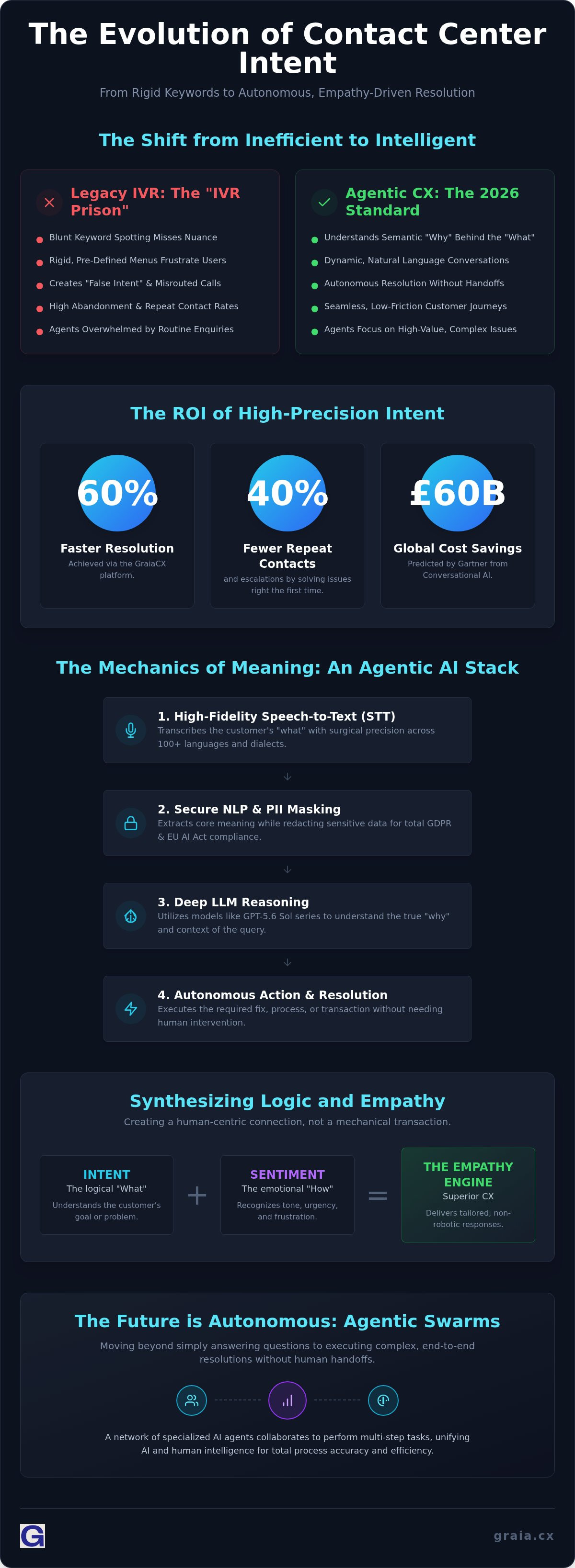
What if your contact center didn't just hear what your customers said, but actually understood what they meant? For years, legacy systems have relied on rigid keyword spotting that forces customers into frustrating, circular IVR trees. It's a broken model that leaves agents overwhelmed by routine enquiries and drives callers to abandon their journey in search of a human who actually listens. In 2026, the standard for contact center intent detection has evolved from simple routing to the cognitive trigger for autonomous, empathy-driven resolution. You've likely felt the pressure to modernise as Gartner predicts conversational AI will slash global labour costs by £60 billion this year alone.
We agree that the era of "good enough" automation is over. You're here because you demand a system that eliminates repetitive handoffs and delivers a seamless experience across every channel. This guide provides a blueprint for building an agentic CX framework that understands, empathises, and resolves issues without human intervention. We will break down the shift toward Agentic CCaaS, examine the regulatory impact of the EU AI Act on emotion detection, and demonstrate how the GraiaCX platform achieves 60% faster resolution times while maintaining total process accuracy.
Key Takeaways
- Master the transition from rigid keyword spotting to sophisticated contact center intent detection that decodes the semantic 'why' behind every customer interaction.
- Explore the technical synergy of STT and LLM reasoning to build a 2026-standard stack that prioritises privacy through rigorous PII masking.
- Synthesise logic and empathy by integrating sentiment analysis into your intent framework to eliminate robotic or tone-deaf customer experiences.
- Leverage 'Agentic Swarm' architecture to move beyond simple answering toward autonomous resolution using action-oriented Conversational Agents.
- Achieve 60% faster average resolution times by unifying AI and human intelligence within the action-oriented GraiaCX platform.
The Evolution of Contact Center Intent Detection: From Keywords to Consciousness
True contact center intent detection is the cognitive bridge between a customer's frustration and a business's resolution. It represents the AI's ability to extract the "why" behind a customer's "what" in real-time, moving beyond mere transcription to genuine comprehension. We've seen a massive shift in the evolution of call centers, where systems once relied on manual switchboards and later, blunt keyword spotting. Legacy technology might catch the word "billing" and route the call to a queue, but it misses the nuance of a customer stating, "I think I was overcharged for my last subscription."
In 2026, semantic understanding is the non-negotiable standard. This level of precision requires an agentic ccaas platform to bridge the gap between understanding a problem and executing a fix. When your system functions as an "Empathy Engine," it recognises that intent is the first step toward growth. Understanding a customer's goal allows the AI to mirror their urgency and provide a tailored response, rather than a generic script. It's the difference between a mechanical transaction and a human-centric connection.
Why Traditional IVR Trees Fail the Modern Customer
Static menus are the "IVR Prison" of customer service. They force users into pre-defined categories that rarely match the complexity of human needs. This creates the "false intent" trap, where a customer selects a generic option and ends up in the wrong department after a long wait. Modern enterprise ai contact center solutions replace these rigid trees with dynamic, natural conversations. By identifying the specific issue immediately, you eliminate the friction that leads to high abandonment rates and frustrated agents who must deal with misrouted calls.
The ROI of High-Precision Intent Recognition
Accuracy translates directly to the bottom line. High-precision recognition is linked to a 40% reduction in repeat contacts and escalations, as issues are resolved correctly the first time. The impact on Average Handle Time (AHT) is equally transformative. When the AI identifies the core issue within the first 10 seconds, it equips agents or virtual assistants with the exact tools needed for resolution. Beyond the individual call, this rich intent data informs workforce management and capacity planning, allowing you to anticipate volume shifts based on the actual topics being discussed rather than just call volume.
The Mechanics of Meaning: How Agentic AI Decodes Intent Across 100+ Languages
Decoding human intent requires a sophisticated orchestration of high-stakes technology. The process begins with high-fidelity Speech-to-Text (STT), flows through Natural Language Processing (NLP), and culminates in deep reasoning powered by the GPT-5.6 Sol series. This stack allows for semantic analysis that identifies a customer's goal with surgical precision. To ensure this intelligence remains secure, GraiaCX integrates PII Masking and Protection as a core feature. This ensures that sensitive customer data is redacted during the intent extraction phase, a critical requirement for compliance with the EU AI Act and GDPR.
Accuracy isn't just about catching keywords. GraiaCX employs a "Hybrid Search" architecture that blends vector and lexical search. This dual approach ensures the system understands contact center intent detection even when customers use regional slang or industry-specific jargon. By using the "Language Profile" feature, enterprises can select specific STT providers to optimise accuracy for local dialects. This technical foundation is essential for the future of customer experience (CX), where understanding must be instantaneous and global.
Multilingual Intent: The Power of Live Call Translation
True contact center intent detection must transcend borders. By leveraging live call translation software, organisations can detect intent in over 100 languages. It isn't just about the words. "Formality Tuning" allows the AI to recognise if a customer expects a formal or informal tone based on their cultural context. We also apply "Speech Correction" rules. These refine recognised speech to remove disfluencies before categorisation, ensuring the underlying meaning is never lost in translation. To explore how these technologies integrate into your existing workflow, you can browse our latest insights on the GraiaCX blog.
Contextual Continuity: Preserving Intent Across Channels
A customer's journey rarely stays in one place. If a user starts an enquiry on WhatsApp and moves to a voice call, the intent must follow them. GraiaCX's "Session Continuity" feature within the unified omnichannel desktop ensures that context is preserved during every handoff. It eliminates the friction of starting over. GraiaCX ensures that every interaction begins where the last one ended, effectively ending the era of customers having to repeat their problems to multiple agents. This persistent understanding allows for a seamless transition between automated systems and human experts.
Intent vs. Sentiment: Merging Logic with Empathy for Superior CX
Logic is the skeleton of customer experience, but empathy is its soul. While intent defines what a customer wants to achieve, sentiment captures how they feel during that pursuit. Without this synthesis, contact center intent detection remains a cold, mechanical exercise. Imagine a customer struggling with a failed payment. If the system only identifies the "payment" intent without sensing the caller's rising anxiety, it delivers a tone-deaf response that exacerbates the friction. We believe that understanding the "why" is only half the battle; you must also master the "how."
GraiaCX's "Empathy Engine" ensures every interaction is contextually aware. Our AI agents don't just process data. They adjust their conversational style in real-time to match the customer's emotional state. A frustrated user receives a concise, professional resolution that respects their time, while a curious prospect might experience a warmer, more descriptive engagement. By prioritising high-urgency or high-frustration intents, the platform ensures that the most vulnerable customer journeys receive the immediate, sophisticated attention they deserve.
Real-Time Emotion Detection as an Intent Modifier
Sentiment acts as a critical modifier for every identified intent. A "Cancellation" request from an angry customer triggers a fundamentally different "Hybrid Flow" than a neutral enquiry. In the former, the system might immediately prioritise the call or offer a bespoke gesture of goodwill to mend the relationship. For global operations, our "Original Audio" detection is vital. It allows agents to hear the emotional subtext and vocal inflections even during translated calls. Combined with "Live Coaching" nodes, the system provides real-time guidance to help agents navigate emotionally charged waters with poise and precision.
Reducing Turnover by Supporting Agents with Emotional Intelligence
The mental toll on frontline staff is immense. High-stakes interactions often lead to burnout, but ai agent assist tools provide a protective layer. By identifying the "emotional path" of a call early, the AI reduces the agent's cognitive load. It offers empathy-grounded response suggestions and uses "Writing Assistants" to maintain brand-consistent warmth mid-conversation. This support doesn't just improve the customer experience. It empowers the agent, fostering a sense of mastery that significantly reduces turnover in high-pressure environments by ensuring they never have to face a difficult interaction alone.
Operationalizing Intent: Deploying Agentic Swarms for Autonomous Resolution
Intent is no longer a destination; it's a catalyst. Traditional contact center intent detection stops once the call is routed to a queue, leaving the customer to repeat their story to a human agent. We believe resolution should begin the moment the intent is identified. By deploying an "Agentic Swarm" architecture, we move beyond simple chatbots to a network of specialised virtual agents. These digital experts are purpose-built for Sales, Billing, or Technical Support, ensuring that every enquiry is met with domain-specific intelligence rather than generic scripts.
Precision is the prerequisite for trust. Graia's agents are action-oriented, moving from simply answering questions to executing complex tasks via deep API integrations. To ensure 100% process accuracy, especially for regulated intents, we utilize "Hybrid Flows." This framework combines the empathetic reasoning of an LLM with deterministic business logic. This synergy allows the system to handle sensitive requests with the necessary guardrails while our "Next Best Action" framework, launching in March 2025, will proactively suggest the optimal path for every unique interaction.
The 5-Step Intent-to-Action Workflow
Transforming a customer's goal into a completed transaction requires a methodical progression. Our architecture follows a structured five-step path to ensure nothing is lost in translation:
- Capture: The system ingests multi-modal input, including voice, text, or even visual data like error screenshots.
- Mask and Extract: We apply PII Protection and Masking to secure sensitive data while determining the primary intent and key entities like Order IDs.
- Assign: The interaction is instantly handed to the specific agent within the "Swarm" best suited for the task.
- Execute: The agent performs the "Hybrid Flow," balancing human-like empathy with strict rules, such as refund limits or eligibility checks.
- Resolve: The issue is closed autonomously, or a seamless handoff occurs where a human agent receives a structured summary of everything discussed.
Actionable Integrations: Connecting Intent to Your CRM and ERP
Data silos are the enemy of effective automation. Graia features native integrations with Salesforce, Microsoft Dynamics 365, and ServiceNow, allowing our agents to act as a true extension of your workforce. An agent can independently reschedule a delivery or update an account status without human intervention. To maintain total transparency, we provide "Conversational Agent Insights." This creates a clear audit trail of every reasoning step the AI took, ensuring you remain in control of the customer journey. To see how these integrations can transform your operational ROI, you can explore our latest technical deep-dives on the Graia blog.
The Graia Advantage: Transforming Intent into Actionable ROI
Success in the modern enterprise isn't defined by the technology you buy, but by the outcomes you orchestrate. Graia brings a 25-year legacy of innovation to the table, providing a foundation of stability in an era of rapid digital upheaval. We've moved beyond the fragmented systems of the past to create a Unified Engagement Platform. This is a space where AI and human intelligence collaborate within a single, fluid stream. It ensures that contact center intent detection isn't a siloed process, but a shared insight that empowers every member of your team to deliver excellence.
Implementation shouldn't feel like a risk. Our SIP and iframe deployment model allows you to achieve Day-1 automation without the need for a costly or disruptive "rip-and-replace" of your existing infrastructure. You gain the power of an Agentic CCaaS while preserving your current investments. Looking toward the end of 2026, our roadmap includes Automated Knowledge Extraction and Sentiment-driven Coaching. These features will allow your system to learn from every interaction, constantly refining its own intelligence to stay ahead of evolving customer expectations.
Measuring Success: Moving Beyond CSAT
Traditional metrics like CSAT often fail to capture the complexity of modern interactions. In 2026, we're introducing more sophisticated indicators of health: the "Intent Resolution Rate" and the "Empathy Score." These provide a deeper look at whether you're actually solving problems and how your brand is perceived emotionally. You can track your contact center roi with ai through our native Power BI integrations, which turn raw data into a narrative of growth. Enterprise clients already report a 25% improvement in agent productivity, as the platform strips away the administrative burden that slows down resolution.
The Future: Proactive Experience Hubs
The vision is clear. We're transforming the contact center from a reactive cost center into a proactive value center. It's a shift from waiting for problems to anticipating needs. We invite visionary leaders to use our "Simulator" tool to stress-test their own intent workflows against real-world scenarios before they go live. This transparency builds the trust necessary for true digital transformation. The era of rigid, frustrating service is over. It's time to empower your team with Graia's Agentic platform and redefine what's possible for your customer experience.
Elevating the Intelligence of Every Interaction
The landscape of customer engagement has reached a critical inflection point. Legacy systems that rely on basic keyword spotting are no longer sufficient to meet the sophisticated demands of the modern consumer. By embracing advanced contact center intent detection, you transition from a reactive posture to a model of proactive, autonomous resolution. We've demonstrated how the synthesis of semantic understanding and emotional intelligence creates a more human-centric experience while driving unprecedented operational efficiency.
Graia delivers this transformation through 25 years of CX innovation. Our partners consistently achieve 60% faster resolution times and 40% fewer escalations by moving beyond simple routing to action-oriented support. It's about empowering your human agents to focus on high-value connections while AI handles the routine with surgical precision. The path to a frictionless future is built on understanding the "why" behind every call. We're ready to help you lead that evolution.
Discover the future of Agentic CX at Graia's Insight Hub
Frequently Asked Questions
What is the difference between intent detection and keyword spotting?
Keyword spotting identifies specific strings like "refund," whereas intent detection understands the semantic goal behind the sentence. A legacy system might flag the word "refund" but miss a customer saying "I need my money back for the broken item." Modern contact center intent detection uses Large Language Models to decode the context and nuance of human speech. It moves from mechanical matching to cognitive understanding, ensuring the customer's actual problem is addressed immediately.
How accurate is AI intent detection for complex customer inquiries?
High-precision intent detection currently achieves near-human levels of accuracy by using Hybrid RAG and deterministic business logic. By combining LLM reasoning with your company’s specific data, the system can untangle multi-part requests that would confuse older bots. It doesn't just guess; it verifies entities like account numbers and order dates against your CRM. This ensures that even the most intricate technical enquiries are categorised and resolved with total process accuracy.
Can intent detection work across different languages and dialects?
The platform supports over 100 languages and various regional dialects through specialised Language Profiles. By selecting specific Speech-to-Text providers for different regions, the system maintains high accuracy for accents that often trip up generic models. It captures the underlying intent regardless of whether the customer speaks formal English or local slang. This global capability ensures that your support remains consistent and empathetic across every territory you serve, regardless of linguistic variation.
How does intent detection handle sarcasm or ambiguous phrasing?
Advanced models use sentiment analysis and contextual clues to distinguish between literal statements and sarcastic remarks. If a customer says "Great, another broken part," the system recognises the negative sentiment and modifies the intent from a compliment to a complaint. This prevents tone-deaf automated responses. By analysing the entire conversation history rather than just the last sentence, the AI resolves ambiguity by looking at the broader context of the interaction.
Is customer data used to train the LLMs for intent detection?
Graia operates on a privacy-first principle where customer data is never used to train external models. We employ PII Protection and Masking as a core feature to redact sensitive information before the intent is even processed. This ensures your enterprise remains compliant with the EU AI Act and GDPR. Your proprietary data stays within your secure environment, providing the benefits of advanced AI without compromising your customers' trust or your corporate security.
How does intent detection improve First Contact Resolution (FCR)?
Intent detection improves FCR by ensuring the customer is immediately paired with the correct resource, whether that's an autonomous agent or a human specialist. By identifying the root cause of an enquiry within seconds, the system eliminates the need for multiple transfers or follow-up calls. It provides the resolving agent with the exact context needed to close the case. This precision turns every initial touchpoint into an opportunity for total resolution without further friction.
What is an 'Agentic Swarm' in the context of intent detection?
An Agentic Swarm is a multi-agent architecture where specialised virtual experts collaborate to resolve a single customer goal. Once contact center intent detection identifies a complex need, it assigns specific tasks to different digital agents, such as one for billing and another for technical troubleshooting. These agents work in parallel to provide a comprehensive solution. This swarm approach allows for deeper domain expertise than a single, general-purpose chatbot could ever provide.
Does implementing intent detection require replacing my existing CCaaS platform?
Implementation does not require a "rip-and-replace" approach thanks to our SIP and iframe integration model. You can layer agentic capabilities over your legacy infrastructure, gaining immediate automation without a massive technical overhaul. This allows you to modernise your customer experience at your own pace. By integrating directly into your current desktop environment, your team can start benefiting from intelligent intent detection without the need to learn an entirely new system.