
Live Translation vs. Bilingual Agents: The 2026 Strategic CX Comparison
The assumption that human-only bilingual staffing represents the absolute pinnacle of global customer experience has become a costly operational liability. While the human touch remains vital, the reality of managing fragmented language queues and paying a 19% wage premium for specialized talent creates a rigid architecture that cannot scale. You're likely facing the exhausting cycle of high attrition and talent scarcity for rare dialects, all while trying to maintain a premium service level. This strategic comparison of live translation vs bilingual agents explores whether your current model is serving your growth or stifling your agility.
At GraiaCX, we understand that the pressure to reduce operational costs must not come at the expense of customer satisfaction. You will discover how to dismantle these silos by comparing the tangible costs, technical accuracy, and empathy levels of AI-driven solutions against traditional staffing. We provide a methodical breakdown of how to support 100+ languages instantly while remaining fully compliant with the 2026 transparency obligations of the EU AI Act and Ofcom. This is your roadmap to a unified, borderless CX engine that elevates human potential through sophisticated computational intelligence.
Key Takeaways
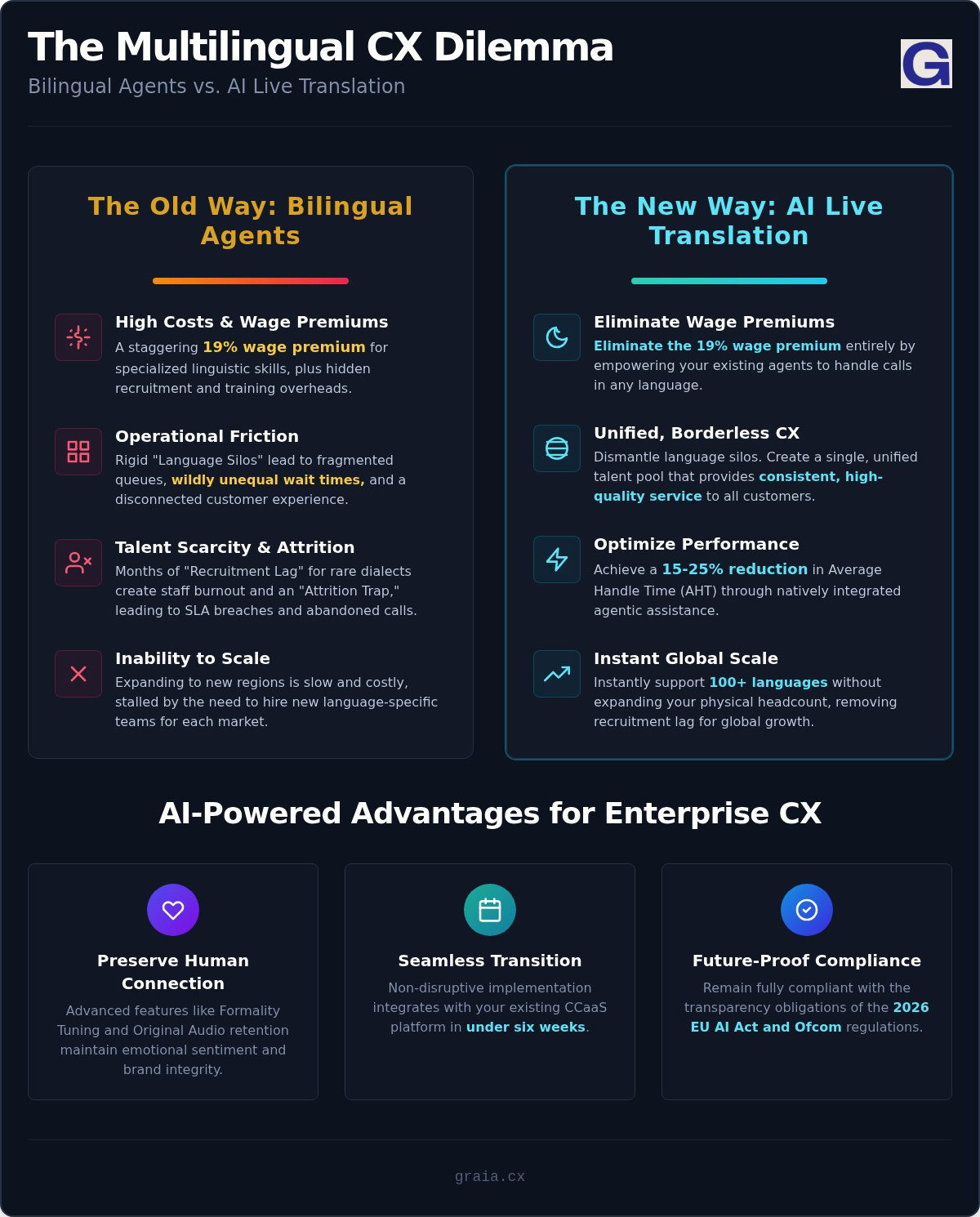
- Eliminate the 19% wage premium and recruitment friction by scaling your support to 100+ languages instantly without expanding your physical headcount.
- Optimize operational performance by achieving a 15-25% reduction in Average Handle Time through natively integrated agentic assistance.
- Master the strategic nuances of live translation vs bilingual agents to move beyond rigid language silos toward a unified, borderless customer experience.
- Preserve human connection and brand integrity using advanced features like Formality Tuning and Original Audio retention that maintain emotional sentiment.
- Transition seamlessly into the future of CX with a non-disruptive implementation process that integrates with your existing CCaaS platform in under six weeks.
The Multilingual CX Dilemma: Bilingual Staffing vs. AI Innovation
For decades, the bilingual agent model stood as the undisputed pillar of international customer support. It relied on a simple, if expensive, premise: to serve a customer in Madrid or Berlin, you must hire a speaker in Madrid or Berlin. This 20th-century approach served its purpose when global markets were siloed. Today, it creates a rigid architecture of "Language Silos" where routing based on tongue results in wildly unequal wait times. A customer speaking English might connect in seconds, while a French speaker languishes for ten minutes. This disparity isn't just an operational friction; it's a brand failure.
GraiaCX Live Call Translation disrupts this imbalance by serving as a real-time voice-to-voice and voice-to-text bridge. It empowers every agent to become a "Universal Agent". The strategic choice between live translation vs bilingual agents is no longer about choosing between a machine and a human. It's about deciding whether your CX engine remains restricted by geography or becomes truly borderless. Modern AI enables universal communication that scales instantly without sacrificing the human nuance required for complex problem-solving. By evaluating live translation vs bilingual agents, enterprises can finally eliminate the recruitment lag that stalls global expansion.
The State of Global Customer Support in 2026
Commerce has evolved into a borderless reality, yet many contact centres remain trapped in local logistics. By 2026, consumer patience has evaporated. Waiting ten minutes for a specific language specialist is a relic of a slower era. Customers expect immediate, high-fidelity resolutions regardless of their native dialect. The emergence of the Universal Agent, augmented by agentic AI, allows brands to meet these expectations. Instead of managing twenty different language queues, leaders at GraiaCX now help organisations deploy a single, unified talent pool that handles any call from any territory.
Defining Live Translation for the Enterprise
Enterprise-grade technology bears little resemblance to the consumer translation apps found on smartphones. While those apps struggle with background noise and specialized terminology, GraiaCX Live Call Translation is a sophisticated CCaaS module designed for high-stakes environments. It prioritizes sub-second latency to ensure the natural cadence of conversation remains intact. This isn't a robotic replacement that strips away personality. It's an empathy-preserving bridge that allows the human agent's intent and tone to reach the customer clearly, regardless of the linguistic barrier.
The Hidden Costs and Operational Friction of Bilingual Agent Models
Maintaining a roster of bilingual agents isn't just a staffing choice. It's a significant financial commitment that often yields diminishing returns as your business scales. The 25-50% wage premium typically paid for specialized linguistic skills represents only the visible portion of the expenditure. Beneath the surface lies a complex web of recruitment fees, training overheads, and shift differentials that inflate the cost per interaction. When comparing live translation vs bilingual agents, the operational friction of the latter often outweighs the perceived benefits of native fluency in high-volume environments.
Finding talent for rare dialects or specific technical proficiencies in a tight UK labour market frequently leads to months of "Recruitment Lag." During these gaps, your existing staff face increased volumes, inevitably triggering the "Attrition Trap." Specialized agents are notoriously difficult to replace. They're more prone to burnout because they cannot be easily supported by the rest of the floor during peak times. This lack of elasticity leads to language-specific queue spikes, resulting in SLA breaches and abandoned calls that damage your reputation.
Wage Premiums and the Bottom Line
The overhead of managing multiple language-specific shifts is staggering. You aren't just paying for the hour worked; you're paying for the scarcity of the skill. When you calculate the contact center roi with ai, the contrast becomes stark. Traditional models require over-provisioning to account for volatility. An agentic model, however, scales with your traffic. This shift allows you to reallocate budget from wage premiums into enhancing the overall quality of your service delivery.
The Fragility of Language-Based Routing
Siloed agents create a "feast or famine" workflow. One language queue might be overwhelmed while agents in another sit idle. This fragmentation often forces customers through multiple transfers just to find a speaker who understands their problem. While following best practices for multilingual websites helps at the digital entry point, the human handoff remains the weak link in traditional setups. A pooled agent model, powered by real-time translation, ensures every agent is a universal resource. Transitioning to this model removes the barriers that prevent your team from performing at their peak. You can explore more about modernising your infrastructure on our GraiaCX innovation blog.
Real-Time Live Translation: How Agentic AI Redefines Multilingual Support
GraiaCX Live Call Translation operates as a sophisticated pipeline, transforming vocal input into translated output with sub-second latency. This process involves converting spoken audio into text via high-fidelity Speech-to-Text (STT), processing that text through a Large Language Model (LLM) for contextual understanding, and regenerating it into the target language using Text-to-Speech (TTS). When weighing live translation vs bilingual agents, the technical superiority of this agentic approach lies in its ability to handle 100+ languages without the physical limitations of a human roster. It effectively removes the "Language Silo" problem discussed earlier by making every agent a universal resource.
Security remains paramount for enterprise deployments within the United Kingdom. GraiaCX ensures strict PII protection by scrubbing sensitive data before it reaches the translation engine. This privacy-first architecture guarantees data sovereignty, ensuring your customer information is never used for external model training. It's a robust, stable alternative to the variable privacy risks often associated with traditional BPO staffing models. By maintaining control over the data flow, you protect your brand's integrity while expanding your global reach.
Beyond Literal Translation: Context and Formality
Literal translation often fails because it ignores cultural nuance. In professional Japanese or German environments, using the wrong level of formality can alienate a customer instantly. GraiaCX solves this through "Formality Tuning," which allows the system to adjust its tone to match specific cultural expectations. This precision is the missing piece in the live translation vs bilingual agents debate. To ensure absolute control, the "Cancel Agent Message" feature allows agents to review and revise a translation before it ever reaches the customer's ear. This technology mirrors the concept of live audio-to-audio (A2A) translation, but with a layer of human-in-the-loop oversight that preserves the interpersonal connection.
Custom Vocabulary: Speaking the Language of Your Brand
Generic AI often stumbles over industry jargon or proprietary product names. GraiaCX overcomes this by implementing Custom Vocabulary, which improves accuracy from a standard 85% to a verified 95-98% with targeted training. This ensures your agents always sound like experts, not robots. For regulated industries in the UK, verbatim script-locked messaging is critical for compliance. By integrating these guardrails, live call translation software provides a level of consistency that human agents, prone to fatigue and improvisation, often struggle to maintain over a long shift.
Strategic Comparison: Performance Metrics, Accuracy, and Human Empathy
Performance in the modern contact centre isn't just about cost per head; it's about the fluidity of the customer journey. When evaluating live translation vs bilingual agents, the most striking metric is the typical 15-25% reduction in Average Handle Time (AHT). By removing the friction of manual interpretation or the need for slow, external over-the-phone services, agents resolve issues with far greater velocity. First Contact Resolution (FCR) also climbs significantly. You're no longer forced to route a complex technical query to a junior agent simply because they speak the language. Instead, you route to the subject matter expert, and the AI handles the linguistic bridge.
The capacity gap between these two models is undeniable. A human agent, no matter how gifted, is physically capped at two or three languages. Graia Live Call Translation supports 100+ languages instantly. This allows your enterprise to scale into emerging markets like Brazil, Vietnam, or Poland overnight without a single local hire. It represents the shift from a rigid, fragile staffing model to an elastic, borderless workforce that responds to demand in real time.
The Empathy Factor: Hearing the Human Voice
Critics often suggest that AI lacks the soul required for high-stakes service. They're mistaken. Graia retains the "Original Audio" alongside the translation, allowing your agents to hear the customer's actual voice. They can detect the sharp intake of breath that signals frustration or the slight lilt of relief that a text-only transcript would miss. This unique feature bridges the empathy gap that often plagues traditional automated solutions. By offloading the exhausting burden of linguistic processing, AI reduces agent cognitive load, allowing your team to focus entirely on genuine human connection rather than mental conjugation.
Accuracy vs. Speed: Finding the Equilibrium
Speed without precision is a liability. Traditional human interpreters often introduce an awkward lag that kills the natural cadence of a conversation. Graia utilizes "Partial Translation" segments, delivering meaning in real-time bursts that maintain the flow of dialogue. With targeted training, accuracy reaches a verified 95-98%, supported by an Agent Assist layer that provides grounded suggestions during the call. This ensures your team stays on-brand and compliant without missing a beat. To see how these metrics transform enterprise operations, explore our latest CX strategy insights.
Implementing Graia Live Call Translation: The Path to Borderless Growth
Modernising a global contact centre often triggers fears of long, disruptive overhauls. This "Rip-and-Replace" myth persists because traditional BPO transitions are notoriously slow. Graia Live Call Translation shatters this expectation. By integrating via SIP and a lightweight iframe, the platform functions as an overlay rather than a replacement. Your existing infrastructure remains intact while your agents gain instant access to a 100+ language bridge. This technical simplicity ensures that the choice between live translation vs bilingual agents is no longer a question of IT capacity, but one of strategic growth.
The implementation follows a methodical 4-6 week tuning process. During this window, we calibrate the Custom Vocabulary and Formality Tuning to your specific brand voice. This isn't a generic deployment. It's a precise alignment of technology with your interpersonal standards. Once active, you can deploy an "Agentic Swarm" architecture. This model allows you to assign your most talented agents to specialized queues, such as billing or technical support, regardless of the language the customer speaks. You move from linguistic silos to a merit-based workforce where skill, not syntax, dictates the customer outcome.
Seamless Integration with Genesys, Avaya, and NICE CX
The Graia Call Translation Agent Widget sits natively within your existing agent desktop. Whether your team uses Genesys, Avaya, or NICE CX, the interface is seamless. There is no need for agents to toggle between windows or manage third-party apps. This unified workspace is the foundation of a modern enterprise ai contact center. It allows your staff to remain focused on the customer while the agentic layer handles the computational heavy lifting of real-time translation.
The Roadmap to ROI
Success is measured through tangible operational gains. By achieving a 15-25% reduction in AHT and a significant climb in FCR, the financial justification becomes undeniable. You eliminate the recruitment friction and premium salaries associated with the traditional model. The "Writing Assistant" feature further ensures that every response, whether spoken or typed, maintains your brand's specific tone and compliance standards. This isn't just a tool; it's a multilingual customer experience engine designed for the high-stakes demands of 2026. To lead this transformation in your organisation, explore the Graia blog for the latest in CX innovation.
The Evolution of a Borderless Customer Experience
The era of fragmented language queues and restrictive hiring premiums is reaching its end. By transitioning from traditional staffing to an agentic model, your organisation can achieve a typical 15-25% reduction in AHT while supporting over 100 languages and dialects instantly. This shift isn't just about efficiency; it's about empowering your best talent to serve any customer, anywhere, without the friction of a linguistic barrier. When you evaluate the agility of live translation vs bilingual agents, the strategic advantage of a unified, AI-augmented workforce becomes undeniable.
Integrating this capability doesn't require a technical overhaul. With native support for Genesys, Avaya, and NICE CX, you can deploy a sophisticated multilingual engine that preserves human empathy through original audio retention and formality tuning. It's time to move beyond the limitations of geography and embrace a truly global service standard. Elevate your global CX strategy with the Graia Live Call Translation engine and lead your organisation into a more connected, resilient future. Your journey toward operational excellence starts today.
Frequently Asked Questions
Is live call translation accurate enough for technical support?
Yes, accuracy reaches a verified 95-98% when the system is trained with your specific data. Graia Live Call Translation utilizes Custom Vocabulary to master complex technical jargon that generic tools often miss. This precision is vital for UK industries where technical clarity is a non-negotiable requirement. It ensures your subject matter experts can solve intricate problems without language barriers ever obstructing the resolution process.
Does live translation sound like a robot to the customer?
No, the platform employs high-fidelity Text-to-Speech that maintains a natural conversational cadence. We also retain the "Original Audio" so your agents can hear the customer's true emotional tone. This prevents the interaction from feeling clinical or detached. Features like Formality Tuning ensure that cultural nuances are respected; making the experience feel deeply human and sophisticated rather than mechanical or transactional.
How much can I save by replacing bilingual agents with AI translation?
You can eliminate the 19% wage premium typically paid for bilingual talent in the current market. By removing the need for specialized language-based routing, you also reduce recruitment fees and training overheads significantly. The cost per interaction drops as you move away from rigid staffing models. This allows you to scale your support to 100+ languages without a proportional increase in your physical headcount.
Can Graia Live Call Translation handle brand-specific product names?
Yes, the system uses a Custom Vocabulary feature to ensure absolute accuracy for your proprietary terms. You can upload specific product lists and industry-specific jargon directly into the engine. This prevents the AI from misinterpreting your unique brand identity or technical specifications. It guarantees that your universal agents always sound like seasoned experts on your specific offerings; regardless of the language they are speaking.
What happens if the AI makes a mistake during a live call?
The system includes a human-in-the-loop "Cancel Agent Message" feature for immediate oversight. If an agent notices a potential mistranslation on their screen, they can intervene or revise the text before it reaches the customer. Agent Assist also provides grounded suggestions to keep the conversation on track. This redundancy ensures that the human agent remains the protective guide; maintaining the integrity of the entire customer interaction.
Does Graia integrate with my existing Genesys or Avaya platform?
Yes, Graia integrates natively with Genesys, Avaya, and NICE CX platforms. It functions as a lightweight iframe or SIP overlay that sits directly within your existing agent desktop. This means your team won't need to switch between different applications or manage new software windows. The implementation is designed to be non-disruptive; allowing your contact centre to go live in as little as four weeks.
Is my customer data used to train the translation models?
No, your customer data is never used for external model training. Graia follows a privacy-first architecture that prioritises data sovereignty and UK GDPR compliance. All PII is scrubbed before processing to ensure maximum security for your enterprise. This protective framework ensures that your organisation remains compliant with the latest 2026 transparency obligations while protecting the interpersonal experience of every caller you serve.
How does live translation affect Average Handle Time (AHT)?
You will typically see a 15-25% reduction in Average Handle Time. By eliminating the lag of manual interpretation and the need for slow language-based transfers, resolutions happen with much greater velocity. When comparing live translation vs bilingual agents, the AI model removes the friction that usually stalls global support calls. This efficiency allows your team to handle higher volumes without sacrificing the quality of the connection.