
How to Measure Contact Centre Efficiency: The 2026 Framework for Agentic CX
What if the metrics you have used to define success for decades are now the very things sabotaging your brand’s future? You likely feel the mounting pressure to automate, yet you're still tethered to rigid benchmarks that penalize agents for the deep empathy required in complex human interactions. Learning how to measure contact centre efficiency in 2026 requires a fundamental shift in perspective. It is no longer about how fast a human speaks, but how effectively an Agentic Swarm orchestrates a resolution.
We understand that bridging the gap between legacy systems and autonomous AI feels like a high-stakes gamble. You need to prove the ROI of automation beyond simple deflection rates while maintaining 100% process accuracy via Hybrid Flows. This article provides the roadmap you need to master the transition to agentic KPIs. You'll learn to balance operational speed with AI-driven intelligence, reducing costs without sacrificing the interpersonal quality of your brand.
We will break down the specific metrics for a hybrid workforce and show you how to integrate these insights into your current reporting infrastructure like Power BI. From reducing human cognitive load to leveraging Live Call Translation, we're moving toward a future where efficiency and empathy coexist seamlessly.
Key Takeaways
- Shift your focus from Average Handle Time to Resolution Velocity to measure how effectively your team solves problems rather than just how quickly they end calls.
- Deploy Autonomous Resolution Time (ART) as a core metric to evaluate the success of your Conversational Agents in resolving multi-step customer journeys without human intervention.
- Eliminate costly language silos by using Live Call Translation to unify your global support queues and reduce the operational burden of specialized bilingual staffing.
- Master how to measure contact centre efficiency by syncing real-time data with Power BI, creating a transparent framework that tracks both human empathy and AI speed.
- Secure 100% process accuracy through Hybrid Flows while using AI-powered "Judges" to ensure every automated interaction maintains your brand’s emotional standards.
Beyond AHT: Why Legacy Efficiency Metrics Need a 2026 Upgrade
The metrics that once signaled operational health now often mask systemic decay. For decades, leadership teams focused on volume; today, we must prioritize value. Contact centre efficiency is the ratio of successful resolutions to total resource expenditure across human and AI channels. If your dashboard still prioritizes Average Handle Time (AHT) above all else, you're likely penalizing your best performers for solving the very problems your AI couldn't. Understanding how to measure contact centre efficiency in this new era requires discarding the volume-based lens in favor of a holistic, agentic framework.
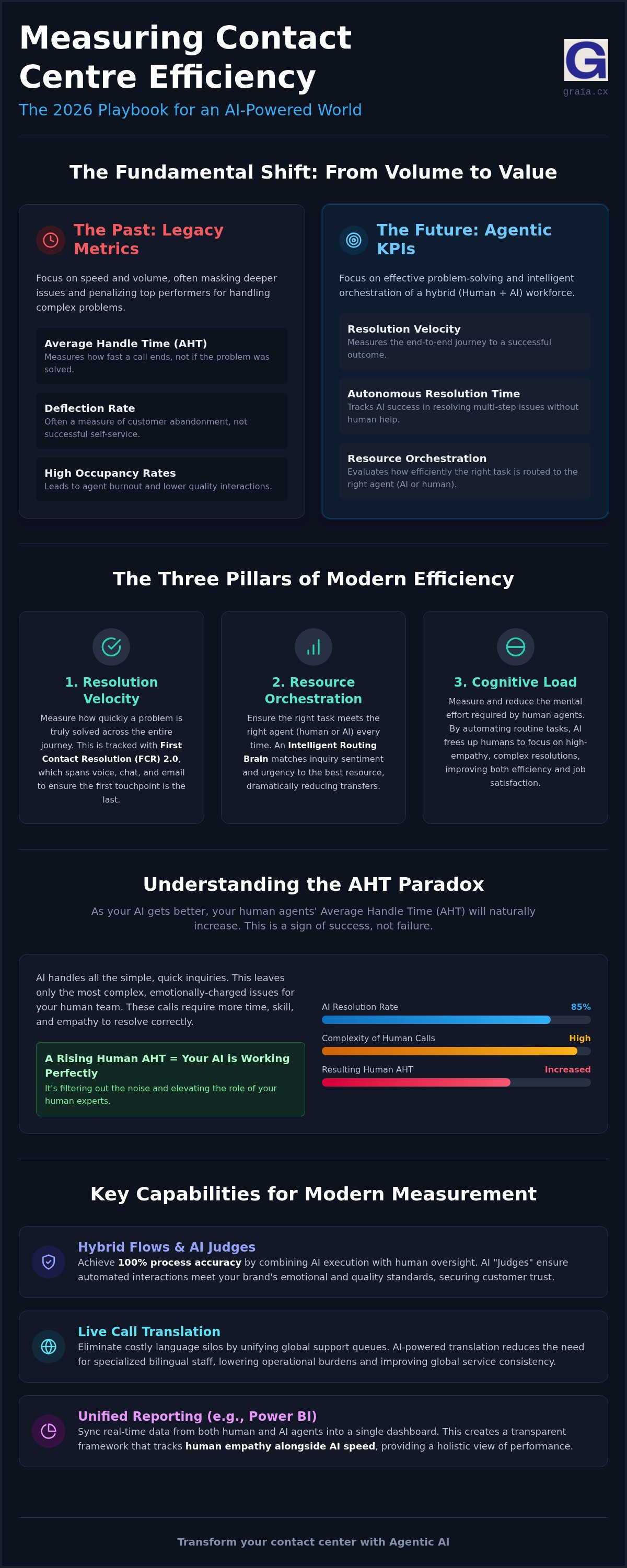
This shift reveals the AHT Paradox. As Conversational Agents resolve routine inquiries, the remaining queue for human agents consists exclusively of high-complexity, emotionally charged issues. Naturally, these calls take longer. A rising human AHT is often the clearest indicator that your AI is working perfectly; it's filtering out the noise and leaving the nuanced work to the people who handle it best. We must stop measuring how fast a human can end a conversation and start measuring how effectively they can resolve a crisis.
The Failure of Traditional IVR Metrics
Traditional IVR systems relied on "deflection" as a success metric, but deflection is often just a polite term for customer abandonment. When a system lacks deep intent understanding, it forces "Zero-Outs," where frustrated users bypass automation entirely to reach a human. This creates inefficient, siloed queues and destroys the integrity of First Call Resolution (FCR) data. True efficiency doesn't push the customer away; it pulls the resolution closer by ensuring the first touchpoint is the final one.
The Rise of the Hybrid Workforce
The 2026 workforce is hybrid. We must redefine the "Agent" to encompass both our human staff and our Conversational Agents. An Agentic CCaaS platform orchestrates these resources, ensuring that a simple password reset goes to AI while a delicate retention conversation reaches a human. Speed is the baseline, but empathy is the differentiator. To maintain brand loyalty, your measurement framework must track the emotional resonance of an interaction alongside its technical resolution. Efficiency is no longer a mechanical tally. It's a strategic orchestration of human talent and machine intelligence.
The Three Pillars of Modern Contact Centre Efficiency
Efficiency in the agentic era isn't about exhausting your workforce through high occupancy rates. It's about orchestration. When we evaluate how to measure contact centre efficiency today, we must look beyond the mechanical speed of a single interaction. We focus on three foundational pillars: Resolution Velocity, Resource Orchestration, and Cognitive Load. These pillars ensure that your operation remains lean without sacrificing the psychological well-being of your agents or the satisfaction of your customers.
By shifting focus from volume to these strategic areas, leaders can unlock true contact center roi with ai. It's a transition from simply managing a queue to mastering a multi-agent ecosystem where every resource is utilized at its highest potential.
Resolution Velocity vs. Handle Time
Resolution Velocity measures how quickly a problem is solved across the entire customer journey, not just how fast a call ends. We use First Contact Resolution (FCR) 2.0 to track these outcomes across voice, chat, and email simultaneously. Action-Driven AI plays a critical role here. Unlike basic bots, a Conversational Agent executes multi-step tasks within the flow. Graia’s Hybrid Flows ensure 100% process accuracy during these tasks, which eliminates the need for customers to call back to fix errors made during the initial automation phase.
Optimising Resource Orchestration
The right task must meet the right agent every time. We utilize an Intelligent Routing Brain to match the sentiment and urgency of an inquiry to the most appropriate resource. This might be a specialized human agent or a specific AI module within a Swarm Architecture. This level of precision significantly reduces transfer rates. When you improve initial intent recognition, you stop the "ping-pong" effect where customers are bounced between departments, a common drain on operational resources. You can explore more about these integrated strategies in our latest industry insights.
Reducing Cognitive Load
The final pillar is the mental effort required from your human staff. We measure cognitive load to prevent burnout and ensure agents have the mental bandwidth for high-empathy interactions. Agent Assist provides real-time coaching and automated documentation, allowing agents to focus on the person, not the software. When agents aren't fighting their tools, they solve problems faster and with greater accuracy. This isn't just a productivity gain; it's a fundamental elevation of the human role within the digital framework.
Measuring the Impact of Agentic AI and Automation
Legacy deflection metrics are a relic of a transactional past. In a sophisticated 2026 framework, we no longer celebrate when a customer simply stops talking to us. We celebrate when their problem is resolved. If you want to master how to measure contact centre efficiency, you must distinguish between a call that was "contained" by a bot and one that was truly resolved. This distinction is the foundation of Autonomous Resolution Time (ART), a metric that tracks the speed and success of your self-service ecosystem.
The true power of an agentic system lies in its ability to act, not just converse. Graia’s Conversational Agents achieve up to 60% faster resolution times by executing backend API tasks directly. By removing the need for a human to bridge the gap between the chat interface and the database, you eliminate the friction that historically slowed down the customer journey. Efficiency is the result of direct action.
ART: The New Standard for Self-Service
Autonomous Resolution Time (ART) provides a unified view of efficiency across voice, chat, and email. Unlike traditional containment rates, ART measures the duration from the initial intent recognition to the confirmed resolution of the task. To maintain high accuracy during these autonomous sessions, we utilize Hybrid RAG retrieval. This ensures the AI isn't just guessing; it's pulling from a privacy-first, verified knowledge base to provide 100% process accuracy. If an interaction doesn't result in a confirmed resolution, it isn't counted toward your efficiency gains.
Quantifying Agent Assist Value
When an issue is too complex for automation, the transition to a human must be seamless. We measure Handoff Context Retention to track how often customers are forced to repeat their details. A high retention score indicates that your AI is successfully passing intent, sentiment, and history to the human agent. Integrating ai agent assist tools into the daily workflow further elevates this process by providing real-time "Next Best Action" suggestions.
We track the Agent Assist Adoption Rate to see how frequently staff rely on these AI-driven drafts and summaries. This has a direct impact on operational costs by:
- Reducing After Call Work (ACW) through automated interaction summaries.
- Shortening "Time to Proficiency" for new hires by providing an on-the-job digital coach.
- Lowering the cognitive burden on veteran agents, allowing them to handle more complex cases without exhaustion.
By measuring these specific AI-human synergies, you gain a clearer picture of how to measure contact centre efficiency in a way that reflects the modern hybrid workforce. You aren't just looking at how much work is being done; you're looking at how intelligently that work is being distributed.
Multilingual Efficiency: Breaking the Language Silo
Language barriers act as a hidden tax on global operations. They force leaders into a binary choice: hire expensive bilingual staff or accept poor service levels in non-primary markets. When considering how to measure contact centre efficiency on a global scale, you must account for the Bilingual Wage Premium. Industry data suggests these specialized agents command a 25% to 50% premium over their monolingual counterparts, yet they often sit in siloed queues that lack the elasticity of the main pool. This creates a fragmentation of resources that destroys your operational leanness.
Breaking these silos requires a shift toward Queue Fluidity. This is the ability for any agent to handle any call, regardless of the primary language spoken. By integrating live call translation software, you transform your entire workforce into a global response team. You don't need to manage ten different language-specific queues; you manage one unified flow of talent. This orchestration ensures that your most skilled problem solvers are always available to your most valuable customers, irrespective of geography.
Reducing AHT with Real-Time Translation
Speed in a multilingual environment is often hampered by the latency of traditional translation methods. We solve this through Partial Translation. This technology allows agents to begin processing a request before the customer has even finished their sentence, providing a head start on the resolution process. To maintain technical accuracy, we employ a Custom Vocabulary that recognizes industry-specific terminology across more than 100 languages. Organizations typically see a 15% to 25% reduction in AHT after just four to six weeks of system tuning. It's about maintaining the pace of resolution without the friction of a language gap.
Operational Flexibility and Staffing
The elimination of language pods simplifies your staffing model and significantly reduces agent stress. When agents feel empowered to handle any global inquiry through a seamless translation widget, their confidence grows. This empowerment has a measurable impact on attrition rates, as the job becomes less about struggling with vocabulary and more about solving complex customer problems. You're no longer hiring for language skills first and service skills second. You're hiring the best problem solvers and giving them the tools to speak to the world. Discover more strategies on how to measure contact centre efficiency in our comprehensive CX resource library.
How to Implement a Modern Measurement Framework
Transitioning from legacy metrics to an agentic model requires more than just new software. It demands a structural reimagining of your data architecture. To master how to measure contact centre efficiency, you must build a framework that bridges the gap between raw technical performance and genuine customer resonance. This process begins with four decisive steps that turn fragmented data into a unified strategy for growth.
- Step 1: Integrate CCaaS data with Enterprise BI. Stop relying on surface-level CRM reports that lack visibility into AI reasoning or "Swarm" handoffs. Use OData to feed your Agentic Omni-Channel Platform data directly into Power BI for a deep-dive analysis of your operational health.
- Step 2: Define Empathy Guardrails. Deploy AI-powered "Judges" to score 100% of interactions. These judges ensure that while efficiency increases, your brand’s emotional intelligence and technical accuracy remain intact.
- Step 3: Audit Bot-to-Human escalation paths. Identify logic gaps where customers are forced to repeat themselves. Every handoff is a potential point of friction that must be smoothed through better context retention and intent recognition.
- Step 4: Shift from Cost Centres to Experience Hubs. Start tracking churn risk reduction alongside operational savings. When you resolve an issue autonomously, you aren't just saving pennies; you're protecting the long-term value of the customer relationship.
Data Integration and Transparency
Transparency is the foundation of trust in any digital transformation. Traditional systems often act as black boxes, providing results without explaining the reasoning behind an AI's decision. By prioritizing Conversational Agent Insights, you create a robust audit trail for every interaction. This allows you to use AI Guardrails to monitor compliance and brand voice automatically across all channels. When you visualize the entire customer journey in a single pane, you see the true impact of how to measure contact centre efficiency across voice, chat, and social media simultaneously.
Continuous Optimisation with Simulators
The most resilient frameworks don't wait for customer feedback to identify errors. We use Bot-to-Bot simulations to stress-test your resolution logic before it ever reaches a live environment. These simulators help identify potential model hallucinations or low-confidence responses by analyzing token-level probabilities. This proactive approach ensures that your Hybrid Flows maintain 100% process accuracy from day one. Ready to modernise your operations? Explore enterprise ai contact center solutions to begin your transition to a value-driven, agentic future.
Orchestrating the Future of Agentic CX
The transition from legacy metrics to an agentic framework is no longer a distant vision; it's an operational necessity for the 2026 enterprise. You've seen that mastering how to measure contact centre efficiency requires a shift from counting minutes to quantifying resolutions. By embracing metrics like Autonomous Resolution Time and Resolution Velocity, you prioritize the customer’s outcome over the agent’s speed. This evolution allows your human talent to focus on high-empathy interactions while AI handles the technical execution with 100% process accuracy.
Graia’s platform is built on a 99.9% uptime guarantee via Microsoft Azure infrastructure, ensuring your global support never sleeps. Our partners reduce escalation rates by up to 40% while supporting 100+ languages through real-time live call translation. You don't have to choose between operational leanness and human connection. You can have both. It's time to lead your organization toward a future where every interaction, whether human or AI, is a catalyst for brand loyalty.
Transform your efficiency with Graia’s Agentic CCaaS Platform and start building a more intelligent, empathetic contact centre today.
Frequently Asked Questions
What is the most important metric for contact centre efficiency in 2026?
Resolution Velocity has overtaken traditional duration-based benchmarks as the definitive metric for success. While legacy systems focused on ending calls quickly, modern frameworks prioritize how effectively a problem is solved across the entire customer journey. By focusing on First Contact Resolution (FCR) 2.0, leaders can ensure that their how to measure contact centre efficiency strategy accounts for the total effort required to reach a verified outcome, regardless of the channel used.
How does AI handle time (AHT) differ between human and autonomous agents?
Conversational Agents typically achieve up to 60% faster resolution times because they execute backend API tasks directly without manual data entry. In contrast, human AHT often rises in an agentic environment. This happens because AI handles routine queries, leaving only complex, high-value interactions for staff. You shouldn't penalize humans for this increase; it's a sign that your automation is successfully filtering out the simple noise and elevating the human role.
Can I measure contact centre efficiency in real-time?
You can achieve total real-time visibility by integrating your CCaaS data with enterprise business intelligence tools like Power BI. Using an OData feed allows you to monitor agentic swarms, human performance, and customer sentiment as they happen. This transparency is vital for identifying logic gaps in bot-to-human escalation paths. Real-time tracking ensures you can pivot your routing strategy immediately if specific queues become inefficient or if sentiment scores begin to drop.
How do I calculate the ROI of an agentic CCaaS platform?
Calculating ROI requires looking beyond simple labor savings to track a 40% reduction in escalations and a 25% improvement in agent productivity. You must factor in the "Bilingual Wage Premium" savings provided by Live Call Translation and the reduction in "Time to Proficiency" for new hires using Agent Assist. By analyzing the total cost per resolution rather than the cost per call, you gain a true understanding of how to measure contact centre efficiency in financial terms.
What is the difference between call deflection and autonomous resolution?
Call deflection is a legacy concept that often hides poor experiences by simply moving customers away from human agents. Autonomous resolution is the proactive completion of a task within an AI channel using Hybrid Flows and RAG retrieval. While deflection might result in a "Zero-Out" where the customer restarts the journey in frustration, autonomous resolution ensures the customer’s intent is fully met. True efficiency is measured by successful outcomes, not just diverted volume.
How does live call translation affect average handle time?
Live call translation typically reduces AHT by 15% to 25% after an initial tuning period of four to six weeks. It eliminates the significant delays associated with third-party interpreters and the confusion of language barriers. Features like Partial Translation allow agents to see recognized speech in real-time, enabling them to begin processing requests before the customer finishes speaking. This fluidity speeds up the interaction while maintaining high technical accuracy through custom vocabularies.
What role does sentiment analysis play in measuring efficiency?
Sentiment analysis acts as a critical "Empathy Guardrail" that prevents efficiency gains from damaging your brand perception. It allows your Intelligent Routing Brain to match high-urgency or negative-sentiment customers with your most experienced human agents automatically. By tracking sentiment alongside resolution speed, you ensure that your operation isn't just fast, but also emotionally intelligent. This balance is what transforms a standard cost centre into a sophisticated, value-driven experience hub for your global audience.
How can I track the efficiency of my remote contact centre agents?
Tracking remote efficiency requires a unified omnichannel desktop that provides consistent real-time analytics regardless of the agent's physical location. You should use Agent Assist tools to provide remote staff with the same level of coaching and next-best-action guidance they would receive in a physical centre. By monitoring "Handoff Context Retention" and "After Call Work" (ACW) levels, you can identify if remote agents are struggling with cognitive load or technical friction in their home environments.