
How to Get Executive Buy-In for CX Projects: The 2026 Strategic Blueprint
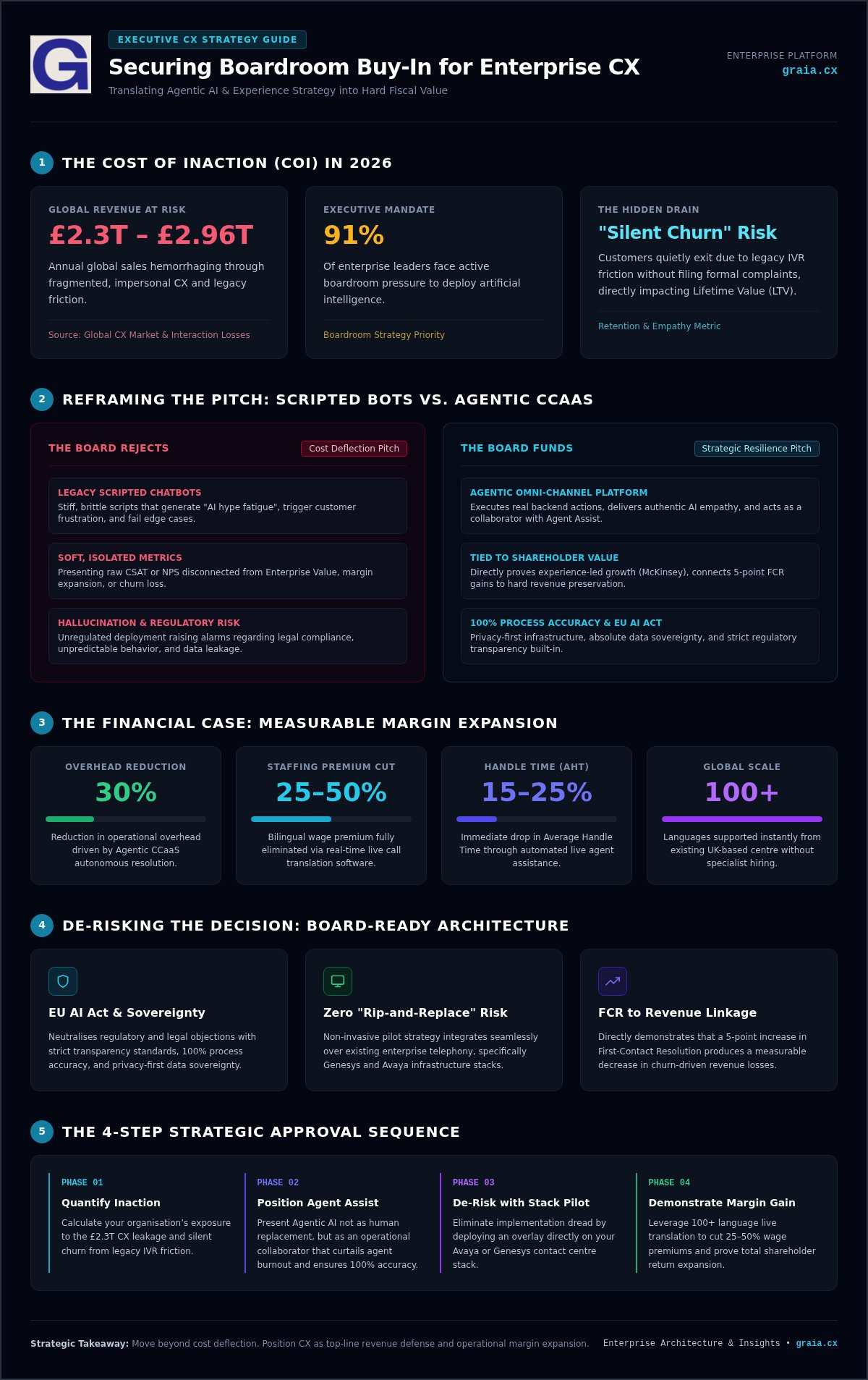
Nearly £2.3 trillion in global annual sales is currently hemorrhaging through the cracks of fragmented, impersonal customer experiences. You understand that genuine customer empathy isn't a soft metric; it's a hard-coded requirement for retention in 2026. However, translating that conviction into a funded reality is increasingly difficult as boards grow weary of AI hype and unproven promises. This challenge is precisely why learning how to get executive buy-in for cx projects is now the definitive survival skill for the visionary CX leader.
You face a boardroom that demands 100% process accuracy and absolute data sovereignty, leaving many leaders struggling to bridge the gap between technical potential and fiscal approval. This blueprint provides the sophisticated strategy required to reframe complex technology as a shield for your organisation’s top-line revenue. We will break down the precise, data-backed arguments for Agentic AI, demonstrate how to navigate the strict transparency requirements of the EU AI Act, and provide a clear roadmap to secure the budget and momentum your next project deserves. It's time to move beyond cost deflection and start pitching strategic resilience.
Key Takeaways
- Reframe your narrative from technical functionality to strategic resilience to address the £2.3 trillion global revenue risk linked to poor customer experiences.
- Master how to get executive buy-in for cx projects by translating Agentic AI capabilities into the financial language of margin expansion and the reduction of bilingual staffing premiums.
- Neutralise security and compliance objections by presenting a privacy-first framework that aligns with the EU AI Act and guarantees absolute data sovereignty.
- De-risk the transition with a non-invasive pilot strategy that integrates seamlessly into your existing Genesys or Avaya stack without a costly rip-and-replace overhaul.
- Transition your contact centre from a reactive cost centre to a proactive revenue engine that uses real-time intelligence to predict churn and identify growth opportunities.
Why Your CX Pitch Fails: Bridging the Gap Between Tech and Vision
Executives don't reject CX projects because they lack interest in customer satisfaction. They reject them because the pitch often sounds like a request for a bloated cost centre. While you speak about "omnichannel synergy," the board hears "expensive infrastructure." This fundamental misalignment is why so many leaders struggle when researching how to get executive buy-in for cx projects. By 2026, the stakes have evolved; the empathy gap is no longer a soft HR concern but a documented financial liability. Recent data suggests nearly £2.96 trillion of global annual sales is at risk due to poor interactions. To win the room, you must pivot from a reactive cost-saving narrative to a growth-enablement strategy that treats CX as a primary revenue engine.
The Language of the Boardroom
Standard metrics like NPS and CSAT often fail to move the needle in a high-stakes budget meeting. You need to bridge these metrics to Enterprise Value and Customer Lifetime Value (LTV). Executives are particularly sensitive to "Silent Churn," the quiet exodus of customers who abandon a brand due to legacy IVR friction without ever filing a formal complaint. Integrating foundational customer experience management disciplines ensures your proposal aligns with the CEO’s top strategic priorities: top-line growth, risk mitigation, and operational leverage. When you connect a 5-point increase in First-Contact Resolution to a specific reduction in churn-related revenue loss, you stop asking for a budget and start offering a solution.
The Problem with "Bot-First" Thinking
Boardrooms are suffering from "AI hype" fatigue. They've seen rigid, scripted chatbots fail and fear the legal repercussions of AI hallucinations in regulated sectors. To secure support, you must differentiate between legacy bots and modern Agentic AI. Executives are skeptical of tools that provide static answers; they want systems that execute backend actions. Position your Agentic Omni-Channel Platform as a sophisticated collaborator that empowers human talent rather than a clumsy replacement. By focusing on 100% process accuracy and using Agent Assist to reduce burnout, you address the executive fear of unpredictability while delivering the "AI empathy" that modern UK consumers now consider standard.
Constructing the Financial Case: Beyond Simple ROI to Strategic Value
Securing a budget requires a shift from defensive accounting to offensive value creation. Executives are no longer moved by vague promises of better service; they demand a framework that ties every pound spent to measurable market dominance. McKinsey's analysis on experience-led growth demonstrates that organisations prioritising journey quality outperform their peers in total shareholder return. Understanding how to get executive buy-in for cx projects means presenting a financial model that accounts for both immediate efficiency and long-term expansion.
The Cost of Inaction (COI) is your most persuasive weapon. In a landscape where 91% of leaders face board pressure to deploy AI, standing still is a choice to lose market share. Mastering how to get executive buy-in for cx projects requires you to quantify the gap between your current performance and the potential of an agentic future. Agentic CCaaS reduces operational overhead by 30% through autonomous resolution. This isn't just about cutting costs. It's about reallocating human talent to high-value interactions that drive loyalty.
The Multilingual Multiplier
Entering new territories traditionally requires a massive capital outlay for specialised bilingual staff. These roles often carry a 25-50% wage premium, creating a significant barrier to entry for UK firms looking to scale globally. By implementing live call translation software, you eliminate this premium entirely. You enable your existing UK-based centre to support over 100 languages instantly. This approach typically yields a 15-25% reduction in Average Handle Time (AHT) within just six weeks, as agents no longer struggle with language barriers or awkward handoffs. It transforms the contact centre from a local support hub into a global growth engine.
Productivity Gains through Agent Assist
High agent turnover is a silent killer of contact centre margins. The constant cycle of hiring and training drains resources and dilutes the quality of the customer experience. Modern ai agent assist tools provide real-time transcripts and next-best-action suggestions that slash onboarding time by 25% while driving significant improvements in First-Contact Resolution (FCR). When agents feel supported by intelligent systems, their satisfaction scores rise and burnout rates plummet. This stability creates a more resilient operation and a more persuasive case for investment. You can explore our latest ROI frameworks to see how these productivity gains translate into enterprise-level savings.
Navigating Executive Objections: Security, Compliance, and Data Sovereignty
Even the most robust financial model can falter when faced with the scrutiny of a CISO or Compliance Officer. When you are refining your strategy on how to get executive buy-in for cx projects, you must address the "AI trust deficit" head-on. The primary concern for any UK board is data sovereignty. They need an ironclad guarantee that proprietary customer interactions won't be used to train public foundation models. By positioning your project within the NIST AI Risk Management Framework, you transform a perceived risk into a demonstration of rigorous governance.
Modern Agentic platforms utilise a "Prompt Shield" defence to neutralise toxicity and injection attacks. This isn't just a technical feature; it's a strategic safeguard for your brand’s reputation. To ensure 100% process accuracy, we employ Hybrid Flows that combine the conversational fluidity of LLMs with the deterministic certainty of rule-based logic. This creates an "Audit-ready AI" environment, providing a transparent trail of reasoning that satisfies even the most stringent compliance officers. It's about building a system that is as accountable as it is intelligent.
The Privacy-First AI Mandate
Enterprise-grade security requires more than just encryption. It demands a Privacy-First AI approach, leveraging frameworks like the Azure OpenAI Trust Framework to ensure data remains within isolated tenant partitions. Automated PII masking ensures that sensitive information is never exposed, maintaining strict compliance with GDPR and Ofcom regulations. For UK organisations, regional hosting is non-negotiable. It ensures that data never leaves the jurisdiction and remains under your total control, providing the peace of mind that executives require to sign off on large-scale digital transformations.
Mission-Critical Accuracy
Hallucinations are the enemy of executive confidence. To prevent AI from inventing facts, we use Hybrid Search (RAG) to ground every interaction in your vetted knowledge base. This ensures the AI only speaks from a position of verified truth. Before any workflow reaches a customer, it is stress-tested by a layer of AI "Judges" who evaluate responses for accuracy and brand alignment. This multi-layered validation ensures that your Conversational Agent maintains a consistent, professional voice that reflects your organisation’s values, regardless of the complexity of the query. By demonstrating this level of control, you make it much easier to understand how to get executive buy-in for cx projects that involve sensitive customer touchpoints.
The Pilot Strategy: Proving Agentic Value Without a "Rip-and-Replace" Risk
One of the most persistent obstacles to understanding how to get executive buy-in for cx projects is the perceived threat of technical paralysis. C-level leaders often associate AI transformation with multi-year "rip-and-replace" cycles that jeopardize operational stability. To bypass this skepticism, you must lead with a "drop-in" integration strategy. By layering AI modules onto your existing Genesys, NICE CX, or Avaya stacks via SIP and iframe, you demonstrate immediate value without disrupting the core telephony architecture. This low-risk approach works. It allows you to secure quick wins within a 90-day window by focusing on high-volume, low-complexity use cases that provide instant relief to your human agents.
Establishing clear "Success Gates" is essential for sustaining momentum. These are pre-defined performance milestones, such as a 40% reduction in escalations or a 25% improvement in agent productivity, that trigger subsequent phases of investment. When you prove that the initial pilot generates measurable efficiency, the conversation shifts from budget justification to strategic scaling. You aren't just asking for funds; you're presenting a validated roadmap for enterprise-wide evolution.
The Low-Friction Entry Point
Starting with a narrow, high-impact scope significantly reduces deployment risk and executive anxiety. Many organisations find success by first implementing Email Draft Mode or Agent Assist to support their frontline teams. These tools leverage your existing CRM and ERP data to ensure the AI is action-oriented from day one, providing agents with the intelligence they need to resolve issues faster. By choosing a SaaS-based model, you also minimize initial CAPEX, which is often a primary concern for the CFO. This strategy ensures you're delivering results before the first major invoice is even due.
Scaling with the Swarm
Once the initial value is established, you can transition to a more sophisticated "Agentic Swarm" architecture. This involves deploying specialized virtual agents-each an expert in a specific domain like Billing, Returns, or Tech Support-who work together to solve complex customer journeys. Unlike monolithic bots, these specialized agents possess deep expertise that ensures higher accuracy and better customer outcomes. Enterprise AI contact center solutions maintain perfect context across every channel, ensuring that when an interaction moves from AI to a human, no information is lost. This seamless handoff protects the interpersonal experience while maximizing operational leverage.
Ready to build your pilot roadmap? Explore our 90-day implementation guide to start your transformation today.
Presenting the Agentic Future: Moving from Cost Centre to Revenue Engine
The final hurdle in learning how to get executive buy-in for cx projects is painting a vivid picture of the "after" state. By 2026, the most successful organisations have moved beyond reactive ticket management. They've built a predictive hub where the contact centre acts as a radar for the entire enterprise. This isn't a cost centre anymore. It's a revenue engine that uses real-time intelligence to identify churn risks before they escalate and spots upsell opportunities when the customer is most receptive. When you present this vision, you're offering the board a way to future-proof the organisation against rising labour costs and the persistent talent shortages facing UK service centres.
Closing your pitch requires a return to the bottom line. You must frame contact center roi with ai as a definitive competitive advantage rather than a mere technical upgrade. In a market where 73% of consumers switch to a competitor after a few bad interactions, the ability to deliver consistent, empathetic, and accurate service at scale is the only sustainable way to protect your margins. You aren't just buying software. You're securing the brand's future. Mastering how to get executive buy-in for cx projects means proving that the cost of inaction far outweighs the investment in innovation.
The Proactive Hub
An Agentic CX platform does more than just answer queries. It captures the "voice of the customer" with granular precision, feeding real-time insights directly into your product roadmap and marketing strategy. If a specific feature causes friction, the AI identifies the trend across thousands of sessions before your human analysts can even run a report. This session continuity across social, voice, and email builds a level of brand loyalty that legacy systems simply cannot match. It even converts abandoned calls into automated multi-channel follow-ups, ensuring that every missed connection is a recovered opportunity for growth.
Final Call to Action for CX Leaders
Your next step is to develop a 12-month Agentic CX roadmap that balances immediate productivity gains with long-term strategic evolution. Start by identifying the high-impact use cases we've discussed, from Live Call Translation to Agent Assist, and map them against your organisation’s core KPIs. The path to transformation is methodical, but the urgency is real. Those who wait for the "perfect" moment risk being left behind by more agile competitors who are already reaping the rewards of agentic automation.
We invite you to dive deeper into the technical implementation guides and strategic frameworks available on our site. Secure your seat at the forefront of CX innovation-explore our latest insights and start building the future of your contact centre today.
Securing Your Strategic Mandate
The transition from legacy support to an Agentic future is no longer a technical choice; it is a strategic necessity. By reframing your narrative around strategic resilience and quantifiable empathy, you can finally bridge the gap between technical potential and boardroom approval. We have explored how a "drop-in" integration de-risks the pilot phase while delivering an immediate 40% reduction in escalations and repeat contacts. This isn't just about operational efficiency. It's about leveraging 25 years of industry-leading CX innovation to protect your organisation's top-line revenue.
Understanding how to get executive buy-in for cx projects requires a sophisticated balance of technical expertise and financial foresight. With a 99.9% uptime guarantee backed by Azure, you can present a roadmap that is as stable as it is visionary. It's time to move beyond defensive accounting and start leading the boardroom conversation on growth. Master the strategic shift to Agentic CX-read the GraiaCX blog. The future of your contact centre is ready for activation, and the momentum starts with your next pitch.
Frequently Asked Questions
How do I quantify the ROI of an AI CX project?
You quantify ROI by measuring both operational leverage and value protection. Focus on the 25% improvement in agent productivity and the 40% reduction in escalations GraiaCX typically delivers. Combine these with Silent Churn prevention metrics to show how the project protects top-line revenue. This data-backed approach is essential when learning how to get executive buy-in for cx projects. By linking these efficiencies to Customer Lifetime Value, you'll transform a cost conversation into a strategic investment.
What is the biggest mistake when pitching CX technology to executives?
The most common failure is focusing on technical features rather than enterprise value. Executives don't view terms like omnichannel as expensive infrastructure but as a growth engine. To succeed, you must reframe the pitch around strategic resilience and quantifiable empathy. Avoid the pilot trap of undefined outcomes. Instead, present a clear 12-month roadmap with defined Success Gates that align with the CEO's top priorities: growth, risk mitigation, and operational scale.
How can I ensure AI accuracy in a regulated industry?
Accuracy in regulated sectors is achieved through Hybrid Flows that combine the fluidity of LLMs with deterministic, rule-based logic. This ensures mission-critical processes follow rigid business rules that the AI cannot circumvent. We use Retrieval-Augmented Generation (RAG) to ground every response in your vetted knowledge base, preventing hallucinations. Additionally, prompt shields and output scanning provide the necessary guardrails to maintain compliance with Ofcom and GDPR standards while ensuring brand consistency.
Does Agentic AI require replacing our existing contact centre software?
No, modern Agentic AI is designed for non-invasive drop-in integration. You can add sophisticated AI modules to your existing Genesys, NICE CX, or Avaya stacks via SIP and iframe. This eliminates the need for a costly rip-and-replace overhaul of your core telephony architecture. It's a key factor in how to get executive buy-in for cx projects, as it preserves your current investments while unlocking advanced automation.
How long does it take to see results from a CX AI pilot?
You can expect to see measurable results within the first 90 days of a focused pilot. Specifically, organisations using Live Call Translation typically achieve a 15-25% reduction in Average Handle Time (AHT) within just 4 to 6 weeks of tuning. By selecting a high-volume, low-complexity use case for the initial phase, you generate the rapid proof of value required to trigger further enterprise-wide investment and maintain boardroom momentum.
What is the difference between a chatbot and an Agentic AI agent?
Traditional chatbots are often rigid, scripted tools limited to answering FAQs via decision trees. In contrast, an Agentic AI agent is action-oriented and capable of executing actual transactional tasks. These agents integrate with your CRM and ERP systems to process refunds, reschedule deliveries, or update accounts autonomously. While chatbots don't resolve inquiries, Agentic agents do so with human-like empathy and technical precision, moving the contact centre from a cost centre to a proactive hub.
How does Live Call Translation affect Average Handle Time (AHT)?
Live Call Translation significantly reduces AHT by eliminating the friction of language-based queues and the need for awkward handoffs to bilingual staff. Agents can process multilingual requests in real-time, often seeing a 15-25% reduction in handle time within 6 weeks. It also removes the 25-50% wage premium associated with bilingual hiring. This efficiency allows your existing UK centre to support over 100 languages instantly, streamlining operations and improving first-contact resolution.
Can I use my existing CRM data to power the AI without security risks?
Yes, you can leverage your CRM data safely through a privacy-first AI framework. GraiaCX ensures absolute data sovereignty, meaning your proprietary customer interactions and knowledge bases are never used to train public or foundation models. We utilise regional hosting and PII masking to protect sensitive information in alignment with GDPR. It's about grounding the AI in your own vetted data via RAG to ensure high accuracy without compromising security or customer trust.