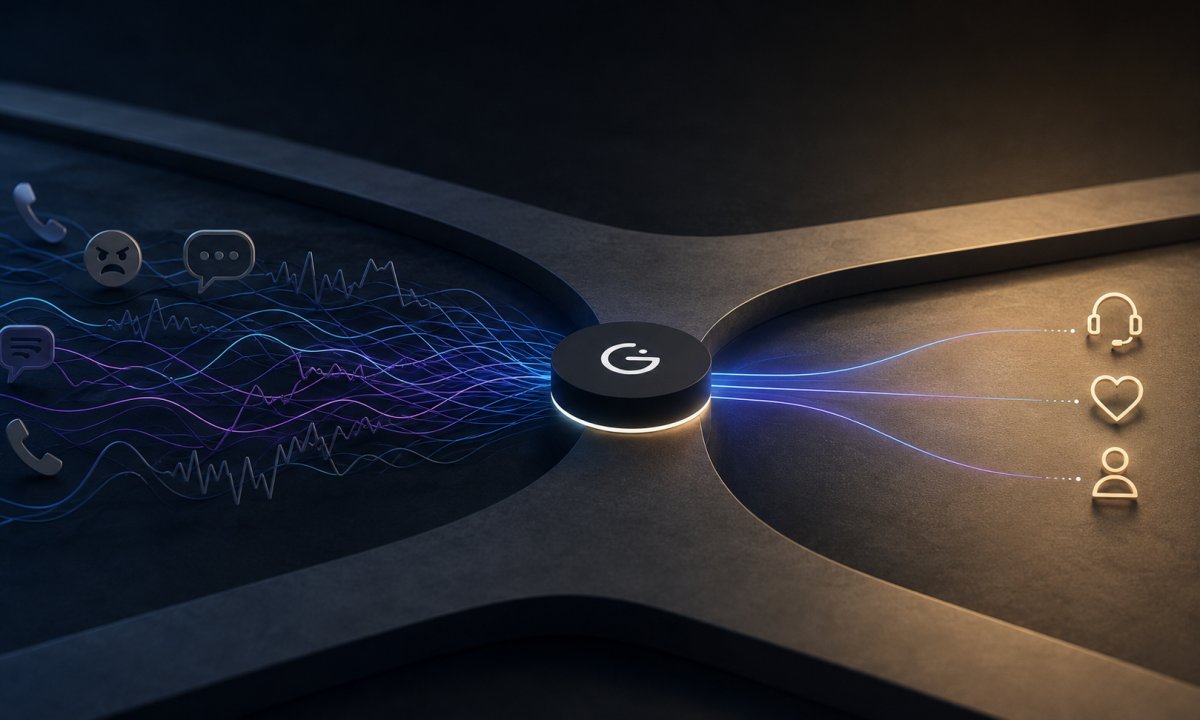
Contact Centre Emotion Detection AI: The 2026 Guide to Empathetic Automation
Most contact centres spend millions measuring how much their customers hate them, only to receive the data weeks after the caller has already churned. This reactive approach to contact center emotion detection ai is a fundamental flaw that leaves your best agents burnt out and your customers feeling like they're shouting into a void. You know the frustration of watching high-value users walk away because a scripted bot failed to sense their mounting desperation. It's a systemic failure of empathy, but it's one that visionary leaders are finally ready to rectify.
This guide reveals how modern emotional intelligence transforms cold data into immediate, empathetic action. You'll learn how to move beyond passive sentiment reporting to orchestrate real-time resolutions that slash handle times and bridge the gap between AI and human support. We will explore the shift toward agentic swarm architecture, showing you how to empower your team with the precision of an "Empathy Engine" designed for the 2026 landscape.
Key Takeaways
- Bridge the empathy gap by moving beyond rigid keyword-matching to address the underlying emotional triggers that drive customer churn.
- Harness multimodal contact center emotion detection ai to interpret vocal tone, linguistic nuance, and situational context for a deeper understanding of caller intent.
- Transition from passive historical sentiment reporting to live emotional intelligence, allowing your team to intervene during the moments that matter most.
- Orchestrate an "Agentic Swarm" architecture that routes interactions based on emotional intensity, ensuring high-stress escalations reach your most resilient specialists.
- Equip human agents with real-time assistance and empathetic response suggestions to accelerate resolution times and reduce the cognitive load of high-stakes interactions.
The Empathy Gap: Why Traditional Contact Centres Feel Robotic
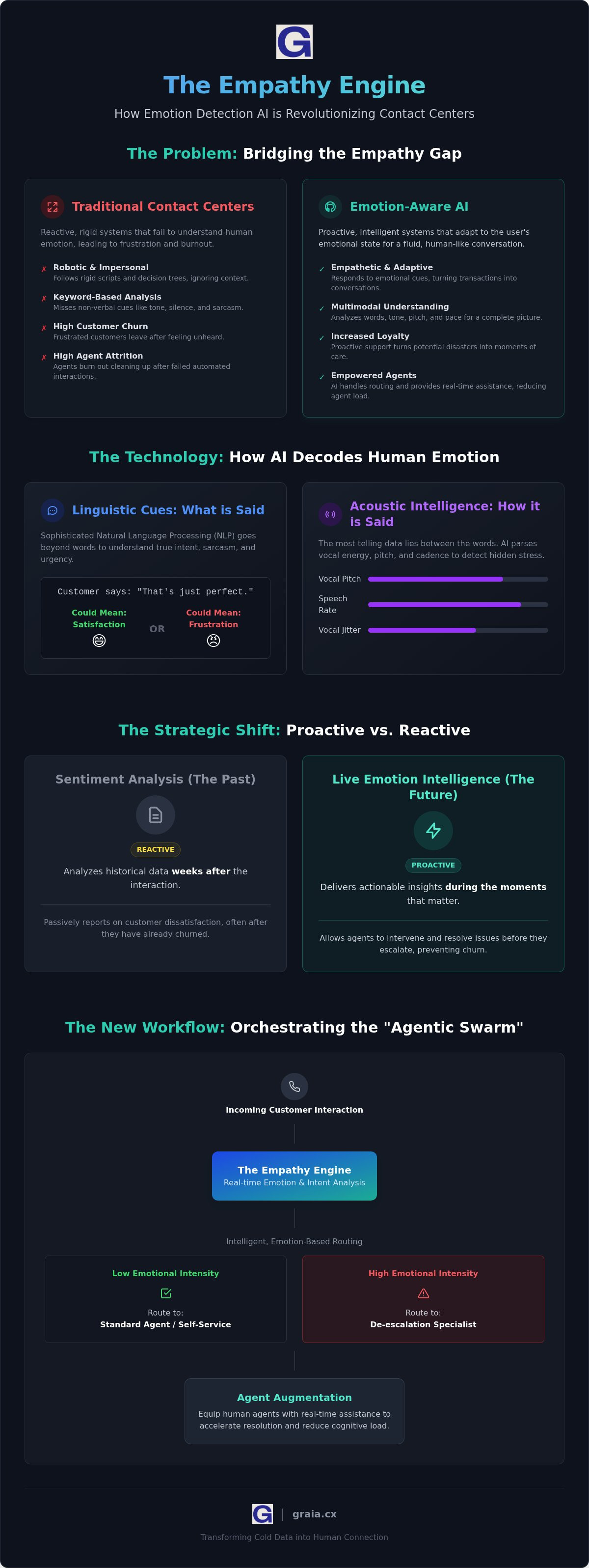
Efficiency is a double-edged sword. While automation has scaled operations, it has simultaneously widened the "Empathy Gap." This is the psychological disconnect that occurs when a customer's urgent, emotional need is met with a cold, algorithmic response. Traditional keyword-based sentiment analysis often flags a call as "neutral" simply because the customer didn't use a specific profanity. It fails to detect the sharp intake of breath or the long, frustrated silence that signals a relationship on the brink of collapse. Modern contact center emotion detection ai solves this by looking past the transcript to see the person. It recognizes that a customer's silence can be louder than their words.
The cost of this emotional misalignment is staggering. When automation feels robotic, it doesn't just frustrate the caller; it devalues the brand. This leads to rapid churn and high agent attrition, as human staff are left to clean up the wreckage of failed automated interactions. The solution lies in the shift toward Agentic CX. This isn't just about better bots. It's about creating a responsive, intelligent ecosystem that adapts its behavior based on the emotional state of the user, turning a rigid transaction into a fluid conversation.
The Failure of Legacy IVR and Basic Chatbots
Linear decision trees are built for logic, not life. When a customer is dealing with a high-stakes moment, like a frozen bank account or a missed flight, being trapped in a "loop of doom" is catastrophic. Legacy systems are deaf to non-verbal cues. They don't register an increased speech rate or the tremors in a voice that indicate rising anxiety. These platforms often ignore silence entirely, treating it as a lack of input rather than a sign of confusion or anger. This technological blindness forces customers to repeat their trauma to multiple agents, which only serves to accelerate brand erosion. If your system can't feel the heat of a caller's frustration, it will inevitably get burned.
The Business Case for Emotional Intelligence
Empathy is not a soft skill; it's a hard metric. Resolving complex billing disputes or technical failures requires more than just the right answer. It requires the right tone. By prioritising emotional resonance, brands can see a direct impact on Customer Lifetime Value (CLV) and a significant reduction in agent burnout. Emotion recognition technology serves as the vital bridge between raw data and genuine human connection, allowing systems to pivot their strategy based on the caller's state of mind. When an AI can detect frustration early, it can route the call to a specialized "de-escalation" expert before the situation becomes unsalvageable. This proactive approach turns potential PR disasters into loyalty-building moments of care.
How AI Decodes Human Emotion: Beyond Simple Keyword Matching
Human communication isn't a linear stream of text. It's a complex, multi-layered weave of vocabulary, vocal inflection, and rhythmic timing. While legacy tools relied on primitive keyword matching, modern contact center emotion detection ai treats every interaction as a multimodal data set. By synthesizing linguistic nuance with acoustic signals, these systems create a high-definition portrait of the customer’s state of mind in real-time. It's no longer just about what they said; it's about what they meant.
Linguistic Cues: What is Being Said
Detecting sarcasm, hesitation, and urgency requires sophisticated Natural Language Processing (NLP) that understands intent over syntax. A customer saying "That's just perfect" can signify total satisfaction or mounting rage. To navigate this, 2026-era architectures utilize Hybrid Retrieval-Augmented Generation (RAG). This ensures that while the AI recognizes emotional distress, its responses remain grounded in verified enterprise facts. This grounding is essential for any self service customer support ai, preventing the hallucinations that often plague generic models. By analyzing cross-cultural emotional markers, these platforms maintain empathy across global boundaries, ensuring that urgency is recognized regardless of the dialect or language spoken.
Acoustic Intelligence: How it is Being Said
The most telling data often lies in the spaces between the words. Acoustic intelligence parses vocal energy, pitch, and cadence to identify stress markers such as "vocal jitter" or unnatural speech rates. Academic research on contact centre emotion recognition confirms that these non-verbal cues are the most reliable indicators of impending escalation. When a system detects "dead air" or frequent agent interruptions, it immediately flags the interaction for intervention. High-fidelity noise cancellation and advanced speech-to-text engines ensure these subtle cues aren't lost to background static. By 2026, transformer-based models have become the standard, enabling near-instantaneous emotional inference that allows for proactive de-escalation before a customer even voices their complaint.
Understanding the technical "how" is the first step toward transforming your operation into a responsive, empathetic ecosystem. Explore our latest CX insights to see how these technologies are being deployed in high-stakes enterprise environments.
Sentiment Analysis vs. Live Emotion Intelligence: A Strategic Comparison
Data is useless if it arrives too late to change the outcome. Most organisations treat sentiment analysis as a post-mortem, an autopsy of a failed interaction that provides clarity only after the customer has churned. While historical reporting is essential for systemic health, it cannot save a high-value relationship in the heat of a crisis. This is where the distinction between sentiment analysis and live contact center emotion detection ai becomes critical for the modern enterprise. One tells you what happened; the other tells you what is happening right now, giving you the power to intervene before the silence becomes permanent.
A hybrid model is no longer optional. You must leverage historical trends to identify product flaws while using live emotional intelligence to drive immediate resolution. This dual-layered strategy ensures that your operation is both strategically sound and tactically agile. You need the historical data to fix the engine, but you need live intelligence to steer the car.
Post-Call Reporting: The QA Perspective
Historical sentiment analysis remains the bedrock of Quality Assurance. It allows leaders to identify systemic friction points, such as recurring billing errors or technical hurdles that trigger universal frustration. By aggregating emotional trends, you can tailor your training modules to address specific gaps in agent soft skills. Interestingly, USC Marshall School of Business research indicates that AI-driven insights can actually help people feel more heard than interactions with untrained humans. Using this historical data to coach agents on tone and empathy ensures that your human workforce evolves alongside your technology, turning past failures into future successes.
Live Intervention: The Agentic Perspective
The true power of 2026-era technology lies in its ability to act as a real-time co-pilot. By triggering next best action customer service protocols based on live emotional spikes, the system can pivot the conversation's trajectory instantly. If the contact center emotion detection ai detects a sharp rise in vocal energy or linguistic distress, it provides the agent with immediate de-escalation scripts or empathetic response suggestions. This proactive orchestration is a primary reason why advanced platforms can reduce escalations by 40%. In cases where a call trends toward extreme toxicity, automated supervisor alerts ensure that human leadership can step in exactly when they're needed, protecting both the customer relationship and the agent's mental well-being.
Orchestrating the "Swarm": Implementing Emotion-Driven Workflows
Most legacy systems treat emotion as a post-call tag, a static label applied to a recording for later review. This is a missed opportunity. In the 2026 landscape, sophisticated contact center emotion detection ai acts as a live trigger within an "Agentic Swarm" architecture. Instead of routing calls based solely on agent skill sets or department codes, the system uses the caller's real-time emotional state as a primary variable. When the "Empathy Engine" detects high-intensity frustration or a risk of churn, it immediately reconfigures the workflow. It's a shift from passive observation to active orchestration.
To maintain brand integrity, this architecture employs "Judges." These are secondary AI models that monitor interactions in the background, scoring them for brand voice compliance and emotional resonance. If an automated response or a human agent's tone begins to drift away from the corporate standard, the Judge provides an instant correction. This ensures that even in high-stress scenarios, the interaction remains professional and protective of the customer relationship.
Routing Based on Emotional State
Static queues are the enemy of resolution. By integrating contact center emotion detection ai into your routing logic, you can automatically escalate high-anger calls to specialised retention specialists before the customer even asks for a manager. This process involves more than just a transfer; it's an emotional handoff. The receiving agent is briefed with the exact context: "I see you're frustrated about the billing delay; I've already pulled up the records to fix it." This eliminates the "effort gap" where customers feel forced to repeat their grievances, a primary driver of secondary escalation. By acknowledging the emotion before the technical problem, you demonstrate that the customer is heard and valued.
The Role of AI Guardrails and Ethics
Implementing emotional intelligence requires rigorous ethical boundaries. We use "Prompt Shields" to ensure that the AI remains a stable, reassuring presence, preventing it from mirroring a customer's aggression or becoming defensive. Data sovereignty is equally critical. Emotional and biometric data must be protected under UK GDPR standards, using robust PII masking to ensure that sensitive identifiers are stripped before processing. At GraiaCX, we leverage Azure-based security to keep this data within sovereign boundaries, ensuring it is never used to train public models. There is a fundamental ethical requirement for transparency; customers should always know when an AI is assisting in the empathetic delivery of their support. Build a more resilient, compliant operation by exploring our latest guides on AI ethics and orchestration.
Elevating Every Interaction with GraiaCX Agentic Intelligence
True transformation requires more than just observation. It demands an integrated platform capable of turning emotional insights into immediate operational results. GraiaCX unifies voice, chat, and email through a native Empathy Engine, ensuring that your contact center emotion detection ai isn't just an add-on, but the core intelligence of your operation. By treating every channel as a single, cohesive conversation, we eliminate the fragmented experience that typically fuels customer frustration. It's a visionary approach to CX that prioritizes human connection without sacrificing enterprise scale.
We recognize that most enterprises cannot simply "rip-and-replace" their existing infrastructure. GraiaCX is designed to breathe new life into legacy systems like Genesys and Avaya, adding a layer of agentic intelligence to your established workflows. This integration allows you to deploy sophisticated Agent Assist tools that provide real-time transcripts and empathetic response suggestions directly to your human staff. The result is a future-ready contact centre where AI empathy drives 25% productivity gains, allowing your team to focus on the high-value interactions that define your brand.
Action-Oriented AI: From Detection to Resolution
Detection is only half the battle. Our Agentic Omni-Channel Platform goes further by performing complex backend tasks like processing refunds or rebooking services during the exact moments of emotional peak. This capability is the reason our partners see 60% faster resolution times through emotion-aware automation. When the system detects a customer's relief or satisfaction, it capitalizes on that momentum to finalize the inquiry. To ensure consistency, our Writing Assistant tool scans every outgoing message, ensuring that the tone reflects your specific brand values. This proactive stance reduces the cognitive load on agents while maintaining a high standard of care.
Getting Started with Agentic Emotion Detection
Evolution doesn't have to be a multi-year project. With GraiaCX, you can achieve Day-1 automation by deploying no-code self-service agents that are grounded in emotional intelligence from the first interaction. Success in this new era is measured by more than just Average Handle Time (AHT). We help you track the metrics that actually matter: CSAT, Sentiment Shift, and overall Resolution Speed. By focusing on how a customer feels at the end of a call compared to the beginning, you gain a true understanding of your operation's impact. We invite you to explore the GraiaCX platform and discover how to bridge the empathy gap in your own organisation.
Defining the Next Era of Empathetic Orchestration
The days of cold, transactional automation are over. We've moved beyond simple sentiment tagging into an era where contact center emotion detection ai acts as the primary catalyst for real-time resolution. By bridging the empathy gap and orchestrating your workflows around human feelings rather than just department codes, you transform your operation from a cost centre into a loyalty engine. It's time to stop analyzing the past and start influencing the present. The technology to turn frustration into advocacy is no longer a vision; it's a measurable reality.
With 25 years of CX innovation, GraiaCX provides the stability of a 99.9% uptime guarantee alongside cutting-edge agentic intelligence. Our partners are already achieving a 40% reduction in escalations by simply listening to what their customers aren't saying. Don't let your brand be defined by robotic responses when you can lead with intelligence and heart. Transform your CX with GraiaCX Agentic Intelligence and build the responsive, human-centric future your customers deserve.
Frequently Asked Questions
What is the difference between sentiment analysis and emotion detection?
Sentiment analysis is a historical reporting tool that categorizes past interactions as positive, negative, or neutral. It serves as a post-mortem to help you understand what happened during a call after the customer has already hung up. This retrospective approach is useful for long-term quality assurance but offers no help during a live crisis.
In contrast, contact center emotion detection ai provides live, multimodal intelligence by analyzing vocal tone, pitch, and linguistic nuance in real-time. It tells you what is happening now, giving your team the power to pivot the conversation's trajectory before a customer decides to churn. While sentiment is static data, emotion detection is actionable intelligence.
Can AI accurately detect sarcasm or cultural nuances in a contact centre?
Modern systems accurately detect sarcasm and cultural markers by using transformer-based models that prioritize intent over literal syntax. By combining acoustic intelligence with advanced NLP, the AI identifies the mismatch between a customer's words and their tone. For instance, it can tell when "That’s great" is spoken with the flat pitch of genuine frustration.
This ensures your global operations maintain empathy across different dialects and communication styles. The system recognizes that urgency and anger are expressed differently across cultures, adjusting its internal scoring to ensure that every caller feels heard and understood regardless of their linguistic background.
How does emotion detection AI handle privacy and GDPR compliance in the UK?
We handle UK GDPR compliance through robust PII masking and sovereign Azure-based security frameworks. Every interaction is processed to trigger real-time actions, but sensitive identifiers are stripped away before the data is stored or analyzed. This protective layer ensures that your customer’s biometric and linguistic data remains secure and private.
Our architecture is built for the 2026 regulatory landscape, ensuring that emotional data is never used to train public models. This commitment to data sovereignty protects your brand from the heavy penalties associated with non-compliance. You gain the benefits of deep emotional insight without compromising the trust of your users.
Does emotion detection work across all channels, including email and social media?
Emotion detection is a core feature of our Agentic Omni-Channel Platform, unifying voice, chat, and email into a single intelligence layer. The system analyzes text-based cues like punctuation, capitalization, and response delay to gauge frustration in digital channels. It treats a frantic series of short emails with the same urgency as a high-volume voice call.
This cross-channel visibility ensures a consistent emotional response regardless of how the customer chooses to connect. By maintaining this "emotional thread" across platforms, your agents don't have to guess the caller's state of mind when they switch from a chat window to a phone line. The context follows the customer, reducing effort and improving resolution speed.
Will using emotion detection AI make my contact centre feel more robotic?
Integrating an "Empathy Engine" actually removes the robotic feel of traditional systems by enabling non-linear, responsive interactions. Traditional bots fail because they follow rigid decision trees that ignore human distress. When an AI can sense frustration, it stops following a script and starts providing a personalized, human-centric solution.
This technology bridges the gap between automated efficiency and genuine human understanding. It allows the AI to acknowledge a customer’s feelings directly, which validates their experience and de-escalates tension. Far from feeling mechanical, it makes your digital self-service feel more like a conversation with a resilient and capable partner.
How does emotion detection help reduce agent burnout and turnover?
Contact center emotion detection ai reduces burnout by providing agents with real-time coaching and de-escalation suggestions through Agent Assist. High-stress interactions are the primary driver of agent attrition. By providing "next best action" prompts during a difficult call, the system lowers the cognitive load on your human staff and gives them the confidence to resolve the issue.
Additionally, the system can automatically route high-toxicity calls to specialized specialists or trigger immediate supervisor alerts. This protective layer ensures that your agents aren't left to handle extreme emotional escalations without support. When agents feel empowered and protected by their technology, they are far more likely to stay with the organisation.
Can I integrate emotion detection AI with my existing Genesys or Avaya system?
You can integrate GraiaCX intelligence with your existing Genesys or Avaya infrastructure without a costly "rip-and-replace" project. Our platform acts as an intelligent overlay that feeds emotional data and agentic workflows directly into your established CCaaS environment. This allows you to modernize your operations while preserving your previous hardware investments.
This integration ensures that you can add live emotional intelligence to your current queues and reporting dashboards. You don't have to retrain your entire staff on a new interface. Instead, you enhance their existing tools with the precision of an Empathy Engine, turning your legacy system into a modern, responsive powerhouse.
What is an "Agentic Swarm" and how does it relate to customer emotion?
An Agentic Swarm is a sophisticated architecture where multiple specialized AI agents collaborate to resolve a single inquiry based on emotional triggers. When the system detects a specific emotional state, it "swarms" the interaction with the necessary resources. For example, a "Billing Agent" and a "Retention Agent" might work together in the background to provide a human agent with a custom discount offer.
This ensures the customer is met with the exact level of authority and empathy required for their specific situation. Instead of a single bot trying to do everything, the swarm provides a multi-layered response that is perfectly tuned to the customer's needs. It is the definitive solution to modern industry frustrations, ensuring that every interaction is resolved with speed and care.