
Self-Service Customer Support AI: The 2026 Enterprise Readiness Checklist
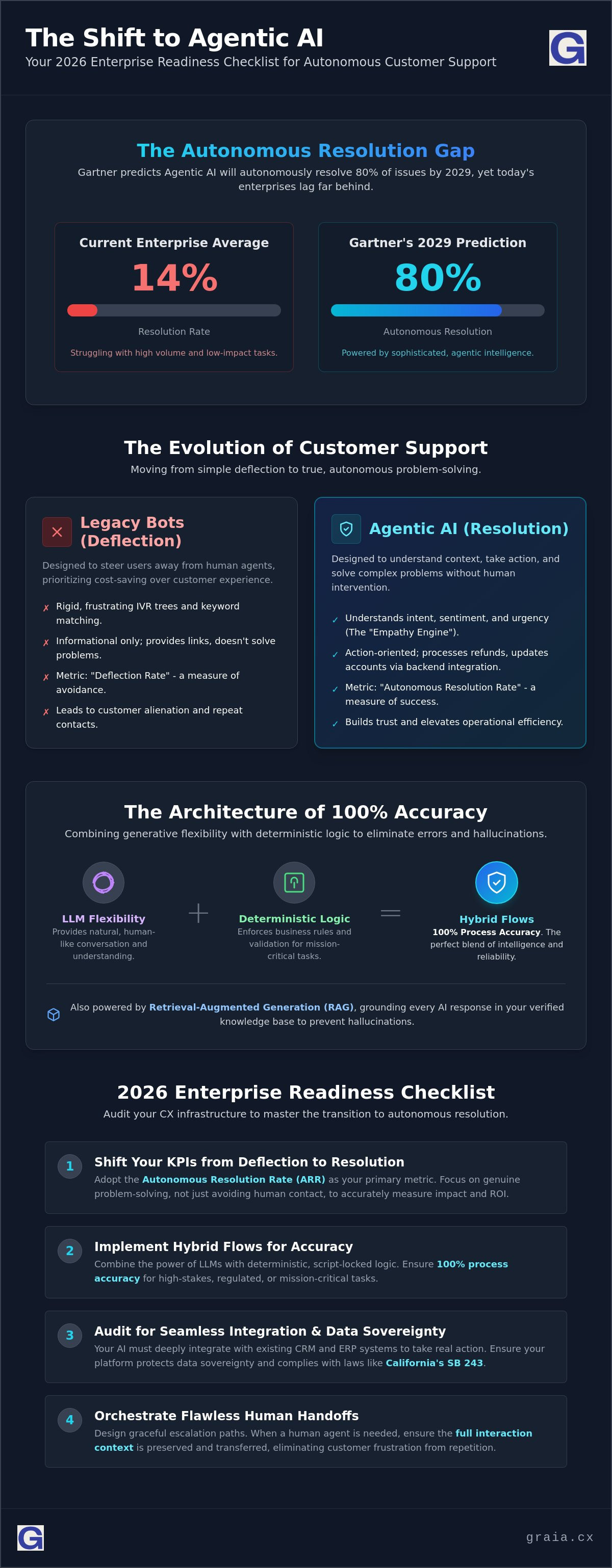
Gartner predicts that agentic AI will autonomously resolve 80% of common customer service issues by 2029, yet many enterprises currently struggle with a resolution rate of just 14%. You likely feel the weight of this gap every day. Your human resources are drained by a relentless volume of routine inquiries, while rigid IVR systems continue to frustrate the very customers you aim to serve. Implementing a robust self service customer support ai strategy is no longer about simple deflection. It's about building an empathy engine that executes complex tasks with absolute precision.
We understand the hesitation that comes with deep automation, particularly the fear of AI hallucinations in high-stakes, regulated environments. This article delivers the definitive 2026 enterprise readiness checklist to help you master the transition to autonomous resolution. You'll discover how to achieve 100% process accuracy using Hybrid Flows, comply with evolving transparency laws like California’s SB 243, and ensure every automated interaction scales gracefully to a human agent with full context. It's time to move beyond mechanical deflection and elevate your operational potential through sophisticated, agentic intelligence.
Key Takeaways
- Move beyond legacy deflection metrics to embrace autonomous resolution as the definitive standard for modern enterprise excellence.
- Discover how Hybrid Flows and Agentic Swarms combine LLM flexibility with deterministic logic to achieve 100% process accuracy.
- Audit your infrastructure for 2026 readiness to ensure your self service customer support ai protects data sovereignty and integrates seamlessly with your existing CRM.
- Adopt the Autonomous Resolution Rate (ARR) as your primary KPI to track genuine problem-solving and its direct impact on reducing average handle time.
- Master the art of the "Empathy Engine" by orchestrating seamless handoffs that preserve full interaction context for your human agents.
Beyond Deflection: Defining Agentic Self-Service Customer Support AI
Deflection is a legacy metric; it is the language of avoidance. For years, the primary goal of customer service technology was to steer users away from human agents to protect the bottom line. This approach prioritized cost over connection. It resulted in rigid, frustrating experiences that often left customers more alienated than when they began. Modern enterprises are moving past this defensive posture. They are embracing a new standard: autonomous resolution. In this model, success is not measured by how many people we turn away, but by how many complex problems we actually solve without manual intervention.
The shift from reactive chatbots to proactive agentic intelligence requires a sophisticated understanding of intent and emotion. A high-performing self service customer support ai doesn't just parse keywords. It interprets the underlying sentiment of a request, recognizing when a customer is frustrated, urgent, or confused. This emotional intelligence allows the system to adjust its tone and priority in real time, ensuring the digital experience feels human even when it is entirely automated.
Agentic Self-Service AI is a system that understands context and executes backend tasks autonomously.
The Evolution of Conversational Intelligence
We've moved far beyond the era of rigid IVR trees and simple keyword matching. While the core technology of chatbots has existed for decades, the transition to natural language understanding (NLU) has unlocked deeper potential. True intelligence requires "grounding" the AI in your specific enterprise knowledge base. This prevents the system from wandering into irrelevant or inaccurate territory. By anchoring every response in verified facts, you restore customer trust. Empathy-driven automation ensures that every interaction feels like a partnership, moving the needle from mechanical replies to genuine assistance.
Action-Oriented AI vs. Informational Bots
The fundamental difference between a legacy bot and an self service customer support ai lies in the ability to take action. Informational bots are designed to answer FAQs; they point users toward help articles. In contrast, action-oriented systems process refunds, update billing cycles, and troubleshoot technical failures. This requires deep integration with your CRM and ERP systems. By connecting your Agentic Omni-Channel Platform directly to your backend infrastructure, you enable real-world execution. The system maintains session continuity across voice, chat, and social, ensuring that a customer who starts a refund request on email can finish it via a Conversational Agent without repeating a single detail.
The Architecture of Accuracy: Hybrid Flows and Agentic Swarms
Precision is the foundation of trust. In the pursuit of a superior self service customer support ai, many enterprises fall into the trap of over-relying on the creative fluidity of Large Language Models (LLMs). While these models offer remarkable linguistic flexibility, they lack the inherent guardrails required for mission-critical operations. We solve this through Hybrid Flows. This sophisticated architecture bridges the gap between generative intelligence and deterministic logic. By script-locking essential business rules, we ensure that the system never deviates from your established protocols, providing a level of reliability that purely generative systems simply cannot match.
Hallucinations are a non-starter in regulated industries. To eliminate this risk, we utilize Retrieval-Augmented Generation (RAG). This process ensures that every response generated by a Conversational Agent is grounded in your specific, verified data. Instead of "guessing" a resolution based on training data, the AI retrieves the exact information required from your knowledge base and synthesizes it into a natural, accurate response. This combination allows for 100% process accuracy, ensuring your automation is as dependable as your best human agent.
Designing Deterministic Workflows
Mission-critical tasks demand certainty. When a customer initiates a high-value transaction or a sensitive data update, LLM creativity becomes a liability. We employ sophisticated "Decision Nodes" and "Collect Data" nodes equipped with regex validation. These components act as digital checkpoints. They verify that every piece of input, from account numbers to medical IDs, meets exact criteria before the process continues. This level of control is essential for maintaining compliance in healthcare and finance, where a single error can lead to significant regulatory risk. It's about building a framework where the AI is empowered to act, but only within the safe boundaries you define.
The Power of the Multi-Agent Ecosystem
Complexity requires specialization. Rather than a single, general-purpose bot, we deploy an "Agentic Swarm." This ecosystem consists of specialized virtual experts dedicated to specific domains like billing, technical troubleshooting, or sales. An Intelligent Routing Brain sits at the center of this swarm. It analyzes the user's intent and urgency in real time, matching them with the specific agent best equipped to resolve the issue. If the context shifts, the system facilitates a seamless handoff between these virtual experts, preserving the entire interaction history. You can explore our latest research on how these multi-agent systems are redefining resolution speeds in the enterprise. This approach ensures that your self service customer support ai remains agile, intelligent, and always focused on the fastest path to resolution.
The Enterprise Readiness Checklist: Auditing Your CX Infrastructure
Visionary strategy requires a secure foundation. While the allure of agentic intelligence is powerful, the transition to a truly autonomous self service customer support ai fails without a rigorous audit of your underlying infrastructure. You aren't just deploying a tool; you're integrating a new class of digital employee into your ecosystem. This requires a shift from passive observation to active governance. Every API connection, data point, and security protocol must align with the high-stakes demands of the modern enterprise.
Data sovereignty is the first pillar of readiness. In an era where data is the ultimate currency, you must ensure that your customer interactions remain your own. We prioritize a privacy-first approach where your proprietary data is never used to train external, third-party models. This protection is bolstered by sophisticated security guardrails, including prompt shields and toxicity detection. These layers act as a digital immune system, neutralizing malicious inputs and ensuring your AI remains a safe, protective guide for your users.
Technical and Security Requirements
Security isn't a feature; it's a prerequisite. Your infrastructure must support TLS 1.2 encryption for data in transit and AES256 for data at rest to meet global standards. As part of our Q2 2025 roadmap, we're finalizing advanced PII masking and real-time redaction capabilities to ensure full compliance for 2026 operations. You should also verify SOC2 alignment and regional hosting options to maintain data residency requirements. These technical benchmarks ensure your self service customer support ai operates within a fortress of enterprise-grade protection.
Operational and Content Readiness
Intelligence is only as good as its source material. You must audit your knowledge base to ensure every article is "vetted" and factually accurate. This prevents the AI from inheriting legacy errors. Beyond facts, define your brand voice with precision. Whether your tone is formal, concise, or deeply empathetic, the AI must mirror your corporate identity across every channel. We recommend establishing a "Simulator" protocol. This allows for bot-to-bot stress testing, where virtual agents simulate thousands of complex scenarios to identify edge cases before they reach a human customer.
Seamless escalation remains the ultimate safety net. Even the most advanced system will eventually encounter a query that requires human intuition. Your checklist must include defined escalation paths that preserve the full context of the digital interaction. When a Conversational Agent hands a case to a human, it should provide a concise summary of the intent and emotional state of the user. This ensures the transition is invisible to the customer, maintaining the momentum of the resolution while allowing your human agents to focus on the highest-value interpersonal connections.
Measuring the Impact: From Deflection Rates to Autonomous Resolution
Success is no longer measured by the customers you avoid. For decades, the industry obsessed over deflection rates, a metric that effectively rewarded systems for being difficult to navigate. This is a fundamental flaw. In the new era of self service customer support ai, we prioritize the Autonomous Resolution Rate (ARR). This metric tracks the percentage of inquiries that reach a definitive, successful conclusion without human intervention. By focusing on resolution rather than avoidance, you drive a 60% improvement in resolution times while simultaneously elevating the customer experience.
When a query exceeds the scope of automation, ai agent assist tools bridge the gap when self-service escalates, ensuring the human agent receives a curated summary and suggested next steps immediately.
Key Performance Indicators for 2026
Modern CX leaders must look deeper than surface-level volume. You should track the accuracy of "Next Best Action" recommendations and monitor how quickly your human staff adopts these AI-driven insights. Sentiment analysis is equally vital. Are customers ending their automated sessions feeling empowered or exhausted? By measuring the sentiment shift during an interaction, you gain a transparent view of your brand’s emotional resonance. Reducing repeat contact rates and escalation volume directly correlates to a more efficient, high-performing operation.
The ROI of Multilingual Self-Service
Global expansion often carries a heavy tax in the form of bilingual staffing premiums and complex shift rotations. You can now scale your support footprint across 100+ languages without the traditional overhead. By utilizing live call translation software, you eliminate language-based queues and provide 24/7 availability to every market. This removes the cognitive load from your human agents, who no longer struggle with linguistic barriers; it significantly reduces the attrition rates associated with high-stress, multilingual environments. This strategic shift results in a 25% improvement in agent productivity, allowing your team to focus on nuanced, high-value problem solving.
The transformation of your contact center isn't just about technology; it's about the elevation of human potential. When your self service customer support ai handles the routine, your team is free to manage the complex. Discover how to quantify your AI transformation by exploring our detailed impact frameworks.
Orchestrating the Future: Why Graia is the Definitive Partner for Agentic CX
Evolution is inevitable. While many platforms offer basic automation, we provide a unified Agentic Omni-Channel Platform that synthesizes voice, chat, and social media into a single, intelligent flow. This is the culmination of 25 years of CX innovation. Because we maintain full IP ownership of both our AI and Contact Centre components, we offer a level of architectural harmony that fragmented competitors simply cannot replicate. We don't just provide a tool; we deliver a sophisticated partnership that transforms your self service customer support ai from a cost center into a powerful empathy engine.
Speed to value is a critical enterprise requirement. Our platform enables day-1 automation through a no-code setup, allowing your team to deploy complex, agentic workflows without the traditional technical bottlenecks. This rapid deployment doesn't sacrifice depth. Every interaction is grounded in verified facts, ensuring that your brand values are protected and promoted in every digital conversation. You're not just automating tasks; you're elevating the very nature of your customer relationships.
Seamless Human-AI Collaboration
True intelligence recognizes the value of the human element. Our Agentic Omni-Channel Platform ensures that whenever a Conversational Agent identifies a need for human intervention, the transition is flawless. We provide agents with full context summaries and real-time coaching, suggesting the most effective responses based on the ongoing dialogue. This consistency across email, chat, and social messaging reduces agent stress and ensures your customers receive a premium, unified experience regardless of the channel they choose.
Taking the Next Step in Your CX Journey
The transition from legacy systems to a modern, agentic CCaaS architecture is a strategic necessity for 2026. We provide transparent audit trails through Conversational Agent Insights, giving you the visibility required to maintain absolute control over your automated processes. This transparency builds the trust necessary to scale autonomous resolution across your entire enterprise. It's time to move beyond the limitations of the past and embrace a future where technology and empathy work in perfect concert. Elevate your contact centre with Graia’s Agentic AI and begin your transformation today.
Master the Autonomous Era
The transition to a sophisticated self service customer support ai is no longer a futuristic ambition; it's a present-day operational requirement. By moving beyond legacy deflection and embracing agentic swarms, you empower your organization to achieve 100% process accuracy via Hybrid Flows. This evolution doesn't just protect your bottom line. It restores the human element to your contact center by allowing your agents to focus on high-value interactions while the technology handles the routine with absolute precision.
The results are transformative. Enterprises adopting this architecture experience 60% faster resolution times and 40% fewer escalations and repeat contacts. You've audited your infrastructure and mapped your path to 2026 readiness. Now, the final step is execution. Transform your customer experience with Graia’s Agentic CCaaS platform and secure your position as a leader in the next generation of customer service. The future of CX is autonomous, empathetic, and ready for you to lead it.
Frequently Asked Questions
What is the difference between a chatbot and an agentic self-service AI?
Agentic AI differs from traditional chatbots by its ability to reason and execute tasks rather than just delivering scripted responses. While a chatbot might point you to a knowledge base link, an agentic system uses its autonomy to navigate complex workflows. It understands the nuances of intent and manages the state of a conversation across multiple steps. This evolution marks the move from simple message delivery to genuine, intelligent problem-solving.
Can self-service AI take actual actions like processing refunds or bookings?
Yes, modern self service customer support ai executes real-world actions like processing refunds, managing bookings, or updating account details. It achieves this by integrating directly with your CRM and ERP through secure API connections. By moving beyond text-based answers, the system performs the heavy lifting of backend administration. This capability transforms the interface from a passive helper into an active digital employee.
Is my customer data used to train public AI models?
Your data remains exclusively yours and is never used to train external or public AI models. We adopt a privacy-first architecture where your proprietary information is isolated within your secure environment. This ensures that your competitive advantages and customer PII remain protected. Maintaining data sovereignty is a non-negotiable standard for enterprise-grade intelligence in regulated industries.
How does the system handle complex inquiries that require a human agent?
The system identifies complex inquiries through real-time sentiment analysis and intent detection, triggering a seamless escalation when human intuition is required. It doesn't just drop the call. It matches the customer's specific needs with the best-suited human expert. This ensures that the most challenging cases receive the sophisticated care they deserve without disrupting the customer's journey.
Does the customer have to repeat themselves during a handoff to a live agent?
Customers never have to repeat themselves because the human agent receives a full context summary before the handoff is complete. The Agentic Omni-Channel Platform captures the entire history of the automated interaction. This allows the agent to step in with immediate understanding of the problem and the steps already taken. It eliminates the frustration of starting over and maintains a fluid, empathetic connection.
Can the AI handle multiple languages for global customer support?
We support over 100 languages through integrated Live Call Translation and multilingual conversational agents. This allows you to scale global support without the need for a massive bilingual staffing operation. The AI provides consistent service quality across every market you serve. You can maintain 24/7 availability for a worldwide audience while ensuring that language is never a barrier to resolution.
How do you ensure the AI doesn’t hallucinate or provide incorrect information?
We eliminate hallucinations by using Hybrid Flows and Retrieval-Augmented Generation (RAG) to ground every response in verified facts. Unlike purely generative models, our architecture uses script-locked business rules for mission-critical processes. This ensures the self service customer support ai only operates within the boundaries of your approved knowledge base. You get the flexibility of natural language with the absolute precision of deterministic logic.
What is the typical ROI for implementing an agentic self-service platform?
Enterprises typically see a 60% faster resolution time and a 25% improvement in agent productivity within the first year of implementation. By reducing the volume of routine inquiries, you significantly lower your average handle time and operational costs. These gains are paired with a 40% reduction in repeat contacts. The result is a high-performance contact center that delivers measurable brand value and superior customer loyalty.