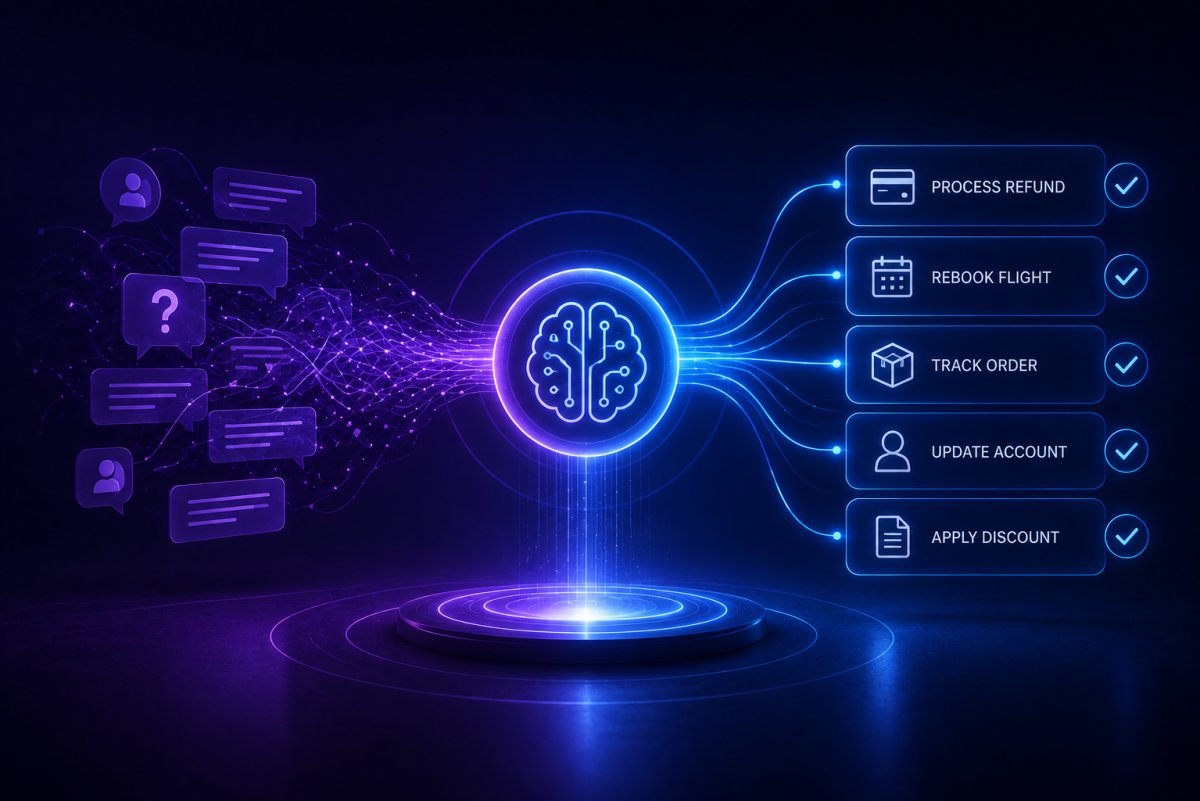
Beyond Chatbots: The Rise of Autonomous Customer Service Resolution
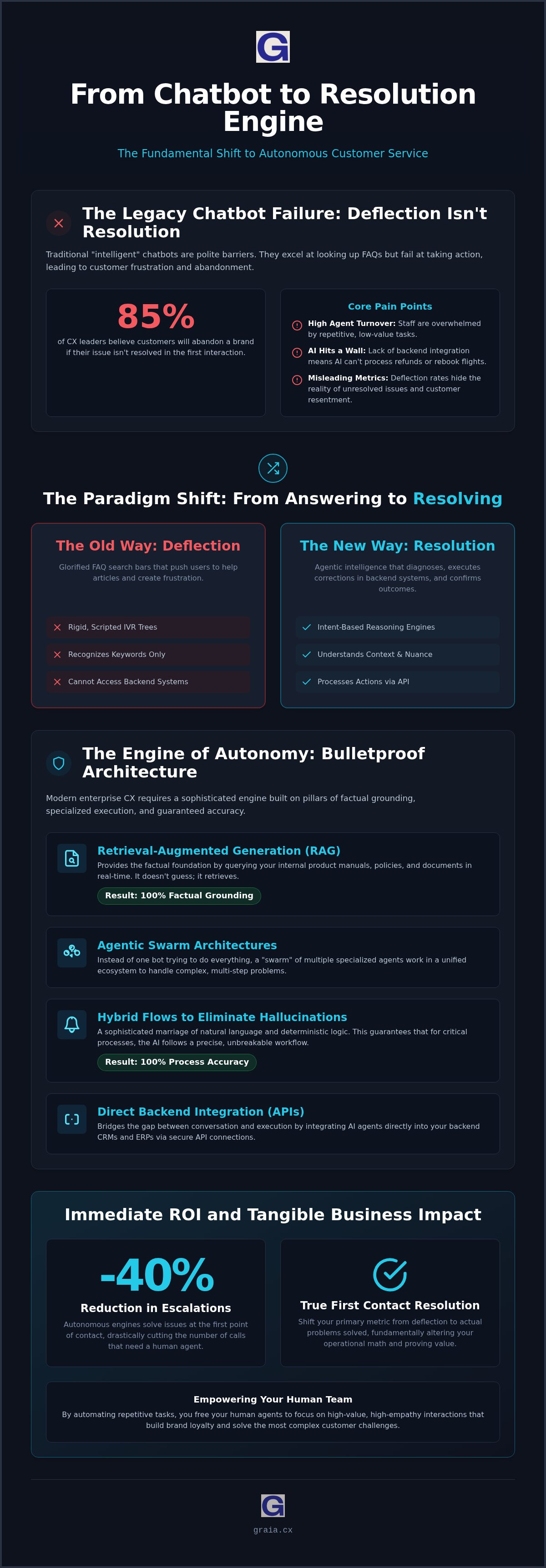
Your customers don't want a conversation; they want a solution. Most "intelligent" chatbots are merely polite barriers that fail the moment a task requires more than a basic FAQ lookup. This gap between expectation and execution is why 85% of CX leaders believe customers will abandon a brand if their issue isn't resolved in the first interaction. Achieving true autonomous customer service resolution requires more than just better natural language processing. It demands a fundamental shift from chatting to doing.
You've likely felt the strain of high agent turnover as your team drowns in repetitive, soul-crushing tasks. It's frustrating to watch your AI hit a wall because it cannot access backend systems to actually process a £50 refund or rebook a flight. This guide reveals how agentic AI and hybrid workflows are transforming contact centres from simple inquiry handlers into autonomous resolution engines. We will explore how to scale your multilingual support and improve First Contact Resolution (FCR) without increasing your headcount, ensuring your operation remains both technically superior and deeply human.
Key Takeaways
- Move beyond mere deflection by understanding the shift toward true autonomous customer service resolution, where AI diagnoses and executes solutions without human touch.
- Explore the technical synergy of Agentic Swarm architectures and RAG, creating a factual foundation that empowers multiple specialised agents to work in a unified ecosystem.
- Eliminate the risk of AI hallucinations through Hybrid Flows, a sophisticated marriage of natural language and deterministic logic that guarantees 100% process accuracy.
- Bridge the gap between conversation and execution by integrating AI agents directly into your backend CRMs and ERPs via secure API connections.
- Identify immediate ROI opportunities with a strategic roadmap for modernising legacy contact centres to reduce escalations by 40% without a costly "rip and replace" of existing infrastructure.
Defining Autonomous Customer Service Resolution in 2026
Automation used to be a wall. For decades, businesses deployed technology to shield their human staff from the rising tide of customer inquiries. This legacy approach to customer service automation relied on deflection, essentially pushing the user away rather than pulling them toward a solution. True autonomous customer service resolution represents a clean break from this defensive posture. It's the capacity for a digital system to diagnose a failure, execute a correction in the backend, and confirm the outcome without any human intervention.
In 2026, the distinction between "answering" and "resolving" is the line between success and obsolescence. While an old-school chatbot might tell a customer how to request a refund, an autonomous engine actually processes the £25 credit in the ERP system. This transition requires moving beyond rigid IVR trees and into the territory of intent-based conversational intelligence. These systems don't just follow a script; they understand the objective. They also employ sophisticated emotion detection to ensure that a frustrated customer is met with a de-escalating tone, maintaining brand empathy while the technical resolution happens in the background.
The Shift from Chatbots to Agentic Intelligence
Simple chatbots have reached their natural limit. They were glorified FAQ search bars that failed the moment a conversation veered off-path. Agentic intelligence replaces these fragile scripts with reasoning engines that possess contextual memory. These agents don't just recognise keywords; they understand the nuances of a long-running dispute. They're built to handle the "messy middle" of customer service, where a user might pivot from a billing query to a technical issue mid-sentence. By maintaining a persistent state of context, autonomous agents resolve complex, multi-step problems that previously required a human supervisor.
Resolution vs. Redirection: Why Metrics Matter
Traditional contact centres often hide behind deflection rates. If a customer hangs up after hearing an automated message, it's often incorrectly logged as a "save." In reality, redirecting a customer to a generic help article often breeds resentment. To thrive, you must shift focus toward true autonomous First Contact Resolution (FCR). This metric measures how often the AI completes the entire task, from initial diagnosis to final execution. This shift fundamentally alters your operational math. When you measure Contact Centre ROI with AI, the value isn't found in how many calls you avoided, but in how many problems you actually solved. GraiaCX redefines this value by focusing on agentic output, ensuring that humans are finally freed to focus on high-value, high-empathy interactions that directly impact Average Handle Time (AHT) across the entire organisation.
The Engine of Autonomy: RAG and Agentic Swarm Architectures
To move from simple deflection to genuine autonomous customer service resolution, the underlying architecture must be bulletproof. Most legacy bots are monolithic. They attempt to handle every request through a single, overstretched logic tree, which inevitably leads to a "jack of all trades, master of none" failure. Modern enterprise CX requires a more sophisticated engine. This engine is built on two pillars: Retrieval-Augmented Generation (RAG) and Agentic Swarm architectures. Together, they ensure that every interaction is grounded in fact and executed by a specialist.
Retrieval-Augmented Generation (RAG) for Factual Grounding
AI is only as reliable as the data it can access. RAG provides the factual foundation by allowing the system to query your specific product manuals, company policies, and internal documentation in real-time. By utilising hybrid search, which combines the semantic understanding of vector search with the precision of lexical search, the AI avoids the "hallucination" trap. It doesn't guess; it retrieves. Grounding is the process of anchoring AI outputs in verified enterprise data. This ensures that when a customer asks about a specific warranty policy or a technical spec, the response is 100% accurate to your brand's unique requirements.
Specialised Agents: The Power of the Swarm
The "Agentic Swarm" concept represents a paradigm shift in how we deploy intelligence. Instead of one bot trying to do everything, we deploy a unified ecosystem of specialised agents. Each agent is a master of a specific domain, such as refunds, technical troubleshooting, or sales. When a customer interaction begins, a "manager" agent identifies the intent and routes the task to the appropriate specialist. This prevents the system from becoming overwhelmed by complexity. The result is a resilient framework for autonomous customer service resolution that scales without losing its edge.
Crucially, this architecture handles transitions between domains with total transparency. If a customer starts with a billing query but then needs technical support, the context is preserved during the handoff. The "Tech Agent" knows exactly what the "Billing Agent" already discussed. This seamless collaboration allows for rapidly evolving product catalogues and high-stakes service environments where friction isn't an option. To see how these architectures are being deployed in real-world scenarios, you can explore more about modern contact centre strategies on our blog.
Solving the Hallucination Problem: Achieving 100% Process Accuracy
The primary barrier to adopting autonomous customer service resolution isn't technical capability; it's trust. Enterprise leaders rightly fear the "hallucination," the moment a generative model goes off-script and promises a customer a £500 refund that violates company policy. To solve this, we must move beyond pure probabilistic models. We need a system that understands human intent but operates within rigid, non-negotiable boundaries. Achieving total accuracy requires a multi-layered approach to governance that combines real-time protection with exhaustive pre-launch testing.
Before any workflow goes live, it must survive a gauntlet of stress tests. We utilise "Simulators" to run thousands of synthetic customer interactions, identifying potential edge cases where the logic might falter. "Judges," which are specialised AI models trained on your specific compliance guidelines, then audit these results for accuracy. Guardrails and Prompt Shields provide an active layer of protection during live interactions, instantly neutralising malicious inputs or "jailbreak" attempts designed to force the AI into unauthorised actions.
Hybrid Flows: Deterministic Logic Meets Generative AI
Hybrid Flows create a necessary boundary where LLM creativity stops and deterministic business rules take over. Think of the LLM as the empathetic voice that understands the customer’s frustration, while the underlying logic acts as the immutable rail. For mission-critical processes like processing returns or updating sensitive account details, 100% accuracy is the only acceptable standard. GraiaCX ensures these processes follow your specific business rules that the AI cannot circumvent, regardless of how a customer phrases their request. This architecture guarantees that every action taken is compliant, predictable, and aligned with your operational standards.
Security and Privacy-First AI Governance
Trust is built on security. In a regulated UK environment, data sovereignty is paramount. Your customer data should never be used to train public models. We implement rigorous PII masking and encryption standards to ensure that sensitive information remains protected within your autonomous environment. Understanding how Enterprise AI Contact Center Solutions maintain compliance is essential for leaders in finance, healthcare, and utility sectors. By prioritising governance, you can scale your autonomous customer service resolution strategy without compromising the privacy of the individuals you serve or falling foul of local regulations.
Action-Oriented AI: Integrating Resolution into the Backend
Conversation is merely the interface. Resolution is the result. To achieve true autonomous customer service resolution, an AI must move beyond the limitations of natural language and into the realm of technical execution. It isn't enough for a system to explain a policy; it must have the agency to act upon it. This transition from "talking" to "doing" is powered by secure API integrations that bridge the gap between the customer's intent and your enterprise's operational core.
While some platforms focus solely on their own ecosystems, a visionary approach requires a heterogeneous strategy. Your AI must communicate seamlessly with Salesforce, Microsoft Dynamics, and bespoke legacy ERPs. It doesn't just inform a customer that their parcel is delayed. It accesses the logistics database, identifies an available delivery slot for the customer's specified address, and re-routes the shipment instantly. This level of autonomy transforms the contact centre from a cost-heavy inquiry hub into a lean, action-oriented engine.
Connecting the AI to Your Tech Stack
- Step 1: Intent Mapping. Audit your historical logs to identify high-volume inquiries that require backend intervention, such as address changes or order cancellations.
- Step 2: API Node Construction. Build secure, executable API nodes that allow the AI to retrieve and write data without exposing the entire database.
- Step 3: Stability Testing. Implement automated regression testing to ensure that backend updates don't break the autonomous workflows.
Even the most advanced systems encounter high-risk exceptions. For complex disputes involving values over £250 or sensitive legal queries, the AI employs a "Human-in-the-Loop" strategy. It recognises the boundary of its own authority and elevates the case to a human specialist before a frustration point is reached. This protective layer ensures that high-stakes decisions always benefit from human judgement and empathy.
Seamless Human Handoff with Full Context
Repetition is the enemy of customer satisfaction. When an autonomous agent transfers a case to a live representative, the transition must be invisible and informed. The AI provides a structured summary of the interaction, including the attempted resolution steps and a "next-best-action" recommendation. This synergy between AI Agent Assist Tools and autonomous agents ensures that your staff aren't starting from zero. They're picking up exactly where the machine left off, armed with the context needed to provide a superior interpersonal experience. Explore our latest insights on agentic workflows to see how these integrations are reshaping the modern service landscape.
Implementing Autonomous Resolution: A Roadmap for Enterprise CX
Theory must now yield to execution. Transitioning to autonomous customer service resolution doesn't require a reckless "rip and replace" of your existing infrastructure. We understand that your Avaya or Genesys stacks represent significant capital investment and years of operational hardening. Instead, the path forward is modular. You begin with "Day-1 Automation," identifying high-volume, low-complexity inquiries that offer immediate ROI. These are the tasks, such as password resets or simple booking updates, where AI can prove its value instantly without disrupting core services.
Success in a pilot phase provides the technical confidence to scale. As these initial workflows stabilise, you move toward a unified Agentic CCaaS Platform. This isn't just about adding a layer of software; it's about evolving your entire service philosophy. You're shifting from a model defined by human headcount to one defined by agentic output. This transition targets a reduction in escalations by 40%, allowing your human staff to focus on the nuanced interactions that define your brand's reputation.
Global Scalability: Multilingual Autonomy
Your brand's reach shouldn't be limited by the linguistic capabilities of your recruitment pipeline. Autonomous agents now resolve inquiries in 100+ languages with native-level fluency. This removes the need for expensive, specialised bilingual teams and allows you to support a global customer base from a centralised UK hub. Live Call Translation Software complements these digital agents, ensuring that even when a human must step in, the language barrier remains invisible. We maintain your brand's specific tone and formality across every culture, ensuring a consistent experience from London to Tokyo.
The GraiaCX Advantage: Empathy-Driven Automation
Efficiency without empathy is a failure of vision. While competitors focus solely on the mechanics of a transaction, GraiaCX’s "Empathy Engine" ensures that every automated resolution feels supportive and human. We combine this emotional intelligence with the technical rigour of our "Swarm" architecture and Hybrid Flows. This guarantees 100% process accuracy, ensuring that your enterprise reliability remains unshakeable even as you scale. You don't have to choose between speed and soul. Explore how GraiaCX transforms contact centres into autonomous resolution engines and reclaim the potential of your customer experience.
The Future of Enterprise CX is Agentic
The era of the reactive chatbot has ended. We've moved beyond simple deflection to a state where intelligence is defined by action. By embracing Agentic Swarm architectures and Hybrid Flows, your organisation can finally bridge the gap between technical precision and human empathy. You don't have to choose between operational efficiency and a genuine connection with your customers. You can have both. This evolution ensures that your contact centre becomes a proactive engine of growth rather than a defensive barrier.
True autonomous customer service resolution is now a measurable reality for the modern enterprise. With GraiaCX, you can achieve a 40% reduction in escalations while maintaining a 100% process accuracy guarantee. Our platform integrates seamlessly with your existing Genesys, Avaya, and NICE CX stacks, allowing you to modernise your infrastructure without a costly "rip and replace" strategy. The transition from a transactional cost centre to a sophisticated resolution engine is within your reach. Transform your contact centre with GraiaCX’s autonomous resolution engine. The path to a more intelligent, responsive, and human-centric future starts today.
Frequently Asked Questions
What is the difference between automated and autonomous customer service?
Automated systems follow rigid, pre-defined scripts to deflect inquiries. In contrast, autonomous customer service resolution involves AI that understands intent, reasons through problems, and executes backend actions without human help. While a traditional bot might link you to a policy page, an autonomous agent processes the refund or rebooks the appointment directly in your CRM. It's the difference between simple redirection and total execution.
Can autonomous customer service agents really handle complex technical troubleshooting?
Yes, they can. By utilising Agentic Swarm architecture, the system assigns specialised agents to specific technical domains. These agents access real-time product manuals and diagnostic data to guide users through multi-step repairs. If a router fails in a Manchester household, the AI doesn't just suggest a reboot. It runs line tests, checks firmware versions, and identifies the specific hardware fault before initiating a replacement.
How does an autonomous resolution system prevent AI hallucinations?
We eliminate hallucinations through Hybrid Flows, which anchor generative AI within deterministic business rules. This ensures the system never "invents" a policy or promises an unauthorised discount. By grounding every response in verified enterprise data via RAG, the AI remains factually accurate. It operates within strict guardrails that prevent it from straying into probabilistic guesswork, ensuring your brand's integrity remains unshakeable across every interaction.
Is my customer data safe when using autonomous AI agents?
Security is built into the architecture. We prioritise UK data sovereignty, ensuring your sensitive customer information is never used to train public models. The system employs rigorous PII masking and encryption standards to protect personal details during every transaction. This proactive approach to governance ensures your organisation remains compliant with local regulations while delivering high-performance automation. Your data stays within your controlled enterprise environment at all times.
How long does it take to deploy an autonomous customer service platform?
A phased deployment ensures immediate value. You can launch "Day-1 Automation" for high-volume, low-complexity tasks in as little as four to six weeks. This initial pilot identifies the low-hanging fruit for rapid ROI. As these workflows stabilise, we scale the system to handle more complex, multi-agent resolutions. This methodical progression allows your team to adapt to the new technology without disrupting daily operations or customer satisfaction.
Do I need to replace my existing contact center software to use autonomous agents?
No replacement is necessary. Our platform is designed to integrate seamlessly with your existing Genesys, Avaya, or NICE CX stacks. It acts as an intelligent layer that enhances your current infrastructure rather than requiring a "rip and replace" overhaul. This modular approach protects your previous capital investments while providing a clear path to modernise your contact centre with autonomous customer service resolution capabilities.
What happens if the autonomous agent cannot resolve the customer’s issue?
The system identifies its own limits through a "Human-in-the-Loop" strategy. If an inquiry becomes too complex or involves high-risk exceptions, the AI initiates a seamless handoff to a live representative. The human agent receives a full structured summary and context of the interaction so the customer never has to repeat themselves. This ensures that even when the machine stops, the resolution process continues without any friction or frustration.
How does autonomous resolution impact the role of human customer service agents?
Automation doesn't replace humans; it elevates them. By handling the repetitive, soul-crushing tasks that drive high turnover, the AI frees your staff to focus on high-empathy, high-value interactions. This shift leads to a 40% reduction in escalations, allowing agents to act as expert supervisors of the AI swarm. Your team transitions from being simple inquiry handlers to becoming sophisticated problem solvers who manage the most critical customer relationships.