Automating Routine Inquiries: 2026 Agentic CX Guide
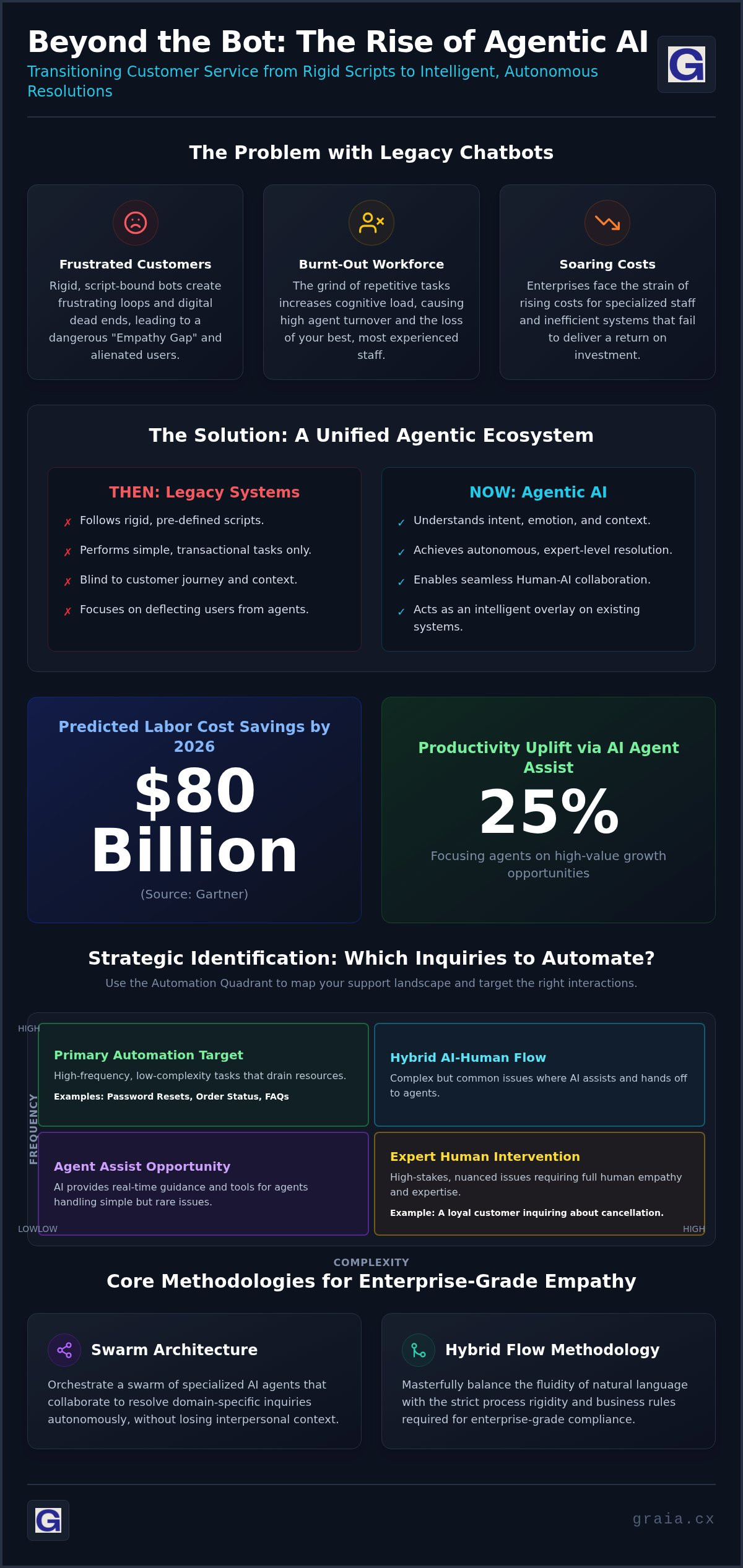
Gartner predicts that conversational AI will slash contact center labor costs by $80 billion in 2026. Yet, for many enterprise leaders, the struggle to automate routine customer inquiries has resulted in rigid bots that frustrate users and increase the cognitive load on a burnt-out workforce. You've likely felt the strain of rising costs for bilingual staff and the sting of high turnover as your best agents flee the grind of repetitive tasks. It's a systemic flaw that requires more than a simple script; it demands a fundamental shift in how we orchestrate the customer journey.
We agree that your customers deserve immediate, empathetic resolutions rather than another digital dead end. This guide empowers you to deploy sophisticated agentic AI that operates with the precision of a seasoned expert. You'll learn to leverage Swarm architecture and hybrid flows to ensure every interaction adheres to strict business rules while maintaining enterprise-grade empathy. We'll preview how to reduce average handle time and increase first contact resolution through a seamless, context-aware handoff that meets the transparency requirements of the 2026 regulatory landscape.
Key Takeaways
- Transition from legacy chatbots to a unified agentic ecosystem that prioritizes human-AI collaboration over simple automation.
- Use the Automation Quadrant to strategically automate routine customer inquiries like password resets and order tracking while preserving human intervention for high-stakes issues.
- Master the "Hybrid Flow" methodology to balance natural language fluidity with the strict process rigidity required for enterprise compliance.
- Orchestrate a specialized Swarm architecture to resolve domain-specific inquiries autonomously without losing interpersonal context.
- Leverage AI Agent Assist to drive a 25% productivity uplift, ensuring that human agents remain focused on complex, high-value growth opportunities.
Beyond the Bot: The Rise of Agentic Customer Service
The era of the rigid, script-bound chatbot is over. For years, enterprises relied on narrow decision trees that forced customers into frustrating loops. Today, we're witnessing the rise of Agentic Customer Experience (CX). This isn't just another layer of technology. It's a unified ecosystem where AI and human collaboration coexist to solve problems in real time. Unlike legacy systems that merely follow instructions, agentic AI understands the nuances of intent, emotion, and context. It acts as a catalyst for growth by identifying the underlying needs of the user before they even articulate them.
We must distinguish between transactional automation and true conversational intelligence. Transactional systems can perform a task, like checking a balance, but they're blind to the customer's journey. Conversational intelligence recognizes why a customer is reaching out and anticipates their next need. When you automate routine customer inquiries through an agentic framework, you aren't just checking a box. You're deploying a system that thinks, adapts, and acts with the authority of a seasoned professional.
The 2026 Shift: Why Routine Inquiries are No Longer "Simple"
Customer expectations have evolved rapidly in this post-LLM world. A simple inquiry about a late delivery now carries the expectation of instant, personalized updates across any channel. If a business over-automates without a grounding in human empathy, they create a dangerous Empathy Gap. This gap alienates users who feel like a number in a database. The focus has shifted from deflection, which aims to keep customers away from agents, to autonomous resolution. This evolution toward Agent-assisted automation represents a fundamental departure from the silos of the past, ensuring that technology supports the agent rather than replacing the connection.
Agentic CCaaS vs. Legacy Chatbots
Modern enterprises are moving away from the rip-and-replace mindset that plagued early digital transformations. Instead, leading agentic ccaas platforms act as an intelligent overlay that unifies voice, chat, and email into a single stream of consciousness. This architecture relies on Contextual Retrieval to provide factual, non-hallucinated answers. By grounding AI in your specific business rules and real-time data, you ensure that it remains accurate and reliable. To automate routine customer inquiries effectively in 2026, your platform must maintain a persistent memory of the customer's history. This ensures that when a handoff occurs, the human agent steps into a conversation that is already halfway to a solution, not starting from zero.
Strategic Identification: Which Customer Inquiries Should You Automate?
Automation is not a blanket solution. It's a surgical strike. To effectively automate routine customer inquiries, you must first map your support landscape using the Automation Quadrant. This framework categorizes interactions by their frequency and their technical complexity. High-frequency, low-complexity tasks represent your primary targets. These include password resets, order status updates, and basic FAQs that currently drain your team's cognitive resources. By offloading these to a Conversational Agent, you reclaim thousands of hours for your human specialists, allowing them to focus on high-stakes problem solving.
However, we must recognize the high-value exception. Some routine inquiries, while technically simple, occur at critical friction points in the customer lifecycle. If a long-term subscriber is inquiring about cancellation, even a routine request requires the nuanced empathy of a human professional to secure retention. You can audit your existing logs using Conversational Insights to pinpoint these specific opportunities. This data-driven approach ensures you aren't just guessing where to apply intelligence; you're identifying the exact moments where technology provides the most relief. If you're looking for more ways to refine your strategy, exploring our latest CX insights can help you stay ahead of shifting consumer behaviors.
The "Action-Oriented" Test for Automation
True transformation occurs when you move beyond mere inquiry handling. When you automate routine customer inquiries with an action-oriented mindset, you empower the AI to execute backend tasks directly. Ask yourself: can your AI execute a refund, reschedule a delivery, or update an ERP? You must evaluate the integration readiness of your CRM and ticketing systems before deployment. Effective automation requires the AI to have permissioned access to your core infrastructure, moving beyond simple text generation. This distinction between answering a question and executing a task is what separates legacy bots from modern agentic partners. When the AI performs the work, the inquiry is resolved, not just deflected.
Prioritizing Multilingual Support
Global support operations often face the crushing expense of hiring specialized bilingual staff. This creates language-based silos that lead to high abandonment rates and inconsistent experiences across different regions. Deploying live call translation software allows you to break these barriers instantly by enabling any agent to support any language. By integrating real-time translation, enterprises can eliminate the 25 to 50 percent wage premiums typically required for bilingual agents while maintaining high service standards. This approach doesn't just save money. It ensures that every customer receives the same level of sophisticated, accurate support regardless of their native tongue. It's about democratizing access to your brand's expertise through intelligent, borderless communication.
The Engineering of Empathy: Balancing LLM Fluidity with Process Rigidity
Modern CX leaders face a complex paradox. They desire the fluid, natural dialogue offered by Large Language Models, yet they require the unyielding accuracy of deterministic logic. We resolve this tension through "Hybrid Flows." By weaving the creative potential of AI with a rigid backbone of business rules, you can automate routine customer inquiries without risking non-compliance. In regulated sectors like finance or insurance, 100% process accuracy isn't a mere goal. It's a non-negotiable mandate for survival.
To safeguard your brand's integrity, we deploy sophisticated Prompt Shields and AI Guardrails. These mechanisms act as digital sentinels, neutralizing toxic inputs and ensuring the AI never circumvents established policies. We maintain a strict privacy-first stance. Your sensitive customer data remains isolated. It's never shared or used to train public models, a commitment that aligns with the rigorous transparency standards of the 2026 regulatory environment. This protective layer allows you to scale intelligence while maintaining total control over your data assets.
Grounding AI in Facts with Hybrid RAG
Hallucinations are the primary enemy of automated trust. We combat this through Retrieval-Augmented Generation (RAG), which forces the AI to consult your specific knowledge base before generating a response. Our "Hybrid RAG" approach utilizes both Dense Vector Search to understand semantic meaning and Sparse Vector Search to pinpoint exact keywords. This dual-layered retrieval keeps your Conversational Agent grounded in your actual product catalog and service documentation. It ensures that the information provided is not just plausible, but factually correct and specific to your enterprise.
Preserving the Human Element in Automated Flows
Efficiency should never come at the cost of genuine connection. We integrate real-time sentiment analysis to monitor the emotional pulse of every dialogue. If the system identifies a surge in customer frustration or a nuanced problem requiring high-stakes empathy, it initiates an immediate human escalation. This ensures that as you automate routine customer inquiries, you're actually deepening the relationship rather than creating friction. The AI also functions as a Writing Assistant, refining the tone to ensure brand consistency across every digital channel. AI Empathy is achieved through sentiment detection and context preservation, ensuring the customer feels heard even when a machine is providing the initial response.
Deploying Your Agentic Swarm: A Step-by-Step Integration Framework
Transitioning from a monolithic bot to a specialized swarm architecture is the definitive way to automate routine customer inquiries at scale. This methodical progression ensures that every interaction is handled by a domain expert, rather than a generalist AI that lacks depth. We approach deployment through five critical phases to guarantee enterprise-grade reliability and process accuracy.
- Step 1: Define Specialized Agents. We architect a "Swarm" of agents, each dedicated to specific domains like billing, technical support, or logistics.
- Step 2: Map Hybrid Flows. We codify the decision-making logic for mission-critical processes, ensuring the AI adheres to your governance standards.
- Step 3: Integrate Systems of Record. We connect the swarm to your CRM and ERP, transforming the AI from a conversationalist into an action-driven resolver.
- Step 4: Execute Bot-to-Bot Simulation. We utilize a "Simulator" to stress test the swarm against millions of synthetic scenarios before a single customer interacts with it.
- Step 5: Deploy AI Judges. We implement automated evaluators that score every interaction based on accuracy, empathy, and resolution success.
Seamless Human Handoff: The End of Customer Repetition
The most significant point of friction in traditional CX is the repetitive explanation. We eliminate this by passing a comprehensive "Interaction Summary" to the live agent the moment an escalation occurs. This isn't just a transcript. It's a structured briefing that highlights the customer's intent, the reasoning path the AI took, and the specific API calls or knowledge base searches performed. By maintaining session continuity across voice, chat, and social messaging, we ensure the customer never has to start over. The agent receives the full context, allowing them to step in with immediate authority and empathy.
Integrating with Existing CCaaS Architecture
Modernization doesn't require a total overhaul of your current infrastructure. We overlay agentic AI on established platforms like Genesys, NICE CX, or Avaya using SIP and iframes for a "no-code" deployment. This cloud-native approach, backed by Azure's secure environment, reduces the technical burden on your IT teams while accelerating your time to value. You can automate routine customer inquiries within your existing workflow, preserving your current investments while elevating your performance. If you're ready to see how this architecture fits your specific environment, explore our latest deployment guides for a deeper dive into integration strategies.
From Efficiency to Growth: Scaling Your AI-Human Collaborative Center
The final stage of the agentic evolution transforms your contact center from a cost center into a primary engine for growth. When you automate routine customer inquiries, you don't just save money; you liberate your human capital. Your agents graduate from the fatigue of repetitive data entry to the high-value role of journey orchestration. They become specialists who resolve complex, multi-stage problems that require deep emotional intelligence. This transition is powered by ai agent assist tools that provide real-time coaching and instant knowledge retrieval, ensuring your team is never left without an answer.
Efficiency translates directly into measurable enterprise value. We see a consistent 25% improvement in agent efficiency specifically through automated wrap-ups and summarization. By removing the administrative burden of post-call work, your team spends more time engaging with customers and less time navigating legacy interfaces. Calculating contact center ROI with ai becomes a straightforward exercise in measuring reduced Average Handle Time (AHT) and significantly higher First Contact Resolution (FCR) rates. It's about maximizing the potential of every interaction.
Continuous Optimization with AI Analytics
Data is the fuel for this ongoing transformation. We utilize Power BI and OData feeds to deliver enterprise-grade reporting that moves beyond surface-level metrics. These analytics identify hidden churn risks by tracking automated sentiment and urgency across every interaction, allowing for immediate intervention. The system doesn't remain static. It uses Automated Prompt Optimization to tune its performance based on real-world outcomes. This ensures your strategy to automate routine customer inquiries remains as dynamic as the market it serves, constantly refining its precision and empathy.
The Future of the Connected Contact Center
The connected contact center of 2026 is a proactive experience hub. Leading enterprise ai contact center solutions allow you to anticipate customer needs before they manifest as a support ticket. We move from reactive support to proactive value creation, identifying opportunities to deepen loyalty through intelligent, timely intervention. This is the hallmark of a visionary brand that values both high-level performance and genuine connection. Your journey toward a more sophisticated, agentic future begins with a single step toward integration. Embrace the evolution and start your agentic journey today.
Orchestrating the Future of Enterprise Connection
The shift from legacy deflection to autonomous resolution represents a strategic imperative for the modern enterprise. By deploying a specialized swarm architecture and grounding it in hybrid flows, you can automate routine customer inquiries while reinforcing the human connections that define your brand. You've discovered how identifying the right tasks and engineering empathy into every dialogue creates a scalable foundation for long-term growth.
True transformation requires a partner that values stability as much as innovation. Our platform provides a 99.9% uptime guarantee, ensuring your operations remain resilient while you achieve 60% faster resolution times and reduce escalations by 40%. It's time to move beyond the limitations of traditional support and embrace a future where intelligence and empathy work in perfect harmony.
Discover the power of the Graia Agentic CCaaS platform and begin your transformation today. The path to a more intelligent, human-centric contact center is open, and the results are within your reach.
Frequently Asked Questions
How does AI automate customer inquiries without losing the human touch?
AI maintains the human touch by utilizing real-time sentiment analysis to detect emotional shifts during every interaction. By integrating Hybrid Flows, the system balances natural language fluidity with strict business logic. This ensures that when you automate routine customer inquiries, the AI remains empathetic and context-aware. If the customer expresses frustration, the system triggers an immediate escalation to a human specialist who receives the full context of the previous dialogue.
Can an AI agent take actual actions like processing a refund or booking a slot?
Yes, modern agentic AI moves beyond simple conversation to execute complex backend tasks through direct integration with your CRM and ERP systems. This allows the Conversational Agent to process refunds, reschedule appointments, or update shipping addresses autonomously. By permissioning the AI to interact with your core infrastructure, you transform it from a basic answering service into a functional resolver that completes the customer's journey without human intervention.
What is the difference between a chatbot and an agentic conversational agent?
The primary difference lies in the level of autonomy and cognitive understanding. Legacy chatbots rely on rigid, pre-defined decision trees that often frustrate users with limited options. In contrast, an agentic conversational agent understands intent, emotion, and context to navigate complex inquiries. It acts as a specialized partner that can perform actions across different systems, whereas a standard chatbot is typically restricted to providing static information or simple deflections.
Does the customer have to repeat themselves when the AI hands off to a human?
No, repetition is eliminated through a seamless handoff process that passes a comprehensive Interaction Summary to the live agent. This briefing includes the customer's intent, the reasoning path the AI followed, and any data retrieved from your knowledge base. Because the agent receives the full context of the dialogue, they can step in immediately with the correct solution, preserving session continuity across every communication channel and increasing first contact resolution.
How do you prevent an AI customer service agent from hallucinating or giving wrong info?
We prevent hallucinations by grounding the AI in your specific enterprise data using Retrieval-Augmented Generation (RAG). This technology forces the AI to consult your verified knowledge base and product catalog before generating a response. By employing both Dense and Sparse Vector Search, the system ensures that every answer is factually accurate and aligned with your brand's policies, while AI Guardrails act as a protective layer against off-policy information.
Is my customer data used to train public AI models?
No, we maintain a strict privacy-first approach where your sensitive customer data is never shared or used to train external, public models. All interactions are isolated within your secure enterprise environment, ensuring full compliance with global data protection standards. This architecture protects your proprietary information while allowing you to automate routine customer inquiries with complete confidence that your data remains your own and is never leaked into the public domain.
How long does it take to deploy an automated inquiry system in an enterprise contact center?
Deployment timelines vary based on complexity, but our cloud-native, Azure-backed infrastructure allows for rapid integration with existing CCaaS platforms. Using no-code deployment tools like SIP and iframes, enterprises can often begin a phased rollout within a few weeks. We recommend starting with high-frequency, low-complexity tasks to achieve immediate ROI, then scaling the agentic swarm to handle more sophisticated domains as your system matures and your processes evolve.
Can AI handle routine inquiries in multiple languages simultaneously?
Yes, our platform utilizes Live Call Translation to break down language barriers across all support channels instantly. This capability allows a single agentic system to support dozens of languages simultaneously without the need for specialized bilingual staff. By providing real-time, accurate translation, you ensure a consistent experience for global customers while eliminating the high wage premiums typically associated with international support operations, effectively democratizing access to your brand's expertise worldwide.