
AI Dynamic Agent Scripting: 2026 Enterprise CX Guide
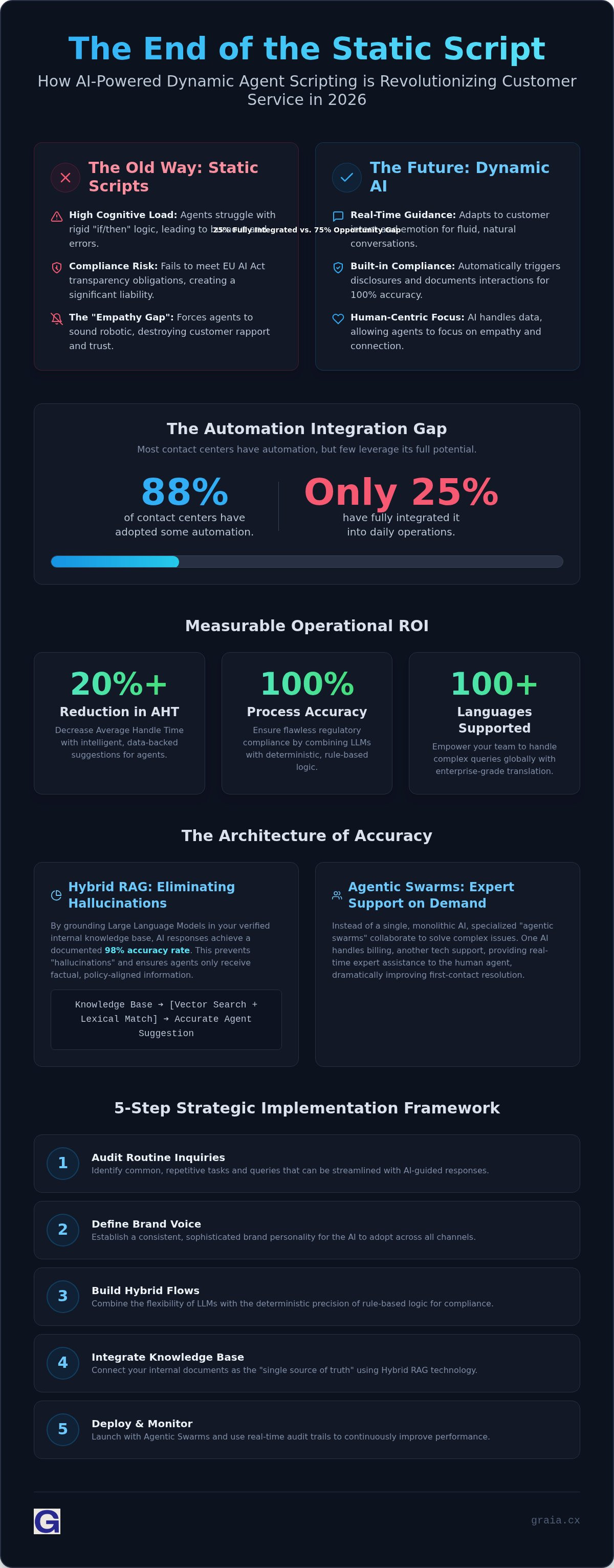
In 2026, the traditional customer service script isn't just a bottleneck; it's a liability that threatens both your regulatory compliance and your brand's soul. While 88% of contact centers have adopted some form of automation, only 25% have managed to fully integrate it into their daily operations. This gap creates a high-pressure environment where agents struggle with cognitive overload and inconsistent messaging. Implementing ai for dynamic agent scripting is no longer an optional upgrade. It's the essential guardrail that allows your team to move beyond rigid, robotic responses toward fluid, empathetic conversations that remain 100% compliant with the now-active transparency obligations of the EU AI Act.
You've likely felt the tension of watching a talented agent stumble through a complex disclosure, or lose a customer's trust because a static script couldn't pivot during a nuanced emotional shift. We understand that your goal isn't just faster calls, but better connections. This guide reveals how to bridge the divide between technical precision and human empathy to reduce your Average Handle Time by 20% or more. We'll explore the architecture of agentic AI and hybrid flows, demonstrating how to empower your workforce to handle complex queries in 100+ languages with absolute process accuracy.
Key Takeaways
- Move beyond the limitations of rigid IVR trees; discover how real-time guidance adapts to customer intent and emotion to bridge the empathy gap.
- Master the architecture of accuracy by combining the natural language of LLMs with deterministic, rule-based logic for flawless regulatory compliance.
- Unlock significant operational ROI by leveraging ai for dynamic agent scripting to reduce Average Handle Time by 20% or more through intelligent, data-backed suggestions.
- Implement a strategic five-step framework to audit routine inquiries and define a consistent, sophisticated brand voice across all digital and voice channels.
- Gain a competitive edge with Agentic Swarm technology that utilizes specialized AI experts to resolve complex issues faster than monolithic, one-size-fits-all systems.
Beyond the Flowchart: The Evolution of AI for Dynamic Agent Scripting
The rigid flowchart has become a cage for the modern enterprise. In 2026, the evolution of conversational agents has reached a critical tipping point where linear decision trees can't keep pace with the nuances of human interaction. Traditional IVR systems and static scripts have created a widening "Empathy Gap." This is a fundamental disconnect where an agent's requirement to follow a fixed protocol overrides their ability to actually listen to the customer. This tension doesn't just frustrate callers; it drives the high agent attrition rates that plague modern contact centers.
We define ai for dynamic agent scripting as a real-time, intelligence-driven guidance system that adapts to intent and emotion while simultaneously triggering backend task execution. It marks a definitive shift from "read this text" to "perform this action." By moving away from static text delivery, the script becomes a living partner in the conversation. It handles the heavy lifting of data retrieval and process adherence so the human agent can focus on the emotional connection.
Why Static Scripts Are a Liability in 2026
Legacy logic imposes a staggering cognitive load on your workforce. Agents must constantly perform mental gymnastics to translate a customer's complex, multi-part story into a binary "if/then" path. This leads to rapid burnout and frequent errors. With the transparency obligations of the EU AI Act now in full force as of August 2026, static scripts are also a significant compliance risk. They often lack the agility to trigger mandatory AI disclosures or manage "high-risk" sentiment analysis with the required documentation. When an agent is forced to sound like a machine, they destroy the rapport needed to resolve disputes or build long-term loyalty.
The Rise of Conversational Intelligence
Modern conversational intelligence detects subtle shifts in a customer's tone, identifying frustration or urgency in milliseconds. By utilizing an Agentic Omni-Channel Platform, enterprises can finally unify voice, chat, and social messaging into a single, intelligent flow. This ensures total contextual continuity. The agent sees every previous interaction across every channel, eliminating the need for the customer to repeat themselves. Agentic scripting is the precise intersection of LLM flexibility and deterministic business logic. It empowers your team to handle complex queries in 100+ languages while maintaining 100% process accuracy. This transition enables the use of "Agentic Swarms," where specialized AI experts support the agent in real-time to resolve issues during the first contact, turning every agent into your most experienced expert.
The Architecture of Accuracy: How Agentic AI Powers Dynamic Scripts
Precision dictates performance. In the high-stakes environment of 2026 customer experience, a scripting tool that guesses is a liability. While early automation relied on rigid trees, modern ai for dynamic agent scripting leverages a sophisticated multi-layered architecture to ensure every interaction remains both fluid and factual. This shift from simple automation to agentic intelligence requires a foundation built on verified data and deterministic guardrails. It is the only way to satisfy the dual demands of human-level empathy and enterprise-grade accuracy.
Hybrid RAG: Eliminating Hallucinations
Trust is fragile; hallucinations destroy it. To prevent AI from inventing policies, we utilize Hybrid Retrieval-Augmented Generation (RAG). This approach combines vector search, which understands semantic meaning, with lexical matching for keyword precision. By grounding the conversational engine in your internal, vetted knowledge base, the system achieves a documented 98% accuracy rate. It treats your company documents as the "single source of truth." This rigorous grounding is supported by academic research on dynamic scripting, which emphasizes the need for adaptive systems that remain within defined operational parameters. Supervisors also benefit from real-time audit trails, providing total transparency into the AI's reasoning for every prompt suggested.
Hybrid Flows: The Secret to 100% Process Accuracy
Not every part of a conversation should be creative. Our "Hybrid Flow" mechanism separates mission-critical steps from natural dialogue. Deterministic nodes handle rigid requirements like payment processing, identity verification, and regulatory disclosures to ensure 100% compliance. Between these fixed points, LLM nodes allow for natural, empathetic conversation. This structure prevents the "robotic" feel of legacy systems while maintaining absolute control over the outcome. To protect these flows, integrated Prompt Shields block malicious inputs and prevent "jailbreaking" attempts, ensuring the agent's instructions remain secure and focused on the task at hand.
The modern enterprise requires LLM-agnostic flexibility. Your scripting engine must support the latest models, whether it is GPT-4o, Claude, or a custom-trained internal model. This adaptability ensures you are never locked into a single provider. Furthermore, these scripts are now action-driven. They don't just tell an agent what to say; they trigger real-time API calls to CRMs like Salesforce and Dynamics 365. This automation handles the administrative burden, allowing the agent to remain present with the customer. If you want to see how these architectures are transforming modern workflows, explore our latest CX strategy insights to stay ahead of the 2026 curve.
Operational ROI: Measuring the Impact of Dynamic AI Scripting
ROI in the modern contact centre is no longer a simple calculation of pennies saved per minute. It's a strategic imperative. In 2026, implementing ai for dynamic agent scripting transforms the operational cost structure by moving from reactive management to proactive guidance. This shift is grounded in sophisticated agentic AI architectures that allow systems to anticipate customer needs before the agent even speaks. The result is a leaner, more agile operation that delivers superior results without compromising on human connection.
The impact is immediate and measurable. By deploying intelligent "Next Best Action" prompts, enterprises typically see Average Handle Time (AHT) drop by 15-25%. This isn't achieved by rushing the customer. It's the result of eliminating the "dead air" while agents search for information. When the script does the searching, the agent does the solving. This directly correlates to a significant boost in First-Contact Resolution (FCR), as agents have real-time access to intelligent, data-backed suggestions that close the loop faster.
The Metrics That Matter in 2026
Speed is a vanity metric if resolution quality is absent. If a customer calls back three times, a low AHT is a failure. We now prioritize the intersection of speed and sentiment. AI-driven sentiment analysis scores agent empathy and policy adherence automatically, ensuring that efficiency never comes at the cost of the brand's voice. This is particularly effective in outbound sales campaigns. Predictive pacing combined with dynamic scripts increases conversion rates by ensuring agents are always prepared for the specific objections of each demographic segment.
Calculating Your Enterprise ROI
Direct cost savings are significant. By utilizing Live Call Translation, you eliminate the need for expensive, specialized bilingual staff, allowing your existing team to support customers in 100+ languages. Training time also plummets. When the script learns alongside the agent, onboarding efficiency increases by 50%. This reduces the initial investment required for new staff and, more importantly, lowers the cognitive load that drives high turnover rates in UK contact centres. To see a detailed breakdown of these numbers, read our comprehensive guide on Contact Centre ROI with AI. It's time to stop viewing AI as an expense and start seeing it as your most powerful catalyst for growth.
Implementing Dynamic Scripting: A 5-Step Strategic Framework
Transitioning from static flowcharts to agentic intelligence requires more than just a software update. It demands a disciplined roadmap that aligns your technical infrastructure with your human objectives. To successfully deploy ai for dynamic agent scripting, enterprises must move beyond the "set it and forget it" mentality. We've developed a five-step framework designed to ensure your transition is seamless, secure, and immediately impactful. This process transforms your contact centre from a cost centre into a high-performance engine of customer loyalty.
Step 1: The Knowledge Base Audit
Your AI is a mirror of your data. If your internal documentation is fragmented or outdated, your dynamic scripts will reflect those flaws. Cleaning your data is the non-negotiable first step. We recommend implementing Hybrid Search, which combines dense and sparse vectors to achieve maximum retrieval accuracy. This ensures the AI understands both the semantic meaning and the specific keywords of a query. Finally, you must integrate your CRM. By connecting the scripting engine to your "source of truth" for customer data, you allow the AI to personalize every prompt based on real-time account history and previous interactions.
Once your data is grounded, you must define your brand voice. Whether your identity is strictly professional, warmly friendly, or efficiently concise, the AI's tone must be configured to match. This consistency builds trust. From there, we build the "Agentic Swarm." Rather than one monolithic bot, you assign specialized virtual agents to specific domains like billing, sales, or technical support. These specialists work in the background, providing your human agents with the exact expertise needed for the current context.
Step 4: Stress-Testing with the Simulator
Never test your logic on a live customer. We utilize a high-fidelity simulator to run bot-to-bot conversations, stress-testing every possible branch of a dialogue before go-live. This identifies logical dead-ends and ensures the transition between deterministic rules and natural language nodes is fluid. The simulator also performs toxicity detection. It ensures the AI remains professional and compliant even when faced with "angry" or provocative simulations. By analyzing token-level probability, we can identify exactly where the model feels "weak," allowing us to provide additional grounding before the script ever reaches an agent's screen.
The final step is continuous optimization. We use AI "Judges" to automatically score performance and refine prompts based on real-world outcomes. This creates a self-improving loop where your scripts actually get smarter with every interaction. If you're ready to begin your migration to an agentic model, explore our deployment guides to see how we've helped global enterprises master this transition.
The GraiaCX Advantage: Orchestrating Empathy with Agentic Swarms
While many competitors treat ai for dynamic agent scripting as a series of slightly more complex flowcharts, GraiaCX introduces a fundamental shift in orchestration. We don't rely on a single, monolithic bot that tries to be everything to everyone. Instead, our architecture utilizes "Agentic Swarms." This concept mirrors high-performing human teams by deploying multiple specialized virtual experts that collaborate in real-time. This ensures that the intelligence supporting your agent is always precisely tuned to the specific problem at hand.
Specialized Experts: The Swarm Concept
In a traditional environment, a billing query might be handled by the same logic as a technical troubleshooting call, leading to generic and often unhelpful prompts. With our swarm architecture, a dedicated Billing Agent and a specialized Tech Support Agent operate as distinct entities within the same flow. When a customer shifts from asking about an invoice to reporting a hardware fault, the context is preserved perfectly during the internal handoff. Intelligent routing then matches the customer to the ideal resource, whether that's a specialized AI expert or a human agent, based on real-time sentiment and historical data. This level of precision is a core component of our Enterprise AI Contact Center Solutions.
Multilingual Mastery
Global enterprises often struggle with fragmented language-based queues that lead to uneven wait times and inconsistent service. We eliminate these silos by integrating Live Call Translation directly into the dynamic script flow. Every agent becomes a multilingual expert capable of handling queries in 100+ languages. This isn't just about literal translation. Our system allows for formality tuning, ensuring that German, Japanese, or Korean cultural nuances are respected during the interaction. By maintaining the original audio "vibe" while the AI handles the linguistic heavy lifting, we protect the human connection that defines your brand.
The final pillar of the GraiaCX advantage is a commitment to privacy-first governance. We recognize that enterprise data is your most valuable asset. Our privacy-first AI ensures that customer data is never shared or used to train external LLMs. This protective layer allows you to innovate with confidence, knowing that your regulatory compliance is baked into the architecture. By unifying voice, chat, and email through an Agentic Omni-Channel Platform, we don't just improve your metrics; we elevate your entire human potential. This is the future of CX, delivered today with 25 years of innovation backing every interaction.
Mastering the Future of Agentic CX
The shift from static flowcharts to intelligent, adaptive guidance is no longer a luxury for the forward-thinking enterprise. It's a fundamental requirement for survival in a regulated, multilingual market. By implementing ai for dynamic agent scripting, you empower your workforce to deliver 60% faster average resolution times while maintaining 100% process accuracy. This transformation isn't about replacing human empathy; it's about amplifying it through technical precision. You've seen how the architecture of Hybrid RAG and Agentic Swarms eliminates the empathy gap and drives a 25% improvement in agent productivity.
The technology now exists to support 100+ languages natively, ensuring your brand's voice remains consistent across every border. Now is the time to lead your organization toward a more intelligent, connected future. Book a Consultation to See GraiaCX in Action and discover how we bridge the gap between technical complexity and human connection. Your agents deserve the clarity of agentic guidance, and your customers deserve the speed of resolution that only a unified, intelligent platform can provide. The path to 2026 excellence starts with a single, visionary step.
Frequently Asked Questions
What is the difference between a chatbot and an agentic script?
A chatbot typically follows a rigid, pre-defined path, whereas an agentic script is a dynamic intelligence layer that adapts to real-time intent and emotion. While traditional bots focus on simple information delivery, ai for dynamic agent scripting prioritizes task execution and empathetic problem-solving. This system functions as a collaborative partner, triggering backend API calls and providing agents with the exact context needed to resolve complex issues rather than simply deflecting them.
Can AI dynamic scripting handle complex tasks like processing refunds?
Yes, the platform handles complex, multi-step tasks like processing refunds or rescheduling deliveries by integrating directly with your CRM and ERP systems. Our Hybrid Flow mechanism ensures these mission-critical processes follow deterministic business rules for absolute accuracy. The AI executes the administrative heavy lifting, such as verifying account status or updating transaction records, while the human agent maintains oversight to ensure a seamless and empathetic customer experience.
How does GraiaCX prevent AI hallucinations in customer conversations?
We eliminate hallucinations by grounding every AI response in your own vetted company documents using Hybrid RAG (Retrieval-Augmented Generation). By combining vector search for semantic meaning with lexical matching for keyword precision, the system reaches a documented 98% accuracy rate. The AI is restricted to your internal knowledge base as its only source of truth, ensuring that every suggestion provided to your agents is factually correct and brand-compliant.
Does my existing CCaaS platform (like Genesys or Avaya) support AI scripting?
GraiaCX integrates natively with major CCaaS providers, including Genesys, Avaya, and NiceCX, through SIP and iframe connectivity. You don't need to replace your existing technology stack to implement ai for dynamic agent scripting across your operation. Our platform drops into your current workflow, providing a unified omnichannel desktop that enhances your existing tools with advanced conversational intelligence and real-time agent assistance without requiring a "rip-and-replace" migration.
Will our customer data be used to train public AI models like ChatGPT?
Your customer data is never shared with third parties or used to train public AI models like ChatGPT. GraiaCX operates on a privacy-first architecture within the Microsoft Azure trust framework, ensuring total data sovereignty for every tenant. We use PII masking and encryption to protect sensitive information both in transit and at rest, maintaining strict adherence to GDPR and other national regulatory standards for enterprise security.
How long does it take to deploy a dynamic agentic script?
Basic configuration and "Day-1 automation" can be achieved rapidly through our no-code setup, though full enterprise-grade optimization typically takes four to six weeks. This period allows for the precise tuning of your knowledge base and the stress-testing of your hybrid flows using our built-in simulator. During this time, we refine speech-to-text accuracy and phrase lists to ensure the system handles your industry-specific terminology with the highest possible precision.
Can the AI understand and translate different dialects and accents?
Our platform supports over 100 languages and is designed to recognize a vast array of regional dialects and accents with high accuracy. By utilizing multiple specialized speech-to-text providers, we optimize recognition for the specific linguistic nuances of your customer base. The system also features formality tuning for languages like Japanese or Korean, ensuring that translations respect cultural expectations and maintain the professional tone required for high-stakes enterprise interactions.
What happens if the AI script reaches a logical dead-end?
If the AI encounters a query it cannot resolve or reaches a logical dead-end, it triggers a seamless handoff to a live human agent. This escalation includes a structured summary of the entire interaction, ensuring the customer never has to repeat their problem. These fallback paths are pre-defined within our hybrid flows, maintaining a protective environment where the customer is always guided toward a resolution by the most qualified resource available.