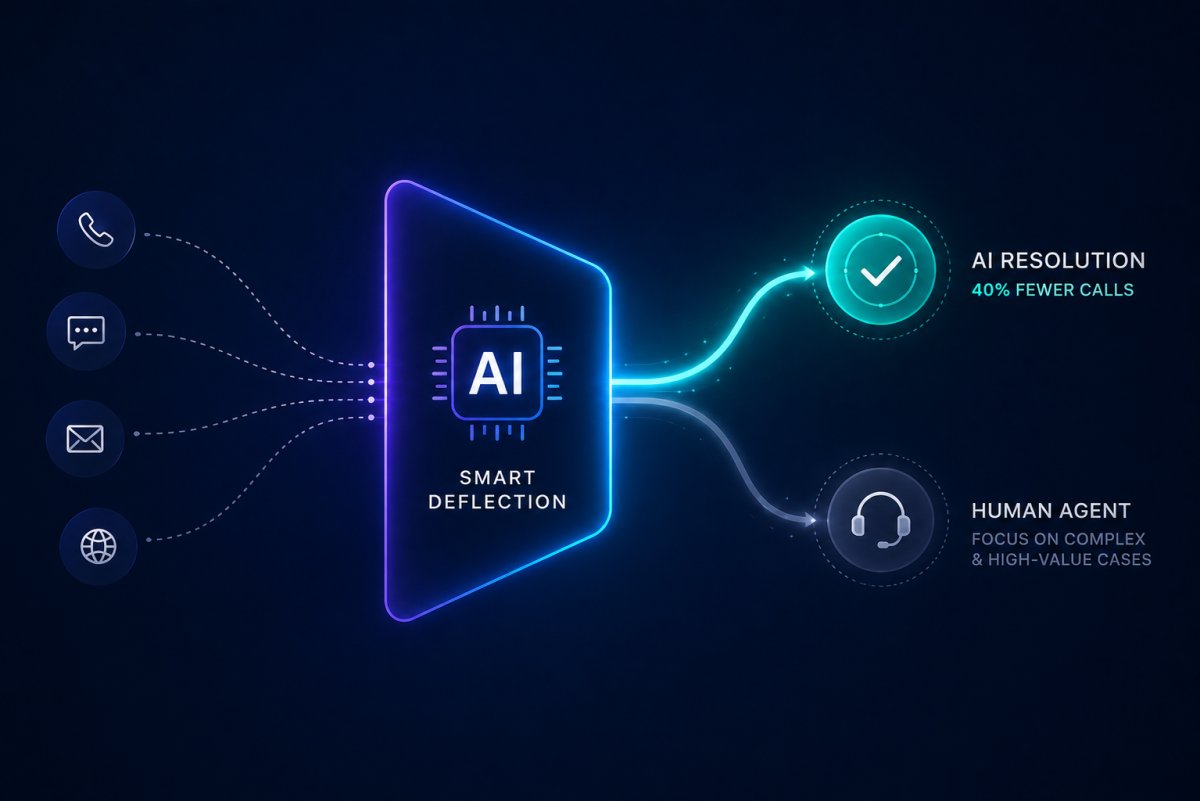
AI Call Deflection: 2026 Agentic CX Guide
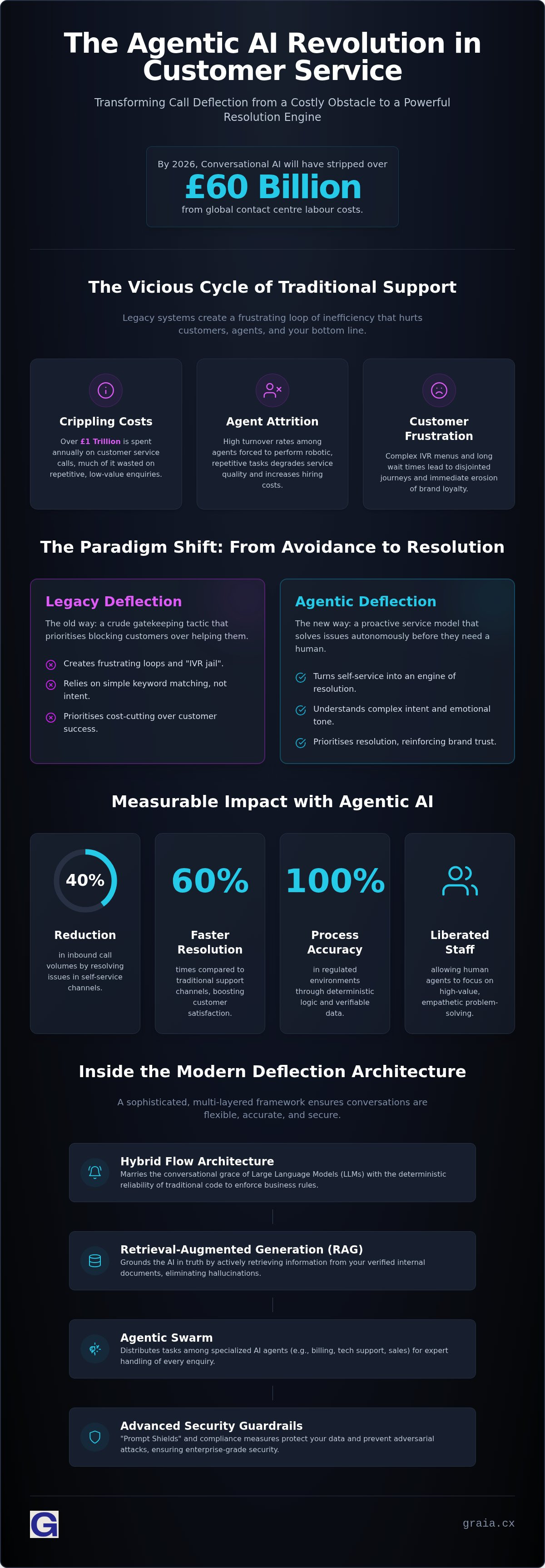
By the end of 2026, conversational AI will have stripped over £60 billion from global contact centre labour costs. However, for many UK enterprises, this efficiency has arrived at a steep price: the erosion of human connection. You've likely seen the fallout in your own operations. High costs from routine enquiries and rising agent attrition create a cycle of frustration that traditional IVR systems simply cannot break. Implementing ai for call deflection shouldn't mean building a wall to keep customers out; it should mean opening a faster, more intelligent door.
We understand that your goal is to protect your margins without sacrificing the empathy that defines your brand. In this guide, you'll discover how to reduce call volumes by 40% while simultaneously increasing customer satisfaction through action-oriented agentic AI. We'll examine the shift from passive chatbots to sophisticated agents that resolve issues autonomously. You will learn how to maintain 100% process accuracy in regulated environments, improve your First Contact Resolution, and finally liberate your human staff for the high-value work they were hired to do.
Key Takeaways
- Transition from legacy avoidance tactics to Agentic Deflection, turning your self-service channels into powerful engines of autonomous resolution.
- Deploy Hybrid Flow architectures to combine the flexibility of LLMs with the deterministic logic required for 100% accuracy in regulated UK environments.
- Reduce inbound volumes by 40% using sophisticated ai for call deflection that identifies customer intent and adjusts its emotional tone in real-time.
- Map high-volume, low-complexity intents to specialized AI agents, allowing your human workforce to focus on high-stakes, empathetic problem-solving.
- Future-proof your contact centre by integrating an agentic ecosystem that delivers 60% faster resolution times and seamless cross-channel continuity.
Redefining Call Deflection: From Avoidance to Agentic Empowerment
In the high-stakes environment of 2026, call deflection has moved beyond the crude gatekeeping tactics of the past. It's no longer about blocking access to support; it's the strategic redirection of enquiries to autonomous resolution channels that actually work. AI call deflection is a proactive service model that solves issues before they reach a human agent. This shift represents a fundamental evolution from legacy systems to agentic empowerment. Modern deflection relies on three non-negotiable pillars: lightning speed, clinical accuracy, and deep human empathy. By prioritising the resolution over the channel, you transform a potential point of friction into a moment of brand reinforcement.
For decades, businesses relied on Interactive Voice Response (IVR) to manage volume. These systems often created "Legacy Deflection," a frustrating loop of numeric menus that prioritised cost-cutting over customer success. Agentic deflection flips this script. By deploying a sophisticated Conversational Agent, companies provide an intelligent alternative that understands complex intent rather than just matching keywords. This ensures the customer feels heard while their problem is solved in seconds, not minutes.
The True Cost of Traditional Telephony
Relying on traditional voice support is an expensive gamble for UK enterprises. Beyond the obvious operational overheads, the hidden costs of long wait times and agent attrition are staggering. When customers are trapped in disjointed journeys, brand loyalty evaporates almost instantly. Globally, businesses spend over £1 trillion annually on customer service calls. Much of this investment is wasted on repetitive, low-value enquiries that leave both customers and staff exhausted. High attrition rates among agents who are forced to perform robotic, repetitive tasks only deepen the financial wound and degrade the quality of your human-led service.
Why Customers Prefer Resolution Over Interaction
There's a common myth that customers always demand a human voice. In reality, they demand a resolution. Whether it's 2 PM or 2 AM, the modern consumer values an immediate, accurate answer over a twenty-minute wait for a human agent. This is where "Growth through AI Empathy" becomes a critical differentiator. By providing 24/7 availability through an Agentic Omni-Channel Platform, you transform the perception of your support from a hurdle to a helpful resource. It's about providing a protective guide that respects the customer's time. Empathy isn't just a human trait; it's the natural outcome of a customer being understood and helped without delay.
The Mechanics of Modern Deflection: RAG, LLMs, and Hybrid Flows
Modern resolution requires more than a clever chatbot. It demands a sophisticated architectural foundation that balances creative linguistic flexibility with rigid operational logic. At the heart of effective ai for call deflection lies Retrieval-Augmented Generation (RAG). This technology ensures the AI doesn't rely on its training data alone, which can be years out of date. Instead, it actively retrieves factual information from your verified internal documents before generating a response. This grounding eliminates the risk of hallucinations, ensuring every interaction is anchored in truth.
GraiaCX’s architecture utilises a "Hybrid Flow" model. This system marries the conversational grace of Large Language Models (LLMs) with the deterministic reliability of traditional code. While the LLM interprets the customer's emotional state and intent, the deterministic layer enforces your specific business rules. To further enhance this, an "Agentic Swarm" architecture distributes tasks among specialised agents. You have one agent dedicated to billing, another to technical support, and a third to sales. This ensures that every enquiry is handled by a specialist with the specific context required for a perfect resolution.
Security is the final, vital component of this framework. GraiaCX implements "Prompt Shields" and advanced security guardrails to protect your data and prevent adversarial attacks. These measures ensure that every interaction remains within the bounds of enterprise compliance and UK data protection standards. This protective layer allows you to deploy AI with confidence, knowing your brand's reputation and your customers' privacy are shielded by industry-leading technology.
Grounding AI in Truth with Hybrid Search
Accuracy isn't an accident. We achieve it through hybrid search, combining dense vector search for semantic understanding with lexical matching (BM25) for precise keyword identification. This dual-layered approach ensures 100% accuracy even in complex, regulated UK environments. Every decision the AI makes is recorded in reasoning logs. These logs provide a transparent audit trail, allowing your compliance teams to see exactly why an AI agent chose a specific path. Unlike "black box" models, this transparency builds the trust necessary for high-stakes enterprise deployment.
Action-Oriented AI: Integrating with CRM and ERP
Deflection fails if the AI can't execute tasks. When implementing ai for call deflection, the focus must be on resolution, not just avoidance. A customer calling about a late delivery doesn't want a sympathetic chat; they want a new delivery slot. Effective agentic ccaas platforms bridge the gap between conversation and execution by integrating directly with your CRM and ERP systems. This allows the AI to perform high-value actions autonomously:
- Processing partial or full refunds.
- Rescheduling deliveries or service appointments.
- Updating account details and security credentials.
By empowering the AI to "do" rather than just "say", you provide a complete resolution that makes the human call unnecessary. To explore more about how these systems are evolving, you might want to stay updated with our latest CX insights.
Beyond the Chatbot: Why Conversational Agents Outperform Legacy IVR
Traditional telephony has long been defined by the rigid constraints of keyword-based IVR. These systems represent a legacy of avoidance, forcing customers through numeric menus that offer little more than a digital dead end. In contrast, modern ai for call deflection leverages deep intent recognition and emotional intelligence to provide a resolution that feels earned, not forced. While an IVR listens for a specific word, a Conversational Agent understands the subtle nuances of human speech, identifying the difference between a routine enquiry and an urgent crisis.
A significant pain point in the UK customer journey is the lack of session continuity. We've all experienced the frustration of explaining a problem on chat, only to be forced to repeat it when we pick up the phone. High-performing enterprise ai contact center solutions eliminate this friction by maintaining context across every touchpoint. Whether the customer starts on email and moves to voice, the AI retains every detail. This ensures the customer never has to repeat themselves, creating a seamless narrative that respects their time and intelligence.
Detecting Sentiment and Emotion in Real-Time
Automation often fails because it lacks the ability to read the room. Our "Empathy Engine" philosophy changes this by monitoring tonal shifts, pace, and vocabulary to identify rising frustration in real-time. If a customer’s voice tightens or their language becomes sharp, the AI doesn't just keep reciting a script. It adjusts its own tone to be more reassuring or triggers a proactive escalation to a human specialist before a complaint is even filed. Empathy in AI is about deep context and understanding, not just the insertion of polite, robotic phrases into a conversation.
The Multi-Agent Ecosystem vs. The Monolithic Bot
The era of the "one-size-fits-all" chatbot is over. Today's most effective architectures mirror a high-performing human contact centre by employing a "swarm" of specialised virtual experts. Instead of one monolithic bot trying to know everything, we deploy individual agents with deep expertise in specific domains like billing, technical troubleshooting, or sales. This multi-agent approach is the gold standard for ai for call deflection because it ensures resolution speed is maximised; the customer is always speaking to the most qualified "mind" for their specific problem. These agents work in concert, handing off the customer with total context when the conversation shifts topics. This ecosystem doesn't just deflect calls; it orchestrates a superior standard of care.
Strategic Implementation: Orchestrating a Deflection Framework
Moving from a conceptual understanding to a live environment requires a disciplined, step-by-step roadmap. Orchestrating a framework for ai for call deflection isn't a structural patch; it's a fundamental realignment of how your brand interacts with the world. Success depends on precision. You must identify where the friction lies and deploy the right intelligence to smooth it out before the customer reaches for the phone.
Follow these five essential steps to build your agentic ecosystem:
- Step 1: Intent Audit. Identify high-volume, low-complexity enquiries. These 'deflectable' intents, such as status updates or password resets, are the primary candidates for ai for call deflection.
- Step 2: Hybrid Flow Mapping. Design your hybrid flows to ensure mission-critical processes follow strict business rules. This ensures the AI remains flexible in conversation while staying rigid in execution.
- Step 3: Anticipatory Service. Deploy proactive notifications. By solving an issue before the customer even knows it exists, you eliminate the need for the call entirely.
- Step 4: Intelligent Routing. Implement dynamic routing that matches customers with the optimal agent, whether that's a specialised AI expert or a human specialist for high-emotion cases.
- Step 5: Automated Validation. Use 'Judges', which are autonomous AI evaluators, to stress-test your workflows. These systems simulate thousands of interactions to find edge cases before you go live.
Proactive vs. Reactive Deflection
Effective strategy balances two distinct approaches. Proactive deflection uses SMS or email updates to prevent the "Where is my order?" call before it's even dialled. Reactive deflection captures the customer at the point of contact, offering a seamless "digital-first" transition during an IVR wait time. You'll find that contact center roi with ai is maximised when these strategies work in tandem, reducing the total load on your human staff while keeping customers informed.
Breaking the Language Barrier as a Deflection Tactic
Language frustration is a hidden driver of call escalations in global enterprises. If a customer can't find a resolution in their native tongue, they'll inevitably call your UK support centre. Integrating live call translation software allows you to offer immediate, high-quality support in over 100 languages. This isn't just about translation; it's about cultural resonance. Through formality tuning, your AI can maintain brand standards in German or Japanese, ensuring every interaction feels local and respectful. To see how these frameworks can be tailored to your specific industry, explore our full resource library.
Future-Proofing CX: The Graia Agentic Ecosystem
The future of the contact centre isn't found in isolation. It lives within a unified, human-plus-AI ecosystem that treats technology as an extension of human potential rather than a replacement for it. By integrating ai for call deflection into a broader agentic framework, enterprises move beyond simple volume management. Graia delivers a measurable 40% reduction in escalations and a 25% improvement in agent productivity. These aren't just figures on a dashboard; they represent a fundamental shift in operational health and staff morale. Our 'Day-1 Automation' promise ensures that this transformation begins immediately, utilising a no-code setup that allows for rapid, low-friction deployment across your existing infrastructure without the need for exhaustive technical overhauls.
Seamless Human-AI Collaboration
When the AI successfully deflects routine enquiries, the human agent's role becomes more critical, not less. To support this evolution, our ecosystem includes sophisticated ai agent assist tools that provide real-time coaching and next-best-action suggestions during live interactions. Automated wrap-up and summary features save agents significant time per call, removing the administrative burden that often leads to burnout. This synergy empowers your team to handle complex, high-empathy cases with the full context provided by the AI. It ensures that when a human does step in, they are equipped to provide the definitive resolution the customer expects.
Enterprise-Grade Security and Sovereignty
Trust is the currency of the digital age. We recognise that for UK enterprises, data sovereignty is a non-negotiable requirement for maintaining regulatory compliance. Graia is built on a foundation of absolute privacy; your client data is never used for external model training. We implement rigorous PII masking, end-to-end encryption, and SOC2-aligned standards to protect your most sensitive information at every touchpoint. This protective framework ensures that your ai for call deflection strategy is both bold and secure, allowing you to innovate without compromising your integrity. As you look toward the next horizon of customer experience, explore the Graia blog for deeper insights into agentic CX.
Mastering the Agentic Shift: The Path to Resolution-First CX
The transition from legacy IVR to agentic empowerment isn't just a technical upgrade; it's a strategic mandate for UK enterprises. By leveraging Hybrid Flows and RAG retrieval, you ensure that every interaction is grounded in truth and executed with clinical precision. This shift allows you to move beyond the avoidance mindset of the past. Implementing sophisticated ai for call deflection transforms your contact centre from a cost-heavy bottleneck into a streamlined engine of customer success that prioritises resolution over redirection.
You've seen the potential for a 40% reduction in escalations and the ability to serve a global audience with live translation in 100+ languages. These results are underpinned by SOC2-aligned security standards, ensuring your data remains sovereign and secure at all times. The era of the "please repeat your issue" frustration is ending. It's being replaced by a seamless, multi-agent ecosystem that respects both the agent's time and the customer's intelligence.
It's time to lead your industry into a more empathetic, efficient future. Read more about the future of Agentic CX on our blog and discover how to elevate your service standards today. Your journey toward a more intelligent, human-centric contact centre is just beginning.
Frequently Asked Questions
What is call deflection and how does AI improve it?
Call deflection is the strategic redirection of inbound enquiries to autonomous digital channels for faster resolution. Modern ai for call deflection improves this process by moving beyond the rigid, numeric menus of legacy systems and using deep intent recognition to solve problems in real-time. This ensures customers aren't just being avoided; they're being served with a level of speed and precision that traditional telephony cannot match.
Will call deflection negatively impact my customer satisfaction scores?
Properly executed deflection actually improves satisfaction scores by eliminating wait times and providing immediate resolutions. Customers in the UK increasingly value their time above all else. When an AI agent provides an accurate answer in seconds, it removes the friction that typically drives poor CSAT. Our Empathy Engine ensures the interaction remains supportive and respectful throughout the entire journey, protecting your brand reputation.
How does agentic AI ensure 100% accuracy in regulated industries?
We achieve 100% accuracy through a Hybrid Flow architecture that combines Large Language Models with deterministic business logic. In regulated sectors like finance or healthcare, this ensures the AI never deviates from approved protocols or legal requirements. Every response is grounded in your verified data through Hybrid RAG retrieval, providing a transparent audit trail that satisfies even the most stringent UK compliance standards.
Can AI for call deflection actually take actions like processing refunds?
Yes, modern ai for call deflection is designed to execute complex workflows such as processing refunds, rescheduling deliveries, or updating account credentials. By integrating directly with your CRM and ERP systems, the AI moves from passive conversation to active execution. This capability ensures that the deflection is successful because the customer's original intent is fully resolved without any human intervention required.
What is the difference between a chatbot and a conversational agent?
Chatbots are typically reactive, linear systems that rely on simple keyword matching to provide pre-scripted answers. Conversational Agents are autonomous, intent-aware entities that understand context, sentiment, and nuance. They operate within a multi-agent ecosystem, or 'swarm', where specialised virtual experts collaborate to solve complex problems. This results in a fluid experience that focuses on genuine resolution rather than just simple redirection.
How do I identify which calls should be deflected to AI?
You should begin with an intent audit to identify high-volume, low-complexity enquiries that consume significant human resources. Routine tasks like checking order status, updating account details, or answering basic FAQs are ideal candidates for automation. By deflecting these predictable intents, you liberate your human staff to focus on high-stakes cases that require deep emotional intelligence and complex, creative problem-solving.
Does Graia integrate with my existing CCaaS platform like Genesys or Avaya?
Graia is built to integrate seamlessly with leading enterprise CCaaS platforms, including Genesys, NICE, and Avaya. Our Agentic Omni-Channel Platform acts as an intelligent layer that unifies your voice, chat, and email streams without requiring a full infrastructure overhaul. This ensures you don't have to rip and replace your existing systems to benefit from advanced automation; you simply enhance your current capabilities.
What happens if the AI agent cannot resolve a customer's inquiry?
If an enquiry exceeds the AI's autonomous capabilities, the system triggers a seamless handoff to a human specialist. The human agent receives the full transcript and context of the interaction via Agent Assist, ensuring the customer never has to repeat themselves. This protective transition maintains the relationship and ensures that even the most complex issues are resolved with total continuity and professional care.