
Agent Assist for Complex Issues: 2026 Guide to Agentic CX
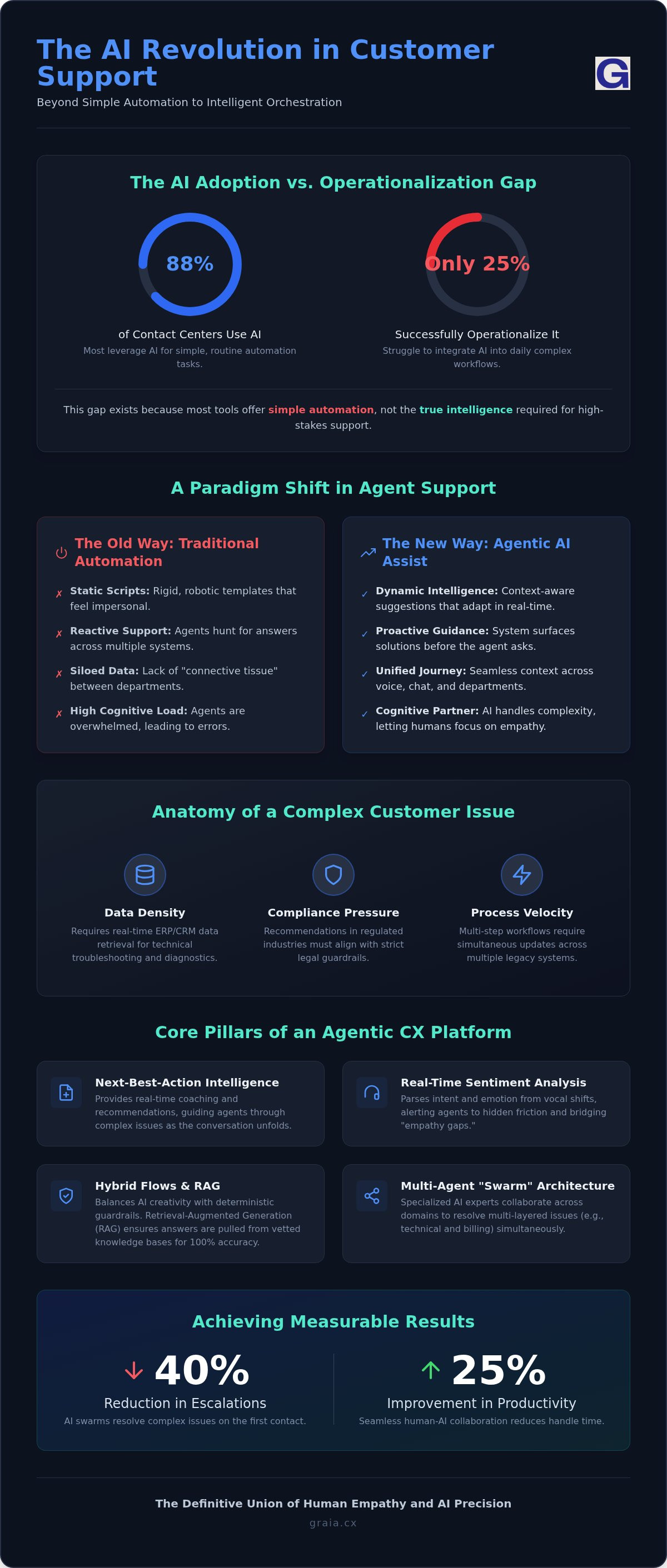
Why do 88% of contact centers utilize AI while only 25% have successfully operationalized it into their daily workflows? This massive gap exists because most tools offer simple automation rather than true intelligence. You've likely seen your best agents struggle under the crushing cognitive load of regulated environments where one wrong word carries legal weight. It's frustrating to watch customers repeat themselves during escalations because your systems can't keep up. We understand that high-stakes support requires sophisticated agent assist for complex customer issues that acts as a cognitive partner, not just a search bar.
This guide reveals how an agentic swarm architecture transforms these high-pressure moments into seamless resolutions. You'll discover how real-time intelligence, multi-agent coordination, and empathetic automation reduce average handle time while actually improving the human experience. We'll show you how to build a resilient, compliant, and deeply human support ecosystem by exploring the shift toward the human as an orchestrator of AI systems, the impact of GPT-6 Astra, and the strict transparency requirements of the 2026 EU AI Act.
Key Takeaways
- Learn how agent assist for complex customer issues moves beyond basic automation to provide real-time coaching and next-best-action intelligence during high-stakes interactions.
- Discover how advanced sentiment analysis and real-time intelligence bridge empathy gaps during escalations, ensuring your team maintains a sophisticated human connection.
- Explore the "Swarm" architecture where specialized AI experts collaborate across domains to resolve multi-layered technical and billing queries simultaneously.
- Master the use of Hybrid Flows to balance generative AI creativity with deterministic guardrails, ensuring total process accuracy for mission-critical transactions in regulated environments.
- Uncover the strategic path to achieving a 40% reduction in escalations and a 25% improvement in productivity through seamless human-AI collaboration.
What is Agent Assist for Complex Customer Issues?
Traditional support systems are reaching their breaking point. While basic bots handle simple queries, they crumble when faced with multifaceted problems that require nuance and cross-departmental visibility. True agent assist for complex customer issues isn't a passive database; it's an active, real-time support companion that provides coaching and next-best-action recommendations as a conversation unfolds. It functions as a layer of intelligence that sits between the agent and the enterprise stack, translating raw data into actionable empathy.
There is a fundamental difference between routine automation and complex issue orchestration. Routine automation is binary. It follows a pre-defined path until it hits a wall. Orchestration, however, understands the context of a high-stakes escalation. It recognizes that Agent-assisted automation must do more than just fill digital forms; it must empower the human at the center of the storm. When issues cross departmental lines, traditional IVR and simple chatbots fail because they lack the "connective tissue" to see the full customer journey. An Agentic CCaaS platform maintains session continuity across voice and chat, ensuring that no detail is lost when a technical issue evolves into a billing dispute. It bridges the gap between silos, turning a fragmented experience into a unified narrative.
The Anatomy of a Complex Customer Issue
Complexity isn't just about difficulty; it's about integration. A truly complex issue often involves three critical layers:
- Data Density: Technical troubleshooting that requires real-time ERP or CRM data retrieval to diagnose a unique hardware failure.
- Compliance Pressure: Billing disputes in regulated industries where every recommendation must align with strict legal guardrails.
- Process Velocity: Multi-step workflows like rebookings or account migrations that require simultaneous updates across legacy systems.
Moving Beyond Static Scripts to Dynamic Intelligence
Rigid templates are the enemy of genuine connection. In the past, agents were forced to follow static scripts that felt robotic and clinical. Modern LLMs change this dynamic by generating contextually relevant suggestions that adapt to the customer's emotional state and specific history. We are seeing a shift from reactive support, where the agent hunts for answers, to proactive guidance, where the system surfaces the solution before the agent even asks. By deploying agent assist for complex customer issues, organizations can finally move away from the frustration of "dead-end" interactions. This transition reduces cognitive load and allows the agent to focus on the human element of the interaction. Agentic CX is the definitive union of human empathy and AI precision.
Real-Time Intelligence: Parsing Intent and Emotion During Escalations
High-stakes escalations are where brand loyalty is forged or destroyed. Most legacy systems fail during these critical moments because they ignore the emotional subtext that drives human behavior. To bridge this "empathy gap," modern agent assist for complex customer issues utilizes high-fidelity transcription and synthesis from providers like Azure and ElevenLabs. These tools don't just record words; they capture the subtle vocal shifts that signal rising frustration or burgeoning trust. By parsing intent and emotion in real-time, the system alerts agents to hidden friction points before they derail the conversation.
Intelligence without grounding is a liability. While generative models are powerful, they require strict guardrails to remain reliable in regulated environments. We solve this by implementing Retrieval-Augmented Generation (RAG), which forces the AI to pull answers exclusively from your vetted internal knowledge base. This approach distinguishes general generative tools from specialized AI agents for complex tasks that must interact with enterprise systems with 100% accuracy. To further reduce cognitive load, the platform provides instant, high-context summaries of previous bot interactions. Agents no longer need to hunt through transcripts; they receive a synthesized brief the moment the call connects. Explore our latest insights on the GraiaCX blog to see how real-time intelligence is reshaping the enterprise.
Contextual Retrieval with Hybrid Search
Precision requires a dual approach. We utilize hybrid search to combine dense vector search, which understands the underlying meaning of a query, with lexical matching for exact keyword accuracy. This ensures that when an agent asks for a specific policy or technical spec, the system retrieves the correct document even if the customer uses non-standard terminology. By grounding agent assist for complex customer issues in this architecture, we eliminate hallucinations and ensure every recommendation is factually sound.
Live Call Translation as an Accessibility Tool
Complexity shouldn't be limited by language. Our platform supports over 100 languages, allowing your best specialists to resolve issues for a global customer base without language barriers. By utilizing live call translation software, agents can view translated text while still hearing the "Original Audio." This is vital for detecting sentiment and tone that might be lost in text alone. It transforms the agent workspace into a truly inclusive environment where technical expertise, not language proficiency, defines the quality of the resolution. This capability has directly contributed to a 40% reduction in escalations for our global enterprise partners.
The Multi-Agent Swarm: Orchestrating Specialized Experts
One monolithic AI model is no longer enough for the modern enterprise. We've replaced the "jack-of-all-trades" bot with a sophisticated swarm of specialized digital experts. This architecture assigns specific domains, like billing, technical troubleshooting, or logistics, to dedicated agent nodes that collaborate in real-time. As IBM explains agent assist technology, these systems utilize NLP and machine learning to guide humans through intricate workflows. When a customer presents a multifaceted problem, a 'Billing Agent' and a 'Tech Support Agent' can work together within the same session, sharing context and data to ensure no detail is missed. This level of orchestration is essential for effective agent assist for complex customer issues, as it prevents the silos that typically lead to customer frustration.
The results are measurable and immediate. By deploying specialized AI assistance, organizations typically see a 15-25% reduction in Average Handle Time (AHT) for their most difficult cases. This isn't just about speed; it's about accuracy. When the system handles the data retrieval and cross-system coordination, the human agent is freed from the mechanical burden of "tab-switching." When a handoff occurs, the agent receives a structured recap and full session history, ensuring they never have to ask the customer to repeat themselves. It transforms the agent's role from a data entry clerk into a high-level orchestrator.
Domain-Specific Virtual Experts
Monolithic bots often struggle with context drift when a conversation shifts from a technical bug to a refund request. A swarm architecture avoids this by routing queries through specialized nodes, such as a 'Data Collection' node or a 'Decision' node. Each interaction path maintains a clear audit trail and record of AI reasoning. This transparency is vital for regulated industries where you must be able to justify why a specific recommendation was made. It turns the AI from a black box into a verifiable partner that strengthens your compliance posture.
The Role of the Human-in-the-Loop
AI is a catalyst, not a replacement. We build systems with clear escalation triggers that fire the moment the AI identifies a situation it cannot resolve autonomously. This might be a high-sentiment "empathy gap" or a legal complexity requiring nuanced human judgment. Features like 'Email Draft Mode' allow the AI to compose a sophisticated response for the human agent to review and refine before sending. By equipping your team with modern ai agent assist tools, you empower them to focus on high-value empathy while the swarm handles the heavy lifting. This collaboration ensures that agent assist for complex customer issues remains grounded in human oversight and genuine connection.
Implementing Hybrid Flows: Balancing LLM Creativity with Precision
Pure generative AI is a liability when precision is paramount. We have moved beyond the era of "good enough" automation. We solve the inherent unpredictability of large language models through Hybrid Flows. This architecture combines the fluid, conversational power of models like GPT-6 Astra with the rigid, deterministic business logic required for mission-critical tasks. It ensures 100% process accuracy for high-stakes transactions, such as processing complex payments or modifying sensitive healthcare records. By deploying agent assist for complex customer issues, you gain the transformative benefits of agentic intelligence without sacrificing the structural integrity of your enterprise operations.
Security isn't an afterthought; it's the foundation of trust. We implement advanced Prompt Shields to neutralize toxicity and prompt injection attacks before they ever reach your core systems. This proactive defense is coupled with a strict privacy-first mandate. Your customer data remains exclusively yours. It's never used to train public models or shared with external entities. This privacy-first approach ensures that your proprietary enterprise intelligence stays within your digital perimeter, providing peace of mind in an increasingly volatile cyber landscape.
Five Steps to Deploying Agentic Workflows
Transitioning to a truly agentic model requires a methodical and transparent approach. First, map your most complex, high-friction processes to rule-based "Hybrid Flow" logic. Second, integrate your platform with existing CRM and ERP systems via secure APIs to provide the AI with real-time data access. Third, stress-test these workflows using sophisticated "bot-to-bot" simulators that can identify edge cases before they impact a live customer. Fourth, configure AI "Judges" to score adherence to brand voice and internal policy. Finally, deploy with the confidence that your system is both capable and compliant. Discover how to master these deployment steps on the GraiaCX blog.
Action-Driven Support in Regulated Industries
In sectors where compliance is non-negotiable, traditional AI often falls short. Our platform empowers agents to perform high-value actions, such as updating ERP data or processing refunds, directly within the agentic workspace. We maintain strict GDPR and Ofcom compliance through script-locked suggestions that prevent agents from deviating from approved legal language. We ensure data sovereignty with regional hosting and SOC2-aligned standards, satisfying the most rigorous regulatory demands of 2026. This is the future of agent assist for complex customer issues: a system that is as protective as it is productive.
The GraiaCX Advantage: Unifying Empathy and Automation
GraiaCX stands at the pinnacle of CX innovation. For 25 years, we have refined the intersection of human connection and technological precision. Our platform isn't just another tool; it's a comprehensive Agentic Omni-Channel Platform designed to solve the most stubborn industry frustrations. By providing sophisticated agent assist for complex customer issues, we empower enterprises to achieve a 40% reduction in escalations and 60% faster resolution times. This isn't theoretical. It's the standard we set for the modern contact center. We don't just provide software. We provide a visionary partnership that prepares your organization for the future of service.
We respect your existing investments. Our solution offers native integration with Genesys, NICE CX, and Avaya, as well as any SIP-enabled platform. This interoperability ensures that your transition to an agentic model is smooth and immediate. Looking toward the horizon, our roadmap for 2026 includes automated prompt optimization and real-time coaching to keep your team at peak performance. It's important to recognize that our specialized Agent Assist (Next Best Action) feature is scheduled for release on March 31, 2025, marking a new era in agent assist for complex customer issues. We provide the stability you need today with the evolution you require for tomorrow.
Modernizing Legacy Contact Centers
GraiaCX is the definitive partner for enterprise ai contact center modernization. We understand the complexity of legacy infrastructure. Our modular approach allows you to deploy advanced AI capabilities without a costly "rip-and-replace" of your current tech stack. The GraiaCX Omnichannel Desktop unifies voice, chat, and social interactions into a single, cohesive interface. It eliminates the friction of fragmented systems and provides agents with a stable, high-performance environment that scales with your needs.
Maximizing ROI Through Agentic Intelligence
True value is found in the elevation of human potential. When you reduce the cognitive load on your team, you directly combat agent attrition and burnout. Calculating contact center roi with ai becomes a straightforward exercise in observing First Contact Resolution (FCR) improvements and a 25% gain in agent productivity. By automating the mechanical and supporting the emotional, we create a sustainable path to growth. The era of transactional support is over. Transform your contact center with GraiaCX and lead the evolution of the customer experience.
Orchestrating the Future of the Agentic Contact Center
The evolution of customer experience isn't just about faster responses; it's about deeper intelligence. We've explored how specialized swarms and Hybrid Flows redefine what's possible in high-stakes environments. Implementing agent assist for complex customer issues allows your team to transcend traditional limitations by replacing cognitive overload with real-time, actionable insights. It's a move toward a more resilient, compliant, and profoundly human support ecosystem where technology serves the specialist.
Transitioning to this future state requires a partner who understands both the technical architecture and the human psychological element. With 25 years of CX industry experience and a 99.9% uptime guarantee, GraiaCX provides the stable foundation your enterprise demands. Our native integration with major CCaaS providers ensures you can modernize without the risk of disruption. Ready to see the transformation in action? Book a Demo of GraiaCX Agent Assist today and empower your team to lead the next era of customer connection. Your journey toward agentic excellence starts now.
Frequently Asked Questions
What is the primary difference between a standard chatbot and an Agentic Conversational Agent?
An Agentic Conversational Agent goes beyond the rigid, menu-driven responses of a standard chatbot by understanding complex intent and taking direct action. It uses Hybrid Flows to integrate with your CRM and ERP systems, allowing it to process refunds or update account details autonomously. This shift from simple conversation to task execution is the hallmark of the Agentic Customer Experience. It ensures that routine inquiries are resolved without human intervention while preserving context for higher-level issues.
How does Agent Assist handle complex billing or technical issues in regulated industries?
Our platform utilizes Hybrid Flows to balance the natural language of LLMs with deterministic, rule-based logic. This ensures 100% process accuracy for mission-critical tasks in regulated environments. By providing agent assist for complex customer issues, the system delivers script-locked suggestions that agents must follow verbatim for compliance. This combination of AI empathy and rigid guardrails allows your team to navigate billing disputes or technical troubleshooting with total confidence and a clear audit trail.
Will my customer data be used to train external AI models?
We maintain a strict privacy-first mandate where your enterprise data remains exclusively yours. GraiaCX ensures that customer information is never shared or used to train external or third-party AI models. We utilize regional hosting and SOC2-aligned standards to provide data sovereignty and peace of mind. This protective approach allows you to leverage advanced intelligence without compromising the confidentiality of your proprietary business data or your customers' sensitive information.
How does the 'Swarm' architecture improve first-contact resolution (FCR)?
The "Swarm" architecture assigns specialized digital experts to specific domains like billing or technical support. Instead of a single, monolithic bot, these agents collaborate in real-time within a single session. This prevents the departmental silos that typically frustrate customers and force them to repeat themselves. By matching the customer with the right specialized node immediately, we drive higher first-contact resolution rates and ensure that complex, multi-layered queries are resolved correctly the first time.
Can GraiaCX integrate with my existing Genesys or Avaya contact center platform?
Yes, GraiaCX offers native integration with major CCaaS providers including Genesys, NICE CX, and Avaya. Our platform is designed to drop into your existing tech stack via SIP and iframe without requiring a costly "rip-and-replace" of your infrastructure. This interoperability ensures that you can modernize your contact center and deploy sophisticated agent assist for complex customer issues immediately. We provide the connective tissue that bridges your legacy systems with the future of agentic intelligence.
What happens if the AI assist provides an incorrect or unhelpful suggestion?
Our system includes deterministic guardrails and clear fallback paths to prevent unhelpful interactions. Agents utilize a cancel-and-edit window to revise or reject suggestions before they reach the customer. AI-powered "Judges" continuously score interactions based on brand voice and policy adherence to identify weak confidence levels. If the system detects a situation it cannot resolve autonomously, it triggers a seamless human handoff with a full structured recap for the live agent.
How does real-time translation work for complex technical support calls?
Real-time translation supports over 100 languages by utilizing high-fidelity transcription and synthesis. It features "Original Audio," which allows agents to hear the customer's natural voice to detect sentiment and tone that text alone might miss. Custom vocabulary and phrase lists ensure that technical brand names and industry-specific terminology are translated with 95-98% accuracy. This capability removes language barriers, allowing your best technical specialists to serve a global audience without needing bilingual proficiency.
What is the expected reduction in Average Handle Time (AHT) after implementing Agent Assist?
Organizations typically see a 15-25% reduction in Average Handle Time after the initial 4-6 weeks of system tuning. Our platform also delivers a 60% improvement in overall resolution speed by automating data retrieval and providing real-time coaching. Our specialized Agent Assist (Next Best Action) feature is scheduled for release on March 31, 2025. This roadmap ensures that your contact center continues to gain productivity as the technology evolves.