
2026 UK Customer Service Productivity Benchmarks: The Enterprise Guide to Agentic CX
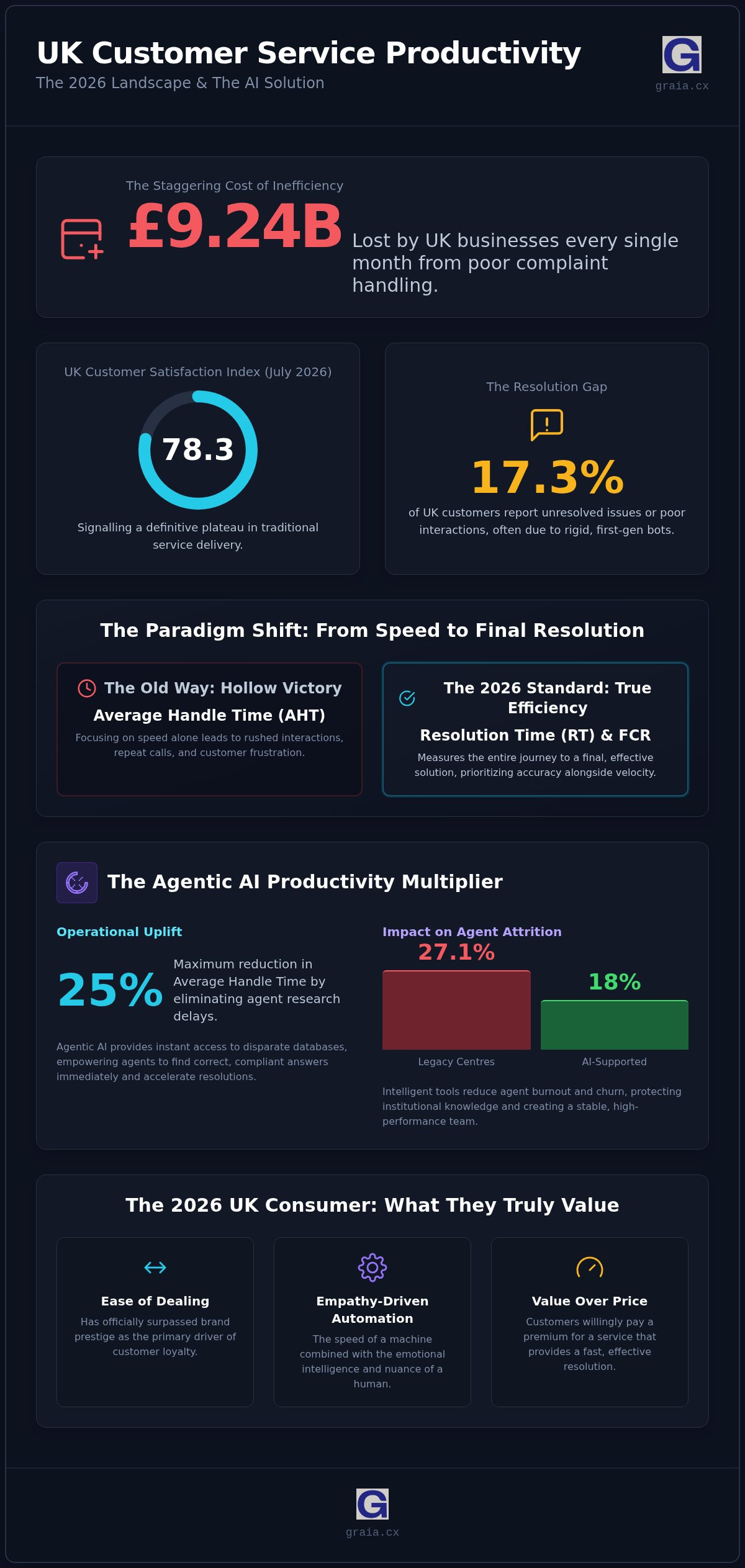
UK businesses are currently losing £9.24 billion every month to the rising cost of complaint handling. It is a staggering drain on the national economy. This figure highlights a fundamental flaw in traditional service models that rely on linear scaling. You've likely noticed your own customer service productivity benchmarks uk stagnating even as staff costs continue to climb. It's a frustrating paradox where teams work more hours, yet the July 2026 UKCSI score remains stubbornly low at 78.3.
We understand the struggle of balancing operational speed with genuine human empathy. This guide provides the definitive 2026 productivity data you need to recalibrate your enterprise operations and move beyond legacy limitations. You'll discover how to leverage agentic AI to break the cycle of rising costs and declining satisfaction. We'll explore how integrating Conversational Agents and Live Call Translation can reduce Average Handle Time by up to 25% while finally eliminating the expensive hiring premiums for bilingual staff. It's time to transition from manual effort to intelligent resolution.
Key Takeaways
- Analyse the current customer service productivity benchmarks uk to identify the systemic inefficiencies costing enterprises billions in complaint handling every month.
- Move beyond traditional Average Handle Time by adopting Resolution Time as the definitive metric for high-performance, agentic contact centres.
- Quantify the impact of Conversational Agents and Agent Assist on your operational bottom line, targeting a 25% uplift in overall agent productivity.
- Compare your performance against sector-specific leaders in Finance and Retail to identify and close competitive gaps in your automation strategy.
- Implement hybrid flows with GraiaCX that combine technical precision with an empathy-driven approach to maintain high satisfaction scores while accelerating resolution.
The 2026 Landscape: Mapping UK Customer Service Productivity
The UK Customer Satisfaction Index (UKCSI) reached 78.3 in July 2026. This isn't just a static data point; it's a warning for enterprises. It signals a definitive plateau in traditional service delivery. Despite massive investments in legacy automation, 17.3% of UK customers still report unresolved issues or poor interactions. This gap exists because many firms implemented rigid, first-generation bots that frustrate rather than resolve. They prioritised cost over connection, and the results are showing in the national averages.
The financial impact is visceral. UK businesses are currently hemorrhaging £9.24 billion every single month due to poor complaint handling and inefficient staff allocation. This massive drain underscores why customer service productivity benchmarks uk are now the primary focus for C-suite executives. High-performing organisations are refocusing on First Call Resolution (FCR) as the ultimate metric of efficiency. They realise that speed without resolution is just an expensive way to lose a customer.
The Macro-Economic Impact of CX Productivity
The 2026 labour market remains exceptionally tight. Staffing crises and global talent shortages have made human-only service models unsustainable and prone to reliability failures. There's a direct, proven correlation between high UKCSI scores and long-term enterprise profitability. In the 2026 UK context, CX productivity is defined as the strategic ability to eliminate the £9.24bn monthly national waste by replacing friction with fluid, agentic resolutions. It's about doing more with the talent you have by removing the administrative burden from their shoulders.
The Consumer Perspective: What UK Customers Value in 2026
British consumers have evolved. "Ease of dealing" has officially surpassed brand prestige as the primary driver of loyalty. Competitive pricing no longer provides a safety net for poor service productivity; customers will pay a premium for a resolution that doesn't waste their time. They demand empathy-driven automation. This means they want the speed of a machine but the emotional intelligence of a human. They want systems that understand the nuance of their frustration, not just the keywords in their query.
The 2026 business environment has forced a radical rebranding of the contact centre. It's no longer a cost centre to be minimised; it's a value hub where every interaction secures customer lifetime value. Enterprises that master their customer service productivity benchmarks uk are the ones turning service into a competitive advantage rather than a liability. They don't just answer calls; they protect the brand's future.
Deconstructing Core Benchmarks: AHT, FCR, and the Empathy Index
The era of tracking speed for speed’s sake has ended. In 2026, sophisticated enterprises have realised that a low Average Handle Time (AHT) is a hollow victory if it doesn't result in a definitive resolution. We're witnessing a fundamental shift in customer service productivity benchmarks uk toward Resolution Time (RT). This metric captures the entire journey, from the first interaction to the final solution. It ensures that efficiency isn't achieved at the expense of effectiveness, especially in a landscape where customers value their time above all else.
While speed matters, the human element remains the true differentiator. High attrition rates continue to plague the industry, with legacy centres seeing turnover as high as 27.1%. This constant churn destroys institutional knowledge and creates a productivity vacuum. By contrast, organisations that support their staff with intelligent tools see attrition drop to 18%. Productivity in 2026 is as much about protecting your human talent as it is about optimising your digital assets.
Average Handle Time vs. Average Resolution Time
Enterprises implementing agentic AI now expect a 15-25% reduction in AHT within the first six weeks of deployment. This gain doesn't come from rushing the customer. It comes from eliminating the "dead air" where agents traditionally search through disparate databases. In complex, regulated UK industries, "fast" can be a liability if it compromises compliance. Understanding Contact Centre ROI with AI requires redefining these metrics to prioritise accuracy alongside velocity. True productivity is measured by how quickly a problem stays solved.
FCR: The 2026 Efficiency Frontier
First Contact Resolution (FCR) is the gold standard for UK enterprise productivity. By leveraging agentic RAG (Retrieval-Augmented Generation) and deep knowledge grounding, top-tier centres are targeting a 5-10 point increase in FCR. This is driven by contextual retrieval, which ensures the system understands the history of a query before the agent even picks up the phone. Top-performing UK contact centres have already documented a 40% reduction in escalations through these methods. For organisations managing large-scale operations, adhering to established performance metrics for public services provides a robust framework for benchmarking these improvements.
The integration of an "Empathy Index" allows leaders to quantify the emotional quality of every interaction. This ensures that as we automate, we don't sacrifice the connection that builds brand loyalty. If you're looking to balance these technical gains with a human-centric approach, our latest industry insights offer a deeper exploration of how empathy and automation coexist in high-performing teams.
The AI Productivity Multiplier: Benchmarking Human-AI Collaboration
The 2026 landscape demands more than incremental speed. It requires a fundamental multiplier. Agentic productivity represents this shift by deploying autonomous Conversational Agents that resolve routine enquiries 24/7 without human intervention. This transformation redefines customer service productivity benchmarks uk, moving the focus from mere activity to meaningful resolution. It ensures your most expensive resource, human empathy, is reserved for the moments that define brand loyalty. We're no longer just managing calls; we're orchestrating intelligence.
The Role of AI Agent Assist Tools
Integrating AI Agent Assist Tools into the enterprise workflow creates a powerful feedback loop. These systems deliver real-time coaching that reduces onboarding time by 30%, allowing new hires to reach peak performance weeks ahead of traditional schedules. They automate the tedious elements of the job, such as writing summaries and managing wrap-ups, which significantly lowers the cognitive load on your staff. By adopting a human-AI swarm architecture, where agents and AI collaborate on complex cases, organisations are achieving 60% faster resolution times. This isn't just about efficiency; it's about empowering your team to succeed.
Live Call Translation as a Productivity Lever
Language-based queues are a legacy bottleneck that destroys efficiency. In 2026, paying a 25-50% wage premium for bilingual staff is no longer a strategic necessity. Sophisticated Live Call Translation Software now provides 95-98% accuracy across industry-specific terminology, effectively removing the need for specialised language silos. This allows UK-based hubs to provide seamless global support from a single location. Removing these silos has a profound impact on the UK Customer Satisfaction Index (UKCSI), as wait times plummet and accessibility rises. It turns your contact centre into a truly global value hub.
The evidence is undeniable. Enterprises that embrace an Agentic CCaaS platform see an overall 25% productivity gain within the first few months. This is the new standard for customer service productivity benchmarks uk. It’s a future where technology protects your people and your profits simultaneously. You're not just keeping pace with the industry; you're setting the tempo for the next decade of service excellence.
Sector-Specific Performance: From Finance to Public Services
Performance isn't uniform across the British economy. While the national average sits at 78.3, the banking sector has surged to 82.0. This significant gap reveals how specific industries are successfully recalibrating their customer service productivity benchmarks uk by adopting agentic frameworks. Retail and e-commerce continue to grapple with high-volume refund and order processing, where the friction of manual verification still slows resolution. Public services, meanwhile, are navigating the complex OS methodology to drive efficiency without sacrificing the universal accessibility required by citizens.
Utilities and telecoms face a different hurdle. They've seen a spike in "service issues" that traditional reactive models simply cannot handle. The solution lies in automated proactive communication. By notifying customers about outages or billing changes before they feel the need to call, these sectors are transforming their productivity from a defensive posture into a strategic asset. It's about solving the problem before the customer even recognises it exists.
Banking on AI: Why Finance Leads the Benchmarks
Precision is the currency of trust in the financial world. Top UK banks are now achieving 100% process accuracy through Hybrid Flows, which blend technical guardrails with human oversight. These organisations utilise Enterprise AI Contact Center Solutions to ensure every interaction remains compliant with evolving UK regulations. This shift has led to a documented reduction in PII-related security breaches, as agentic systems handle sensitive data with a level of consistency that manual processes cannot match. By automating the verification layers, agents are free to handle the complex advisory roles that truly build lifetime value.
Utilities and the Productivity Challenge
Resiliency is non-negotiable for utility providers. We can take lessons from UK Power Networks, which demonstrated how turning storm-level crises into trust-building events relies on scalable communication. To maintain stability during peak demand, utility providers are focusing on:
- Implementing predictive pacing to manage outbound surges and handle 30% more volume.
- Deploying multi-channel callbacks to reduce queue congestion and meet UK SLA requirements.
- Automating proactive updates to decrease the volume of inbound "status check" enquiries.
This proactive stance prevents the contact centre from becoming a bottleneck during periods of high demand. It ensures that even in a crisis, the human element is supported by a robust digital framework that keeps the information flowing.
To see how your specific sector compares against the latest customer service productivity benchmarks uk, explore our detailed industry performance reports. Understanding these nuances is the first step toward reclaiming lost operational value and securing your position as a sector leader in 2026.
Mastering Your Benchmarks with GraiaCX’s Agentic CCaaS
Achieving the next tier of service excellence requires more than just better management; it demands a superior architecture. GraiaCX provides the technical bridge between legacy limitations and the future of agentic resolution. By integrating seamlessly with your existing infrastructure, whether you rely on Genesys, NICE CX, or Avaya, we enable a rapid, "No-Code" deployment that delivers results in weeks, not years. This isn't a disruptive overhaul. It's an intelligent elevation of your current capabilities, designed to help you finally surpass the customer service productivity benchmarks uk that have historically constrained your growth.
Technical superiority must be balanced with human psychology. We've engineered our platform with a dedicated Empathy Engine that ensures every automated interaction feels authentically human and contextually aware. This grounding in emotional intelligence is why our partners maintain such high satisfaction scores even as they scale their automation efforts. GraiaCX doesn't just process queries. We preserve the interpersonal connection that defines your brand.
The Agentic CCaaS Advantage
Efficiency without accountability is a risk no enterprise can afford. The Agentic CCaaS Platform serves as the definitive 2026 reference for UK leaders who prioritise both performance and transparency. With our no-code workflow builder, your team can achieve Day-1 automation, mapping complex customer journeys with intuitive precision. Every interaction remains fully auditable. GraiaCX provides comprehensive audit trails of AI reasoning to ensure your operations remain aligned with UK compliance standards, offering real-time transparency into how decisions are made and resolutions are reached.
Security is the foundation of our partnership. Our platform is grounded in the Azure OpenAI Trust Framework, ensuring your data remains sovereign and fully compliant with UK GDPR regulations. GraiaCX protects your enterprise from the reputational risks associated with data mishandling while providing the computational power needed to drive a 25% improvement in agent productivity. It's a stable, reassuring presence in a volatile technological environment.
Future-Proofing Your UK Contact Centre
Our commitment to your success extends beyond the current quarter. The GraiaCX Q3 2025/2026 roadmap introduces automated knowledge extraction, a feature designed to turn every interaction into a learning opportunity for your entire organisation. As we move closer to 2027, the integration of sentiment analysis for live coaching will redefine what's possible in human-AI synergy. We don't just help you meet today's customer service productivity benchmarks uk; we provide the tools to set the standards for tomorrow. Your productivity shouldn't be a drain on your resources. It should be your most powerful differentiator.
The first step toward this transformation is clarity. We invite you to audit your current performance through a GraiaCX simulation, a precise diagnostic tool that reveals the hidden value within your existing workflows. Stop managing stagnation and start orchestrating growth.
Securing Your Competitive Edge in the Agentic Era
The July 2026 data presents a clear mandate. Legacy systems can't sustain the performance required in today's high-stakes enterprise environment. To surpass the current customer service productivity benchmarks uk, leaders must adopt agentic workflows that prioritise definitive resolution over mere activity. This evolution isn't just an operational preference; it's a strategic necessity to reclaim the billions currently lost to systemic friction. High performance requires high intelligence.
Graia provides the technical foundation for this transformation. Our platform drives a 25% productivity uplift. It combines Red Dot-level design with a SOC2-aligned Azure infrastructure to ensure your growth is both beautiful and secure. We're here to help you protect your human talent while accelerating your digital potential. You have the vision to lead your sector. We possess the technical intelligence to make that leadership permanent.
Master your benchmarks with Graia’s Agentic CCaaS platform and turn your service operation into a definitive differentiator. Your journey toward superior resolution starts now.
Frequently Asked Questions
What is the average customer satisfaction score in the UK for 2026?
The July 2026 UK Customer Satisfaction Index (UKCSI) score stands at 78.3. This national average provides a critical baseline for leaders tracking customer service productivity benchmarks uk to identify where their own operations sit relative to the market. While this figure indicates a plateau in traditional service models, it highlights the significant opportunity for enterprises to differentiate themselves by adopting more responsive, agentic resolution strategies.
How much does poor customer service productivity cost UK businesses?
Inefficient complaint handling and lost staff time currently cost UK businesses an estimated £9.24 billion every month. This massive financial drain is a direct result of relying on legacy systems that cannot scale effectively without increasing headcount. By automating routine enquiries, enterprises can redirect these funds into high-value growth initiatives. Transitioning from a reactive cost centre to a proactive value hub is the most effective way to eliminate this monthly waste.
Which UK sector has the highest customer service productivity benchmarks?
The Finance and Insurance sector currently sets the pace with an average score of 82.0. Banks have achieved these high customer service productivity benchmarks uk by implementing hybrid flows that combine technical precision with human oversight. This sector's success demonstrates that even in highly regulated environments, intelligent automation can drive both compliance and satisfaction. Other industries are now looking to these financial models as a blueprint for their own digital transformations.
How can AI improve Average Handle Time (AHT) without losing empathy?
AI improves AHT by removing the "dead air" where agents traditionally search for information or perform repetitive data entry. GraiaCX’s platform achieves a 15-25% reduction in handle time while using a dedicated Empathy Engine to ensure interactions remain human-centric. This allows agents to focus entirely on the customer’s emotional needs rather than administrative tasks. The result is a faster resolution that feels more personal, not less.
What are the benefits of live call translation for UK contact centres?
Live call translation enables UK hubs to support over 100 languages without the need for specialised bilingual staff. This technology removes language-based queues, which significantly reduces wait times and improves accessibility for all customers. By delivering 95-98% accuracy in industry-specific terminology, GraiaCX allows your existing team to handle global enquiries with confidence. It effectively eliminates the 25-50% wage premium usually associated with multilingual support teams.
Is AI data used to train public models in GraiaCX’s platform?
No, your customer data is never used to train public or external AI models on the GraiaCX platform. We operate a privacy-first architecture where every interaction remains within a secure, partitioned environment. Our infrastructure utilises the Azure OpenAI Trust Framework to ensure total data sovereignty and full alignment with UK GDPR standards. We protect your enterprise’s intellectual property with the same rigour that we apply to our own advanced computational innovations.
How does agentic AI integrate with existing platforms like Genesys or Avaya?
GraiaCX integrates with major CCaaS providers like Genesys, NICE CX, and Avaya through SIP and secure iframe widgets. This "No-Code" approach allows for rapid deployment, enabling your team to achieve Day-1 automation without a complex "rip-and-replace" project. Our platform acts as an intelligent orchestration layer that enhances your existing tech stack. It provides agents with a unified workspace that preserves context across every communication channel.
What is the expected ROI for implementing AI agent assist tools in the UK?
Enterprises typically experience a 25% overall productivity gain within weeks of implementing AI agent assist tools. This ROI stems from a 60% reduction in resolution times and a 40% decrease in escalations. Additionally, these tools reduce agent stress and attrition by automating tedious wrap-up tasks and providing real-time coaching. By empowering your staff to succeed, you create a more stable, efficient, and profitable service operation.