
The Root Causes of Contact Centre Stress: A 2026 Strategic Analysis
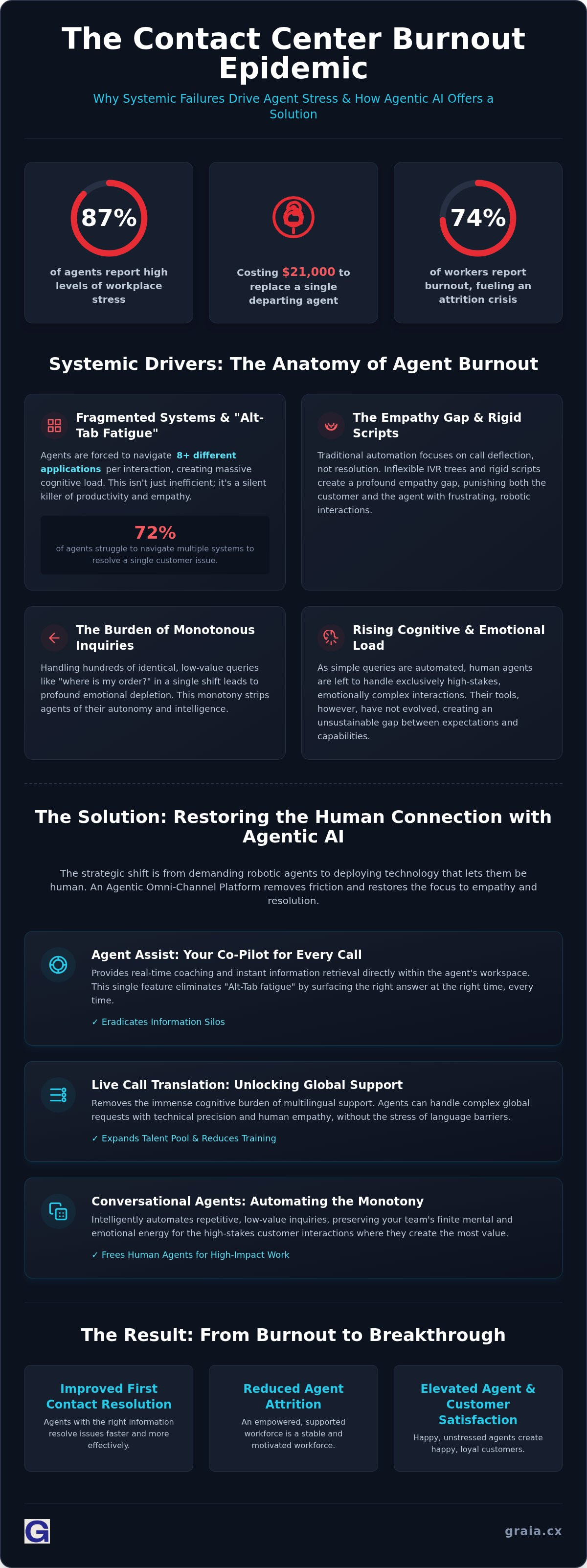
87% of contact centre agents now report high levels of workplace stress, a figure that highlights a systemic failure in how we equip our frontline teams. You've likely seen this reflected in rising attrition rates and the $21,000 it costs to replace a single departing agent. It's exhausting to watch high-potential talent burn out because they're forced to navigate fragmented systems while managing increasingly complex, emotionally charged customer demands. We agree that identifying the root causes of contact centre stress is no longer just an HR exercise; it's a vital financial necessity for the modern enterprise.
This strategic analysis identifies the systemic drivers of burnout and demonstrates how agentic technology can finally liberate your workforce from robotic repetition. We'll explore the critical shift from individual resilience training to structural AI integration. You'll discover how an Agentic Omni-Channel Platform, powered by Agent Assist and Live Call Translation, removes cognitive friction to restore the human connection that drives modern CSAT. This journey provides the roadmap you need to reduce attrition and improve First Contact Resolution through the intelligent elevation of your workforce potential.
Key Takeaways
- Identify how structural friction and fragmented workflows act as the primary causes of contact centre stress, shifting the focus from agent resilience to systemic optimization.
- Discover how Live Call Translation removes the cognitive burden of multilingual support, allowing agents to handle complex global requests with technical precision and human empathy.
- Learn to leverage Conversational Agents to automate repetitive, low-value inquiries, preserving your team's mental energy for high-stakes customer interactions.
- Explore the impact of Agent Assist in providing real-time coaching and instant information retrieval, effectively eliminating "Alt-Tab" fatigue and information silos.
- Transition your strategy from simple call deflection to meaningful resolution, fostering a high-performing culture that prioritizes agent well-being and First Contact Resolution.
The Anatomy of Contact Centre Stress in 2026
Contact centre stress isn't a personal failing of the workforce. It's a systemic failure of the infrastructure. For decades, the industry prioritized rigid scripts and mechanical efficiency over human connection, effectively forcing agents to act as biological interfaces for disparate databases. This legacy approach has reached a breaking point. In the modern call centre work environment, the primary causes of contact centre stress stem from tools that fight the user rather than empower them. When agents are trapped between an angry customer and a slow, fragmented legacy system, burnout isn't just a possibility; it's an inevitability. The cost of this silence is staggering. With 74% of workers reporting high levels of burnout, the UK attrition crisis has become a drain on both enterprise intelligence and financial stability.
The Shift from Physical to Cognitive Fatigue
Modern CX is exponentially more taxing than it was a decade ago. While basic queries have shifted to self-service, the interactions reaching human agents are now exclusively high-stakes and emotionally complex. Agents no longer just provide information. They manage crises. Navigating a fragmented tech stack during these intense live calls creates a massive cognitive load that traditional training cannot fix. Research shows that 72% of agents struggle to navigate multiple systems to resolve a single customer issue. This "Alt-Tab fatigue" is a silent killer of productivity. When an agent's mental bandwidth is consumed by finding data across seven different tabs, their capacity for empathy evaporates, leaving them feeling like a cog in a broken machine.
The Empathy Gap: Why Rigid Systems Fail
Traditional automation was designed for deflection, not resolution. Rigid IVR trees and inflexible scripts create a profound empathy gap that punishes both the customer and the agent. Customers arrive at the conversation already frustrated by robotic loops, while agents are forced to follow scripts that ignore the nuance of human emotion. This psychological dissonance is exhausting. We've identified that a "human-in-the-loop" strategy is the only sustainable path for 2026. By integrating an Agentic Omni-Channel Platform, businesses can finally bridge this gap. This ensures technology handles the mechanical data retrieval while the human focuses on emotional resolution. Addressing these causes of contact centre stress requires a fundamental shift: moving away from systems that demand agents act like robots, and toward technology that allows them to be human again.
Systemic Drivers: Why Traditional Call Centres Breed Burnout
Traditional operational models aren't just inefficient; they're toxic. We see agents on the verge of burnout because the infrastructure forces them into a state of perpetual cognitive overload. The primary causes of contact centre stress are rarely about the volume of calls themselves, but rather the friction required to resolve them. When an agent is tasked with solving complex human problems using tools from a bygone era, the mental strain becomes unsustainable. It's a fundamental misalignment between human potential and technical limitation.
Technical Friction and Information Silos
Technical friction remains the primary driver of agent attrition. On average, an agent in a legacy environment must navigate between 8 or more applications during a single customer interaction. This fragmented workflow creates "dead air," those agonizing periods of silence where agent anxiety spikes as they scramble through disconnected CRM and ERP systems. Research shows that 72% of agents struggle with this need to switch between multiple systems to resolve a single issue. This isn't just a delay; it's a drain on the human spirit. Repetitive data entry in these silos treats skilled professionals like data-entry clerks, stripping away their professional dignity and replacing it with technical frustration.
The Burden of Routine Inquiries
Monotony is a quiet catalyst for exhaustion. Handling 50 identical "where is my order" calls in a single shift leads to profound emotional depletion. This lack of autonomy, combined with rigid scripts, prevents agents from applying their intelligence to meaningful work. We also see the "Metric Trap" in full effect. Management often prioritises Average Handle Time (AHT) over genuine resolution, forcing agents to rush interactions and sacrifice quality for speed. This creates a cycle of "Information Asymmetry" where customers often have more data from your website than the agent has on their dashboard. Transitioning to a more fluid architecture allows for a redistribution of these tasks, ensuring that human talent is reserved for human problems. You can explore more on how to modernise your workforce strategy to combat these systemic pressures and restore balance to your operations.
The Cognitive Load of Multilingual and Omnichannel Support
Managing global customer bases introduces a unique layer of psychological strain. We often overlook language barriers and fragmented channel transitions as primary causes of contact centre stress, yet they represent some of the most significant cognitive burdens on the modern agent. In a UK landscape where customer diversity is the norm, the pressure to maintain technical accuracy while navigating cultural nuances is immense. It's a high-stakes environment. Agents aren't just translating words; they're attempting to bridge emotional gaps in real-time. This mental gymnastics leads to rapid exhaustion and frequent SLA breaches in specialized language queues.
The causes of contact centre stress are deeply amplified when agents handle sensitive issues in a non-native language. Mistakes feel catastrophic. The fear of misunderstanding a high-value client or misinterpreting a critical instruction creates a state of constant anxiety. Supporting this, research from Cornell University on worker stress highlights how restrictive work environments and high cognitive demands directly correlate with declining mental health. When agents lack the tools to bridge these gaps, they don't just work harder; they burn out faster. It's a fundamental failure of support that demands a technological resolution.
Breaking the Language Barrier without Burnout
Hiring and retaining bilingual staff remains a persistent challenge in the UK's competitive market. The "bilingual wage premium" puts immense financial stress on operations, while the agents themselves face the burden of being the sole resolution point for specific demographics. We believe technology should act as a protective shield. By integrating Live Call Translation, you remove the fear of linguistic error. This technology provides real-time transcripts and formality tuning, allowing agents to focus on the human sentiment of the call rather than the dictionary definition of the words. It reduces the cognitive load by transforming a high-pressure translation task into a supported, empathetic interaction.
Omnichannel Continuity and Context Loss
Nothing frustrates an agent more than context loss. When a customer moves from chat to voice and is forced to "start over," the agent inherits that accumulated frustration. This omnichannel friction is a major contributor to workplace tension. Fragmented desktops force agents to manually reconstruct a customer's journey, a process that is both slow and prone to error. Unified agent desktops and AI agent assist tools are essential for preserving context across every touchpoint. By ensuring that the conversation history follows the customer, you eliminate the mental switching costs that drain agent energy. This continuity restores a sense of flow to the workday, turning chaotic channel-hopping into a seamless, high-performance narrative.
Strategic Mitigation: Moving from Rigid Scripts to Agentic Support
Superficial management fixes cannot bridge the gap created by a broken infrastructure. While we've mapped the fundamental causes of contact centre stress, solving them requires a paradigm shift from simple deflection to total resolution. We must stop expecting agents to function as biological filters for routine data. By deploying agentic technology, you allow the system to absorb the technical friction, leaving the human professional to provide the empathy and complex reasoning that no machine can replicate. It's a fundamental move from managing symptoms to curing the systemic disease of burnout.
Deploying Conversational Agents for Routine Tasks
AI shouldn't replace the agent; it should protect them. When a Conversational Agent handles repetitive inquiries like order tracking or password resets, it removes the robotic monotony that drains morale. This shift can reduce call volumes by up to 40%, providing agents the luxury of time required for nuanced, high-stakes cases. This transition toward autonomous customer service resolution transforms the contact centre from a cost-sink of burnout into a hub of high-value human interaction. It's about liberating your workforce from the mundane.
Real-Time Coaching and Agent Assist
Confidence is the best antidote to anxiety. Addressing the root causes of contact centre stress means replacing outdated scripts with dynamic, real-time support. Using Agent Assist to provide instant knowledge base retrieval during live calls eliminates the frantic search through fragmented databases. It drastically reduces "new starter anxiety" by providing smart suggestions and next-best-action guidance. This isn't just about speed; it's about accuracy and psychological safety. Sentiment analysis tools now alert supervisors to at-risk interactions before they reach a boiling point, ensuring that support is proactive rather than reactive.
By automating post-call manual work, you give agents the breathing room they need to reset before the next interaction. Implementing hybrid flows ensures process accuracy while boosting agent confidence. It's time to evolve your strategy beyond rigid scripts and embrace a future where intelligence supports every interaction. To begin your transformation, explore our strategic guides on agentic CX.
GraiaCX: Restoring Human Empathy through Intelligent Automation
GraiaCX isn't just another software vendor. We are the architects of a more human workplace. By addressing the systemic causes of contact centre stress at their source, our Agentic CCaaS platform transforms the frontline experience from a state of survival to a state of peak performance. Our "Empathy Engine" philosophy ensures that AI serves as a protective layer, absorbing technical complexity so your people can focus on what they do best: connecting with other humans. This isn't about replacement. It's about empowerment. We've identified that when agents feel supported by their tools, they deliver the genuine empathy that modern customers demand.
The business case for this evolution is undeniable. You can explore the specific Contact Centre ROI with AI to see how value-driven automation drives measurable growth while simultaneously reducing agent attrition. Investing in your workforce's mental bandwidth is the most effective way to secure long-term enterprise stability.
The GraiaCX Difference: Multilingual and Omnichannel
We've eliminated the "Alt-Tab" fatigue that drains agent energy. By unifying voice, chat, and email into a single, intelligent interface, the GraiaCX Agentic Omni-Channel Platform ends the era of fragmented data entry. Our Live Call Translation feature removes the hiring stress of finding bilingual staff, allowing your existing team to support customers in over 100 languages with total confidence. In complex enterprise environments, our "Agentic Swarm" architecture ensures that routine tasks are handled by Conversational Agents, while high-stakes issues are seamlessly escalated to humans equipped with real-time Agent Assist coaching. This integration ensures that no agent is ever left to struggle with information silos during a live interaction.
A Future-Proof Strategy for UK Contact Centres
Operating a modern centre requires more than just performance; it requires absolute stability. GraiaCX is built for the national UK market, ensuring that you meet Ofcom and GDPR compliance standards without adding to the administrative burden of your agents. We provide the tools to scale your support globally from a single UK hub, protecting your margins while elevating your service quality. By resolving the technical causes of contact centre stress, we allow you to build a workforce that is not only high-performing but genuinely resilient. It's time to leave legacy frustrations behind. Modernise your contact centre with GraiaCX today and restore the human element to your customer experience.
Reclaiming Human Potential in the Agentic Era
The causes of contact centre stress are deeply rooted in technical friction rather than human incapacity. We've demonstrated that replacing rigid legacy scripts with intelligent, agentic support isn't just an operational upgrade; it's a moral imperative for the modern enterprise. By liberating your workforce from the "Alt-Tab" fatigue of fragmented systems, you restore the human empathy that defines world-class customer service. Confidence drives performance. The shift toward a more intelligent infrastructure is the definitive path to sustainable growth.
Transitioning to an Agentic Omni-Channel Platform delivers immediate, measurable results. Enterprises partnering with GraiaCX see a 25% improvement in agent productivity and a 40% reduction in escalations. With Live Call Translation supporting over 100 languages, your team can scale global operations without the psychological burden of linguistic barriers. It's time to move beyond survival and start building a high-performing, empathetic workforce. Empower your agents and reduce burnout with GraiaCX. Your journey toward a more resilient, human-centric contact centre starts today.
Frequently Asked Questions
What are the main causes of stress in a contact centre?
Systemic factors like technical friction and fragmented workflows are the primary causes of contact centre stress. When agents navigate eight or more applications per call, they experience "Alt-Tab" fatigue that drains mental energy. This cognitive overload is exacerbated by handling high-stakes interactions without real-time data. We believe these stresses are symptoms of a broken infrastructure that forces human professionals to act like robotic data-entry clerks rather than empathetic problem solvers.
How does contact centre stress affect agent attrition?
Stress is the leading driver of the UK attrition crisis, with 53% of highly stressed agents likely to leave within six months. Each departure costs an enterprise between $10,000 and $21,000 in recruitment and training. This cycle creates a "brain drain" that damages service quality and increases the burden on remaining staff. Reducing the causes of contact centre stress is therefore a vital financial strategy for maintaining a high-performing, stable workforce.
Can AI really help reduce agent stress instead of increasing it?
AI reduces stress by serving as a partner that absorbs robotic, repetitive tasks. By deploying a Conversational Agent to handle routine queries like order tracking, you liberate human agents for more meaningful work. Our platform also uses Agent Assist to provide real-time coaching and instant knowledge retrieval. This support layer has been proven to drive a 25% improvement in productivity while shielding agents from the cognitive exhaustion of searching through fragmented legacy databases.
What is the "Empathy Gap" in customer service?
The "Empathy Gap" is the psychological dissonance created when rigid, outdated IVR systems fail to acknowledge customer emotion. Agents are often forced to follow restrictive scripts that ignore the nuance of a conversation, leading to frustration for both parties. GraiaCX bridges this gap by using hybrid flows that combine natural language understanding with business precision. This ensures that technology handles the mechanical details while humans focus on providing genuine emotional resolution.
How does multilingual support contribute to agent burnout?
Multilingual support adds a significant cognitive load, as agents must manage technical accuracy while navigating cultural and linguistic nuances. The fear of making a catastrophic error in a non-native language creates a state of constant anxiety. Our Live Call Translation technology removes this burden by providing real-time transcripts in over 100 languages. This allows agents to focus on sentiment and resolution without the stress of hiring bilingual staff or managing language-specific queues.
What technical tools are most effective at reducing agent cognitive load?
The most effective tools are those that unify the workspace and provide proactive support. An Agentic Omni-Channel Platform eliminates "Alt-Tab" fatigue by consolidating voice, chat, and email into one interface. Agent Assist is equally critical, as it offers next-best-action suggestions and instant information retrieval. These tools work together to reduce mental switching costs, allowing agents to maintain their flow and focus on resolving complex issues with technical precision and empathy.
How can I measure the ROI of reducing agent stress?
ROI is measured through reduced recruitment costs, improved First Contact Resolution (FCR), and increased agent tenure. A stress-free environment typically sees 40% fewer escalations and faster average resolution times. You should also track the reduction in training time for new starters who are supported by Agent Assist. By lowering the cognitive barriers to entry, businesses can scale their operations more efficiently while maintaining high brand perception and customer satisfaction scores.
Is contact centre stress inevitable in high-volume environments?
High volume doesn't inherently cause burnout; it's the friction of the process that creates exhaustion. Stress is a choice made through infrastructure design. When you automate routine inquiries via Conversational Agents and provide real-time coaching, high volume becomes manageable. We see that moving from a strategy of "deflection" to one of "intelligent resolution" restores balance. A well-equipped centre remains a high-performing environment where human empathy is protected, regardless of call volumes.