Live Call Translation Software: The 2026 Guide to Global CX
Your ability to scale globally should never be held hostage by the local recruitment market. For years, expansion meant bracing for the "bilingual premium," where securing a fluent German speaker or a Mandarin expert in a competitive talent pool required paying 25% more in wages just to keep the lights on. This is where live call translation software transforms from a technical novelty into a strategic engine for revenue. You've likely felt the frustration of long queues for specific dialects and the sting of losing a highly trained specialist to a competitor. It's a systemic flaw that makes international growth feel like a liability rather than an achievement.
We understand that high-stakes enterprise growth requires both technical precision and human empathy. By decoupling your support capabilities from the constraints of geography, you can now empower your existing team to communicate fluently in over 100 languages. We'll show you how to achieve 98% translation accuracy and reduce your average handle time by up to 25% without hiring a single new bilingual agent. This guide breaks down the 2026 CX landscape; we'll cover everything from EU AI Act compliance to the rise of agentic platforms that preserve the human connection in every conversation.
Key Takeaways
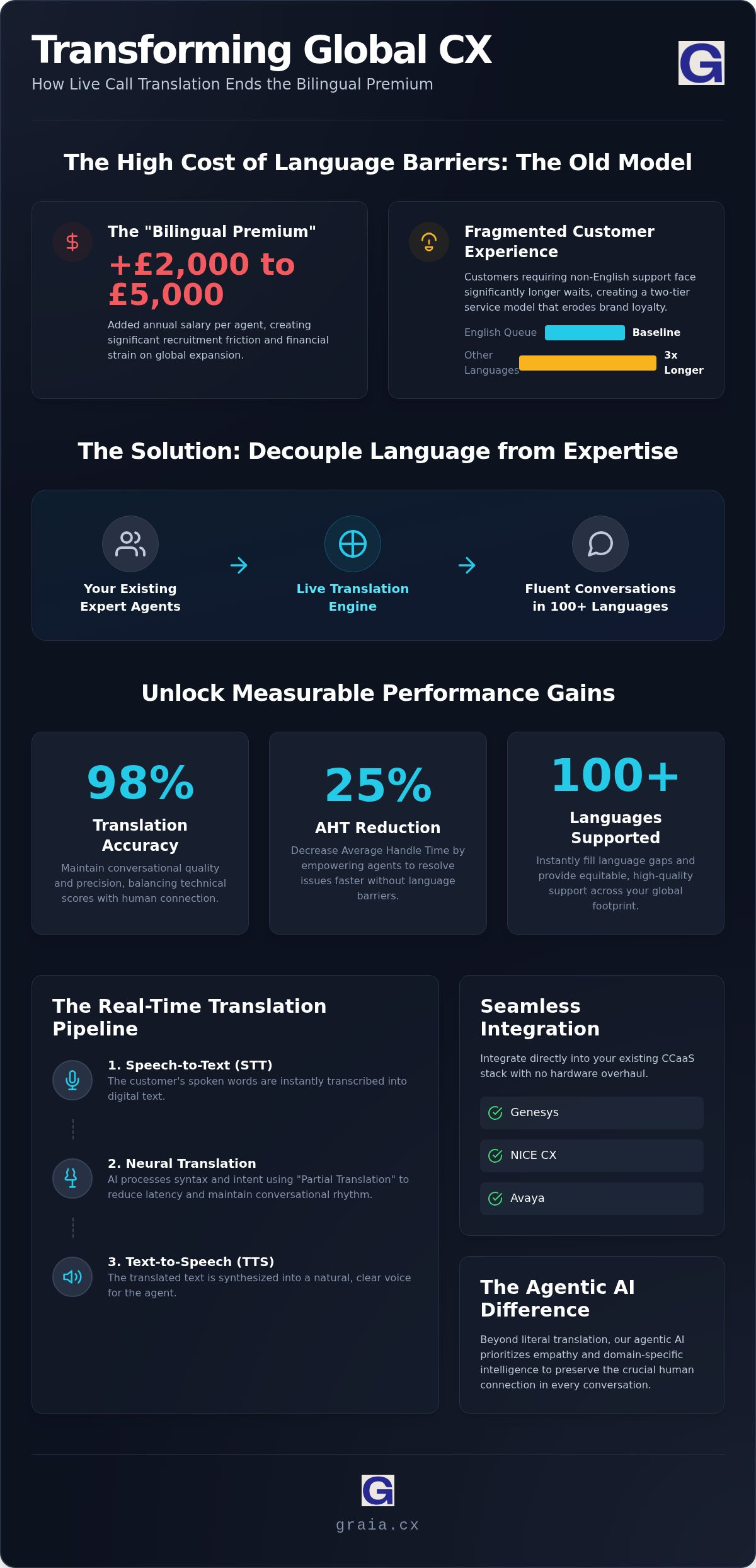
- Eliminate the £2,000 to £5,000 annual wage premium per bilingual agent by decoupling language skills from technical expertise. You'll learn to remove recruitment friction and fill language gaps across your global footprint instantly.
- Master the architecture of modern live call translation software to achieve near-instant communication across 100 languages. We'll explain how partial translation reduces latency so your team can react to customer needs without awkward pauses.
- Balance technical precision with human connection by moving beyond simple BLEU scores. Discover how to maintain 98% accuracy while reducing average handle time by up to 25% through agent-led editing windows.
- Simplify your digital transformation with seamless SIP-based connectivity and Iframe widgets. You can integrate multilingual capabilities directly into your existing Genesys, NICE CX, or Avaya desktop without a hardware overhaul.
- Elevate your customer experience using agentic AI that prioritises empathy and domain-specific intelligence. Explore how swarm architecture ensures your support remains sophisticated and emotionally intelligent across every region.
The Bilingual Staffing Crisis: Why Global CX Needs a New Model
Traditional recruitment is a broken lever for global growth. You cannot hire your way out of a scaling crisis when the talent pool is shallow and the costs are punitive. In the UK market, the "bilingual premium" adds a significant burden to your balance sheet, often requiring an additional £2,000 to £5,000 in annual salary per agent. This financial friction is compounded by high attrition rates and the sheer difficulty of finding technical specialists who also happen to be fluent in niche dialects. It's a strategy of diminishing returns that leaves your operation vulnerable to local labour market fluctuations.
The result is a fragmented service model where your customers are penalised for their geography. Data indicates that callers requiring support in languages other than English often endure queues three times longer than the baseline. This "Language-Based Queue" doesn't just frustrate users; it creates a two-tier experience that erodes brand equity in emerging markets. live call translation software offers the only viable exit from this cycle. It acts as a real-time bridge, translating not just vocabulary but the subtle emotional cues that define a successful interaction.
The Economic Impact of Language Barriers
Language silos create operational rigidity. When your workforce is divided by mother tongue, you lose the ability to shift resources to where demand is highest. A surge in Italian tickets might leave your English-speaking team idle while wait times skyrocket in Milan. This fragmentation leads to missed opportunities and reduced operational flexibility. The industry is moving toward AI-augmented support models that treat language as a software layer rather than a human constraint. By removing these silos, you transform your contact centre into a unified, agile force capable of responding to global trends in seconds.
Beyond Basic Translation: The Agentic Difference
Traditional, literal translation frequently fails because it ignores context. To understand the complexity of this task, one only needs to look at how simultaneous interpretation works in high-stakes settings. It requires an understanding of intent, not just syntax. We're entering the era of the "Multilingual Experience Engine," a shift that prioritises the quality of the interpersonal connection over mechanical word replacement.
Modern live call translation software restores agent confidence by providing a safety net of accuracy and sentiment detection. It ensures the human element remains at the centre of the conversation, allowing your team to solve complex problems without the anxiety of a language barrier. This agentic approach doesn't just translate words; it translates expertise.
How Real-Time Voice Translation Software Works in 2026
The machinery behind modern live call translation software is a sophisticated orchestration of three distinct computational layers. It begins with Speech-to-Text (STT), where the acoustic signal is transcribed into digital prose. This is immediately followed by Neural Translation, which processes the syntax and intent. Finally, Text-to-Speech (TTS) synthesises the result into a natural voice. In 2026, this entire pipeline happens in near-real-time, moving us past the era of awkward, punctuated pauses that defined legacy tools.
Speed is the currency of connection. To eliminate the silence that once plagued cross-border calls, we utilise "Partial Translation" algorithms. Instead of waiting for a full sentence to conclude, the system begins translating logical chunks as they're spoken. This allows agents to grasp the customer's intent within milliseconds, maintaining the natural rhythm of a human conversation. It transforms a technical hurdle into a seamless flow of information.
Language is more than just data; it's etiquette. In markets like Japan or Germany, the distinction between formal and informal address is vital for brand integrity. Modern tuning allows for "Formality Switching," ensuring your agents don't inadvertently cause offence by using incorrect honorifics. Additionally, custom vocabulary training ensures the AI recognises your proprietary product names and industry-specific jargon, preventing the "hallucination" of generic terms. If you're looking to dive deeper into these technical strategies, our latest CX insights offer a roadmap for technical implementation.
The Role of STT and TTS Engines
Performance depends on the engine under the bonnet. We integrate with leading providers like Speechmatics for high-accuracy recognition and ElevenLabs or Azure for voice synthesis that sounds indistinguishable from a human. The quality of the TTS engine is what prevents "bot fatigue" during long support calls. By implementing custom phrase lists and industry-specific tuning, you can elevate transcription accuracy from a generic 85% to a mission-critical 98%.
Preserving Human Sentiment with Original Audio
Purely synthetic interactions often feel hollow. This is the "Ghost in the Machine" problem, where the nuances of human emotion are lost in the digital shuffle. True empathy-driven automation allows agents to hear the original audio at a lower volume in the background. By detecting tremors in a voice or the pace of speech, agents can sense frustration or relief that text alone cannot convey. This combination of real-time sentiment analysis and raw audio ensures the empathy gap remains closed, allowing your team to act as protective guides for your customers.
Accuracy vs. Empathy: Evaluating Your Translation Platform
Technical metrics are a starting point, not the finish line. While a high BLEU score (Bilingual Evaluation Understudy) indicates linguistic precision, it rarely accounts for the emotional resonance of a live conversation. If your live call translation software delivers grammatically perfect sentences that feel clinical or detached, the customer's trust will inevitably evaporate. True evaluation requires looking past the algorithm to the human outcome, ensuring that the synthetic voice doesn't alienate the caller through a lack of warmth or inappropriate prosody.
Empowering your agents is the most effective way to close this empathy gap. We provide a "Cancel-and-Edit" window, a brief pause that gives the agent final authority over the translated output. This ensures that nuances, local idioms, or sensitive phrasing are handled with a human touch before the audio reaches the caller. For regulated industries in the UK, such as financial services or healthcare, script-locked messaging ensures that compliance is never sacrificed for speed. It allows for a hybrid flow where the agent controls the narrative while the AI handles the heavy lifting of linguistic conversion.
The Compliance and Security Framework
Data sovereignty is the cornerstone of enterprise-grade AI. In an era of strict GDPR enforcement and evolving UK data protection standards, your platform must offer local hosting and robust PII masking as standard. Our roadmap for Q2 2025 specifically prioritises advanced PII protection and masking features, ensuring that sensitive customer data is redacted before it ever touches a third-party translation engine. This level of security creates an audit-ready environment where translated logs can be used for dispute resolution without compromising privacy or legal standing.
Operational ROI and Efficiency
Efficiency is the natural byproduct of a well-integrated, intelligent system. By optimising these translation workflows, organisations typically see a reduction in Average Handle Time (AHT) of 15% to 25%. This isn't just about shorter calls; it's about better ones. First Contact Resolution (FCR) often climbs by 5 to 10 points because agents can finally understand the root cause of an issue without the fog of a language barrier. This represents a tangible shift in contact center roi with ai, transforming what was once a logistical nightmare into a streamlined engine for global customer satisfaction.
Integrating Translation into Your Existing CCaaS Stack
Modernising your global infrastructure doesn't require a "rip-and-replace" upheaval of your existing telephony. We advocate for a modular approach. By integrating live call translation software directly into your current voice path via a SIP-based connectivity model, you sidestep the risks of a total system overhaul. This surgical implementation drops translation capabilities into the existing stream, preserving your investment in legacy hardware while granting immediate access to 100+ languages and dialects. It's about evolution, not disruption.
The agent experience dictates the success of any technical rollout. We utilise Iframe integration to embed the translation widget directly into the agent desktop, ensuring your team never has to toggle between disparate applications during a high-stakes call. This unified interface facilitates sophisticated workflow orchestration. Using no-code builders, you can design routing logic that identifies a caller's language in real-time and directs them to the most appropriate resource. Before a full-scale launch, we recommend rigorous testing and simulation to stress-test bot-to-human handoffs, ensuring the transition remains invisible to the customer.
Native Integrations: Genesys, Avaya, and NICE CX
Deployment shouldn't force you to abandon your trusted telephony provider. Our solution offers native hooks into enterprise leaders like Genesys, Avaya, and NICE CX, maintaining session continuity across both voice and digital channels. This ensures that the customer's journey remains coherent as they move from a translated call to a follow-up email or chat. To see how this fits into a broader agentic ccaas platform, you must view translation as a foundational component of a unified intelligence layer rather than an isolated utility.
The "Chat-Only" Hybrid Mode
Integration also functions as a powerful accessibility tool. In noisy UK contact centre environments, agents can enable a "Chat-Only" hybrid mode, allowing them to read voice-to-text transcriptions while the customer continues to speak. This significantly reduces cognitive load and prevents transcription errors during high-pressure interactions. It also empowers agents with speaking disabilities by providing text-to-voice output, ensuring your workforce is as inclusive as it is global. If you're ready to explore these technical configurations, our implementation guides provide the granular detail your IT team needs to begin.
GraiaCX: The Multilingual Engine for Agentic Customer Experience
GraiaCX represents the next evolution of the global contact centre. We don't just provide live call translation software; we offer an agentic engine that prioritises empathy over mere computation. While legacy tools struggle with literal word replacement, our platform understands the psychological state and intent of the caller. This is achieved through our unique Swarm Architecture. By deploying a network of specialised AI agents that focus on specific domains, we ensure that a technical support call in Spanish or a billing inquiry in Cantonese receives the same depth of expertise as your primary language.
True intelligence is action-oriented. GraiaCX goes beyond the transcription of words to the execution of complex tasks. Imagine an agent managing a high-stakes dispute in Portuguese; while the translation flows, the AI is simultaneously verifying account details and processing a refund in the background. This seamless human-AI collaboration preserves the context of the interaction and removes the administrative burden from the agent. It's a partnership that elevates human potential, allowing your team to focus on connection while the technology handles the logistics.
Real-World Impact: From 80% to 98% Accuracy
The transition from generic models to customised language profiles moves the needle on performance. Our partners frequently report an accuracy jump from 80% to 98%, a shift that fundamentally changes the customer's perception of your brand's commitment to their region. By removing the need for a £5,000 annual wage premium per bilingual staff member, we've made global expansion a budget-neutral reality for UK enterprises. GraiaCX ensures 100% process accuracy by utilising Hybrid Flows that combine automated precision with human oversight.
Future-Proofing Your Global Strategy
Static systems are obsolete. GraiaCX utilises continuous learning to optimise prompts based on live data, ensuring your translation engine becomes more sophisticated and culturally nuanced with every call. You can scale to 100+ languages on Day 1, removing the months of recruitment friction and training costs typically associated with new market entry. This isn't just a tool for today; it's a foundation for a borderless enterprise that treats every customer like a local.
Ready to break the language barrier? Explore GraiaCX’s live translation solutions
The Future of Borderless Customer Experience
The decision to scale globally no longer requires a trade-off between operational cost and customer satisfaction. By implementing live call translation software, you move beyond the constraints of local labour markets and the punitive costs of bilingual wage premiums. We've explored how a unified intelligence layer can support 100+ languages natively, allowing your existing team to deliver sophisticated, empathy-driven support to every corner of the globe. It's a fundamental shift that treats language as a bridge rather than a barrier.
Technical hurdles that once made international expansion a liability have been dismantled. With seamless SIP and iframe integration, you can transform your contact centre without a hardware overhaul. You'll see a reduction in average handle time of up to 25% while maintaining the human connection that defines your brand. This is the era of the borderless enterprise. Your capacity for growth is limited only by your vision, not the language your customers speak. It's time to empower your workforce and protect your customers with a solution that values connection as much as precision.
Empower your agents with real-time translation; read more on our blog
Frequently Asked Questions
How accurate is live call translation software for technical industries?
High-precision live call translation software reaches 95% to 98% accuracy after industry-specific tuning. Generic models often stumble on technical jargon; however, our platform adapts to the unique linguistic landscape of your sector. This ensures that complex engineering terms or medical nuances aren't lost in the digital shuffle. It transforms a mechanical process into a reliable communication tool that your technical specialists can trust during every interaction.
Does live translation work with my existing Genesys or Avaya system?
Native integration with Genesys, Avaya, and NICE CX is a core capability of our platform. You don't need to replace your existing telephony; instead, the system drops directly into your current voice path via SIP-based connectivity. This modular approach preserves your legacy investments while immediately unlocking global support. It ensures session continuity across all channels, providing a stable foundation for your international customer experience strategy.
What is the typical latency for real-time voice translation?
Typical latency for real-time translation is now under 2 to 3 seconds. By utilising "Partial Translation" algorithms, the system begins processing logical chunks of speech before the speaker even finishes their sentence. This eliminates the awkward silences that once plagued cross-border communications. It maintains the natural rhythm of human dialogue, ensuring that your agents can respond with the speed and confidence required in high-stakes service environments.
Can the software handle specific dialects and regional accents?
The platform natively supports over 100 languages and their associated regional dialects. Whether your caller is using a specific Swiss-German variant or a regional Spanish accent, the neural engines are trained to recognise these acoustic nuances. This breadth of coverage ensures that your global expansion isn't limited to capital cities. It allows you to provide a truly local experience in every market you choose to enter.
How does the system handle sensitive customer data like credit card numbers?
Sensitive information is protected through robust PII masking and local data hosting. Our Q2 2025 roadmap introduces advanced masking features that redact credit card numbers and personal identifiers before they ever reach the translation engine. This ensures your operation remains compliant with UK GDPR and SOC2 standards. We treat data sovereignty as a non-negotiable requirement, providing a secure environment for even the most regulated industries.
Is it possible to hear the original customer’s voice during the translation?
You can hear the customer's original voice at a reduced volume using our "Original Audio" feature. This is vital for detecting sentiment, such as a tremor of frustration or a sigh of relief, which text alone might miss. It bridges the empathy gap by keeping the agent connected to the human element of the call. This dual-stream approach ensures that your team remains emotionally intelligent and responsive to the caller's mood.
Do I need to hire specialized IT staff to manage the translation platform?
Managing the platform doesn't require a new team of specialised IT staff. Because the software integrates as a modular layer within your existing CCaaS stack, your current administrators can handle the day-to-day operations. We provide the technical framework and ongoing support required to keep the system optimised. This allows you to focus on strategic growth rather than the maintenance of complex, standalone translation hardware.
Can the AI handle brand-specific terminology and product names?
Custom vocabulary training allows the AI to master your specific brand names and proprietary product terminology. You can upload custom phrase lists to ensure the software never "hallucinates" or replaces your unique terms with generic alternatives. This level of customisation is what elevates the accuracy from a baseline 85% to a mission-critical 98%. It ensures your brand voice remains consistent and professional across every language you support.