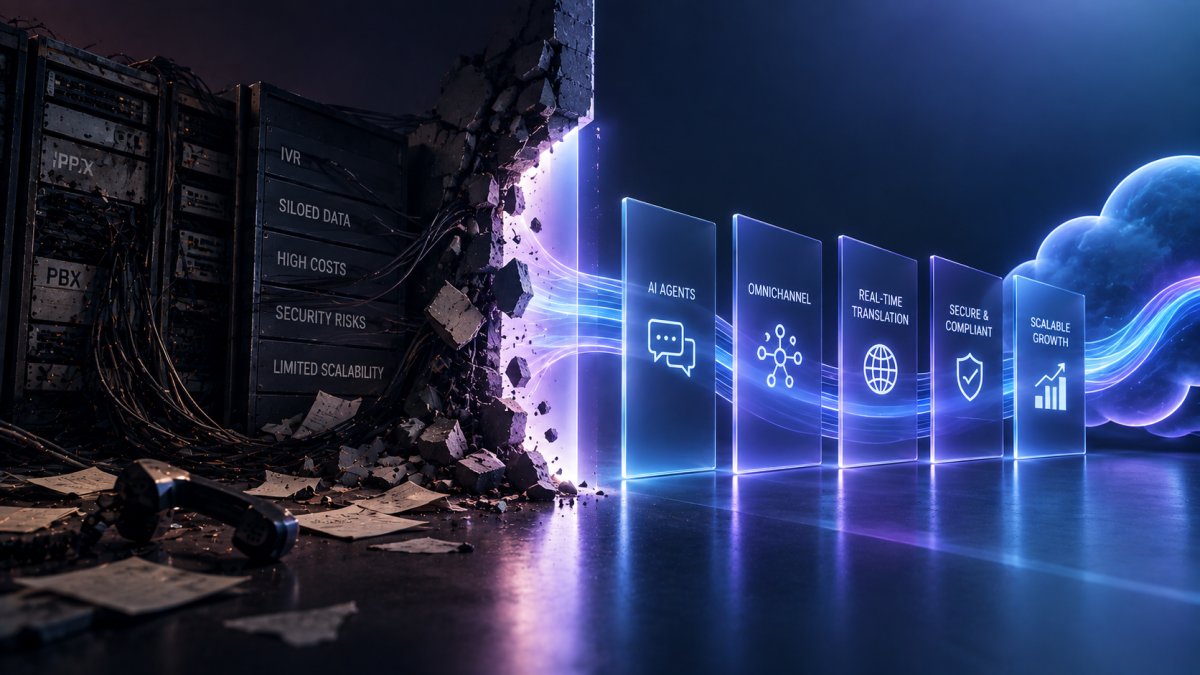
Legacy Call Centre System Risks: The Hidden Cost of Operational Fragility in 2026
In 2026, the average cost of a US data breach has reached a staggering $11.5 million. This figure transforms technical debt from a back-burner concern into a direct threat to your enterprise's survival. Maintaining the status quo often feels like the safest path, yet the reality of legacy call centre system risks is that they create a fragile foundation that cannot support the weight of modern customer expectations or evolving security mandates. You've likely seen the signs already. Maintenance fees are skyrocketing. Your best agents are burnt out by repetitive interactions. The empathy gap between your brand and its customers is widening every day.
We understand the pressure of protecting your margins while trying to innovate within a rigid framework. This guide identifies the critical security, financial, and experience risks inherent in ageing contact centre infrastructure and charts a strategic path to agentic modernisation. You'll gain a deep understanding of how to justify the budget for transformation and see exactly how AI integrates with your existing technology stack. We will break down the financial impact of ageing infrastructure and provide the evidence needed to move from a state of operational fragility to one of resilient, intelligent connection.
Key Takeaways
- Quantify the compounding cost of technical debt and learn why maintaining on-premise PBX hardware now represents a critical point of operational failure.
- Discover how to bridge the empathy gap by replacing rigid IVR trees with conversational agents that eliminate repetitive interactions and customer frustration.
- Evaluate the most dangerous legacy call centre system risks in 2026, ranging from unpatched security vulnerabilities to the high cost of manual PII handling.
- Master a risk-mitigation roadmap that uses SIP and iframe integration to deliver agentic intelligence without the disruption of a total system overhaul.
- Solve the bilingual staffing trap by leveraging live call translation to reduce escalations and accelerate resolution times across more than 100 languages.
The Hidden Fragility of Legacy Call Centre Infrastructure
The foundation is cracking. For decades, enterprises relied on on-premise PBX and first-generation cloud setups to manage their customer interactions, but these systems have become heavy anchors in a fast-moving digital economy. The primary legacy call centre system risks today aren't just technical; they are existential. As major telecommunication providers decommissioned copper-based POTS lines in late 2025, the cost of maintaining call centre infrastructure that relies on physical hardware has surged. This technical debt compounds every month, draining resources that should be funding your next growth phase.
Fragmented inboxes create a disjointed narrative where the customer is forced to act as the primary bridge between your departments. When data lives in silos, your agents lack a unified view of the customer journey, leading to operational paralysis. You can't scale during peak demand because your systems don't talk to each other; they merely coexist in a state of expensive isolation. This lack of agility prevents seamless global expansion, as adding new regional nodes often requires months of manual configuration rather than a few clicks.
The Death of the Deterministic IVR
"Press 1 for Sales" is a relic of a simpler era. In 2026, customers expect immediate, autonomous intent-understanding rather than navigating a maze of rigid IVR trees. These deterministic models are the primary drivers of "rage-clicking" and churn because they fail to account for human emotion or urgency. Transitioning from intent-guessing to agentic intelligence allows your system to sense a customer's frustration and route them accordingly, turning a potential disaster into a loyalty-building moment.
Maintenance vs. Innovation: The Budget Trap
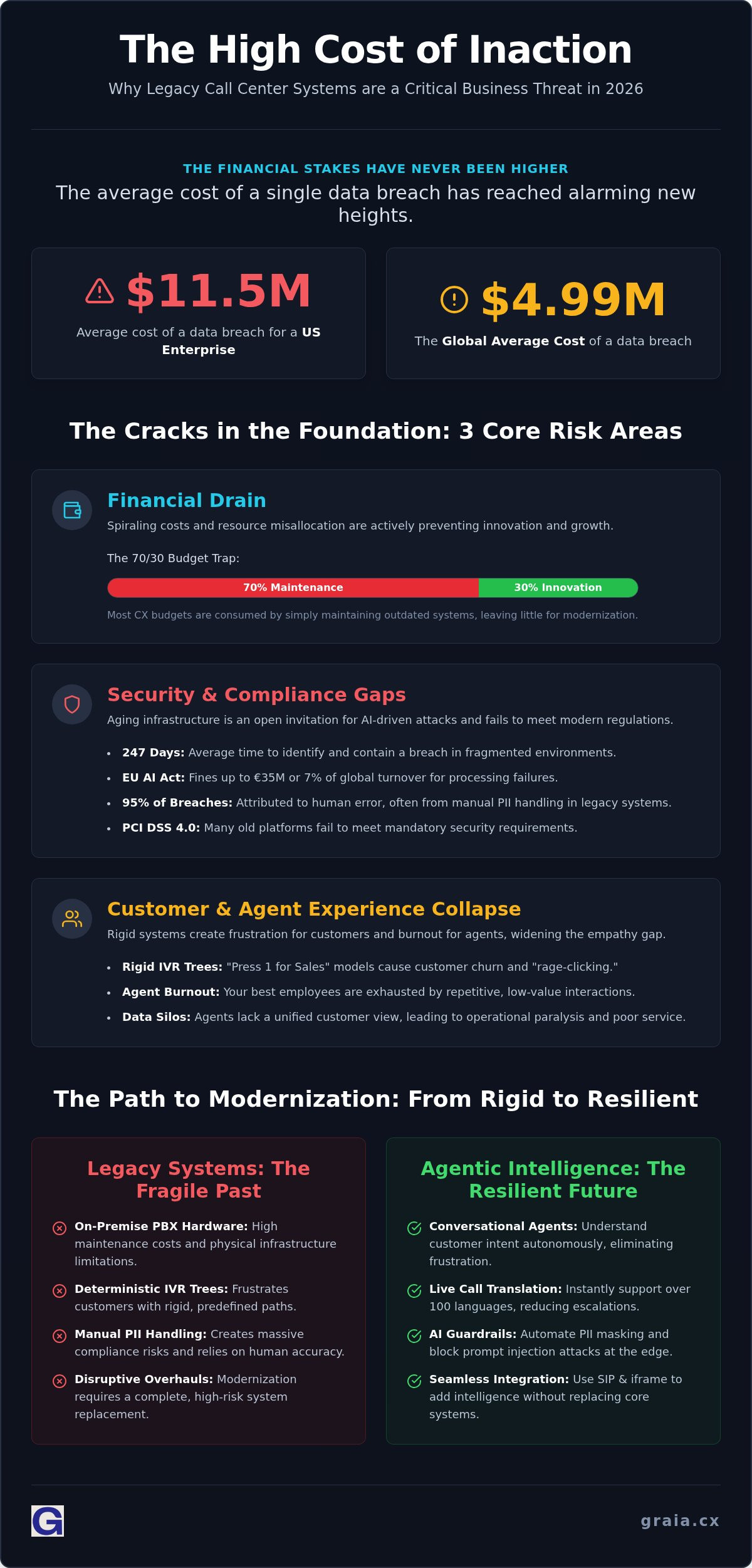
The 70/30 rule is killing your competitiveness. Most enterprises spend 70% of their CX budget just keeping old lights on, leaving a mere 30% for actual innovation. This budget trap is often reinforced by vendor lock-in, where proprietary legacy hardware makes migration feel like an insurmountable mountain. You hit a tipping point when the cost of patching a failing system exceeds the ROI of modernisation. Identifying this moment is critical to avoid being buried by the mounting legacy call centre system risks that your competitors have already solved through more flexible, agentic platforms.
Security and Compliance: The Evolving Threat Landscape
The financial stakes of a security failure have never been higher. In 2026, the global average cost of a data breach reached a record $4.99 million, while US enterprises face a staggering $11.5 million per incident. These legacy call centre system risks stem from a fundamental mismatch between ageing infrastructure and the velocity of modern AI-driven attacks. Unpatched systems act as open invitations for ransomware, especially when it takes an average of 247 days to identify and contain a breach in fragmented environments.
Compliance is no longer a checklist; it's a moving target. The EU AI Act, effective as of August 2026, imposes penalties of up to €35 million or 7% of global turnover for processing failures. Older systems often rely on manual PII handling, which is a significant liability given that 95% of breaches are still attributed to human error. Furthermore, many legacy platforms fail to meet the mandatory PCI DSS 4.0 requirements that became effective in March 2025. Their audit logs are frequently insufficient for the granular transparency demanded by modern GDPR and Ofcom standards.
Hardening the CX Perimeter with AI Guardrails
Traditional firewalls cannot stop a malicious actor from trying to subvert a bot's logic. Prompt Shields serve as a critical defensive layer, identifying and blocking prompt injection attempts designed to extract sensitive data or bypass business rules. PII masking at the edge ensures that identifiers are redacted before they ever touch an LLM, maintaining strict data sovereignty. Hybrid Flows provide the mechanism for 100% process accuracy by combining deterministic control with agentic flexibility.
Data Sovereignty in the Age of LLMs
Privacy is the cornerstone of the modern customer relationship. A major risk in current "bolt-on" AI solutions is the inadvertent use of customer data to train public models, which can lead to catastrophic data exfiltration. GraiaCX eliminates this threat by ensuring all client data remains isolated and confidential. By leveraging regional hosting and SOC2-aligned standards, we provide a protective framework that keeps your intellectual property secure. You can explore more about protecting your enterprise in our latest CX security insights. This proactive approach to cybersecurity and compliance risks ensures your transition to AI is both bold and safe.
The Cost of Disconnection: CX and Agent Productivity Risks
Context is the currency of trust. When a customer is forced to repeat their account details and problem history every time they move between channels, that trust evaporates. This context loss, often called the "Repeat Yourself" Syndrome, is a direct byproduct of fragmented legacy call centre system risks. These systems weren't built for a world where a customer starts a journey on social media, moves to chat, and finishes on a voice call. They were built for silos; today, those silos are destroying your customer relationships.
The friction isn't limited to the customer side of the screen. Your agents are likely battling clunky, outdated desktops that require them to toggle between multiple disconnected applications. This high cognitive load is a primary driver of the 30% to 45% annual turnover rate seen across the industry. When you consider that the average cost to replace a single agent is $14,000, the financial impact of operational fragility becomes painfully clear. Agents become so preoccupied with navigating the system that they lose the ability to provide genuine empathy, widening the gap between your brand and its users.
Eradicating the Language Barrier
The traditional bilingual staffing model is failing. Hiring for specific language queues creates a 25% to 50% wage premium, yet it still leaves you vulnerable to volume spikes in specific regions. Implementing live call translation software allows any agent to support customers in over 100 languages instantly. This technology doesn't just lower costs; it improves First Contact Resolution (FCR) by ensuring the best-qualified agent handles the call, regardless of the language spoken. Features like original audio preservation ensure that the human nuances of conversation remain intact, protecting the emotional connection.
Reducing Cognitive Load with Agent Assist
Burnout is often the result of mental exhaustion rather than call volume. By deploying ai agent assist tools, you can provide real-time transcripts and smart suggestions that guide agents through complex processes. These tools can reduce onboarding time by as much as 50%, allowing new hires to reach peak productivity faster. Automating the wrap-up process alone can reclaim 5 to 10 minutes of agent time every hour, transforming the role from a data entry clerk into a high-value brand ambassador.
Strategic Modernisation: Moving from Rigid Systems to Agentic AI
Total system overhauls are a ghost story told to justify inaction. You don't need to burn your existing infrastructure to the ground to embrace agentic intelligence. The myth of "rip-and-replace" often keeps enterprises trapped in a cycle of mounting legacy call centre system risks, yet the path forward is actually incremental. By leveraging SIP and iframe technology, you can drop advanced AI capabilities directly into your legacy Avaya or Genesys environment. This surgical approach allows you to layer intelligence over your current stack, providing immediate relief without the trauma of a multi-year migration project.
We've moved beyond the era of the monolithic, do-it-all chatbot. The modern standard is an "Agentic Swarm" architecture, where a network of specialized experts handles specific tasks with surgical precision. One agent might manage complex scheduling while another focuses on billing disputes, all coordinated by an orchestrator that understands context. To ensure 100% process accuracy, these agents utilize Retrieval-Augmented Generation (RAG). This technique grounds every response in your actual verified business data, effectively eliminating the risk of AI hallucinations that often plague generic models and threaten brand reputation.
The 4-Step Modernisation Roadmap
Success requires a methodical progression from silos to synergy. We recommend a structured four-step approach to mitigate operational fragility:
- Step 1: Audit existing silos to identify high-volume, routine inquiries that drain human resources.
- Step 2: Implement Conversational AI for self-service on digital channels to provide instant resolution for common tasks.
- Step 3: Deploy Agent Assist to support human staff during complex voice calls with real-time suggestions.
- Step 4: Enable full integration of Live Call Translation to achieve global scalability without local hiring constraints.
Measuring Success Beyond AHT
Average Handle Time (AHT) is a legacy metric that often rewards speed over quality. In an agentic environment, contact center roi with ai must be measured through agent retention and CSAT scores. You should track your "Automation Rate" alongside your "Resolution Rate" to ensure that customers aren't just being diverted, but actually helped. Modern platforms now use AI "Judges" to score conversations in real-time, ensuring strict adherence to policy and brand voice across every interaction. You can start building your roadmap today by exploring our latest implementation guides.
GraiaCX: Bridging the Gap with Agentic Intelligence
GraiaCX represents the definitive bridge between the limitations of the past and the potential of the future. We prioritize 100% process accuracy through our Agentic Omni-Channel Platform, ensuring that every interaction is grounded in verified truth. Our foundation is built on 25 years of empathy-driven innovation; we understand that technology must serve the human experience. By unifying voice, chat, and social channels into a single, cohesive framework, we eliminate the fragmentation that defines many modern enterprises. This unification is powered by Hybrid Search, which combines semantic and keyword matching to achieve 98% accuracy in information retrieval.
Our agents do more than just talk. They act. Through deep API integrations, GraiaCX Conversational Agents process refunds, update account details, and book service slots in real-time. This level of autonomy transforms the contact centre from a cost centre into a driver of operational excellence. It directly mitigates legacy call centre system risks by replacing fragile, manual workflows with resilient, automated actions that don't require a total infrastructure overhaul. We provide the stability you need to innovate with confidence.
Zero-Friction Integration
Modernisation shouldn't be a burden. GraiaCX acts as an intelligent layer that sits over your existing CCaaS investments, providing native support for Microsoft Dynamics 365, Salesforce, and ServiceNow. This "No-Code" promise ensures that you can deploy rapid Day-1 automation without a lengthy development cycle. You maintain the value of your current Avaya or Genesys stacks while gaining the sophisticated capabilities of a modern, agentic system. It's a partnership designed for speed and reliability.
The Future of Agentic CX
Our vision for 2026 is one of continuous, intelligent evolution. The roadmap includes advanced sentiment analysis for live coaching and automated testing to ensure every interaction meets your brand’s standards. The Agentic Swarm is our definitive answer to enterprise complexity, allowing specialized agents to collaborate seamlessly on behalf of the customer. This architecture ensures that your organization remains agile, secure, and deeply connected to the people you serve. The time for hesitant patches has passed. You are ready to Modernise your legacy centre with GraiaCX and reclaim your operational stability.
Transforming Operational Fragility into Enterprise Resilience
The transition from rigid infrastructure to an agentic framework is no longer a luxury; it's a necessity for survival. We've explored how legacy call centre system risks compound over time, creating vulnerabilities in security, compliance, and customer trust. By moving away from deterministic models and embracing specialized AI experts, you reclaim the ability to connect with your audience on a deeply human level. The path to modernisation is incremental, allowing you to protect your existing investments while layering on the intelligence required for the 2026 market.
GraiaCX provides the stable, visionary partnership needed to navigate this evolution. Our platform is built on secure Microsoft Azure infrastructure and offers support for over 100 languages through live translation. With a proven 40% reduction in escalations, we empower your team to focus on high-value interactions rather than system troubleshooting. It's time to move beyond the limitations of the past and build a foundation that grows with your ambition. Upgrade your CX strategy with the GraiaCX Agentic Platform today and experience the power of truly connected intelligence.
Frequently Asked Questions
What are the biggest security risks of legacy call centre systems?
Unpatched legacy systems act as open invitations for ransomware and sophisticated data exfiltration. In 2026, the average cost of a US data breach reached a record $11.5 million, highlighting the danger of ageing infrastructure. These legacy call centre system risks also include manual PII handling and auditability gaps that fail to meet modern GDPR or PCI DSS 4.0 standards. GraiaCX mitigates these threats with Prompt Shields and edge-based PII masking to ensure total data sovereignty.
How does an agentic CCaaS platform differ from traditional cloud contact centres?
Traditional cloud contact centres often rely on rigid, deterministic IVR trees that merely route calls. An agentic CCaaS platform uses autonomous intent-understanding and specialized "swarms" to take actual actions, such as processing refunds or updating ERP data. While traditional systems focus on connectivity, agentic platforms prioritize resolution. This shift reduces escalations by 40% and ensures that customer context is preserved across every channel, from social media to live voice.
Can I add AI features to my existing Avaya or Genesys system without replacing it?
You can layer agentic intelligence over your existing infrastructure without a risky "rip-and-replace" project. GraiaCX uses SIP and iframe technology to integrate directly with platforms like Avaya, Genesys, and NICE CX. This "bridge" approach allows you to deploy Conversational Agents and Live Call Translation as an intelligent layer. It’s a strategic way to modernise your operations while protecting your current technical investments and avoiding massive operational downtime.
How does live call translation reduce operational risks?
Live call translation eliminates the "Bilingual Staffing Trap," where businesses pay a 25-50% wage premium for language-specific queues. By supporting over 100 languages in real-time, you remove language-based bottlenecks and reduce long wait times. This technology ensures First Contact Resolution (FCR) increases by 5-10 points. The best-qualified agent handles the call regardless of the language spoken, which significantly reduces the cognitive load and stress that lead to high agent attrition.
What is the "Empathy Gap" in customer service automation?
The Empathy Gap occurs when rigid automation forces customers to navigate frustrating mazes or repeat themselves across channels. When agents are buried under clunky legacy desktops, they focus on system navigation instead of the human being on the line. Agentic AI restores this connection by handling routine inquiries and providing agents with real-time context. This allows your human staff to focus on complex, high-value problems where emotional intelligence and genuine empathy are most required.
How long does it take to see ROI from contact centre modernisation?
Most enterprises begin seeing measurable results within 4 to 6 weeks of deployment. Typical impacts include a 15-25% reduction in Average Handle Time (AHT) and a 60% improvement in resolution speed. By reclaiming 5 to 10 minutes of agent time per hour through automated wrap-ups, the platform pays for itself quickly. The ROI also includes critical intangible gains, such as reduced agent recruitment costs and improved customer loyalty scores across the entire journey.
How does GraiaCX ensure AI responses are accurate and grounded in facts?
We use a dual-layer approach called Hybrid Flows to ensure 100% process accuracy. This combines Large Language Models for natural conversation with deterministic, rule-based logic for business precision. Additionally, Retrieval-Augmented Generation (RAG) grounds every response in your vetted knowledge base. This ensures that the AI doesn't "hallucinate" or provide off-policy information. We also use AI "Judges" to score conversations in real-time for brand voice and policy adherence.
What happens if the AI cannot resolve a customer issue?
The system is designed for seamless human collaboration rather than total replacement. If the Conversational Agent identifies a complex problem or senses high customer frustration, it triggers an automatic handoff to a live agent. This handoff includes a structured summary of the prior interaction so the customer never has to repeat themselves. This proactive approach ensures that every inquiry reaches a resolution, maintaining high satisfaction while reducing the burden on your human workforce.