How to Deploy Agentic RAG for Customer Service Automation: The 2026 Enterprise Roadmap
By the end of 2026, 40% of enterprise applications will embed task-specific AI agents, yet many leaders remain trapped in a cycle of pilot programs that never reach production. You've likely experienced the "hallucination ceiling" of traditional RAG, where bots provide eloquent answers but fail to execute actual business logic. It's a common frustration: your data is trapped in silos, your IVR trees are rigid, and your customers are left waiting for a human to do what an agent should have already handled.
We believe that enterprise AI must be more than a sophisticated search engine; it must be an autonomous executor of your brand's promises. This roadmap details how to deploy agentic rag for customer service automation to achieve 100% process accuracy while reducing handle times by 25%. You'll master the transition from passive retrieval to action-oriented agents that resolve complex issues directly within your CRM and ERP systems. We'll preview the move toward "Swarm" architectures, the integration of hybrid flows for regulatory compliance, and the methodology for seamless human handoffs that preserve every ounce of context.
Key Takeaways
- Transform passive knowledge bases into active problem-solvers by transitioning from traditional retrieval to goal-oriented, autonomous reasoning.
- Discover how to deploy agentic rag for customer service automation through a structured 5-step roadmap that prioritizes precise knowledge extraction and specialized agent domains.
- Replace rigid, monolithic chatbots with a "Swarm" architecture of specialized virtual experts designed to collaborate on complex, multi-skill inquiries.
- Ensure 100% process accuracy in regulated environments by utilizing Hybrid Flows that anchor fluid LLM creativity within deterministic business logic.
- Achieve measurable CX transformation with a projected 60% reduction in resolution times and a significant decrease in repeat customer contacts.
Understanding Agentic RAG: Beyond Simple Information Retrieval
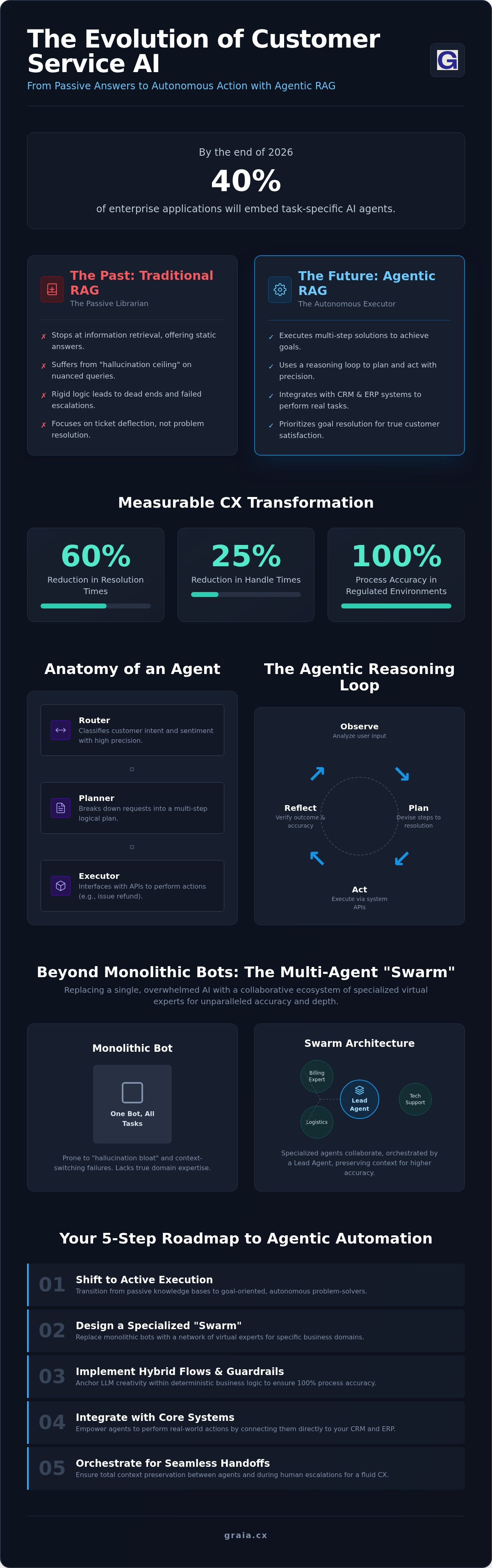
The evolution of customer service technology has reached a critical inflection point. While Retrieval-augmented generation (RAG) revolutionized how AI accesses external data, it often stops at providing a static answer. Agentic RAG represents a fundamental shift. It isn't just about finding information; it's a goal-oriented system that reasons through a problem, plans a multi-step solution, and executes that plan with precision. This technology transforms AI from a passive librarian into an active participant in the customer journey.
Traditional systems focus on ticket deflection, essentially trying to keep the customer away from human agents. Agentic RAG prioritizes goal resolution. This is achieved through a continuous "Reasoning Loop" where the system observes the customer's input, plans the necessary steps, acts by interfacing with internal systems, and reflects on the outcome to ensure accuracy. It's the difference between a bot that reads a manual and an agent that actually fixes the problem. This shift is vital for enterprises aiming to restore trust in automated interactions.
The Limitations of Traditional RAG in CX
Standard RAG relies heavily on semantic search. This works for simple FAQs but falters when queries become nuanced or multi-layered. If a customer's intent shifts mid-conversation, traditional bots often lose the thread, leading to high hallucination rates as the system tries to force a match. They hit "dead ends" because they lack the agency to look beyond their immediate search results. They can tell a customer how to reset a password, but they can't verify if the account is locked or trigger a security bypass without human intervention.
These rigid systems frustrate users and increase the burden on human staff. When a bot fails to understand context, it forces a contextless handoff. The customer must repeat their story, which erodes satisfaction and increases handle times. Moving beyond these constraints is the first step in learning how to deploy agentic rag for customer service automation effectively.
The Anatomy of an Agentic Service Loop
Building a truly autonomous service agent requires a sophisticated internal architecture. It begins with the Router, which uses high-precision natural language understanding to classify intent and sentiment. Next, the Planner takes over. It breaks down a request like "Where is my refund?" into distinct logical checks across your ERP and payment gateway. Finally, the Executor interfaces with your APIs to perform real-world actions. This might involve updating a shipping status or issuing a credit. By reflecting on the success of these actions, the agent ensures the journey ends in a resolution rather than a referral.
The Multi-Agent Swarm: Designing a Specialized Expert Ecosystem
Monolithic bots belong to a past era of digital frustration. A single AI model attempting to master every operational nuance of your enterprise often suffers from hallucination bloat, where the breadth of its training compromises the depth of its accuracy. GraiaCX’s Swarm architecture replaces this outdated approach with a network of specialized virtual experts. This ecosystem mirrors a high-performing human team; specific agents are dedicated to distinct domains like billing, technical support, or logistics. By narrowing the focus of each agent, we ensure that the reasoning remains sharp and the responses stay grounded.
At the center of this ecosystem sits the Lead Agent. It doesn't solve every problem itself. Instead, it acts as a cognitive conductor. The Lead Agent listens to the customer's initial inquiry, classifies the intent with high precision, and delegates the task to the appropriate specialist. Mastering how to deploy agentic rag for customer service automation requires this level of orchestration. Crucially, GraiaCX ensures total context preservation during these inter-agent handoffs. The system passes the entire conversation history and intent state, which is a vital component for the trustworthy deployment of RAG systems in complex enterprise environments.
Domain Specialization for Multi-Skill Centers
Specialized agents are empowered with restricted knowledge bases and specific API permissions. This isolation prevents the AI from getting distracted by irrelevant data, which significantly reduces context-switching latency. Imagine a customer reporting a billing dispute that actually stems from a technical hardware failure. In a Swarm architecture, the Billing Expert identifies the financial discrepancy, then hands the session to the Technical Expert to troubleshoot the device. Because both agents access a shared, real-time memory, the resolution is fluid and cohesive. Explore more insights on modern CX strategy to see how these architectures are reshaping the industry.
Seamless Escalation to Human Agents
Even the most advanced swarms eventually encounter edge cases that require human empathy and complex judgment. The goal isn't just to hand off the call, but to bridge the empathy gap that occurs when a customer has to repeat their story. When an escalation is necessary, the AI generates a structured, bulleted summary of the entire interaction. This ensures your human staff can step in with full context, instantly understanding what has been tried and what the customer expects. For a deeper look at how this collaboration works, check out our guide on AI Agent Assist Tools. This transition transforms a potential moment of frustration into a powerful demonstration of personalized service.
Grounding and Guardrails: Balancing LLM Creativity with Process Accuracy
Enterprise reliability requires a hard boundary between creative reasoning and transactional execution. While large language models excel at understanding human nuance, their inherent unpredictability is a liability when processing a refund or updating a policy. GraiaCX solves this through "Hybrid Flows." This architecture uses the LLM to navigate natural language understanding but hands off the actual execution to deterministic logic. Accuracy isn't an accident. It's an engineered outcome that ensures your AI never hallucinates a new company policy or ignores a safety protocol.
Security is the foundation of this trust. We implement "Prompt Shields" to block injection attacks and prevent the AI from drifting into banned topics. By leveraging hybrid search that combines dense vector embeddings with BM25 lexical matching, organizations achieve retrieval rates exceeding 98%. This precision is vital for the how to deploy agentic rag for customer service automation journey, as it ensures the agent pulls from the correct, verified documentation every time. For those seeking a deeper technical foundation, the comprehensive conceptual framework for Agentic AI provides the theoretical basis for these multi-layered architectures.
Data sovereignty remains a non-negotiable priority. Your proprietary customer data and internal knowledge bases are your competitive advantage. Under no circumstances should this data be used to train external, public models. We maintain a strict privacy-first stance, ensuring that your enterprise intelligence remains contained within your secure environment while still benefiting from the latest computational advances.
Ensuring 100% Process Accuracy
Regulated industries demand a level of transparency that standard chatbots simply can't provide. We map mission-critical workflows to rigid business rules using "Step-by-Step" nodes. These nodes act as checkpoints that the AI cannot bypass, regardless of how a customer phrases their request. Every interaction generates a "Reasoning Path" audit trail. This log allows supervisors to see exactly why an agent made a specific decision, turning the black box of AI into a transparent, auditable process that satisfies both internal compliance and external regulators.
Toxicity Detection and Brand Alignment
Maintaining a consistent brand voice across thousands of concurrent sessions is a massive psychological challenge. We use "AI Judges" to monitor every output in real time, scoring interactions against your specific brand guidelines for tone and politeness. This goes beyond simple word filtering. It involves formality tuning for multilingual support, ensuring that a German customer receives the appropriate "Sie" address or a Japanese user experiences the correct level of honorifics. If an agent's tone begins to drift, the system self-corrects or flags the session for human review before the customer ever feels the friction.
A 5-Step Roadmap to Deploying Agentic RAG in Contact Centers
The transition from experimental pilots to production-grade autonomy requires more than just technical curiosity. It demands a disciplined, phase-based strategy that prioritizes data integrity and operational security. Understanding how to deploy agentic rag for customer service automation involves a shift in perspective. You are no longer building a search tool; you are architecting a workforce of virtual experts capable of independent reasoning and system execution. This roadmap ensures your deployment is both resilient and scalable.
Success is found in the details of orchestration. We move from grounding your knowledge to integrating real-world actions, followed by rigorous stress-testing that mirrors the chaos of a live contact center. By following this structured path, you can reduce handle times by 25% while maintaining the 100% process accuracy that enterprise stakeholders demand. Start small, validate often, and expand with confidence.
Phase 1: Grounding the Knowledge Base
Building a foundation starts with grounding. You can't skip the manual labor of cleaning data. Automating knowledge extraction from PDFs, web pages, and legacy documentation is just the beginning. We utilize Qdrant for a dense and sparse vector search synergy, ensuring that the most relevant context is always available to the agent. This step eliminates "Garbage In, Garbage Out" scenarios by ensuring every piece of indexed data is verified, structured, and ready for retrieval. High-quality grounding is the only way to prevent the hallucinations that plague traditional RAG systems.
Phase 2: Action Integration and API Orchestration
True agency is found in action. Connecting your swarm to Salesforce, Dynamics 365, or ServiceNow isn't just about data retrieval. It's about transaction processing. We define "Action-Driven" nodes for complex tasks like refund processing or account updates. Security remains paramount during this phase. We implement PII masking at the gateway to protect sensitive customer data while allowing the agent to perform real-world tasks. This secure orchestration allows the AI to move beyond answering questions and start resolving tickets directly within your existing tech stack.
Phase 3: The Simulator and AI Judges
Enterprise deployment demands rigorous validation. We don't go live based on a "good feeling." We run thousands of "Bot-to-Bot" simulations to identify edge cases where the reasoning might falter. This simulator environment stress-tests the swarm's logic before a single customer interacts with it. We use "AI Judges" to evaluate compliance and brand alignment. By performing token-level probability analysis, we can identify potential hallucinations in the reasoning path before they ever reach production. This proactive quality scoring is essential for maintaining trust in automated flows. Explore our latest findings on how simulators are reducing deployment risks for global enterprises.
The final steps involve a phased rollout with human-in-the-loop supervision. Start by deploying to a small, controlled segment of your traffic. Use this period to refine the swarm's performance based on real-world feedback. This measured approach ensures that your human agents and AI agents work in harmony, creating a seamless experience for every customer who contacts your center.
Orchestrating the Future: Why GraiaCX is the Definitive Agentic CCaaS Choice
The transition from static chatbots to Agentic CX is a fundamental evolution in how brands interact with their customers. GraiaCX stands at the pinnacle of this movement. We aren't just a software wrapper. We own the intellectual property for both the CCaaS infrastructure and the AI orchestration layers. This vertical integration eliminates the latency and security vulnerabilities common in fragmented systems. It's the most efficient way to understand how to deploy agentic rag for customer service automation without the burden of complex, multi-vendor management. Our no-code environment ensures Day-1 automation, allowing you to launch sophisticated agents in hours, not months.
By choosing a platform that unifies the communication medium with the intelligence layer, enterprises realize immediate business outcomes. Organizations utilizing our platform report 60% faster resolution times and a 40% reduction in repeat contacts. We don't just deflect tickets; we solve them. This performance is grounded in our ability to maintain 100% process accuracy while scaling to meet the demands of global operations. The result is a customer service journey that feels less like a transaction and more like a partnership.
Unifying Voice, Chat, and Email into One Intelligent Flow
Customers don't think in terms of channels; they think in terms of solutions. GraiaCX maintains session continuity across every touchpoint, ensuring that a conversation started on email can be seamlessly concluded on a voice call with zero loss of context. In a globalized market, this intelligence is amplified by our Live Call Translation capabilities. This allows your agentic swarm to support customers in over 100 languages in real-time, breaking down barriers that once limited your reach. For a broader look at this technological shift, explore The Evolution of the AI Customer Service Platform.
Scaling with Empathy and Intelligence
Growth shouldn't require an endless cycle of hiring and training. By deploying autonomous agents for routine resolutions, you decouple ticket volume from headcount growth. This doesn't replace your human staff; it empowers them to do their best work. Our Agent Assist features provide Next-Best-Action suggestions in real-time, allowing your human agents to focus on the complex, high-emotion cases that define your brand's reputation. It's time to move beyond the limitations of legacy systems and embrace a future where technology serves the human experience. Book a demo to see Agentic RAG in action.
Mastering the Autonomous Frontier
The evolution of the contact center requires a definitive departure from the fragile logic of the past. You now possess the strategic roadmap to transition from fragmented data silos to a cohesive network of specialized virtual experts. This journey ensures that every customer interaction is grounded in verifiable truth and executed with absolute precision. By mastering how to deploy agentic rag for customer service automation, you empower your organization to achieve a 25% productivity gain and 60% faster resolution times.
We stand ready to guide you through this transformation with a platform that guarantees 99.9% uptime and total data sovereignty. The future of service isn't just about answering faster; it's about resolving smarter and restoring trust in every digital touchpoint. Your path toward autonomous excellence starts with a single, bold step toward integration. The tools are ready, the roadmap is clear, and the potential for growth is limitless. We're here to ensure your transition is seamless and your results are immediate.
Experience the Future of Agentic CX with Graia
Frequently Asked Questions
What is the difference between traditional RAG and Agentic RAG?
Traditional RAG retrieves information to answer a question; Agentic RAG reasons to solve a problem. While standard systems act as digital librarians, Agentic RAG acts as a digital executor. It observes the context, plans a multi-step resolution, and interacts with external tools to complete tasks. This shift from information retrieval to goal execution is the foundation of how to deploy agentic rag for customer service automation successfully.
Can an Agentic RAG system actually process refunds or schedule appointments?
Yes, Agentic RAG systems are designed to perform complex transactions through secure API orchestration. Unlike basic bots that merely explain a policy, our agents interface directly with your ERP or scheduling software to issue credits or book slots. We use action-driven nodes to ensure these processes follow your exact business rules. This capability transforms the AI from a simple conversationalist into a functional extension of your operations team.
How does Graia prevent AI hallucinations in customer service?
Graia prevents hallucinations by utilizing "Hybrid Flows" that separate creative natural language understanding from deterministic business logic. We don't let the LLM guess the next step in a sensitive process. Instead, the AI identifies the intent and then follows a rigid, rule-based execution path. Combined with hybrid search indexing that achieves 98% retrieval accuracy, this ensures the agent stays anchored in your verified enterprise documentation at all times.
Is my customer data used to train the AI models?
No, your proprietary customer data is never used to train external or public AI models. We maintain a strict "privacy-first" architecture that ensures your enterprise intelligence and customer interactions remain entirely within your secure environment. Maintaining data sovereignty is a non-negotiable standard for us. We prioritize your competitive advantage by keeping your knowledge bases isolated and protected from the broader datasets used by general-purpose model providers.
Does Agentic RAG work for voice calls as well as chat?
Agentic RAG is natively omni-channel and supports voice calls as effectively as digital chat or email. Our platform maintains session continuity across every touchpoint. If a customer starts an inquiry via chat and later calls for an update, the agent identifies the history and intent immediately. This unified flow ensures that the customer experience remains cohesive, regardless of the medium they choose to reach your contact center.
How long does it take to deploy an Agentic RAG system for a contact center?
Deployment is significantly accelerated through our no-code setup, often allowing for "Day-1" automation for common workflows. While the technical integration is immediate, we recommend a phased roadmap for complex enterprises. This typically includes a few weeks for knowledge grounding and simulator stress-testing. Mastering how to deploy agentic rag for customer service automation involves this careful validation phase to ensure your swarm is fully optimized for your specific operational nuances.
What happens if the AI agent cannot resolve a customer’s query?
If the AI agent identifies a query that exceeds its specialized domain or requires human judgment, it triggers a seamless escalation. The system doesn't just transfer the customer; it provides the human agent with a structured summary of the entire interaction. This context ensures the customer never has to repeat themselves. It bridges the empathy gap and allows your human staff to provide high-value resolution immediately.
Can I integrate Graia with my existing Genesys or Avaya platform?
Yes, Graia provides native, deep-level integration with leading CCaaS platforms including Genesys, Avaya, and NICE CX. We don't require you to rip and replace your existing infrastructure. Instead, our agentic layer sits on top of your current stack, enhancing your capabilities with advanced reasoning and autonomous execution. This allows you to modernize your customer service journey while preserving your previous investments in enterprise communication technology.