![Customer churn cost visualized as lost revenue, acquisition costs, repeat contacts and brand impact accumulating as customers leave. :contentReference[oaicite:0]{index=0}](https://getautoseo.com/storage/hero_images/calculate-customer-churn-cost-2026.jpg?v=357538772835)
How to Calculate Customer Churn Cost: The 2026 Enterprise CX Guide
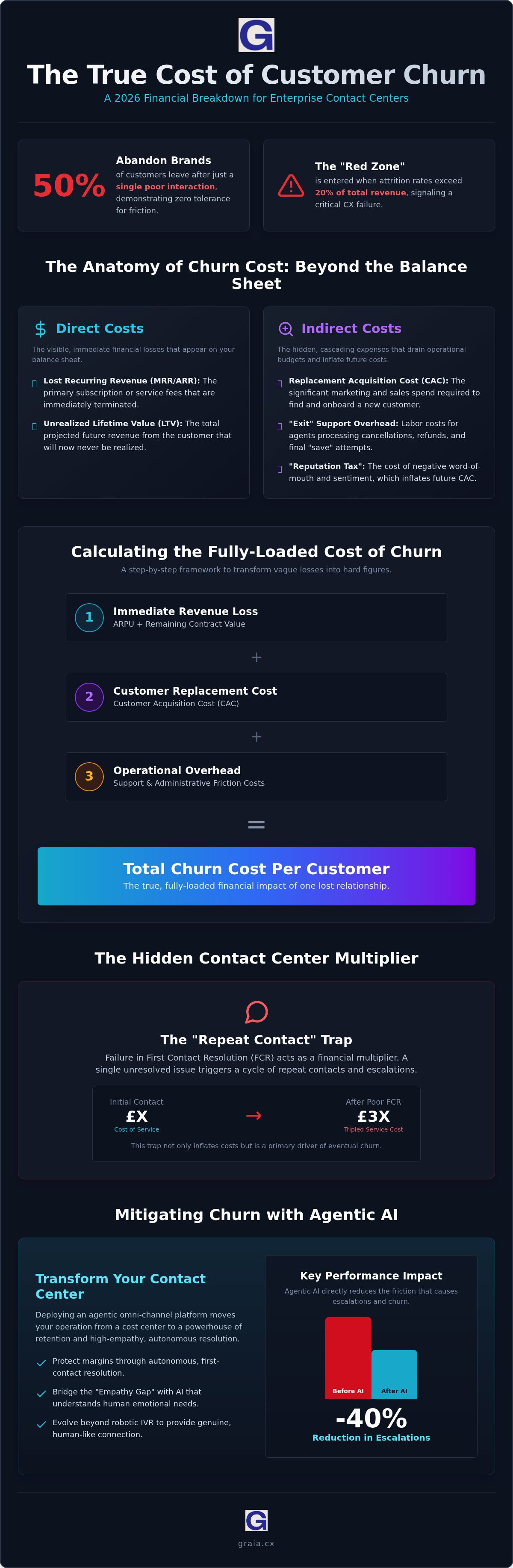
In 2026, customer churn isn't just a line item on a spreadsheet. It's the ultimate metric of the empathy gap within your enterprise. You likely feel the sting of every lost account, yet quantifying that pain for stakeholders remains an elusive challenge. With 50% of customers now abandoning brands after a single poor interaction, the cost of friction has never been higher. You're likely struggling to explain why traditional metrics fail to capture the full financial weight of a fractured customer journey.
This guide empowers you to bridge that gap by mastering the precise art of calculating customer churn cost. You'll move beyond surface-level averages to uncover the hidden variables that drain your budget, from soaring acquisition costs to the systemic waste of repeat contacts. We'll provide the definitive formula to transform vague frustrations into hard figures in GBP. By the end of this article, you'll have the data required to justify a shift toward agentic AI, ensuring your contact center evolves from a cost centre into a powerhouse of retention and genuine human connection.
Key Takeaways
- Master the distinction between immediate direct revenue loss and the cascading operational expenses that inflate your enterprise contact center budget.
- Implement a precise, multi-step framework for calculating customer churn cost by integrating ARPU, remaining contract value, and replacement acquisition costs in GBP.
- Identify how friction in First Contact Resolution acts as a financial multiplier, often tripling the cost of service through the "repeat contact" trap.
- Benchmark your attrition rates against 2026 industry standards to identify if your organization has entered the "Red Zone" where churn exceeds 20% of total revenue.
- Discover how deploying an agentic omni-channel platform can reduce escalations by 40%, protecting your margins through autonomous, high-empathy resolution.
The Anatomy of Customer Churn Cost in 2026
In the high-stakes world of enterprise CX, churn is often reduced to a single, static percentage. This is a fundamental error. To truly understand the health of your organisation, you must view customer churn cost as the total financial weight of every failed interaction and every lost relationship. It isn't just a missing subscription fee; it's the systemic failure of your service engine. Customer attrition represents a cascading drain on your resources that most traditional reporting models fail to capture.
When you begin calculating customer churn cost, you're measuring the "Empathy Gap." This gap exists where technology fails to meet human emotional needs, driving customers toward your competitors. In 2026, this gap has become the primary driver of the "Compounding Expense of CX Failure," where a single unresolved issue triggers a cycle of repeat contacts, escalations, and eventual departure. We must move beyond simple metrics to see the full picture of this attrition.
Direct vs. Indirect Churn Costs
The financial impact of a departing customer splits into two distinct categories. Direct costs are the most visible. They include lost Monthly Recurring Revenue (MRR) and the total projected Lifetime Value (LTV) that will never be realised. These are the "hard" numbers that appear on your balance sheet. However, they're only the tip of the iceberg.
Indirect costs are often more destructive. They encompass the marketing spend required to replace that customer, which in 2026 is significantly more expensive than retention. You must also account for "exit" support interactions. These are the final, high-friction calls or chats where agents spend valuable time processing cancellations rather than creating value. Understanding how Contact Centre ROI with AI can offset these losses is essential for modern leaders. By automating the routine, you protect your margins from these hidden operational drains.
The 2026 Churn Landscape: Why Empathy Matters
The modern consumer has zero tolerance for friction. Robotic, circular IVR interactions are no longer just an inconvenience; they are active emotional triggers for churn. When a customer feels like a number in a machine, their loyalty evaporates instantly. This is why AI-driven empathy has become a non-negotiable asset. It's about ensuring every interaction feels human, even when it's automated. Calculating customer churn cost effectively means accounting for the sentiment of your user base. Process accuracy is a prerequisite for retention. If your systems can't solve a problem correctly the first time, you aren't just losing a ticket; you're losing a customer relationship worth thousands of pounds.
Step-by-Step: Calculating the Fully-Loaded Cost of Churn
Quantifying the damage of a departing customer requires a rigorous, multi-dimensional approach that looks beyond simple revenue loss. Calculating customer churn cost is not a mere accounting exercise; it is a diagnostic tool for your entire CX ecosystem. To move from surface-level metrics to a fully-loaded financial model, you must follow a structured progression that accounts for both visible and invisible drains on your enterprise resources.
The first step involves determining the Average Revenue Per User (ARPU) alongside the remaining contract value. If a high-value enterprise client terminates a £2,000 monthly agreement with six months remaining, your immediate deficit is £12,000. However, this is just the baseline. You must then calculate the Customer Acquisition Cost (CAC) required to secure a replacement. In the UK's competitive 2026 landscape, replacing lost revenue is often more expensive than the revenue itself.
Next, you must factor in the "Support Overhead" of the churn process. Every cancellation involves administrative friction, from processing refunds to the labor costs of final "save" attempts by your retention team. Finally, account for the "Reputation Tax." This represents the quantifiable cost of negative social sentiment and word-of-mouth. In an era of total transparency, a single disgruntled departure can influence dozens of prospects, effectively inflating your future CAC. To deepen your understanding of these dynamics, consider how Managing Churn to Maximize Profits aligns with long-term enterprise sustainability.
The Master Churn Cost Formula
To achieve a definitive figure, use this master formula: Total Churn Cost = (LTV + CAC) + (Operational Exit Cost * Reputation Multiplier). Operational Exit Cost is the labor expense of the final retention-focused contact. This formula is vital because the Reputation Multiplier has reached new heights in 2026. Social messaging transparency means that a customer's exit isn't silent; it's a broadcast that can dampen your brand's authority instantly.
Factoring in the Replacement Cost
The financial reality is stark. It costs between 5 and 25 times more to acquire a new customer than to keep an existing one. For many UK enterprises, marketing spend is becoming less efficient as the market reaches saturation. Every time a customer leaves, you're forced back into the expensive cycle of lead generation and nurturing. GraiaCX’s Enterprise AI Contact Center prevents this cycle by identifying friction points before they lead to an exit. By deploying agentic systems that understand intent, you protect your existing revenue and avoid the "replacement trap." You can explore more strategies for protecting your margins at our CX resource hub.
The Hidden Contact Center Multipliers: AHT, FCR, and Language
Efficiency metrics often mask the true financial impact of attrition. While your team focuses on How To Calculate Churn Rate, your operational KPIs are actively inflating the final bill. High Average Handle Time (AHT) and poor First Contact Resolution (FCR) aren't just operational bottlenecks. They are catalysts for the exit. When you're calculating customer churn cost, you must account for how these multipliers turn a minor service hiccup into a total relationship collapse.
Failing to resolve an issue on the first attempt doesn't just double the workload. It triples the cost. Every repeat contact increases the probability of churn by approximately 15% as customer patience erodes and trust evaporates. This is the "Repeat Contact" trap. It's a cycle of systemic waste where the cost of service balloons while the likelihood of retention plummets. To break this cycle, enterprises must move beyond simple tracking and toward agentic intervention.
The Cost of Miscommunication
Friction often stems from a lack of fundamental understanding. In a globalised market, language barriers represent a massive, unquantified churn risk. Customers who cannot receive support in their native tongue are significantly more likely to abandon a brand after a single interaction. This "sentiment-blind" support is a silent drain on your international revenue, often ignored in standard financial models.
Traditional solutions involve hiring expensive bilingual staff, which typically requires a 25-50% wage premium in the UK market. Our Live Call Translation software eliminates this overhead while saving customers who would otherwise be lost. By removing linguistic friction, you protect your margins and ensure that calculating customer churn cost includes the value of your global reach. Technology should bridge the gap, not widen it.
FCR as a Churn Predictor
First Contact Resolution is the single most important predictor of customer loyalty in 2026. A 10-point increase in FCR correlates to a dramatic reduction in churn expenses because it prevents the frustration that leads to departure. When a customer's problem is solved instantly, their lifetime value is preserved.
We deploy Agent Assist tools to provide "next-best-action" suggestions in real-time, ensuring a first-call fix even for complex inquiries. When combined with an "Agentic Swarm" architecture, context is preserved across every channel. The customer never has to repeat their story. This preservation of context is the ultimate antidote to friction-based churn. It ensures the customer feels known and valued, transforming a potential exit into a moment of reinforced loyalty.
Benchmarking Your Churn Cost Against Industry Standards
Benchmarking isn't about vanity metrics. It's about survival. When you're calculating customer churn cost, you must compare your performance against the 2026 industry leaders to understand your relative market position. If your churn costs exceed 20% of your total revenue, you've entered the "Red Zone." This is a critical state where attrition outpaces growth, threatening the long-term viability of your enterprise. Reaching this threshold signals a systemic failure that requires immediate, agentic intervention to stabilise the ship.
Visionary leaders don't just react to these figures. They use AI "Judges" to simulate and predict risk before it manifests in your churn rate. By stress-testing your existing workflows, you can identify the exact friction points that drive customers away. This proactive stance allows you to maintain "Negative Churn," a state where expansion revenue from your loyal base outweighs any losses from departures. You can discover more about these advanced retention frameworks at our CX resource hub.
Sector-Specific Churn Metrics
The financial weight of attrition varies significantly across industries. In Enterprise SaaS, the 2026 gold standard for annual churn is between 3% and 5%. Here, the focus is on expansion. If you aren't growing your account value faster than you're losing it, you're falling behind. E-commerce faces a different challenge, with monthly B2C churn averaging around 6.7%. In this sector, "return churn" is the silent killer, representing the operational waste of restock logistics and refund processing in GBP.
Travel and hospitality brands face a unique struggle with booking cancellations. A lost booking isn't just a missed £500 transaction. It represents a total loss of future high-margin ancillary sales and loyalty points. These sectors must prioritise First Contact Resolution to prevent a single service hiccup from turning into a permanent exit.
Predictive Churn Analysis
We use the GraiaCX Simulator to stress-test your customer journeys, identifying where friction might trigger an exit. This isn't just data analysis; it's a look into the future of your customer sentiment. By using sentiment analysis for real-time coaching, your agents can adjust their tone instantly to save at-risk customers. We also deploy "Prompt Shields" to ensure your automated systems maintain brand integrity. These shields prevent policy-driven churn by ensuring that AI interactions remain helpful and empathetic, even during complex disputes. Calculating customer churn cost effectively means accounting for these hidden risks before they impact your balance sheet. This approach also reduces agent burnout, addressing the hidden cost of the high-stress environments that traditional systems often create.
Turning the Tide: How Agentic AI Mitigates Churn Expenses
Calculation is merely the precursor to transformation. Once you finish calculating customer churn cost, the focus must shift toward active mitigation. Traditional contact centres are reactive; they wait for the exit rather than preventing the friction. Our Agentic CCaaS Platform serves as the ultimate churn-prevention engine by replacing rigid scripts with proactive, autonomous resolution. By handling routine inquiries 24/7, our Conversational Agents free your human talent for high-empathy saves that require a genuine emotional connection.
Agentic AI doesn't just talk; it acts. It resolves frustration instantly by processing refunds or rescheduling deliveries without requiring a customer to wait in a queue. This immediacy is vital. When a customer's problem vanishes in seconds, the emotional trigger for churn is extinguished before it can smoulder. This approach also addresses the critical link between agent satisfaction and customer loyalty. Happy agents, supported by intelligent systems, are 25% more productive and far less likely to leave. This stabilises your internal costs while protecting your external revenue.
Empowering Agents with AI Empathy
We believe technology should amplify the human heart. Our AI Agent Assist provides real-time transcripts and smart suggestions, ensuring your team has the data they need to lead with empathy. The integrated Writing Assistant maintains perfect tone, grammar, and brand consistency across every interaction. It is a model of collaboration where the AI handles complex data processing, allowing your humans to handle the nuanced emotional heart of the conversation. This synergy ensures that even the most difficult interactions conclude with a sense of resolution rather than resentment.
The ROI of Retention Automation
The financial justification for this evolution is undeniable. By reducing escalations by 40%, enterprises reclaim millions in wasted labour and prevent the systemic drain of repeat contacts. Beyond the efficiency gains, a 60% faster resolution speed transforms the service experience into a driver of "Surprise and Delight." These aren't just technical benchmarks; they are the keys to reclaiming your margin and securing your future. Don't let your revenue leak through the empathy gap. Start reducing your churn costs today by exploring our latest strategies at the GraiaCX resource hub.
Reclaiming Your Margin through Agentic CX
Mastering the art of calculating customer churn cost is the first step toward reclaiming your enterprise margin. You've identified how hidden variables like reputation taxes and repeat contact cycles inflate your operational overhead, turning minor friction into a systemic financial drain. It's time to stop the bleed. By shifting from reactive support to a proactive agentic model, you transform every interaction into a moment of reinforced loyalty rather than a potential exit.
The path forward is clear and technically superior. Implementing an agentic omni-channel platform delivers immediate, documented results: 40% fewer escalations, 60% faster resolution times, and a 25% uplift in agent productivity. These benchmarks represent more than just efficiency; they are the foundations of a resilient, empathy-driven brand that thrives in the 2026 landscape. Explore how Agentic AI can slash your churn costs on the GraiaCX blog. You possess the unique vision required to evolve your contact centre. Let's build a future where every customer feels known, valued, and protected from the frustrations of the past.
Frequently Asked Questions
How do you calculate the cost of customer churn in a contact center?
Calculating customer churn cost requires a fully-loaded formula: (LTV + CAC) + (Operational Exit Cost * Reputation Multiplier). You begin by summing the lost lifetime value and the marketing investment needed for a replacement. Then, add the labour expense of final retention contacts and administrative processing. This approach ensures you capture the total systemic impact rather than just a missing monthly subscription fee on your UK balance sheet.
What is the difference between voluntary and involuntary churn cost?
Voluntary churn cost arises when a customer actively chooses to leave due to dissatisfaction or better competitor offers. In contrast, involuntary churn often stems from administrative failures like expired payment cards. While involuntary churn accounts for 20-40% of subscription losses, both types drain resources. Voluntary churn carries a higher "reputation tax" because it often involves negative social sentiment that inflates your future acquisition costs.
Can AI automation really reduce customer churn expenses?
AI automation significantly mitigates these expenses by eliminating the friction that triggers departures. Our agentic platform reduces escalations by 40% and accelerates resolution times by 60%. By deploying Conversational Agents to handle routine tasks 24/7, you ensure customers receive immediate support. This prevents the frustration-led exits that typically occur when human queues are long or when service is restricted to standard UK business hours.
How much does it cost to replace a lost customer in 2026?
In 2026, acquiring a new customer costs between 5 and 25 times more than retaining an existing one. For a B2B SaaS enterprise, the average acquisition cost is approximately £260 per account, though this figure fluctuates based on sector complexity. When you lose a client, you aren't just losing their revenue; you're forced to reinvest these significant sums into marketing and sales to simply return to your baseline.
Is customer churn cost higher for enterprise businesses than SMEs?
Enterprise businesses typically face much higher churn costs because their Customer Lifetime Value (LTV) is significantly larger. While SMB SaaS churn can exceed 30% annually, enterprise churn is usually under 10%. However, the complexity of enterprise support means that a single lost account represents a massive operational failure. The "fully-loaded" cost for an enterprise includes extensive implementation labour and deep integration work that SMEs rarely replicate.
What are the hidden costs of customer churn that most businesses miss?
Most organisations overlook the "Reputation Tax" and the cost of agent burnout. Negative word-of-mouth in 2026 spreads instantly across social messaging platforms, quietly increasing your future CAC. Additionally, high churn environments create a toxic cycle of stress for your staff. This leads to agent attrition, forcing you to pay for recruitment and training, which further compounds the total financial damage of every departing customer.
How does First Contact Resolution (FCR) impact the cost of churn?
First Contact Resolution is the most reliable predictor of churn cost. Failing to solve a problem on the first attempt often triples the cost of service due to the "repeat contact" trap. Every subsequent interaction increases the probability of churn by roughly 15%. High-performing teams use Agent Assist to secure first-call fixes, preserving the customer relationship and preventing the cascading expenses of a multi-touch resolution process.
Can live translation software help reduce churn in global markets?
Live Call Translation is a vital tool for reducing churn in global markets by removing linguistic friction. Customers who cannot receive support in their native tongue are significantly more likely to abandon a brand after one bad experience. By supporting over 100 languages, you eliminate the need for expensive bilingual staffing premiums of 25-50%. This ensures every customer feels heard and valued, regardless of their location or primary language.