
Global Customer Support Without Bilingual Staff: The 2026 Enterprise Resource Guide
What if the most expensive line item in your global contact center, the 25% to 50% wage premium for bilingual agents, became entirely obsolete by the end of this quarter? You've likely accepted that scaling into new markets requires a fragmented patchwork of regional hubs and specialized language queues. It's a system that breeds inconsistency and leaves customers in smaller markets waiting far too long for a human connection. This structural inefficiency isn't just a cost center; it's a barrier to true global agility.
You can now achieve seamless global customer support without bilingual staff by leveraging agentic AI and real-time translation that preserves the original speaker's emotional nuance. This guide explores how to transition from language-based silos to a unified architecture. You will learn how to reduce average handle time by up to 25% while maintaining human empathy across more than 100 languages and dialects. We're moving beyond simple translation into a new era of intelligent, borderless connection that empowers your existing team to serve the world with technical precision and genuine heart.
Key Takeaways
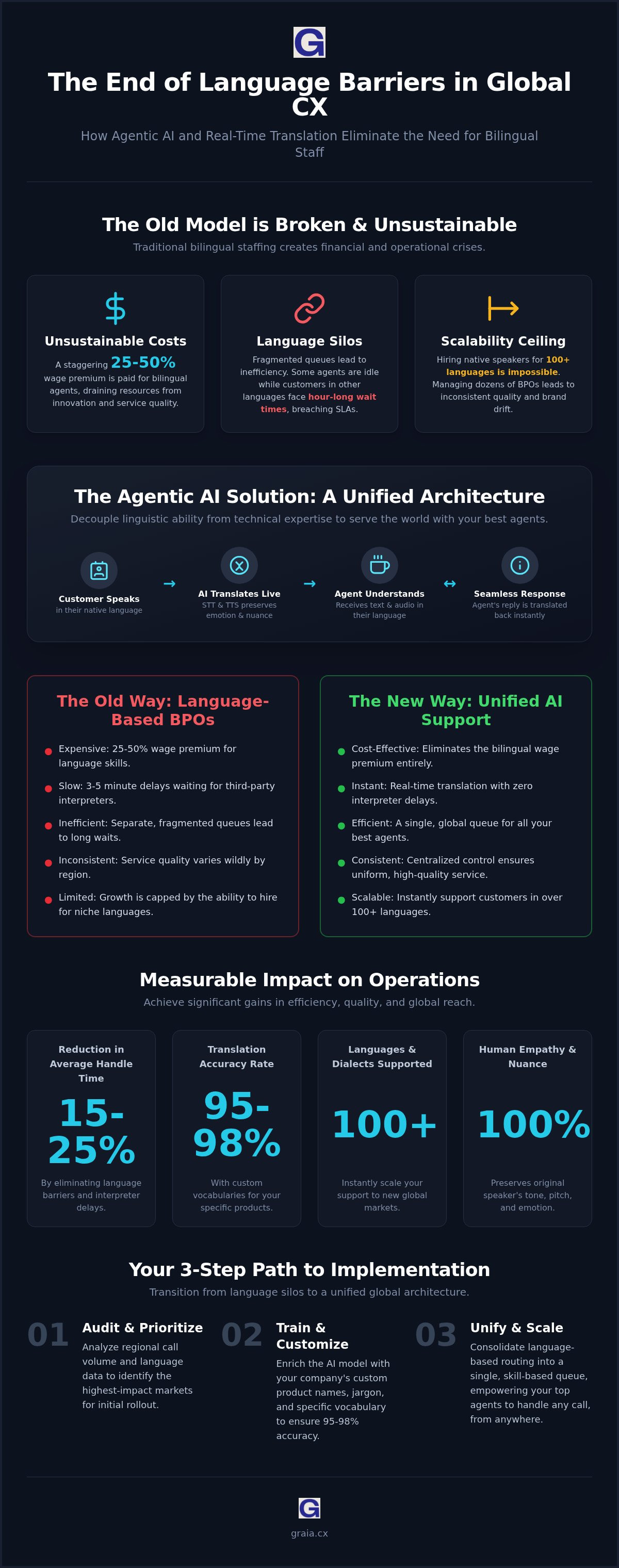
- Understand the strategic shift from traditional recruitment to a unified architecture that bypasses the unsustainable 25-50% bilingual wage premium.
- Discover the technical framework required for global customer support without bilingual staff, focusing on real-time voice engines and agentic AI.
- Identify the operational advantages of AI-enabled support over native-speaker BPOs, specifically the elimination of 3-5 minute delays for third-party interpreters.
- Master the implementation process by auditing regional volume and training your AI with custom product vocabularies to ensure 95-98% accuracy.
- Learn how to achieve a 15-25% reduction in Average Handle Time while maintaining high-quality human empathy across more than 100 different languages.
The Economic Crisis of Bilingual Staffing in Global CX
The traditional model for international expansion is hitting a financial wall. Organizations currently pay a 25% to 50% wage premium to secure bilingual talent; a cost that compounds as you scale into new regions. This isn't just about salaries. It's about the agonizing recruitment lag and the staggering attrition rates found in niche language markets. When a single departure can collapse your support for an entire country, the model isn't just expensive. It is fragile. You are essentially paying a premium for a linguistic skill set rather than the actual quality of service or technical expertise.
Operating global customer support without bilingual staff is no longer a futuristic concept. It's a fiscal necessity. Traditional BPOs are struggling to maintain 24/7 coverage across dozens of time zones while keeping quality consistent. The result is the "Language Silo" problem. Your English queue might be empty while your German or Japanese customers face hour-long wait times. This imbalance forces SLA breaches and creates a fragmented customer experience that erodes brand loyalty. It creates a hierarchy of customers where some receive immediate care while others are relegated to the sidelines.
The Hidden Costs of Language-Based Routing
Routing by language is fundamentally inefficient. You are forced to staff for peak volume in every specific tongue, leading to expensive downtime during off-peak hours. These redundant staffing costs are often hidden within regional hub budgets, yet they drain resources that could be spent on innovation. Beyond the payroll, language barriers in communication directly impact First Contact Resolution (FCR). When an agent and customer struggle to find common ground, frustration peaks. Misunderstandings lead to repeated tickets, escalated calls, and a degraded sense of partnership between the brand and the consumer. Every misinterpretation is a missed opportunity to build trust.
The Scalability Ceiling of Human-Only Support
Hiring native speakers for 100 or more languages is a mathematical impossibility for most enterprises. The logistics of managing 50 different regional BPOs lead to brand drift, where your service quality fluctuates wildly based on local management. This lack of central control is a liability. It's why contact center language barrier solutions have transitioned from a recruitment challenge into a technology-first priority. We are moving toward a unified agentic model where your best agents can serve any customer, anywhere, regardless of the language they speak. This shift eliminates the ceiling on your growth and restores the focus to what matters most: the quality of the human interaction.
How Live Call Translation Redefines Global Accessibility
Language is often the final frontier in customer experience. Live Call Translation isn't just a passive utility; it is a high-performance voice engine that bridges the gap between agent and customer instantly. By decoupling linguistic ability from technical expertise, you can finally scale global customer support without bilingual staff. This technology utilizes a sophisticated stack of Speech-to-Text (STT) and Text-to-Speech (TTS) layers to create a seamless dialogue. Major telecommunications leaders are already deploying live call translation within their networks to handle complex international traffic with minimal latency. It's a shift from staffing for language to staffing for skill.
We've successfully broken the "robot" stereotype that once plagued automated systems. Modern voice synthesis now delivers natural, brand-consistent tones that reflect your specific corporate identity. These engines do more than swap words. They preserve intent and emotion. By detecting the subtle sentiment behind the translation, the system ensures your agents respond with the appropriate level of empathy or urgency. Every syllable becomes an opportunity for connection rather than a point of friction. You can explore more about the future of AI-driven communication in our latest industry insights.
The Mechanism of Real-Time Multilingual Dialogue
Partial translation is the catalyst for conversational flow. It allows agents to process requests as they appear on screen before the customer even finishes speaking, drastically reducing the cognitive load on the agent. Maintaining the "Original Audio" in the background is also critical. It allows the agent to hear the customer's tone, pitch, and hesitation, preserving the human connection that text-only tools lose. Furthermore, formality tuning allows you to respect cultural nuances. You can adjust the engine to use the correct honorifics in Japanese or the precise professional distance required in German, ensuring your brand never sounds out of place.
Grounded Accuracy through RAG and Custom Vocabularies
Generic translation often fails enterprise brands because it lacks industry context. A "bank" in a financial setting is very different from a "bank" in a geographical one. By using Retrieval-Augmented Generation (RAG), translations align strictly with your vetted knowledge bases. This ensures the engine provides accurate technical advice rather than hallucinated guesses. This structured approach elevates accuracy from a standard 80% to a precise 98%. Custom phrase lists and reading rules allow the system to handle your unique product names and complex legal disclaimers with absolute precision, protecting your brand's integrity in every language.
Comparing AI-Enabled Support vs. Native-Speaker BPOs
Choosing between a native-speaker BPO and an agentic AI platform is no longer a simple procurement decision. It's a strategic choice between scaling with friction or scaling with precision. Traditional BPOs rely on a headcount-heavy model that often doubles your operational costs while tethering your growth to the volatility of local labor markets. Relying on external agencies creates a disconnect between your brand's core values and the frontline experience delivered to your international customers.
Transitioning to global customer support without bilingual staff allows you to centralize your talent pool. You can finally prioritize domain expertise over linguistic ability. Speed is the most immediate casualty of the legacy model. Connecting a third-party interpreter typically introduces a 3-5 minute delay into the conversation. In a world where minutes define customer satisfaction, this friction is unacceptable. AI-driven systems remove these gatekeepers, facilitating an immediate, direct dialogue that feels natural and unforced.
Consistency remains the hallmark of enterprise excellence. Native agents, while empathetic, often deviate from brand-vetted scripts or interpret complex technical data through their own cultural lens. This leads to inconsistent service quality across regional hubs. By keeping your support in-house through an AI framework, you ensure that every customer receives identical, high-fidelity information. You also maintain a tighter security perimeter. Your data stays within your enterprise trust framework rather than being processed by third-party agencies with varying compliance standards.
Operational Impact: AHT and FCR Benchmarks
The implementation of ai translation for customer service typically yields a 15-25% reduction in handle time after the first month of deployment. This efficiency stems from removing the pauses inherent in human interpretation. You also drive higher First Contact Resolution (FCR) rates by eliminating the need for language-based callbacks. Agents feel more empowered. They use real-time assist tools to navigate complex queries without the cognitive burnout of switching between mental translation and technical problem-solving.
Empathy and the Human Element
Connection requires more than just translated words. It requires tone. The hybrid model uses "Original Audio" as its secret weapon. Your agents hear the customer's actual voice, allowing them to detect subtle cues like hesitation or relief. This empowers a monolingual agent with multilingual superpowers, blending the speed of AI with the warmth of human intuition. For high-stakes interactions, the system uses script-locked suggestions to ensure mandatory legal disclosures are delivered verbatim. You achieve absolute compliance without sacrificing the genuine human connection that defines your brand.
Best Practices for Implementing AI-Powered Multilingual Support
Transitioning to a borderless service model requires more than just high-performance software. It demands a methodical architectural shift. To successfully deploy global customer support without bilingual staff, you must first audit your historical interaction data to identify high-impact dialects and regions. This data-driven prioritization ensures that your initial rollout addresses the areas with the highest friction and cost. Once you've mapped your linguistic landscape, the focus shifts to the "brain" of your system: your custom vocabulary. You must define product names, industry-specific jargon, and mandatory legal disclaimers to ensure the engine achieves 95-98% accuracy. Without this grounded context, even the most advanced AI will struggle with the technical nuances of your specific enterprise.
The final stages of implementation involve seamless technical connectivity and human empowerment. You can integrate these capabilities via SIP or iframe directly into your existing command centers. Training your agents is equally vital. They must become proficient in using the translation widget and managing "Edit-and-Send" windows, which allow for a final human check before a message is transmitted. This ensures that while the AI handles the linguistic heavy lifting, your team remains the ultimate arbiter of brand quality. For a deeper dive into modernizing your stack, you can explore our comprehensive CX strategy guides.
Technical Integration Strategies
Modern enterprises cannot afford the downtime of a "rip-and-replace" overhaul. The most effective strategy is a SIP-enabled deployment that overlays your existing infrastructure. This allows you to integrate AI with Genesys, Avaya, or NICE CXone without disrupting active workflows. By mirroring the audio stream, the translation engine operates in parallel with your core telephony. You should also configure robust fallback paths. If a query reaches a level of technical complexity that the AI flags as high-risk, the system should trigger an immediate escalation to a specialized human supervisor. This safety net preserves the integrity of your most sensitive customer interactions.
Optimizing for Regional Nuance
Linguistic accuracy is only half the battle; cultural resonance is the other. You must set specific formality levels for each region to align with local expectations. A casual tone that works in the United States might be perceived as disrespectful in South Korea or Japan. Implementing "Reading Rules" is another critical step. These rules ensure the engine correctly formats account numbers, dates, and currencies, preventing the costly confusion that arises from localized data formats. Finally, use AI "Judges" to provide real-time scoring of translated interactions. These secondary models evaluate every dialogue for adherence to your brand voice, ensuring that your sophisticated identity remains intact across every border you cross.
GraiaCX: The Multilingual Customer Experience Engine
The era of linguistic compromise has ended. GraiaCX delivers a unified Agentic CCaaS platform engineered for the complexities of modern enterprise reach. By integrating high-fidelity Live Call Translation for over 100 languages and dialects, we empower your existing workforce to resolve issues with native-level precision. Achieving global customer support without bilingual staff is no longer a logistical hurdle; it is a technological standard that restores your focus to the quality of the customer connection. Our platform doesn't just swap words. It facilitates a deep, empathetic dialogue that respects the cultural nuances of every market you serve.
Our "Swarm" architecture provides a critical layer of intelligence that generic tools lack. It draws upon specialized domain knowledge to ensure that technical support in Mandarin is as accurate as billing inquiries in Portuguese. This intelligence is protected by an uncompromising commitment to security. GraiaCX guarantees that your proprietary data is never used to train public AI models. Your enterprise trust framework remains intact while your operational capabilities expand across the globe. You gain the agility of a local startup with the robust security and stability of a global leader.
Beyond Translation: Agent Assist and Next-Best-Action
True transformation happens when translation is paired with real-time intelligence. Our ai agent assist tools provide live coaching during translated calls, suggesting the most effective path to resolution based on the customer's sentiment and history. The platform also automates the tedious aspects of the job. It generates post-call summaries and wrap-ups in the agent's native language, allowing them to focus entirely on the human on the other end of the line. This streamlined workflow reduces onboarding time for new agents from months to just a few days, creating a more resilient and satisfied workforce.
Future-Proofing Your Global Support Strategy
Scaling into a new territory should take hours, not quarters. With GraiaCX, you can enter new markets instantly without a single new hire, bypassing the recruitment cycles that traditionally stall growth. To ensure you are building on a foundation of excellence, we recommend leveraging our Live Call Translation Buying Guide to select the stack that aligns with your long-term vision. GraiaCX ensures absolute reliability with 99.9% uptime and continuous 24/7 enterprise monitoring, protecting your global operations from the cost of silence. We are your partner in building a world where every voice is heard and every customer is understood.
Mastering the Borderless Contact Center
The shift from legacy staffing to an agentic framework marks the end of the linguistic silo. We have explored how technology now bridges the gap once filled by expensive, fragmented recruitment efforts, allowing you to reclaim control over your brand's global narrative. By centralizing your operations, you can finally deliver a high-fidelity experience to every customer, regardless of the dialect they speak or the region they call from. Implementing a strategy for global customer support without bilingual staff is the definitive path to sustainable enterprise growth in a borderless economy.
GraiaCX empowers your team to support 100+ languages and dialects with native-level precision. Our platform integrates seamlessly with Genesys, Avaya, and NICE CX, allowing you to achieve a 25% reduction in Average Handle Time while maintaining deep human empathy. You possess the vision to identify the flaws in traditional systems; we provide the technical architecture required to rectify them. The borderless enterprise is no longer a future aspiration; it is a current operational reality. Eliminate your language barriers—Book a GraiaCX Demo today and lead your organization into a more connected, empathetic future.
Frequently Asked Questions
How accurate is real-time voice translation for technical customer support?
The system achieves 95% to 98% accuracy after being trained on your specific industry terminology and technical documentation. It doesn't rely on generic translation models that struggle with professional context. Instead, it uses grounded intelligence to ensure that complex technical instructions remain precise and actionable across every language you support.
Can AI call translation handle different accents and regional dialects?
Yes, the engine is designed to support over 100 languages and their specific regional dialects. It recognises the subtle phonetic differences between a customer in London and one in Singapore or Mumbai. This ensures that your service remains locally resonant while you maintain a centralised, highly efficient global operation from a single location.
How much can I save by using AI translation instead of hiring bilingual staff?
Transitioning to global customer support without bilingual staff allows you to eliminate the 25% to 50% wage premium typically required for multilingual talent. You will also see a typical reduction in Average Handle Time of 15% to 25% within the first six weeks. These efficiencies turn your contact centre from a high-cost staffing challenge into a lean, scalable engine for growth.
Does live call translation work with my existing Genesys or Avaya system?
GraiaCX offers native, seamless integration with Genesys, Avaya, and NICE CXone. You don't need to overhaul your entire infrastructure or risk a "rip-and-replace" deployment. It utilises a SIP-enabled overlay that mirrors your audio stream in real time, allowing your agents to stay within the tools they already know and trust.
Will my customers know they are speaking through a translation engine?
Customers experience a natural, empathetic dialogue that feels remarkably human. While many organisations choose to disclose the use of AI for transparency, the advanced voice synthesis and "Original Audio" features prevent the interaction from feeling clinical or robotic. The focus remains on the quality of the resolution rather than the technology facilitating it.
How do you handle brand-specific product names or industry jargon?
We implement custom vocabularies and "Reading Rules" that act as a protective guardrail for your brand identity. This ensures that unique product names, specialised jargon, and mandatory legal disclaimers are translated with absolute fidelity. The system treats your proprietary language as a foundational truth, preventing the hallucinations often found in consumer-grade applications.
What is the latency or delay in a live translated conversation?
Latency is kept to a minimum through partial translation technology that processes speech as it happens. Your agents see the translated text appear on their screen before the customer even finishes their sentence. This allows for a brisk, professional rhythm that eliminates the awkward 3-5 minute pauses inherent in traditional third-party interpretation services.
Is customer data used to train the AI translation models?
No, your data is never used to train public AI models. GraiaCX prioritises your privacy by ensuring that every interaction remains within a secure enterprise trust framework. This commitment to security is a cornerstone of our ability to deliver global customer support without bilingual staff while maintaining absolute compliance. You can learn more about our protocols or book a GraiaCX demo to discuss your specific requirements.