
AI Translation for Customer Service: The Enterprise Guide to Multilingual Support in 2026
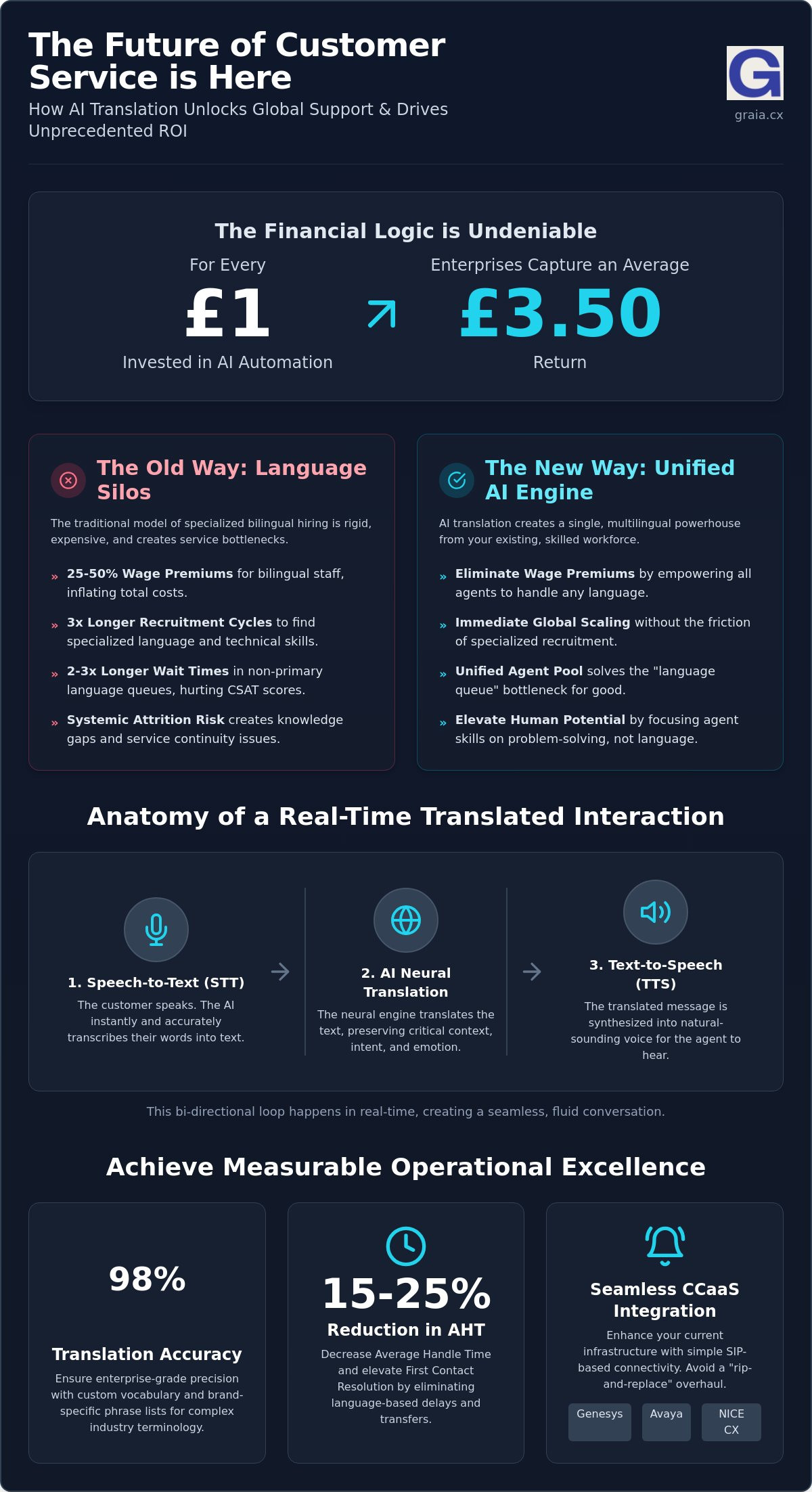
For every £1 invested in advanced automation, forward-thinking enterprises are now capturing an average return of £3.50. The financial logic is undeniable, yet many CX leaders remain tethered to the exhausting cycle of bilingual recruitment and the inevitable wage premiums that follow. You shouldn't have to compromise on speed or budget to serve a global audience. Deploying AI translation for customer service transforms your current workforce into a multilingual powerhouse, breaking the silos of language-specific queues once and for all.
We agree that the era of basic, mechanical chatbot responses is over. Customers expect more than a literal translation; they demand empathy and immediate resolution. This guide reveals how real-time translation technology eliminates hiring barriers while actually improving the emotional quality of your support. We'll explore the strategic shift toward hybrid human-AI workflows and the technical integrations that make seamless, global communication a practical reality for your enterprise in 2026.
Key Takeaways
- Eliminate the unsustainable expense of bilingual wage premiums by transitioning to a unified multilingual engine. You can scale global support immediately without the friction of specialized recruitment cycles.
- Master the technical architecture of ai translation for customer service to deliver fluid, real-time voice support. Understand the sophisticated fusion of speech-to-text and emotive synthesis that preserves genuine human connection.
- Ensure enterprise-grade precision with custom vocabulary and brand-specific phrase lists. Discover the specific features required to achieve 98% translation accuracy across your most complex industry terminology.
- Integrate advanced translation capabilities into your existing Genesys, Avaya, or NICE CX stack seamlessly. Use SIP-based connectivity to enhance your current infrastructure while avoiding the risks of a "rip-and-replace" overhaul.
- Achieve measurable operational excellence with a projected 15-25% reduction in Average Handle Time. See how agentic platforms elevate First Contact Resolution while maintaining privacy-first data standards that never compromise your proprietary information.
Beyond Bilingual Hiring: The Strategic Shift to AI Translation for Customer Service
The traditional model of multilingual support is reaching a breaking point. For decades, enterprises have relied on a fragmented strategy of hiring specialized bilingual agents to staff isolated language queues. This approach is inherently rigid. It creates artificial barriers within your workforce and limits your ability to respond to volatile market demands. By contrast, ai translation for customer service serves as a sophisticated, real-time bridge that digitises the linguistic layer of communication. It allows your most skilled agents to project their expertise across 100+ languages without the need for native fluency in every dialect. It's about elevating human potential, not replacing it.
The financial burden of the old way is significant. Bilingual staff typically command wage premiums between 25% and 50% compared to monolingual counterparts. In the UK market, these additional costs compound across national insurance and pension contributions, inflating the total cost of ownership for every multilingual seat. This is no longer sustainable. As we move into 2026, the imperative is clear: you must scale your global reach without an equivalent surge in headcount. The goal is a unified, flexible agent pool that responds to customers based on their needs, not their native tongue.
The Hidden Costs of Traditional Multilingual Support
Wait times for non-primary language queues are often double or triple those of English lines. This delay isn't just an inconvenience; it's a catalyst for plummeting CSAT scores. The recruitment bottleneck is equally damaging. Finding a specialized agent with the right technical skills and linguistic proficiency takes roughly three times longer than a standard hire. When these agents leave, the knowledge gap they create is immense. Attrition in specialized teams isn't just a turnover statistic; it's a systemic risk to your service continuity.
Solving the 'Language Queue' Bottleneck
The transition to a unified agent pool is the definitive solution to these frustrations. When any agent can handle any language request, the complexity of workforce management (WFM) scheduling evaporates. You no longer need to overstaff a specific shift just to cover a potential Italian or Mandarin call. This flexibility empowers a "Day-1" global expansion strategy. You can enter new markets with confidence, knowing your existing team is already equipped to provide empathetic, high-quality support from the moment the first ticket arrives. Using ai translation for customer service ensures that your brand's voice remains consistent, regardless of the geography.
How Real-Time AI Voice Translation Powers Modern Contact Centers
Live Call Translation is a SIP-integrated bridge that enables bi-directional, real-time voice communication across disparate languages within the enterprise voice environment. It's the technical foundation that allows an agent to converse fluently with a customer speaking a different language, bridging geographical divides without a second of hesitation. This isn't a simple "bot" interaction. It's a sophisticated orchestration of three distinct layers: Speech-to-Text (STT), Neural Translation, and Text-to-Speech (TTS). Together, they form a seamless loop that prioritises both accuracy and human connection.
Precision is the foundation of trust. If the initial STT layer fails to capture the nuance of a customer's request, the entire service experience collapses. Modern ai translation for customer service systems now integrate sentiment and emotion detection into this workflow. This ensures that if a customer sounds frustrated, the translation reflects that urgency, allowing the agent to respond with appropriate empathy rather than a detached, clinical script. The technology doesn't just translate words; it translates intent.
The Anatomy of a Translated Interaction
For an enterprise interaction to feel natural, STT engines must achieve near-perfect accuracy with industry-specific jargon. Whether it's financial regulations or technical support for complex hardware, the system must recognise specialised terminology instantly. Low-latency processing is equally critical. If the delay between a customer speaking and the agent hearing the translation exceeds a few hundred milliseconds, the natural rhythm of turn-taking is lost. Leading TTS providers, such as ElevenLabs, now allow brands to create consistent, high-fidelity voices that mirror their corporate identity, ensuring the translated output sounds professional and reassuring.
Maintaining Human Empathy Through Original Audio
The most advanced platforms include an "Original Audio" feature, which is vital for preserving the human element. This allows the agent to hear the customer's actual voice at a lower volume behind the translation. Hearing the original tone, pace, and emotional inflections helps the agent gauge the customer's mood more accurately than text alone ever could. It reduces the "robotic" feel that often plagues basic automated services, creating a collaborative atmosphere where the customer feels truly heard. Balancing this clarity with the subtle nuances of human speech is what separates a visionary service strategy from a merely transactional one.
Success in a global market requires more than just technical capability; it demands a deep understanding of the interpersonal experience. Explore our latest insights on multilingual customer experience trends to see how these technologies are reshaping the industry.
Critical Features: What Defines Enterprise-Grade AI Translation?
Consumer-grade translation apps are little more than toys in a high-stakes contact center environment. When your team is managing a complex billing dispute or a critical technical outage, "close enough" is a dangerous standard. Enterprise-grade ai translation for customer service must provide more than literal word swaps. It requires a deep, programmable understanding of your corporate identity, industry-specific jargon, and strict regulatory frameworks. Achieving 98% accuracy for brand-specific terms isn't a luxury; it's a baseline requirement for protecting your reputation and ensuring customer trust.
Beyond the words themselves, security and data sovereignty remain the non-negotiable pillars of any enterprise deployment. In a post-GDPR landscape, UK organisations must ensure that PII masking is active at the point of capture. Your customer's sensitive information should never be used to train external models. SOC2 compliance and privacy-first architectures aren't just checkboxes. They are the protective barrier between your most valuable data and the digital wild. A sophisticated partner understands that technical superiority is meaningless without absolute data integrity.
Accuracy vs. Latency: Finding the Enterprise Sweet Spot
High-performance systems don't wait for a sentence to end before they begin working. They use partial translation displays, allowing agents to begin processing the customer's intent while the speech is still being synthesised. It's a delicate trade-off. While deep linguistic analysis provides higher quality, real-time speed is what keeps a conversation from feeling disjointed and unnatural. Optimising for specific dialects ensures that the output resonates locally. Distinguishing Swiss German from Austrian German, for instance, builds immediate rapport that a generic language profile simply cannot match.
Formality and Custom Vocabulary: Speaking the Brand's Language
Regulated industries like insurance or finance cannot risk the errors common in generic translation. A mistranslated account term could lead to a significant compliance breach or a frustrated customer. Custom phrase lists allow you to set immutable rules for how technical terms and account numbers are handled. Formality tuning is equally vital for global success. In cultures like Japan or South Korea, using the wrong level of honorifics can be perceived as a sign of disrespect. Script-locked suggestions ensure that mandatory disclosures are delivered precisely as written, regardless of the language being spoken. This level of control allows ai translation for customer service to act as a true extension of your brand's voice.
- Custom Vocabulary: Ensures 98% accuracy for proprietary brand and technical terms.
- Formality Tuning: Adapts automatically to local cultural norms and linguistic etiquette.
- PII Masking: Protects sensitive customer data before it ever reaches the translation layer.
- Script-Locked Disclosures: Guarantees regulatory compliance across every supported language.
Integrating AI Translation into Your Existing CCaaS Stack
Implementation shouldn't be synonymous with disruption. For the enterprise IT leader, the primary concern is often the risk of a "rip-and-replace" overhaul that threatens service continuity. Fortunately, deploying ai translation for customer service doesn't require a total infrastructure rebuild. By leveraging SIP-based connectivity and iframe integrations, you can overlay advanced linguistic intelligence onto your current environment. This approach allows you to preserve your existing investments in routing and telephony while immediately unlocking global support capabilities.
Modern architectures now favour a hybrid model. This involves combining the creative flexibility of Large Language Models (LLMs) with deterministic business rules. You can define specific parameters for how certain interactions are handled, ensuring that the AI adheres to your brand's unique logic. This orchestration creates a seamless handoff between automated translation and human intervention, where the agent always retains full context of the preceding conversation. It's a technical partnership that prioritises both efficiency and the interpersonal experience.
Empowering Agents with Real-Time Translation Widgets
The Agent Widget serves as a command center within CRM platforms like Salesforce or Zendesk. It allows your team to visualize the original transcript and the translated output side-by-side, providing a clear window into the customer's intent. The "Cancel and Edit" feature is a vital safety net in this workflow. It gives agents the power to pause and refine a translation before it reaches the customer, preventing potential misunderstandings. Additionally, Agent Assist tools provide smart response suggestions grounded in your specific knowledge base, accelerating resolution speed without sacrificing quality.
Modernizing Legacy Centers (Avaya, Genesys, NICE CX)
Legacy architectures often feel like a barrier to innovation, but they don't have to be. You can drop AI translation directly into SIP-enabled environments like Avaya, Genesys, or NICE CX without complex coding. This reduces the technical debt typically associated with contact center modernization. The goal is session continuity across every channel. Whether a customer starts with a translated chat and moves to a live call, the linguistic layer remains consistent. This unified approach ensures that your global service strategy is as stable as it is scalable.
Ready to see how these integrations work in practice? Discover our latest technical guides on modernizing your contact center stack.
The GraiaCX Advantage: A Multilingual Engine Built for CX Growth
GraiaCX positions itself as the definitive multilingual customer experience engine. While generic tools treat language as a friction point, our Agentic Omni-Channel Platform transforms it into a scalable asset. By embedding ai translation for customer service into the core of your operation, we enable a unified brand experience across every touchpoint. Whether the interaction occurs via voice or digital chat, GraiaCX maintains linguistic consistency in over 100 languages. It's a sophisticated orchestration of technical precision and human empathy.
The operational results are immediate. Enterprises using the GraiaCX engine typically achieve a 15-25% reduction in Average Handle Time because agents no longer navigate manual translation barriers. We often see First Contact Resolution rates climb by 5 to 10 points. When your team truly understands the customer's intent, they resolve issues correctly the first time. This isn't just a metric; it's the elevation of your workforce through technical intelligence.
Security and Data Sovereignty in Regulated Industries
Trust is a non-negotiable requirement. GraiaCX ensures that your proprietary data is never used to train external models, creating a closed loop of information security. We implement PII masking and encryption at the point of capture to protect sensitive details before they reach the translation layer. Our platform generates audit-ready transcripts in both original and translated formats, supporting dispute resolution and UK compliance. You retain absolute sovereignty over your data assets at all times.
Measurable Impact: ROI and Operational Efficiency
The financial logic of the GraiaCX engine is compelling. Eliminating the 25-50% wage premiums for bilingual staff allows you to reallocate capital toward broader innovation. Agent productivity increases by 25% as our Agent Assist tools provide real-time, knowledge-grounded suggestions. This combination of cost avoidance and performance gains creates a powerful narrative for stakeholders. For a detailed breakdown of 2026 requirements, consult our live call translation software guide.
GraiaCX provides more than just ai translation for customer service; we provide a framework for borderless growth. We bridge the gap between technical capability and genuine connection. We ensure your global expansion is grounded in practical, high-performance results.
Architecting a Borderless Service Strategy
The era of linguistic silos is ending. By adopting ai translation for customer service, you transition from a reactive, fragmented support model to a proactive, unified global engine. This evolution allows your agents to provide empathetic assistance in 100+ languages without the burden of specialised recruitment or unsustainable wage premiums. It's about more than just efficiency; it's about the elevation of your brand's voice on a global stage.
Success requires technical stability and visionary leadership. Our seamless SIP-enabled integration ensures your legacy stack remains intact while unlocking the performance gains discussed, including a typical 15-25% reduction in Average Handle Time. You aren't just improving metrics; you're building a foundation for genuine human connection that transcends geographical borders. The tools to scale your impact are ready. We're here to ensure your transition is as stable as it is transformative.
Explore our latest insights on Agentic AI and translation in the GraiaCX Blog to stay ahead of the evolving CX landscape. Your journey toward a truly global contact centre begins with a single, intelligent step.
Frequently Asked Questions
Does AI translation for customer service sound like a robot?
Modern neural synthesis creates fluid, natural speech that mirrors human cadence and professional warmth. We utilize high-fidelity providers to ensure your brand's voice remains sophisticated and reassuring. Our "Original Audio" feature further enhances this experience by allowing agents to hear the customer's true emotional tone, preventing the detached feel often associated with legacy automated systems.
How accurate is real-time voice translation for technical support?
Accuracy reaches 98% when the system is properly tuned with your specific brand terms and technical jargon. Generic models often stumble on complex industry language; however, enterprise-grade ai translation for customer service uses custom vocabulary lists to ensure absolute precision. This level of control is critical for regulated sectors like finance or insurance where terminology must be immutable.
Can AI translation integrate with my existing Genesys or Avaya system?
Seamless integration with Genesys, Avaya, and NICE CX is achieved through SIP-enabled architectures and iframe widgets. You don't need a "rip-and-replace" overhaul of your existing telephony to modernise your centre. These tools overlay linguistic intelligence onto your current stack, allowing your IT team to implement global support without disrupting service continuity or losing technical debt.
Is my customer data safe when using AI translation services?
Your customer data is protected by a privacy-first framework that includes PII masking and strict data residency protocols. We ensure that your proprietary information is never used to train external models, maintaining a closed loop of security. This architecture aligns with UK GDPR requirements, providing a secure environment for even the most sensitive financial or medical interactions.
How does AI translation handle different dialects and accents?
Advanced engines distinguish between regional dialects and accents to ensure contextual relevance and local rapport. Whether it's Swiss German or Brazilian Portuguese, the system applies specific language profiles to capture regional nuances. This granularity prevents the misunderstandings that occur with one-size-fits-all models, ensuring the customer feels understood in their native dialect.
What happens if the AI makes a mistake during a live call?
The "Cancel and Edit" window provides a vital safety net by allowing agents to verify a translation before it's delivered to the customer. If the system misinterprets a phrase, the agent can pause and refine the output in real-time. This human-in-the-loop approach ensures that your brand's accuracy remains uncompromised even during high-pressure live interactions.
Does AI translation work for both voice and digital chat channels?
Our platform provides a unified linguistic layer across voice, chat, email, and social media touchpoints. This agentic omni-channel approach ensures that a customer receives the same high-quality, translated experience regardless of their preferred contact method. It simplifies workforce management by allowing any agent in your pool to handle any language on any channel.
How much can I save by using AI translation instead of bilingual agents?
You can recapture significant capital by eliminating the 25% to 50% wage premiums typically commanded by bilingual staff. In the UK, these savings extend to secondary costs like national insurance and pension contributions. Transitioning to ai translation for customer service allows you to scale your global support reach without the friction or expense of specialized recruitment cycles.