
Conversational AI ROI Calculator: Enterprise Business Case & Value Framework (2026)
Measuring conversational AI success by deflection alone is the fastest way to build a business case that collapses under executive scrutiny. Most contact centre leaders know the acute frustration of using a generic conversational ai roi calculator supplied by vendors who treat an abandoned query as a successful resolution. In practice, superficial containment often disguises customer friction, hidden systems integration debt, and the unaddressed burnout driving 30% to 45% annual agent turnover.
You shouldn't have to defend an enterprise investment using flawed assumptions and vague productivity promises. You need an auditable framework grounded in genuine operational capacity and end-to-end resolution. In this guide, you'll master the exact financial framework and formulas needed to calculate enterprise conversational AI return on investment with uncompromising commercial rigour. We step through the validated mathematical models, direct labour and bilingual recruitment savings, and verified payback milestones required to present an airtight case to your board.
Key Takeaways
- Deploy a mathematically rigorous conversational ai roi calculator framework that balances gross efficiency gains against total integration, tuning, and ongoing maintenance expenditure.
- Distinguish between superficial call deflection and autonomous agentic resolution to safeguard customer retention and eliminate expensive repeat-contact loops.
- Quantify tangible operational dividends across average handle times, first-contact resolution, and the elimination of 25% to 50% bilingual agent wage premiums.
- Uncover your true total cost of ownership by factoring in model token consumption, backend API orchestration, and strict UK regulatory compliance requirements.
- Translate operational CCaaS telemetry into an executive-ready financial narrative supported by validated payback milestones and defensible efficiency projections.
The Enterprise ROI Equation: Deconstructing Conversational AI Investment Metrics
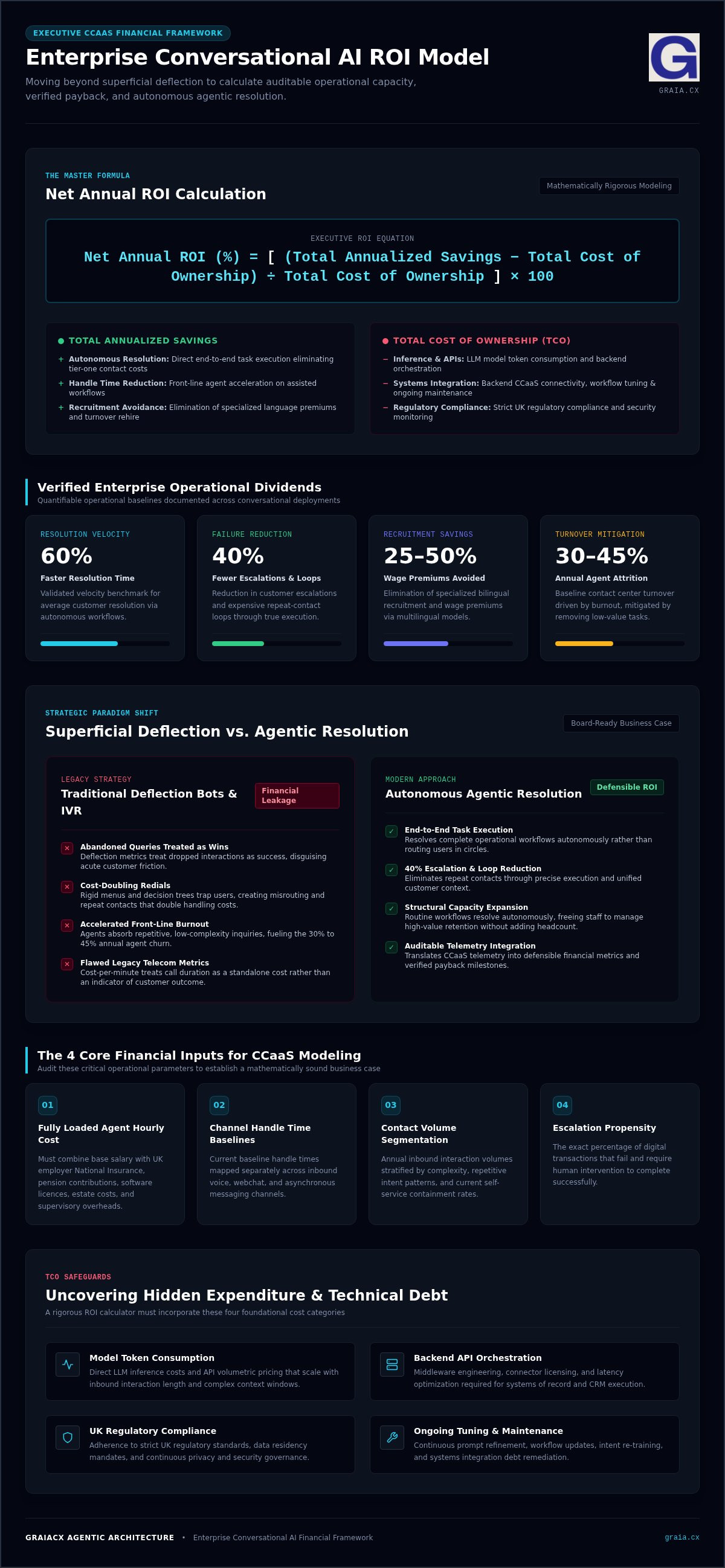
Enterprise conversational AI ROI is the net financial return generated through automated end-to-end resolution and augmented agent productivity, calculated by subtracting the total cost of ownership from total operational savings. Establishing a reliable return on investment requires looking beyond superficial interaction counts. A robust conversational AI business case evaluates the interplay between inbound contact volumes, fully loaded cost per contact, and average handle time (AHT).
Legacy telecom metrics like cost-per-minute fail because they treat contact duration as a standalone cost driver rather than an indicator of customer outcome. Slashing seconds off a call means little if the user receives incomplete answers. Modern commercial models balance immediate direct labour reallocations with long-term capacity expansion. When routine workflows resolve autonomously, front-line teams expand their capacity to manage high-value customer retention initiatives without increasing headcount.
A mathematically sound enterprise conversational ai roi calculator models both direct cost displacement and structural capacity gains across every operational touchpoint.
The Hidden Costs of Legacy IVR and Deflection Bots
Traditional touch-tone systems and basic deflection bots create financial leakage. Rigid decision trees trap users in looping menus, generating customer frustration and high misrouting rates. When unresolved callers inevitably redial, these repeat interactions double overall handling expenses. Forcing front-line teams to absorb repetitive, low-complexity inquiries drives workplace exhaustion, accelerating costly staff turnover while actively damaging customer brand equity.
Core Financial Inputs for Accurate Contact Center Modeling
To populate your conversational ai roi calculator with defensible assumptions, begin by auditing four core operational metrics:
- Fully Loaded Agent Hourly Cost: Base salary combined with UK employer National Insurance, pension contributions, software licences, estate costs, and supervisory overheads.
- Channel Handle Time: Current baseline handle times mapped separately across inbound voice, webchat, and asynchronous messaging channels.
- Volume Segmentation: Annual inbound interaction volumes stratified by complexity, repetitive intent patterns, and current self-service containment rates.
- Escalation Propensity: The exact percentage of digital transactions that fail and require human intervention to complete.
The Conversational AI ROI Calculator Framework: Step-by-Step Modeling
Quantifying automation value requires transparent mathematical modeling rather than opaque vendor assumptions. To construct an executive-ready business case, contact centre leaders rely on a master equation balancing gross efficiency against total expenditure:
Net Annual ROI (%) = [(Total Annualized Savings - Total Cost of Ownership) / Total Cost of Ownership] x 100
Where total annualized savings equals the sum of autonomous resolution gains, assisted handle time reductions, and avoided recruitment premiums. Calculating your return systematically involves five progressive stages, moving from an initial baseline audit to net payback realisation. When modeling phased rollouts across distinct operational cohorts, benchmark against a proven 60% faster average customer resolution time to measure velocity gains. To benchmark your operational baseline against established industry averages, review this detailed analysis of contact centre ROI with AI.
A reliable conversational ai roi calculator models five specific operational dimensions across phased implementation cohorts.
Step 1 & 2: Quantifying Autonomous Resolution and Containment Value
Begin by isolating tier-one inbound interactions suitable for autonomous execution. Multiply these addressable volumes by your fully loaded baseline cost per contact to establish gross containment value. Next, incorporate a 40% reduction benchmark in customer escalations and repeat contacts, reflecting the precision of true task execution over basic deflection. Finally, subtract ongoing API consumption and platform compute expenses to determine net autonomous containment.
Step 3 & 4: Calculating Handle Time and Agent Productivity Gains
Inquiries requiring human empathy benefit directly from cognitive augmentation. Model the financial impact of achieving a 15% to 25% reduction in average handle time within 4 to 6 weeks. Real-time guidance and automated post-call summarization unlock a measurable 25% uplift in human agent productivity. Front-line staff reclaim valuable hours previously lost to manual CRM updates, as documented in our guide to AI agent assist tools.
Step 5: Incorporating Multilingual Support and Staffing Premium Avoidance
Global support operations carry heavy structural overheads. Eliminating 25% to 50% bilingual agent staffing wage premiums immediately alters unit economics. Dynamic translation models remove the requirement for dedicated, language-siloed routing queues, lowering cross-border recruitment and scheduling friction. Explore practical strategies for scaling multilingual operations by reviewing proven live call translation software architectures.
For more detailed technical architectures and enterprise implementation roadmaps, explore the operational frameworks available on the GraiaCX contact centre transformation blog.
Traditional Deflection vs. Agentic Resolution: Comparing Long-Term Value
Containment figures can be deeply deceptive. Superficial deflection merely intercepts a contact, often routing customers away from expensive human channels without solving their underlying request. True agentic resolution actively executes transactional workflows across backend CRM, ERP, and core billing systems. When an autonomous system modifies database records, processes genuine account changes, and answers policy queries accurately, it eliminates secondary customer effort. By pairing dynamic generative models with hybrid retrieval-augmented generation (RAG), enterprises eliminate hallucinatory answers, preventing catastrophic compliance failures under UK consumer protection and financial conduct regulations.
Every reliable conversational ai roi calculator must distinguish between these divergent automation philosophies to project authentic operational savings:
| Operational Attribute | Superficial Deflection Bots | Autonomous Agentic Resolution |
|---|---|---|
| Core Technical Mechanism | Static FAQ decision trees and rigid menu routing | Dynamic reasoning integrated with core transactional APIs |
| Backend Systems Access | Read-only knowledge base retrieval | Read-write execution across CRM, ERP, and payment gateways |
| Downstream Impact | Channel hopping, repeat dials, and customer frustration | End-to-end task completion on the primary channel |
| Escalation Handling | Cold transfers requiring customers to repeat their details | Contextual, warm transfers with pre-drafted agent summaries |
Why Call Deflection Distorts True Operational ROI
Deflecting an inbound query provides a false financial signal. Frustrated users simply abandon failed self-service sessions, only to dial back into voice queues with elevated hostility. These secondary interactions cost twice as much to handle because they frequently demand senior supervisory involvement. Chief financial officers evaluating digital investments must measure verifiable issue completion rates rather than artificial session disconnects.
Downstream Retention and First-Contact Resolution Impact
Achieving a 5 to 10 point increase in first-contact resolution (FCR) permanently shifts contact centre economics. Resolving customer intents on initial contact reduces queue backlogs while safeguarding brand loyalty. When complex queries do necessitate human empathy, preserving full transactional context across channel transfers prevents customer irritation. Higher initial resolution rates correlate directly with reduced churn, compounding customer lifetime value over multi-year operational cycles.
Overcoming Calculation Pitfalls: TCO, Hidden Integration, and Attrition Costs
Procurement teams scrutinise technology business cases with justified scepticism. Flawed financial models fall apart because they overlook ongoing consumption and integration overheads. Calculating true returns requires auditing full Total Cost of Ownership (TCO), including foundational change management and rigorous security oversight. When building your conversational ai roi calculator, apply an explicit 15% risk-adjustment discount to gross benefits. This conservative haircut satisfies internal governance panels and ensures your project delivers under unpredictable operating conditions.
Omitting dynamic variable costs is an equally dangerous error. A realistic model must account for real-time model token consumption, specialized vendor licensing tiers, and recurring compute expenses. Ignoring these ongoing inputs leads to disappointing margin compression once interaction volumes scale across your enterprise.
Accounting for Total Cost of Ownership and System Integration
Legacy architectures demand substantial upfront effort. Factoring in initial SIP trunking, legacy PBX bridging, and custom API connector development prevents mid-project budget overruns. You also need dedicated resources for ongoing prompt engineering, simulator testing, and knowledge repository governance. Operational compliance is equally paramount. Factoring in continuous UK GDPR auditing, SOC2 security validation, and Ofcom dialler rule alignment protects the business from severe legal and financial penalties. For architectural blueprints that streamline legacy integration, read our definitive guide to selecting an agentic CCaaS platform.
Factoring Agent Well-Being and Attrition Reduction into Financial Returns
High contact centre churn quietly bleeds operating margins. With industry attrition averaging 30% to 45%, continually rehiring and training front-line staff drains capital. Automated note generation and proactive knowledge surfacing remove cognitive strain, allowing human agents to focus on complex, high-empathy customer conversations. By protecting your workforce from repetitive Tier 1 fatigue, you extend average employee tenure, lowering annual recruitment expenditure and protecting institutional service knowledge.
Audit your current operational expenses and build a defensible automation roadmap by reviewing our latest frameworks on the GraiaCX customer experience transformation blog.
Projecting Your Enterprise Return with GraiaCX’s Agentic CCaaS Architecture
Maximising automation yields requires unifying disparate capabilities into a consolidated execution engine. Rather than stitching together fragmented point solutions, GraiaCX integrates autonomous Conversational Agents, real-time Live Call Translation, and AI Agent Assist into a cohesive agentic CCaaS ecosystem. This unified architecture deploys hybrid flows, pairing the conversational flexibility of generative language models with the deterministic reliability of programmatic business rules. Seamless SIP and API connectors interface directly with your existing infrastructure, including Genesys, Avaya, and NICE CX. This interoperability eliminates lengthy replatforming cycles, accelerating your journey from initial configuration to validated financial payback.
A rigorous conversational ai roi calculator proves that compounding operational gains across front-office channels creates structural enterprise value.
Verified Business Outcomes Across Omnichannel Touchpoints
Production telemetry confirms that executing end-to-end tasks within an Agentic Omni-Channel Platform transforms operational unit economics. Deployments consistently deliver a 40% reduction in customer escalations and repeat contacts alongside 60% faster average customer resolution times. Direct read-write integrations with core CRM and ERP systems allow autonomous agents to complete identity verifications, policy updates, and payment confirmations without requiring human intervention. Enterprise governance remains central throughout: customer conversational data remains sovereign and is strictly never used to train public models.
Building an Unshakeable Business Case for Executive Stakeholders
Presenting to the CFO demands transparent, multi-scenario financial forecasting. Structure your investment narrative across conservative, baseline, and accelerated adoption models to show how efficiency gains scale responsibly:
- Conservative Scenario: 15% handle time reduction, 20% autonomous containment, and 10% bilingual wage premium mitigation.
- Baseline Enterprise Scenario: 20% handle time reduction, 35% autonomous containment, and 30% bilingual wage premium elimination.
- Accelerated Scenario: 25% handle time reduction within 6 weeks, 45% autonomous resolution, and full 50% bilingual wage premium elimination.
Reinvest direct operational labour savings into proactive, high-value customer retention programmes that strengthen your balance sheet. To access deeper implementation methodologies, governance blueprints, and deployment roadmaps, explore our strategic enterprise library at GraiaCX Insights.
Transforming Contact Centre Economics Through Autonomous Resolution
Building a defensible business case requires abandoning superficial deflection metrics in favour of verified operational throughput. By anchoring your projections to an enterprise conversational ai roi calculator, you replace speculative assumptions with mathematical certainty. Tangible benchmarks confirm the scale of this opportunity: delivering a 40% reduction in customer escalations and repeat contacts, a 60% acceleration in average resolution times, and a 25% measurable uplift in human agent productivity. Simultaneously, eliminating 25% to 50% bilingual agent staffing wage premiums transforms baseline operating efficiency.
Enterprise leaders who embrace agentic resolution protect customer trust while liberating front-line staff from cognitive fatigue. You don't have to navigate legacy modernisation alone. Explore strategic insights and deployment guides on the GraiaCX blog to refine your financial model, validate your payback milestones, and secure decisive executive approval.
Frequently Asked Questions
How much can an enterprise realistically save by deploying conversational AI?
Enterprises realistically reduce front-line operating expenses by 25% to 30% through autonomous resolution and agent augmentation. Combining autonomous task execution for routine enquiries with AI Agent Assist drives down baseline cost per contact while generating a 40% drop in escalations and repeat calls. Additional savings emerge from cutting costly overtime hours during unexpected contact volume spikes.
What is the standard formula used in a conversational AI ROI calculator?
The standard formula calculates Net Annual ROI as [(Total Annual Gross Savings - Total Cost of Ownership) / Total Cost of Ownership] x 100. Gross savings combine autonomous Tier 1 resolution, handle time reductions, and eliminated multilingual wage premiums. A comprehensive conversational ai roi calculator then subtracts upfront integration, recurring software licences, and model token consumption to determine the true net commercial return.
How does conversational AI reduce contact center average handle time?
It reduces handle time by delivering real-time agent guidance, automating post-interaction documentation, and surfacing contextual customer records instantaneously. Deploying intelligent assistance typically reduces average handle time by 15% to 25% within 4 to 6 weeks. Human agents don't spend critical minutes cross-referencing disparate knowledge repositories or manually writing wrap-up summaries, allowing them to conclude complex enquiries faster.
Can an ROI model account for customer satisfaction and retention improvements?
Yes, an enterprise business case accounts for retention by modeling customer churn reduction against average customer lifetime value. Providing immediate resolution and eliminating frustrating menu loops produces a 5 to 10 point lift in first-contact resolution. When customers receive prompt answers without repeating their details across transfers, satisfaction scores rise, directly reducing account cancellations and preserving recurring enterprise revenue.
What happens if our existing contact center uses legacy on-premise PBX or CCaaS?
Modern conversational platforms don't require tearing out existing communications infrastructure or replacing established PBX systems. Graia integrates seamlessly through standard SIP trunking and cloud APIs with leading enterprise platforms such as Genesys, Avaya, and NICE CX. This hybrid approach enables organisations to overlay autonomous conversational agents and real-time translation onto existing telephony routing without experiencing costly operational downtime.
Is cost avoidance from bilingual staffing significant in global contact center ROI?
Avoiding bilingual staffing premiums is one of the most substantial yet overlooked cost-saving drivers in global contact centre operations. Multilingual customer support traditionally demands specialised agents who earn a 25% to 50% wage premium over monolingual peers. Implementing Live Call Translation across voice and digital channels eliminates language-siloed queues, allowing existing front-line staff to resolve customer enquiries in over 100 languages.
How quickly do enterprise organizations achieve breakeven on conversational AI investments?
Most enterprise deployments achieve operational breakeven within 6 to 9 months of initial production launch. Reaching payback depends on transaction volumes and the depth of backend API integration. Phased deployments targeting repetitive inquiries achieve immediate containment gains. Using a validated conversational ai roi calculator helps finance teams track payback velocity alongside 60% faster resolution times as automation matures across operational queues.