
Conversational AI for Financial Services: The 2026 Guide to Agentic Banking
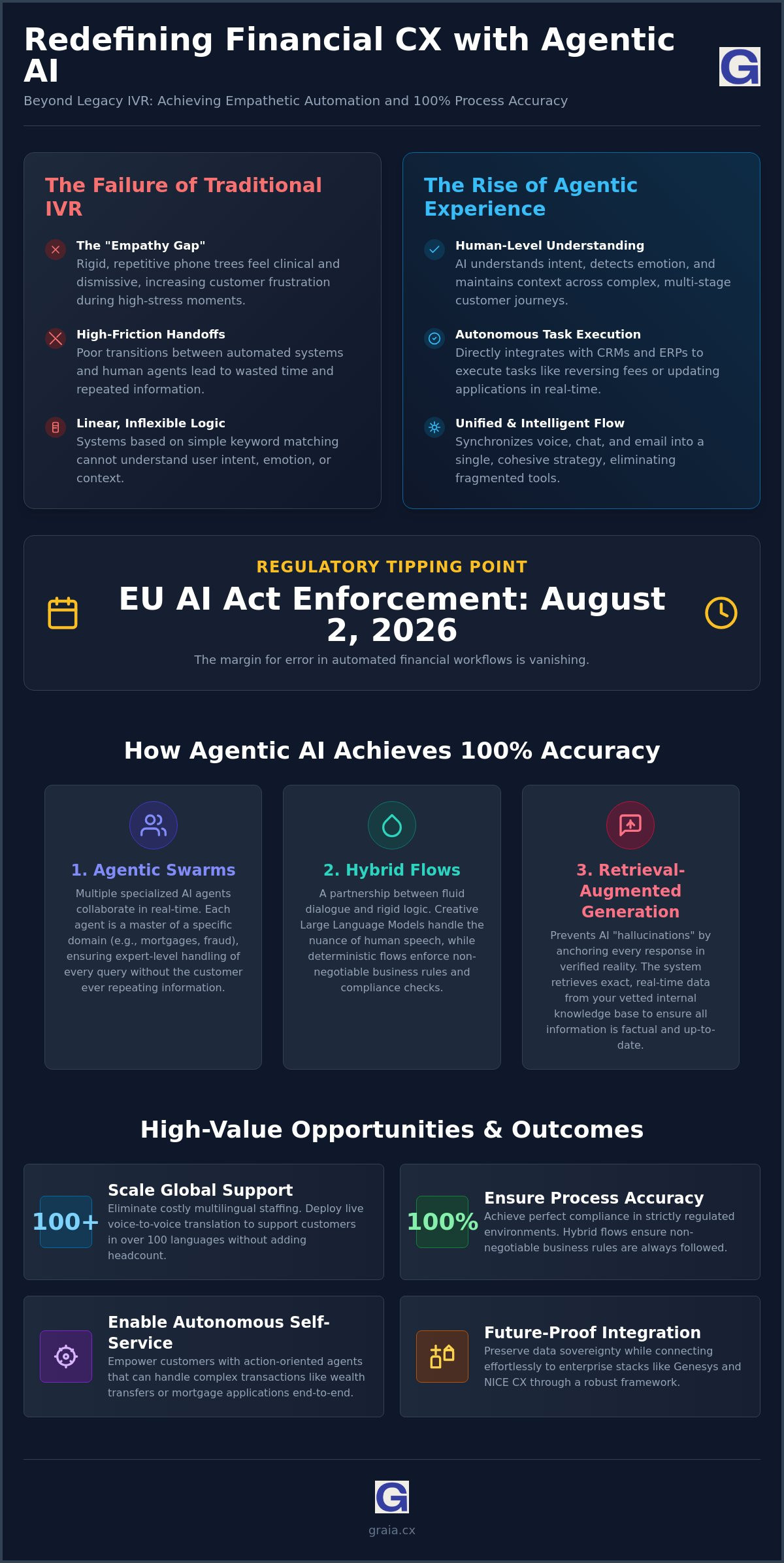
Could a machine handle a high-stakes wealth transfer with the same nuance as your top-tier advisor while maintaining absolute regulatory compliance? For years, the industry settled for rigid IVR systems that drove customer churn or expensive bilingual staffing that drained margins. Today, the integration of conversational ai for financial services has reached a critical tipping point. As the August 2, 2026, enforcement deadline for the EU AI Act approaches, the margin for error in automated workflows has effectively vanished. You're likely feeling the pressure to modernize without compromising the trust you've spent decades building.
We understand that the fear of AI hallucinations in regulated transactions keeps most leaders awake at night. This guide explores how agentic conversational AI is redefining the financial customer experience by bridging the gap between empathic interaction and 100% process accuracy. You'll discover how to leverage specialized AI swarms to reduce your average handle time and scale multilingual support across 100+ languages without adding a single person to your headcount. We're moving beyond simple chatbots into a new era of deterministic precision and human-level connection.
Key Takeaways
- Transition from rigid, legacy IVR systems to sophisticated agentic banking that prioritizes human-level understanding and contextual awareness.
- Master the architecture of Agentic Swarms and Hybrid Flows to ensure 100% process accuracy within strictly regulated financial environments.
- Identify high-value opportunities for conversational ai for financial services, including autonomous self-service transactions and real-time intelligence for human agents.
- Eliminate the high cost of multilingual staffing by deploying live voice-to-voice translation capable of supporting global customers in over 100 languages.
- Build a future-proof integration framework that preserves data sovereignty while connecting effortlessly to enterprise stacks like Genesys and NICE CX.
The Evolution of Conversational AI in Financial Services
The landscape of digital interaction has shifted fundamentally. Legacy systems once relied on keyword matching and linear logic, but modern conversational ai for financial services has transcended these limitations. It's now an agentic system. This means it doesn't just respond; it understands intent, detects underlying emotion, and maintains context across complex, multi-stage journeys. While The Evolution of Conversational AI began with basic scripts, the 2026 standard requires a sophisticated blend of technical precision and human-centric intelligence. We've moved from passive tools to active partners.
Financial services are unique because money is inherently emotional. When a customer contacts their bank, they aren't just seeking data; they're seeking security and validation. We've moved beyond simple FAQ bots that merely point to a help page. Today's action-oriented agents integrate directly with CRMs and ERPs to execute real-time tasks. They can reverse a fee, update a mortgage application status, or flag a suspicious transaction without human intervention. This is the hallmark of the modern "Agentic Customer Experience." It replaces the mechanical feel of old software with a presence that feels both technically superior and emotionally intelligent.
Why Traditional IVR is Failing Modern Banking
The "Empathy Gap" is a systemic failure. Rigid IVR systems force customers through repetitive "phone trees" that feel clinical and dismissive, especially during high-stress moments like reporting a lost card. These systems lack the flexibility to pivot when a customer's tone indicates distress. High-friction handoffs between these automated shells and human agents lead to wasted time and increased frustration. You can explore this transition from limited tools to sophisticated systems in our guide to The Evolution of the AI Customer Service Platform. The goal is to eliminate the friction that drives customer churn.
The Rise of the Agentic CCaaS Platform
The solution lies in a unified ecosystem. An Agentic CCaaS platform synchronizes voice, chat, and email into a single, intelligent flow. It replaces fragmented tools with a cohesive strategy. Modern platforms prioritize "Day-1 Automation," allowing institutions to deploy sophisticated workflows using no-code interfaces. By utilizing advanced LLMs like GPT-4o, these platforms generate natural, human-like dialogue that remains grounded in your specific business rules. This ensures every interaction feels personal while remaining 100% accurate. It's about elevating human potential through seamless technology.
How Agentic Swarms and Hybrid Flows Ensure 100% Accuracy
Most institutions treat AI as a monolithic entity. It's a fundamental mistake. In 2026, the elite standard is the Agentic Swarm. This architecture deploys multiple specialized agents, each a master of a specific domain like mortgage underwriting, card dispute resolution, or technical support. They collaborate in real-time, passing context seamlessly so the customer never repeats a single detail. When Implementing Conversational AI, moving toward a swarm model ensures that the intelligence handling a complex wealth transfer is distinct from the one resetting a password. This specialization is the only way to maintain high-stakes enterprise authority.
We balance LLM creativity with deterministic constraints. While a Large Language Model handles the nuances of human speech, our Hybrid Flows enforce non-negotiable business rules. If a specific transaction requires three-factor authentication, the AI cannot bypass it. This is how conversational ai for financial services achieves 100% process accuracy in high-stakes environments. It's a sophisticated partnership between fluid dialogue and rigid logic. You can explore more about these architectural shifts on our CX innovation blog.
The Technical Pillar: Retrieval-Augmented Generation (RAG)
Hallucinations are a catastrophic liability in banking. We use Retrieval-Augmented Generation (RAG) to anchor every response in verified reality. By combining Vector and Lexical search, the system retrieves exact data from your vetted internal documents rather than relying on its general training. RAG is a mechanism that fetches real-time data to inform AI responses without retraining the model. This grounding ensures that when a client asks about current interest rates or specific policy terms, they receive the truth. It eliminates guesswork and builds the stable presence your customers demand.
Deterministic Logic for Regulated Processes
Mission-critical actions demand a rigid, non-negotiable path. When an agent is processing a refund or updating a beneficiary, there is zero room for "creative" interpretation. We implement Prompt Shields to block malicious inputs and keep the interaction focused on the specific task. For compliance teams, the transparency of Conversational Agent Insights provides an immutable audit trail of every decision and data point accessed. Before any workflow reaches a customer, it faces our Simulator and Judges. These tools stress-test thousands of scenarios, identifying potential failures before they occur to ensure total system reliability.
Key Use Cases: Beyond Basic Customer Support
The utility of conversational ai for financial services extends far beyond answering simple queries about branch hours or interest rates. We've entered an era where AI doesn't just talk; it executes. By integrating conversational AI in banking, institutions can now automate high-stakes transactions that previously required a human touch. This includes moving money between accounts, reporting lost cards, and even providing loan pre-approvals based on real-time data analysis. These are not just interactions; they are complete, self-contained workflows that respect the customer's time and the institution's security protocols.
True sophistication lies in omnichannel continuity. A customer might start a conversation with a webchat while commuting and then transition to a voice call upon reaching home. Our Agentic Omni-Channel Platform ensures that the context follows the user. No detail is lost. No repetition is required. This seamless movement is complemented by proactive engagement. By using predictive pacing for outbound campaigns and multi-channel callbacks, you can reach customers before a frustration peaks. It's a shift from reactive service to a protective, anticipatory partnership.
ID&V and Secure Onboarding
Security is the foundation of every financial relationship. Our Conversational Agents manage Identification and Verification (ID&V) through specialized nodes designed for data collection. These nodes use regex validation to ensure account numbers and sensitive data are captured accurately the first time. This automation reduces the heavy lifting for human agents while maintaining strict compliance with GDPR and Ofcom regulations. Automated guardrails prevent the AI from straying outside of authorized scripts, ensuring that every onboarding journey remains secure and legally sound.
Email and Social Messaging Automation
Digital transformation must include every touchpoint. Our "Email Draft Mode" allows the AI to compose sophisticated responses based on incoming inquiries, which are then presented to human staff for final approval. This ensures brand consistency while significantly accelerating response times. We apply this same intelligence to social DMs on platforms like WhatsApp and Messenger. By treating these channels with the same technical rigor as voice, organizations have seen a 40% reduction in escalations. It's about maintaining a stable, reassuring presence across the entire digital landscape.
Our Agent Assist technology further empowers your human workforce. During live calls, the system provides real-time response suggestions and handles automated wrap-ups. This allows your team to focus on the human element of the conversation while the AI manages the administrative burden. The result is a more efficient, more empathic, and ultimately more profitable contact center.
Scaling Global Operations with Live Call Translation
Global expansion often hits a financial wall: the 25-50% wage premium required for bilingual staffing. It's a significant burden that limits your reach and strains your operational margins. Traditional models rely on fragmented teams scattered across time zones, creating silos that hinder consistent service delivery. Advanced conversational ai for financial services solves this by enabling Live Call Translation. This technology facilitates real-time, voice-to-voice interaction in over 100 languages, allowing your existing workforce to support a global audience without increasing headcount. It's not just about words. It's about presence.
We believe technology should amplify the human element, not replace it. Our system utilizes an "Original Audio" feature so customers can still hear the agent's natural tone and inflection beneath the translated layer. This maintains the empathic bond essential for high-stakes banking interactions. If you're currently evaluating your options, consult our Live Call Translation Buying Guide to navigate the procurement process with confidence.
Formality and Brand Consistency Across Borders
Precision is non-negotiable in the financial sector. A misplaced word in Japanese or German can signal a lack of respect or professional incompetence. We utilize "Formality Tuning" to ensure the AI adopts the correct linguistic register for every culture. By training the system on Custom Vocabulary, we ensure your specific financial terminology and brand names are translated with absolute accuracy. For real-time quality control, agents use a "Cancel Agent Message" window to review and refine translations before they reach the customer's ear. It's a protective layer that guarantees brand integrity.
Operational Impact and ROI
The efficiency gains are immediate. Streamlined multilingual workflows typically reduce Average Handle Time (AHT) by 15-25%. By eliminating language-based queues, you significantly improve First-Contact Resolution (FCR) as any available agent can assist any caller. This flexibility extends to the workforce itself through "Chat-only" modes. This allows agents working in high-noise environments or those with speaking disabilities to deliver elite service via text-to-voice interfaces. You can learn more about optimizing these workflows by exploring our latest operational insights.
Implementing Conversational AI: A Strategic Framework
Modernizing a financial institution's communication stack requires a surgical approach to integration. Successful adoption of conversational ai for financial services doesn't necessitate a complete "rip and replace" of your existing infrastructure. Instead, we connect intelligent modules to established enterprise stacks like Genesys, NICE CX, or Avaya using SIP and secure iframes. This allows you to leverage the stability of your current systems while injecting the technical superiority of agentic intelligence. It's a method that ensures continuity for your operations and security for your clients.
Data sovereignty is the non-negotiable cornerstone of our implementation strategy. We adopt a "Privacy-First" architecture where your sensitive client data is never used to train external models. This protects your intellectual property and ensures compliance with global privacy standards. We recommend a phased rollout to manage this transition effectively. Start by automating routine inquiries like balance checks or password resets. Once these workflows are stabilized, move toward the complex Agentic Swarms discussed earlier to handle nuanced, multi-step financial processes. Continuous improvement is then fueled by Power BI and OData feeds, providing the deep sentiment analysis and enterprise-grade reporting needed to refine every interaction.
Security and Compliance Guardrails
Protection is paramount in regulated environments. We implement PII masking and AES256 encryption for data both at rest and in transit, ensuring that sensitive information remains invisible to unauthorized eyes. Role-Based Access Control (RBAC) further tightens this framework by managing specific AI permissions based on your organizational hierarchy. For mission-critical systems, we align with Category 1 restoration targets, aiming for a 4-hour recovery window. This stability ensures that your digital presence remains a reliable anchor for your customers even during unforeseen disruptions.
The Future of Human-AI Collaboration
We view AI as a sophisticated co-pilot, not a replacement for human expertise. By deploying Agent Assist, you reduce the cognitive load on your staff, allowing them to focus on complex problem-solving and genuine connection. This reduction in stress leads to lower attrition rates and a more empowered workforce. As we look toward 2026, the institutions that thrive will be those that master empathy-driven automation. By bridging the gap between technical precision and human understanding, you don't just solve problems; you build lasting trust in an increasingly digital world.
Mastering the New Standard of Financial Intelligence
The shift toward agentic intelligence is a fundamental evolution in how we protect and grow customer relationships. The evidence is clear; specialized swarms ensure 100% process accuracy while live translation dissolves geographical barriers. Implementing conversational ai for financial services isn't just about efficiency. It's about reclaiming the human element through technical superiority. We offer the security of a partner that owns the entire stack, backed by 25 years of industry-leading innovation and a 99.9% uptime guarantee. It's time to move beyond the limitations of legacy systems and embrace a future built on precision and empathy.
Book a demo of GraiaCX’s Agentic CCaaS platform today to lead the 2026 banking revolution. Your journey toward a more intelligent, connected, and secure customer experience begins with a single strategic decision.
Frequently Asked Questions
How does conversational AI ensure 100% accuracy in financial transactions?
Accuracy is guaranteed by isolating business logic from natural language processing. We use Hybrid Flows where deterministic rules govern transactions while the LLM manages the conversational interface. This ensures that every high-stakes action follows a non-negotiable path. By grounding responses in your vetted documents via RAG, we eliminate the risk of hallucinations in conversational ai for financial services.
Can I integrate conversational AI with my existing Avaya or Genesys system?
Integration is straightforward and designed for enterprise stability. Our Agentic Omni-Channel Platform connects to legacy systems like Avaya or Genesys via SIP and secure iframes. This allows you to modernize your customer experience without a disruptive "rip and replace" strategy. You maintain your current infrastructure while adding a layer of technical superiority.
Does the AI use my customer data to train its public models?
Your data remains entirely under your control. We operate a Privacy-First model where client data is never utilized to train external or public models. This commitment to data sovereignty ensures that your proprietary information and customer details stay within your secure environment. We prioritize protection over simple data processing to maintain your institution's integrity.
How does live call translation handle complex financial terminology?
We utilize Custom Vocabulary training to master your specific industry jargon and brand names. This ensures that conversational ai for financial services remains precise during cross-border interactions. We also apply Formality Tuning for languages like Japanese or German to maintain the professional standards expected in the financial sector, ensuring every translated word reflects your brand's authority.
What happens if the AI fails to understand a customer inquiry?
The system is designed with protective guardrails to handle ambiguity. If a Conversational Agent cannot resolve an inquiry with absolute confidence, it initiates a seamless handoff to a human agent. The human receives a full transcript and context, ensuring the customer never has to repeat themselves. This preserves the empathic connection while maintaining total process integrity.
Can conversational AI handle identification and verification (ID&V) processes?
Automated agents handle Identification and Verification (ID&V) with rigorous precision. By using specialized data collection nodes with regex validation, the system captures account numbers and personal details accurately. This process remains fully compliant with GDPR and Ofcom standards, reducing the administrative burden on your human staff while accelerating the onboarding journey.
How quickly can we see ROI after deploying agentic AI in our contact centre?
Operational impact is visible immediately after deployment. Institutions typically report a 25% improvement in agent productivity and up to 60% faster resolution times. By reducing Average Handle Time (AHT) and eliminating language-based queues, you achieve a rapid return on investment while scaling your global support capabilities without increasing your headcount.
Does live voice translation sound like a robot?
The interaction feels deeply human and personal. Our Live Call Translation technology includes an Original Audio feature that allows the customer to hear the agent's real voice beneath the translated layer. This preserves the agent's tone, inflection, and empathy, ensuring the technology acts as a bridge rather than a barrier to genuine human connection.