
Building a Business Case for Contact Center AI: The 2026 Strategic Framework
The traditional chatbot is dead, yet many UK enterprises are still paying for its funeral. If your current automation strategy relies on basic deflection, you're likely seeing stagnant ROI while your human agents drown in cognitive overload. You've seen the 45% attrition rates and the rising costs of bilingual recruitment, and you know that building a business case for contact center AI requires more than just a promise of reduced call volume. It's time to stop justifying software and start architecting intelligence.
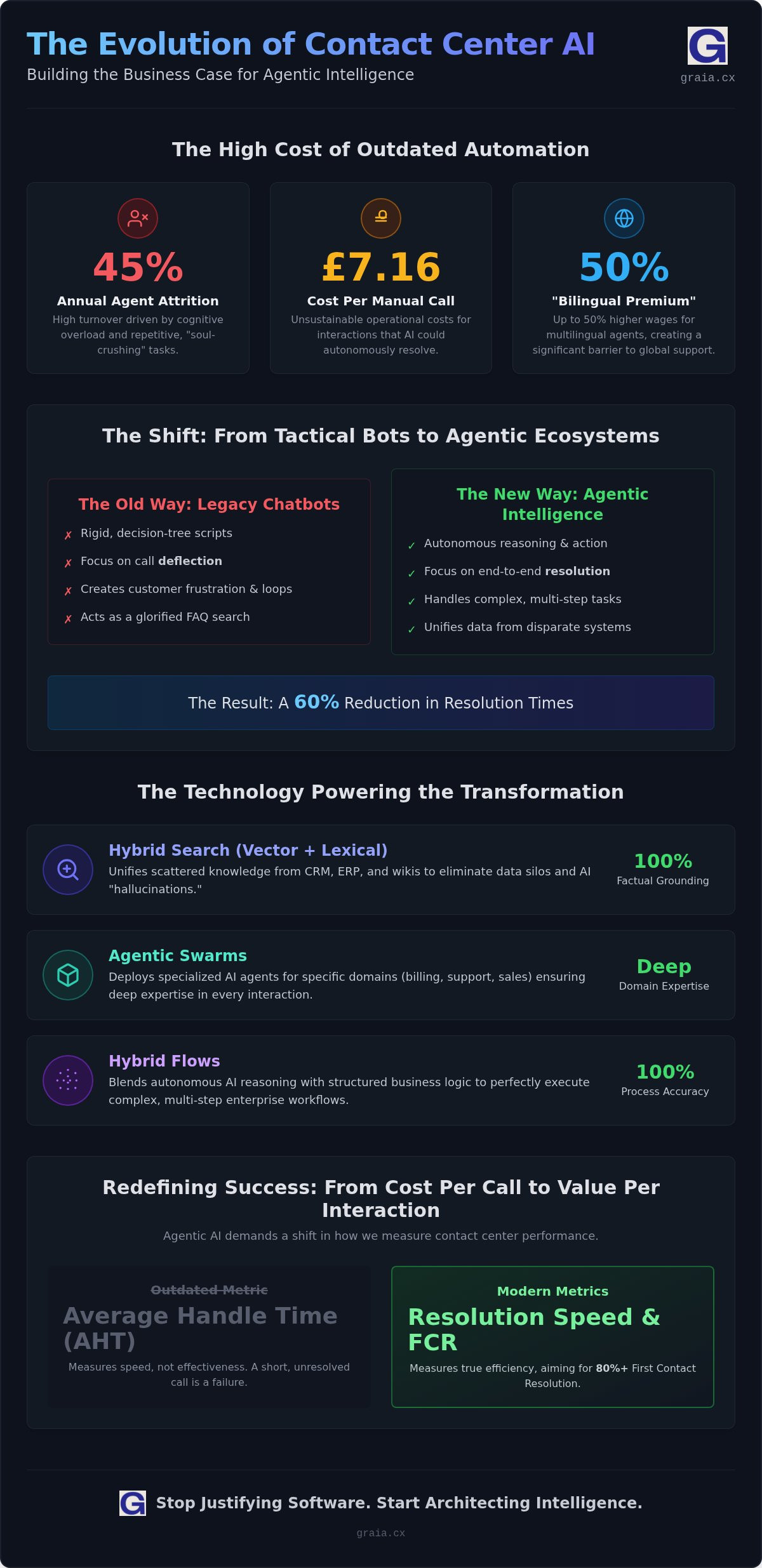
This strategic framework moves beyond the "plug-and-play" fallacy to help you construct a defensible ROI model for the board. You'll learn how to leverage agentic intelligence to slash resolution times by 60% while protecting your margins. We'll show you how to transition from the £7.16 cost of a manual call to a scalable, multi-language model that expands your reach without ballooning your headcount. This article provides the roadmap to move from legacy silos to a unified, high-impact ecosystem that satisfies both your stakeholders and your customers.
Key Takeaways
- Architect an agentic ecosystem that unifies autonomous resolution with human empathy to move beyond the limitations of tactical chatbots.
- Master the precise financial modeling required for building a business case for contact center AI by quantifying the shift from manual £7.16 call costs to scalable agentic interactions.
- Eliminate the 25-50% "Bilingual Premium" on wages by leveraging live translation to support 100+ languages without increasing headcount.
- Mitigate the 45% agent attrition rate by deploying Agent Assist tools that remove cognitive overload and repetitive, soul-crushing tasks.
- Secure long-term ROI with a no-code Agentic CCaaS platform that ensures 100% process accuracy and delivers rapid, day-one automation value.
The 2026 AI ROI Gap: Moving Beyond the "Plug-and-Play" Fallacy
The promise of effortless automation has met a harsh reality across the enterprise landscape. Many organizations find themselves trapped in the "AI ROI Gap," where tactical chatbots fail to deliver the structural savings promised during the procurement phase. These legacy systems often act as little more than glorified FAQ search bars, unable to resolve complex inquiries or access the deep transactional data required for true autonomy. When building a business case for contact center ai, you must move beyond these superficial tools. Success in 2026 requires a shift from reactive scripts to agentic intelligence, a framework where AI doesn't just talk; it acts.
The primary driver of customer frustration remains the rigid, linear nature of legacy IVR and decision-tree bots. Customers are tired of being trapped in loops that ignore their specific context. These outdated systems are the architect of high escalation rates, forcing expensive human agents to redo work that the AI should have handled. By embracing a structural transformation, businesses can achieve 60% faster resolution times. This isn't just a minor efficiency gain; it's a fundamental reordering of how AI in the contact center creates value by prioritizing resolution over mere deflection.
The Integration Crisis: Solving Knowledge Silos
Data fragmentation is the silent killer of contact center efficiency. When critical information is scattered across CRM systems, ERP platforms, and legacy wikis, even the most advanced human agents struggle. For AI, these silos are catastrophic. Building a business case for contact center ai requires a solution to the "Hallucination Risk," which is often the primary barrier to board approval. If an AI can't verify its data, it will invent answers, creating massive regulatory and reputational risk.
We solve this through Hybrid Search, combining Vector and Lexical techniques. This ensures 100% factual grounding by anchoring every response in your verified internal data. By unifying these disparate knowledge sources, you transform the AI from an isolated tool into a central intelligence hub that understands the full scope of your business operations.
From Monolithic Bots to Agentic Swarms
The era of the single, all-knowing bot is over. Modern architectures utilize a "Swarm" approach, where specialized agents handle specific domains like billing, technical support, or sales. This modularity ensures that the AI possesses deep expertise in every interaction. When a customer moves from a billing inquiry to a technical issue, context-aware handoffs ensure they never have to repeat themselves. This seamless transition is powered by Hybrid Flows, a mechanism that guarantees 100% process accuracy by blending autonomous reasoning with structured business logic. This ensures that even the most complex enterprise workflows are executed perfectly every time.
Quantifying Operational Excellence: Metrics That Move the Needle
Legacy metrics are failing the modern enterprise. While many competitors still obsess over Average Handle Time (AHT) as the ultimate efficiency marker, they ignore the cognitive tax placed on agents. When building a business case for contact center ai, you must pivot from "Cost per Call" to "Value per Interaction." A short call that fails to resolve an issue is far more expensive than a slightly longer one that secures a lifelong customer. It's time to stop measuring how fast you can end a conversation and start measuring how effectively you can solve a problem.
First Contact Resolution (FCR) is the engine of this value. By deploying AI Agent Assist tools, businesses can push FCR rates toward world-class levels of 80% or higher. We should prioritise "Resolution Speed" as a superior metric to AHT. Speed to resolution acknowledges that the goal isn't to get off the phone; it's to provide a definitive answer. Simple deflection often creates a "boomerang effect" where customers return with higher frustration. True ROI stems from autonomous resolution that closes the loop without human intervention, transforming the contact centre from a cost sink into a value driver.
Reducing Onboarding and Training Overhead
The UK contact centre sector faces a crisis with annual turnover ranging from 30% to 45%. Replacing an agent involves significant recruitment fees and weeks of lost productivity. High-stakes industries can't afford the "Time to Proficiency" gap where new hires struggle with complex queries. Real-time coaching and "Next Best Action" prompts reduce this onboarding period by at least 25%. These tools act as a protective layer, ensuring junior agents maintain 100% regulatory compliance from day one, which is vital for optimising operational risk.
The Productivity Multiplier: Automated Wrap-ups
Manual administrative tasks are a drain on your most valuable assets. Agents typically spend several minutes after every call typing summaries and updating CRM fields. Automated wrap-ups and "Email Draft Mode" reclaim 15-20% of an agent's productive day. This isn't just about doing more with less; it's about removing the repetitive, soul-crushing tasks that drive attrition. When agents are empowered to focus on the human element of the interaction, productivity becomes a natural byproduct of engagement rather than a forced metric.
The Multilingual ROI: Scaling Global Support Without Headcount
Global expansion has historically been tethered to the expensive and slow process of international recruitment. For UK enterprises, the "Bilingual Premium" is a significant financial barrier, typically requiring a 25-50% wage increase for staff with secondary language skills. This cost alone can derail the financial viability of entering new markets. When building a business case for contact center ai, you must look beyond simple domestic efficiency and consider the massive revenue potential of instant, global accessibility. By deploying Live Call Translation Software, you decouple growth from headcount, allowing your existing team to support over 100 languages in real time.
The strategic shift lies in moving from fragmented, language-specific silos to a "Single Queue" strategy. Traditional routing systems often lead to higher abandoned call rates for non-English speakers because they must wait for a specific agent to become available. This friction vanishes when every agent is capable of handling every enquiry, regardless of the language spoken. Eliminating these routing delays doesn't just improve your SLA performance; it captures revenue that was previously lost to frustration and language barriers.
Staffing Cost Avoidance vs. Market Expansion
AI empowers your national teams to serve global markets from a centralised UK hub, removing the need for local hiring or expensive BPO contracts. Brand consistency is maintained through "Formality Tuning," a critical feature for markets like Germany or Japan where the level of linguistic politeness can define a brand's reputation. We also utilise "Partial Translation" to reduce agent cognitive load. By showing only the most relevant translated segments alongside the original text, agents can process information faster without becoming overwhelmed by a wall of words.
Empathy-First Translation with Original Audio
True human-AI collaboration requires more than just text on a screen. Hearing the original voice sentiment of the customer is vital for maintaining empathy and understanding the urgency of an issue. Building a business case for contact center ai should highlight how translation acts as a protective tool for your workforce. Agent Assist suggestions provide grounded, translated scripts in the agent’s native tongue, which reduces the immense stress and burnout associated with language barriers. When agents feel confident and supported, they deliver a higher quality of interpersonal connection, ensuring that your global expansion remains deeply human.
A Data-Driven Business Case: The Step-by-Step ROI Calculation
The board doesn't want to hear about chatbots; they want to hear about structural margin improvement. Building a business case for contact center ai requires a move from abstract theory to hard financial modelling. To begin, establish your baseline. This includes your total monthly interaction volume across all channels and your average cost-per-contact, which for human-handled calls in the UK often sits around £7.16. Factor in your current attrition rates, which industry data places between 30% and 45%, and the associated recruitment costs. These figures form the foundation of your "cost of doing nothing" scenario.
Your calculation must also account for the Total Cost of Ownership (TCO). This isn't just the subscription fee. It includes integration with legacy CRMs, initial tuning time, and ongoing model optimisation. However, the real value lies in identifying "Value Leakage." This is the revenue lost to missed SLAs and abandoned interactions. By quantifying these missed opportunities alongside the risk mitigation value of script-locked compliance and automated audit trails, you present a narrative of both growth and protection.
Step 1: Audit Routine vs. Complex Volume
Start by categorising your enquiries. Roughly 40% of standard, high-volume interactions can be handled autonomously by AI customer service agents. This shift doesn't just lower costs; it improves intent recognition to slash repeat contacts. You should also audit your abandoned call rates. Every dropped call is a hidden revenue drain and a direct hit to your brand reputation that agentic systems can eliminate through instant response.
Step 2: Project Productivity and Retention Gains
Apply the 25% productivity improvement benchmark to your existing headcount costs. This gain comes from removing manual administrative burdens like wrap-ups and data entry. When building a business case for contact center ai, emphasise the reduction in recruitment costs. By lowering agent attrition through reduced cognitive load, you save thousands in training and onboarding fees. Don't forget to factor in a 30% uplift in outbound efficiency through predictive pacing, which turns your service centre into a proactive revenue engine.
Step 3: Align Stakeholder Value Levers
Each stakeholder requires a different proof point. Finance needs to see the payback period and the long-term net benefit to the balance sheet. Security teams will focus on the Azure OpenAI Trust Framework and the robustness of PII masking protocols. Operations, meanwhile, will be driven by the roadmap to 60% faster resolution times. When these levers align, the business case becomes an undeniable catalyst for transformation. Access our full ROI modelling guide to start your internal audit today.
Future-Proofing the Investment: The GraiaCX Agentic CCaaS Advantage
A business case that only accounts for immediate savings is a house built on sand. As we navigate the complexities of 2026, building a business case for contact center ai must prioritise long-term technical relevance and regulatory resilience. The Agentic CCaaS Platform from GraiaCX serves as the bedrock for this vision, offering a unified solution that bridges the gap between today’s legacy constraints and tomorrow’s autonomous possibilities. With a no-code setup, organisations can bypass lengthy development cycles to unlock Day-1 automation value, ensuring that the initial investment begins paying dividends immediately.
Technical obsolescence is a significant risk in an era of rapid model evolution. GraiaCX remains LLM-agnostic, allowing you to pivot between the latest state-of-the-art series, such as GPT-5.6 Terra or Claude 5 Opus, without rebuilding your entire infrastructure. This flexibility is paired with a privacy-first architecture. In the current regulatory climate, where the EU AI Act and the UK Data (Use and Access) Act 2025 demand stringent oversight, our PII masking and data governance protocols ensure your operation remains compliant and your customers' trust remains unbroken.
Seamless Integration with Legacy Tech
Transformation doesn't require a "rip-and-replace" upheaval. GraiaCX provides SIP-enabled integration with established giants like Genesys, Avaya, and NiceCX, allowing you to enhance your existing stack without the astronomical costs of a total migration. By utilising an iframe approach for the agent desktop, GraiaCX acts as a "Multilingual CX Engine" that drops directly into your current environment. This strategy preserves your previous capital expenditure while instantly elevating your team's capabilities through Agent Assist and Live Call Translation.
The Roadmap to Autonomous Quality Management
Operational excellence requires constant vigilance. Our roadmap includes automated testing designed to identify and neutralise hallucinations before they ever reach a customer. For highly regulated sectors, GraiaCX employs step-by-step nodes that guide agents through complex task execution with 100% process accuracy. This ensures that every interaction meets both your brand standards and legal obligations. Building a business case for contact center ai is about more than just efficiency. It's about a fundamental journey where GraiaCX helps your contact centre evolve from a traditional cost-centre into a high-performance value-hub.
Architecting the Future of Customer Engagement
The era of tactical experimentation is over; the era of strategic execution has arrived. Building a business case for contact center ai in 2026 requires a fundamental shift from simple cost-cutting to the architectural elevation of human potential. By unifying agentic intelligence with your existing infrastructure, you move beyond the "plug-and-play" fallacy toward a model defined by 100% process accuracy via Hybrid Flows. This structural transformation ensures that your automation strategy is as resilient as it is innovative.
You've seen the data. Transitioning to an agentic ecosystem delivers a 25% improvement in agent productivity and results in 60% faster average resolution times. This isn't just about efficiency; it's about reclaiming the interpersonal connection that defines world-class service while protecting your margins against the rising costs of global support. The roadmap is clear, and the tools are ready to transform your contact centre from a legacy cost sink into a visionary value-hub.
Download the 2026 Contact Centre ROI Framework today to begin your journey toward a more resilient, intelligent, and human-centric operation. You have the vision to lead this evolution, and the results will define your success for years to come.
Frequently Asked Questions
How do I calculate the ROI of AI in my contact centre?
Success starts by shifting from manual £7.16 call costs to scalable agentic interactions. Subtract the Total Cost of Ownership from the sum of direct labour savings, attrition reduction, and recovered revenue from abandoned calls. This formula provides the financial foundation for building a business case for contact center ai. You must include both immediate efficiency gains and long term value drivers like improved First Contact Resolution to satisfy board level scrutiny.
What is the "AI ROI Gap" and why do 56% of implementations fail?
The gap occurs when tactical chatbots fail to deliver structural savings. Failures often stem from the plug and play fallacy where enterprises expect results without deep integration. These legacy systems lack the agentic intelligence needed to resolve complex issues, leading to high escalation rates. GraiaCX addresses this gap by providing 100% process accuracy and access to real time data silos, ensuring the initial investment translates into the operational margin improvement promised during procurement.
Can AI really reduce my bilingual agent hiring costs?
Yes, by eliminating the 25-50% bilingual premium typically required for multilingual staff in the UK. Live Call Translation allows your existing team to support over 100 languages in real time. This strategy enables rapid global market expansion without the astronomical overhead of international recruitment. You move from fragmented, language specific queues to a unified, high performance operation that serves customers perfectly regardless of their native tongue or location.
How does Agent Assist technology improve agent productivity?
It acts as a productivity multiplier by automating repetitive administrative tasks. Features like automated wrap ups and real time next best action prompts reclaim 15-20% of an agent's productive day. By removing the cognitive load of searching through fragmented knowledge silos, GraiaCX allows agents to focus on the human element of the interaction. This support leads to a 25% improvement in overall agent productivity and significantly reduces the stress that drives high attrition rates.
What is the typical reduction in Average Handle Time (AHT) with AI?
While we prioritise resolution speed, businesses typically see a significant reduction in AHT through automated data retrieval and instant transcriptions. However, the more impactful metric is the 60% faster average resolution time. By resolving issues correctly on the first attempt, GraiaCX eliminates the boomerang effect of repeat contacts. This efficiency allows agents to handle more complex enquiries while the AI manages routine, high volume tasks autonomously and accurately.
Is my customer data used to train the AI models?
No, GraiaCX prioritises a privacy first approach that ensures your proprietary data remains your own. We utilise the Azure OpenAI Trust Framework and robust PII masking protocols to protect sensitive information. This architecture complies with the UK GDPR and the Data (Use and Access) Act 2025. Your data is used for real time grounding and retrieval within your specific environment, but it is never fed back into public models for training purposes.
How long does it take to see a return on investment with GraiaCX?
Most enterprises begin seeing day one automation value due to our no code setup and seamless SIP enabled integration. While the full payback period depends on your interaction volume and current attrition rates, the 25% productivity gain and reduction in bilingual staffing costs offer immediate relief. Building a business case for contact center ai with GraiaCX focuses on rapid deployment that delivers measurable results within the first fiscal quarter of operation.
What is the difference between a chatbot and an Agentic Swarm?
A traditional chatbot follows rigid, linear decision trees that often frustrate users with limited options. In contrast, an Agentic Swarm from GraiaCX utilises specialised, autonomous agents that collaborate to solve complex problems. This architecture uses Hybrid Search and Swarm logic to navigate knowledge silos and execute transactional tasks with 100% process accuracy. It moves beyond simple deflection to provide genuine resolution, ensuring a sophisticated and seamless experience for every customer interaction.