
AI Automation to Handle Contact Centre Volume Spikes: The 2026 Strategy Guide
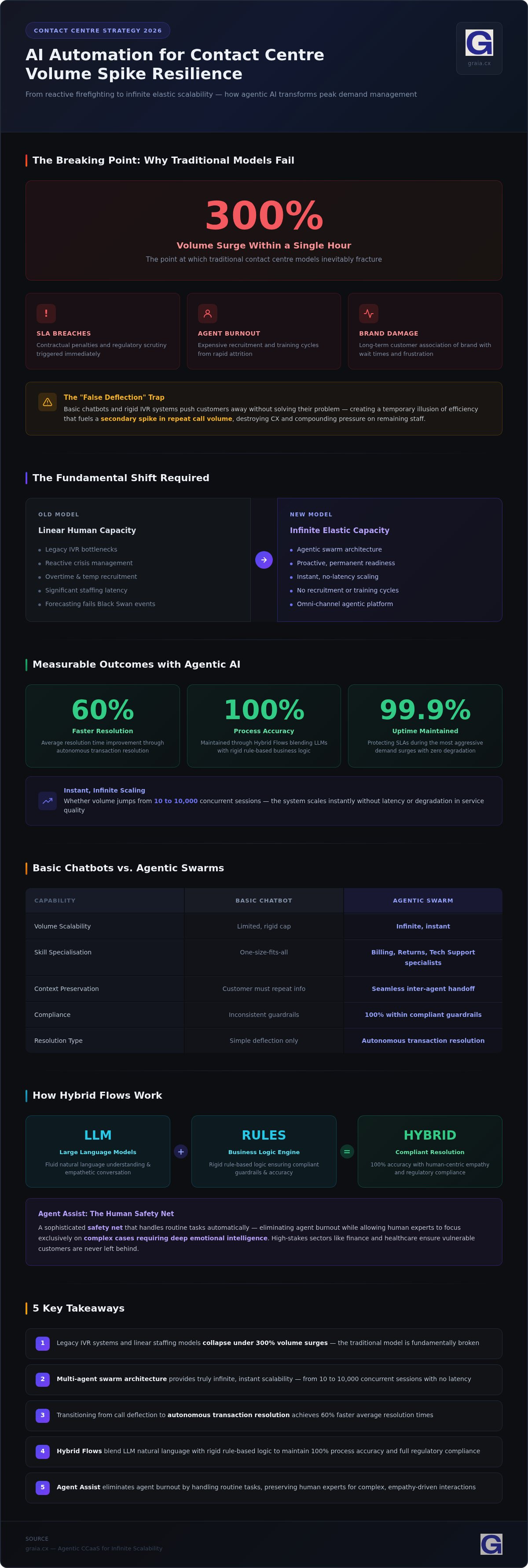
The traditional contact centre staffing model is fundamentally broken because it treats human capacity as a linear resource in an era of exponential demand. You likely recognise the sinking feeling when call queues swell and SLAs begin to fracture, knowing that your agents are already pushed to their absolute limits. Deploying advanced ai automation to handle contact centre volume spikes is no longer about simple deflection; it is about creating a resilient, self-scaling infrastructure that protects both your bottom line and your people.
This strategy guide for 2026 demonstrates how agentic AI and conversational swarms provide the infinite, elastic capacity required to resolve routine inquiries with total accuracy. We will examine how to maintain 99.9% uptime and protect your team from burnout by automating resolutions completely while preserving the human touch for the moments that truly matter. Discover how to transition from reactive crisis management to a proactive, agentic omni-channel platform that scales instantly to meet any challenge without the need for temporary recruitment or costly training cycles.
Key Takeaways
- Understand why legacy IVR systems and linear staffing models collapse under 300% volume surges.
- Deploy ai automation to handle contact centre volume spikes using a multi-agent swarm architecture that scales instantly and infinitely.
- Transition from basic call deflection to autonomous transaction resolution to achieve 60% faster average resolution times.
- Maintain 100% process accuracy and regulatory compliance through Hybrid Flows that blend computational precision with human-centric empathy.
- Leverage Agent Assist to eliminate agent burnout, providing a sophisticated safety net that handles routine tasks while humans focus on complex cases.
The Anatomy of Contact Centre Volume Spikes in 2026
Volume spikes are the seismic shifts of the service industry. They aren't merely busy periods; they are systemic shocks triggered by everything from unforeseen service outages to high-profile product launches. When demand surges by 300% within a single hour, traditional models of contact centre operations inevitably fracture. The cost of this status quo is measured in more than just missed targets. It's reflected in three critical areas:
- Immediate SLA breaches that trigger contractual penalties and regulatory scrutiny.
- Rapid agent burnout leading to expensive recruitment and training cycles.
- Long-term brand damage as customers associate your name with wait times and frustration.
Relying on legacy IVR systems during these peaks creates a bottleneck that no amount of overtime can resolve. Transitioning to ai automation to handle contact centre volume spikes represents a move from reactive firefighting to a state of permanent, elastic readiness. It's about building a system that breathes with your demand.
Why Traditional Forecasting Models Fail
Forecasting is often a retrospective exercise that fails to account for "Black Swan" events. These are the unpredictable, high-impact occurrences that no historical data set can truly anticipate. Because human staffing has a significant latency, you simply cannot recruit or train your way out of a sudden two-hour surge. It's a logistical impossibility. Many legacy systems also suffer from the trap of "False Deflection." This occurs when a basic chatbot or rigid IVR pushes a customer away without solving their problem. It creates a temporary illusion of efficiency, but it actually fuels a secondary spike in repeat call volume as frustrated users fight to reach a human. This cycle destroys the customer experience and compounds the pressure on your remaining staff.
The Emotional Toll of High-Volume Periods
The damage isn't just financial. There is a direct, measurable link between unmanaged volume spikes and agent attrition. When agents are forced to handle back-to-back high-pressure interactions with no respite, burnout becomes an inevitability rather than a risk. For customers in high-stakes sectors like finance or healthcare, long wait times transform simple inquiries into deep-seated anxiety. We often hear the objection that AI might make customers feel ignored during a crisis. The reality is the opposite. By using an agentic omni-channel platform, you ensure that every customer receives an immediate, intelligent response. This preserves your human experts for the complex cases that require genuine empathy and nuanced decision-making, ensuring that your most vulnerable customers are never left behind.
Beyond Elastic Staffing: The Rise of Agentic AI Automation
Staffing for peaks is a losing game of catch-up. True resilience requires a fundamental architectural shift from linear human capacity to the infinite scalability of an agentic swarm. Deploying modern ai automation to handle contact centre volume spikes demands more than a simple chatbot; it requires a coordinated ecosystem of intelligent entities that think, act, and resolve issues autonomously. This isn't just about answering questions. It's about executing complex business processes with 100% accuracy while your human team focuses on the interactions that require deep emotional intelligence.
The core of this transformation lies in Hybrid Flows. By blending the fluid natural language of Large Language Models (LLMs) with rigid, rule-based business logic, enterprises can ensure that every interaction remains within compliant guardrails. This architecture provides truly elastic capacity. Whether your volume jumps from 10 to 10,000 concurrent sessions, the system scales instantly without latency or degradation in service quality. It ensures your SLAs remain intact even during the most aggressive surges.
Specialised Experts vs. Monolithic Bots
Generalist bots often fail because they lack the depth required for multi-skill contact centres. An agentic swarm replaces the "one-size-fits-all" bot with a team of specialised virtual experts. You can assign specific domains, such as Billing, Returns, or Tech Support, to individual agents that possess deep knowledge of those specific workflows. When a customer moves from a billing query to a technical issue, the system handles the inter-agent handoff with seamless context preservation. No customer ever has to repeat themselves. This level of AI-driven resolution ensures that the "Agentic Swarm" effectively manages complex, multi-stage inquiries that would typically overwhelm a standard automated system.
Grounding AI in Facts with RAG
Factual integrity is non-negotiable in enterprise CX. To prevent the "hallucinations" common in consumer-grade AI, we utilise Hybrid Retrieval-Augmented Generation (RAG). This technology uses both dense and sparse vector search to ground every response in your specific, internal knowledge base. It's a critical component for maintaining AI standards and trustworthiness within regulated environments. When a new spike occurs, perhaps due to a specific product bug or a sudden policy change, you can update your knowledge base in real-time. The swarm absorbs this new information instantly, ensuring that even the very first callers during a crisis receive accurate, up-to-date guidance rather than outdated scripts.
Comparing Solutions: Basic Chatbots vs. Agentic Swarms
The distinction between legacy chatbots and modern agentic swarms is the difference between stalling a customer and serving them. Traditional bots were designed for deflection. They exist to route users toward a static FAQ page, effectively acting as a digital barrier rather than a solution. In contrast, ai automation to handle contact centre volume spikes via an agentic swarm focuses on autonomous resolution. These systems don't just talk; they act. They interface with your back-end systems to process refunds, update accounts, or reschedule appointments without requiring human intervention.
This shift fundamentally alters the Average Handle Time (AHT) metric. While legacy bots often increase total friction by forcing customers to repeat their issues once they finally reach a human, agentic platforms eliminate the "Context Gap." Every piece of data collected during the automated interaction is preserved and passed forward. If an escalation occurs, the human agent receives a full briefing, not just a transcript. It transforms the human experience from one of repetitive data entry to high-value problem solving. It's an evolution from being a victim of the queue to being a master of the resolution.
The Resolution Framework
Action-oriented AI is the cornerstone of modern customer retention. While a basic bot might inform a customer that their package is delayed, an agentic system proactively offers a credit or rebooks the delivery through direct API integration. This capability keeps the customer engaged within a single, successful session, preventing the frustration that leads to churn. Agentic CCaaS is a unified ecosystem of human and AI collaboration where intelligence is distributed and outcomes are guaranteed. By prioritising resolution over mere response, you turn a potential service failure into a moment of brand loyalty.
Total Cost of Ownership (TCO) Analysis
Relying on seasonal BPO staffing to manage surges is an expensive, inflexible strategy. The cost of hiring, training, and offboarding temporary staff in the UK can quickly spiral, especially when factoring in the inevitable dip in service quality during the learning curve. Scalable AI modules provide a fixed-cost alternative that maintains 99.9% uptime regardless of demand. Implementing ai automation to handle contact centre volume spikes ensures that your cost per interaction remains stable even when demand triples. By improving First Contact Resolution (FCR) by even 5 to 10 points, enterprises see a massive shift in their operational efficiency. For a deeper dive into these metrics, explore our guide on Contact Centre ROI with AI to understand how value-driven automation protects your margins.
Building a Spike-Resilient CX Architecture
True architectural integrity in a modern contact centre requires more than just cloud migration. It demands an intelligent layer capable of orchestrating complex workflows under extreme pressure. Integrating your ai automation to handle contact centre volume spikes with core systems like Salesforce or Dynamics 365 is the first critical step. Without real-time data access, AI remains a superficial interface. With it, it becomes a functional extension of your workforce, capable of processing refunds, updating bookings, and resolving tickets with zero human intervention.
Resilience is built on a foundation of proactive preparation. By deploying a multi-layered strategy that includes Agent Assist and real-time translation, you create a system that doesn't just survive surges but masters them. This approach ensures your human agents are never left to navigate a crisis without a cognitive safety net.
The Power of Real-Time Integration
Deep connectivity with CRM and ERP platforms allows AI to move beyond conversation and into action. When an agentic swarm can verify a customer's identity and history instantly, it can resolve inquiries that previously required a human touch. One of the most effective efficiency gains involves automating "Email Draft Mode." By generating high-quality response drafts for human review, you can speed up agent responses by 25%. This allows your team to maintain quality without sacrificing speed. To understand how these capabilities transform the daily experience of your staff, explore our guide on AI Agent Assist Tools.
Global Scalability via Translation
Language silos are a hidden bottleneck during volume surges. When a spike hits, you often find yourself with idle agents in one language queue while another overflows. Implementing Live Call Translation Software removes this friction entirely. It allows any agent to handle inquiries in over 100 languages, effectively pooling your entire human resource into a single, global response team. This eliminates the need for bilingual hiring premiums, which can save your organisation between 25% and 50% in staffing costs. It's a strategic move that ensures your ai automation to handle contact centre volume spikes is truly inclusive and globally scalable.
Finally, you must stress-test these workflows before the pressure arrives. Utilising "Simulators" to act as virtual customers and "Judges" to evaluate the AI's performance ensures your logic remains sound under load. These tools identify potential friction points in your Hybrid Flows, allowing you to refine your response strategy in a controlled environment. If you're ready to evolve your infrastructure, explore our latest insights on CX modernisation to stay ahead of the next surge.
GraiaCX: Harnessing Agentic CCaaS for Infinite Scalability
GraiaCX stands as the definitive solution for enterprises seeking more than just a temporary fix for surging demand. By providing an Agentic Omni-Channel Platform, we offer the only empathy-driven ai automation to handle contact centre volume spikes that prioritises the human experience at scale. Our partners see transformative results, including 60% faster average resolution times and 40% fewer escalations. These aren't just numbers; they represent a fundamental shift in how your organisation breathes during a crisis.
Speed of deployment is often the greatest barrier to innovation. GraiaCX's no-code advantage allows for Day-1 automation, ensuring you're protected before the next surge hits. Unlike consumer-grade models, our privacy-first architecture ensures your data is never used to train external models. We provide a secure, closed ecosystem where process accuracy is guaranteed via Hybrid Flows, giving you the confidence to automate even your most complex, regulated workflows.
Why Empathy is the Heart of Automation
True intelligence requires more than just processing data; it requires understanding the person behind the query. GraiaCX's conversational agents are designed to recognise intent and emotion, moving beyond simple keyword matching to grasp the nuance of a customer's frustration or urgency. This emotional intelligence is critical when deploying ai automation to handle contact centre volume spikes in high-stakes industries where every interaction carries significant weight.
When a human touch is required, the transition is invisible to the customer. We facilitate a Seamless Handoff where the human agent receives a comprehensive recap of the AI's interaction. This ensures customers never have to repeat themselves, preserving brand consistency across voice, chat, and social channels. It allows your team to step in with full context, acting as the high-value problem solvers they were trained to be, rather than data entry clerks.
Future-Proofing with GraiaCX
Modernisation doesn't have to mean a rip-and-replace of your existing infrastructure. GraiaCX integrates seamlessly with your current Genesys, NICE CX, or Avaya stacks, acting as an intelligent orchestration layer that enhances your existing investments. Our roadmap to 2026 includes advanced automated prompt optimisation and sentiment-based coaching, ensuring your CX architecture remains at the cutting edge of the industry without disrupting current operations.
We are committed to elevating human potential through sophisticated technology that protects your staff from burnout and your brand from service failures. By choosing a partner that values both technical superiority and deep human empathy, you're not just surviving volume spikes; you're mastering them. Explore our latest insights on Agentic CX to begin your journey toward infinite, elastic scalability.
Mastering the Elastic Future of CX
The transition from reactive staffing to an agentic architecture is the defining shift for the modern enterprise. By deploying ai automation to handle contact centre volume spikes, you move beyond the limitations of linear human capacity and embrace a system that scales instantly. You've seen how agentic swarms and Hybrid Flows ensure total process accuracy while maintaining a 99.9% uptime guarantee. This isn't just about efficiency; it's about protecting your people from burnout and your customers from the friction of long wait times. With native support for over 100 languages, your operation becomes a global, resilient force that remains steady regardless of demand.
It's time to replace the anxiety of the next surge with the confidence of autonomous resolution. Organisations leveraging these tools are already achieving 60% faster average resolution times, proving that high-stakes performance and deep human empathy can coexist. You don't have to choose between operational cost and service quality anymore. Transform your contact centre with empathy-driven automation and build a foundation that thrives under any pressure. The future of service is elastic, and it's within your reach today.
Frequently Asked Questions
How does AI automation handle sudden, unplanned volume spikes?
AI automation provides elastic capacity by scaling instantly to manage thousands of concurrent sessions without the latency associated with human recruitment. By deploying ai automation to handle contact centre volume spikes, you ensure that every customer receives an immediate response regardless of the surge's size. This prevents queue build-up and SLA breaches. The system uses a multi-agent swarm architecture to distribute the load across specialised virtual experts, maintaining high performance during unpredictable events.
Can an AI agent actually resolve complex issues like refunds or bookings?
Yes, agentic AI moves beyond simple conversation to execute specific backend tasks through direct API integrations. These conversational agents connect to your CRM and ERP systems to process refunds, update bookings, or reschedule deliveries autonomously. By using Hybrid Flows, the system ensures that these transactions follow your exact business rules with 100% process accuracy. This turns automation into a resolution engine rather than a mere deflection tool, providing genuine value to the customer.
Will my customers be frustrated by talking to an AI during a spike?
Customers generally prefer immediate, intelligent resolution over waiting in a queue for hours. Our empathy-driven AI understands intent and emotion, providing a natural interaction that avoids the frustration of rigid IVR trees. Because the system can actually resolve the inquiry rather than just offering a FAQ link, satisfaction rates remain high. If the issue is too complex, the AI provides a seamless handoff to a human agent with a full context summary.
Does using AI automation mean I can reduce my human headcount?
The primary goal of ai automation to handle contact centre volume spikes is to elevate your human potential rather than replace it. While it reduces the need for seasonal temporary staff, it allows your permanent team to focus on high-value, empathetic problem-solving. This strategy leads to a 25% improvement in agent productivity and significantly reduces attrition caused by burnout. You're not cutting staff; you're optimising your existing talent for more complex interactions.
How long does it take to deploy an agentic AI solution for a contact centre?
GraiaCX is designed for rapid deployment, often achieving Day-1 automation through our no-code setup. While complex integrations with specific legacy databases can take longer, the core conversational layer can be operational in a matter of weeks. We use simulators and judges to stress-test workflows before they go live. This ensures that your system is resilient and ready to handle the next volume surge without requiring months of development time.
Is our customer data used to train the AI models?
No, we maintain a strict privacy-first approach where your enterprise data is never used to train external or third-party AI models. We utilise the Azure OpenAI Trust Framework to ensure that all information remains within your secure, regional environment. Security is reinforced through PII masking and encryption both at rest and in transit. This data sovereignty is essential for organisations operating in regulated sectors that must comply with strict GDPR requirements.
What happens if the AI agent cannot resolve a customer's query?
The system identifies its own confidence thresholds and triggers a seamless escalation to a human expert when a query exceeds its capabilities. This handoff is frictionless because the human agent receives a structured summary of the entire automated interaction. The customer never has to repeat their problem, which preserves the quality of the experience. This collaborative Agent Assist model ensures that no customer is ever left in a dead-end loop or abandoned.
Can AI automation integrate with my existing legacy CCaaS platform?
Yes, our platform is designed to integrate natively with major providers like Genesys, NICE CX, and Avaya via SIP and iframe widgets. You don't need to perform a modernisation that requires a rip-and-replace of your existing technology stack to gain agentic capabilities. This allows you to add a layer of intelligence and translation to your current infrastructure. It provides a modern, multilingual customer experience engine that works alongside your established workflows.