Agentic AI vs. Chatbot: The 2026 Guide to Autonomous Customer Resolution
Your customers don't want a conversation. They want their billing discrepancies rectified, their technical hurdles cleared, and their complex enquiries resolved without ever hearing the phrase "let me find a human to help you." Understanding the fundamental shift in agentic ai vs chatbot capabilities is no longer a technical luxury; it's the baseline for enterprise survival in 2026.
You've likely felt the sting of circular loops and the spiralling costs of maintaining a bilingual support desk for global reach. Perhaps you've even hesitated to deploy large language models because the risk of a hallucination in a mission-critical billing task is simply too high. We're moving beyond simple deflection. This guide explores how autonomous agents achieve 100% process accuracy and reduce human escalations by 40%. You'll discover how a swarm of virtual experts can manage 100+ languages with the same precision as your best staff, ensuring your UK operations remain fully compliant with the stringent EU AI Act standards that came into full effect in August 2026.
Key Takeaways
- Understand why 2026 marks the end of the deflection-only era and how autonomous agents shift the focus from merely routing enquiries to closing complex cases.
- Examine the technical evolution from scripted loops to agentic ai vs chatbot reasoning, leveraging Hybrid RAG to eliminate hallucinations in mission-critical tasks.
- Adopt the Autonomous Resolution Rate (ARR) as your primary performance metric to capture the true impact of AI on operational efficiency and customer trust.
- Discover how specialized virtual experts can reduce average handle times by 60% while providing seamless, compliant support across more than 100 languages.
- Learn to deploy empathy-driven AI systems that balance high-stakes technical precision with a deep understanding of the human experience in UK contact centres.
Beyond the Bot: The 2026 Shift to Agentic Customer Experience
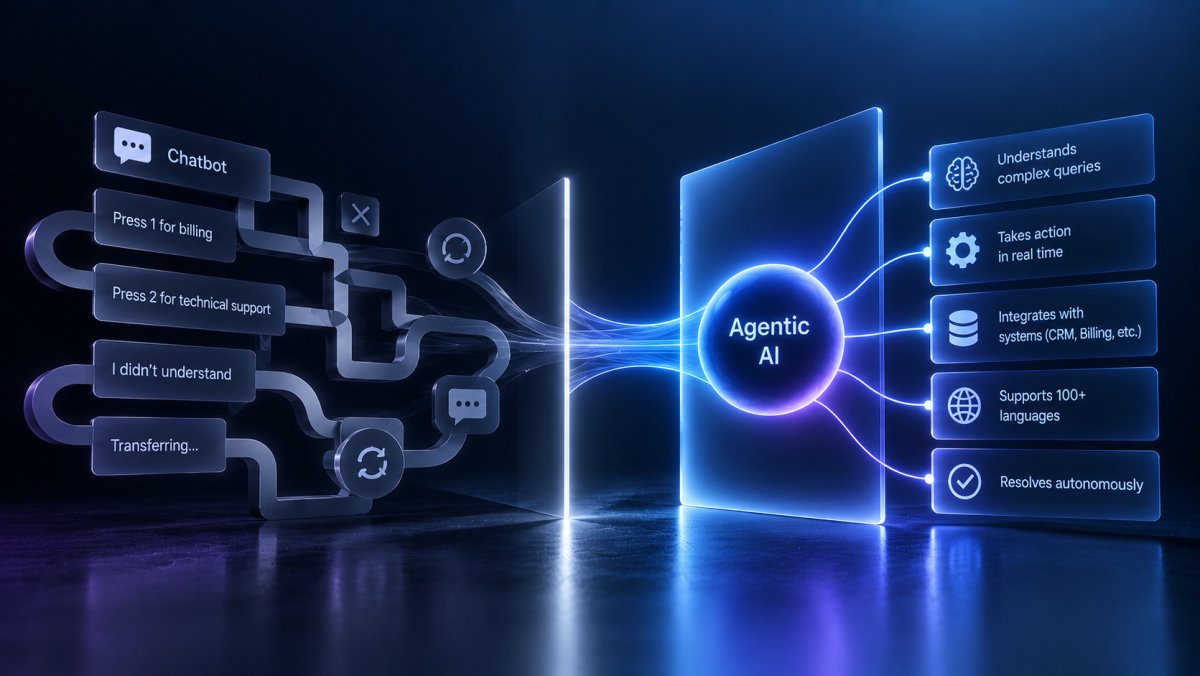
The era of the deflection-only chatbot has reached its logical conclusion. For years, UK enterprises prioritised cost reduction by shielding human agents behind digital walls, but this strategy has backfired. In 2026, the market has matured. We've reached the definitive end of simple automated responses that merely point users toward a FAQ page. The primary economic driver for UK contact centres is no longer just avoiding calls; it's about achieving total autonomous resolution. This fundamental shift in agentic ai vs chatbot philosophy is driven by a desperate need to close the "Empathy Gap" created by rigid, scripted systems that leave customers feeling unheard. When a brand prioritises deflection over help, it erodes the very trust it spent millions to build. UK leaders are now recognising that a frustrated customer is an expensive customer.
The Death of the Linear Decision Tree
Traditional IVR systems are fundamentally broken. They cannot handle the nuance of modern consumer intent. When a customer calls with a complex billing dispute or a technical failure, a "Press 1 for Billing" menu feels like an intentional barrier. These linear trees create transfer loops that decimate First Contact Resolution (FCR) metrics and leave consumers exhausted. In 2026, sophisticated natural language understanding has replaced these frustrating menus. We're seeing a transition where the system listens, understands the emotional weight of the enquiry, and directs the flow without forcing the user to navigate a pre-defined maze. This shift ensures that the customer's journey is defined by their needs, not by the limitations of a rigid software architecture.
Defining the Agentic Customer Experience (CX)
To understand the future of service, we must define the AI agent. While a standard chatbot identifies intent, an agent executes functional action. It's the difference between telling a customer their delivery is delayed and proactively offering a credit while rescheduling the courier. This is the core of the agentic ai vs chatbot distinction. An agent acts as a digital employee. It's capable of using enterprise tools, accessing secure databases, and navigating backend systems with 100% process accuracy. It doesn't just talk; it works. It bridges the gap between the customer's request and the company's internal systems without human intervention.
Agentic CX is the seamless intersection of conversational empathy and autonomous backend action that transforms a mere interaction into a completed resolution.
The Technical Anatomy: How Agentic AI Resolves Where Chatbots Fail
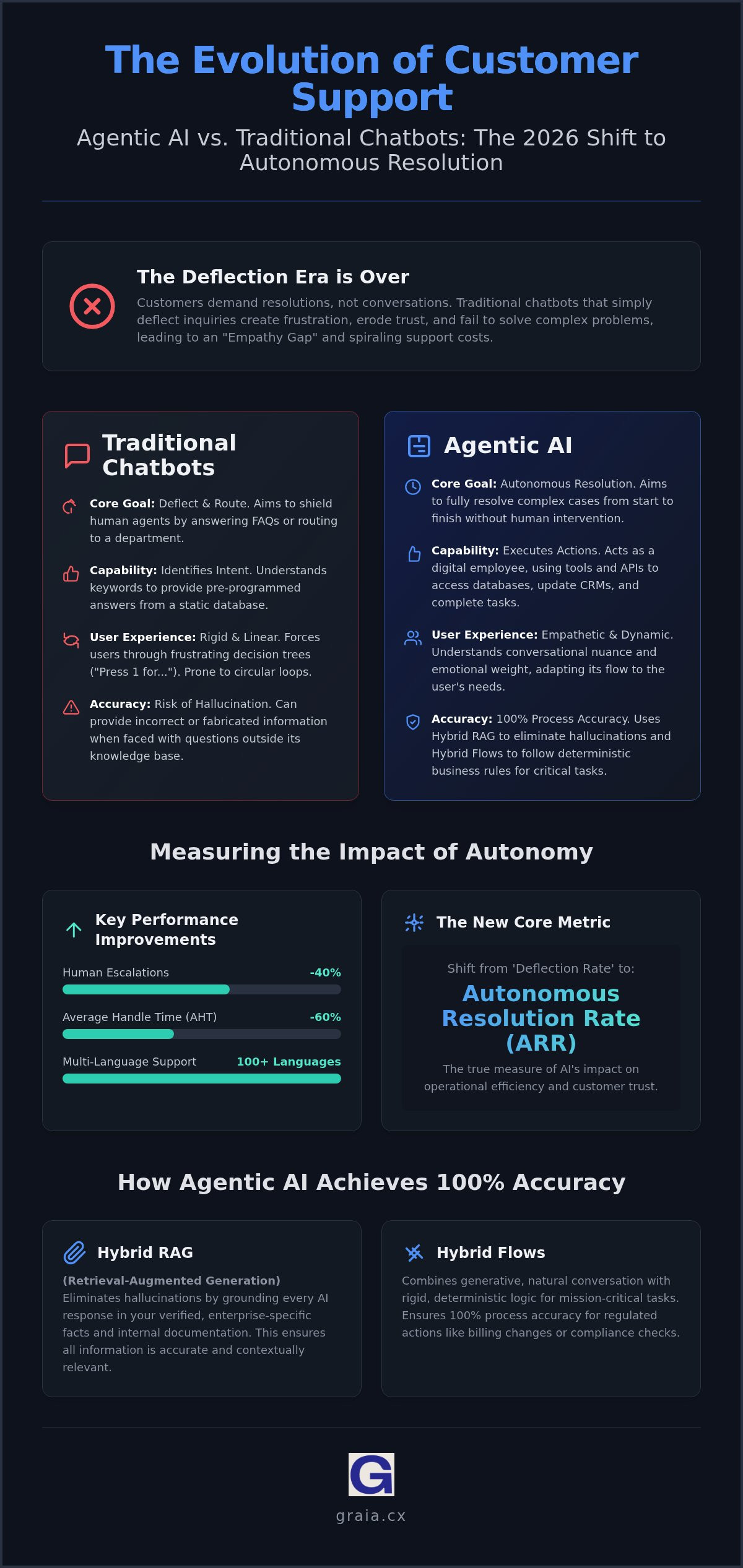
The failure of the legacy chatbot isn't just a lack of linguistic intelligence; it's a structural deficiency. Traditional bots rely on static databases and rigid intent-mapping, whereas MIT Sloan explains agentic AI as a system capable of reasoning through multi-step workflows. This architectural shift is what defines the agentic ai vs chatbot divide. By using Hybrid Retrieval-Augmented Generation (RAG), GraiaCX grounds the AI in your specific enterprise facts. This eliminates the risk of hallucinations by ensuring every response is anchored to verified internal documentation. For UK enterprises, this technical rigour is paired with a privacy-first mandate. Your data remains your own; it's never shared for external model training, ensuring your proprietary knowledge stays within your secure perimeter.
True resolution requires more than just words. It requires action. Agentic systems connect directly to your CRM, ERP, and ticketing platforms through secure APIs. They don't just tell a customer that their technical ticket is open; they proactively check the status, update the priority based on sentiment, and trigger a diagnostic routine. This level of integration transforms the AI from a simple interface into a functional extension of your workforce.
Hybrid Flows: Deterministic Logic for Regulated Industries
In high-stakes sectors like finance or travel, "close enough" is a liability. You need 100% process accuracy. Hybrid flows solve this by constraining generative creativity within rigid business rules. While the AI handles the natural conversation, the underlying logic follows a deterministic path for mission-critical tasks. Whether it's processing a refund under UK consumer rights legislation or verifying a billing change, the system follows exact protocols. It's the perfect marriage of human-like interaction and mathematical certainty, ensuring every regulated workflow is executed without error.
The Swarm Architecture: Specialized Expertise at Scale
A monolithic bot is often a jack of all trades and master of none. The Swarm architecture within GraiaCX replaces this with a team of specialized virtual experts. One agent might focus exclusively on technical troubleshooting, while another manages complex billing enquiries or sales lead qualification. The enterprise agentic CCaaS platform orchestrates these agents, preserving context during seamless internal handoffs. This collective intelligence ensures that a customer never has to repeat themselves, even as their enquiry moves from a technical hurdle to a billing resolution. You can explore more about these architectural shifts in our latest industry reports.
Agentic AI vs. Chatbot: A Comparative Framework for Leaders
Leaders must distinguish between a tool that speaks and a tool that acts. The fundamental agentic ai vs chatbot divide isn't about better prose; it's about the evolution from surface-level intent recognition to deep, context-aware reasoning. While legacy bots rely on rigid scripts that break the moment a customer deviates from the path, autonomous agents utilise dynamic logic to navigate complexity. This shift redefines the objective of automation from merely shielding your staff to actively resolving the customer's crisis.
To evaluate your current CX maturity, consider these four pillars of the agentic framework:
- Dynamic Reasoning: Moving beyond scripted "if-this-then-that" loops to context-aware decision making.
- Case Resolution: Shifting the primary metric from deflection (routing away) to resolution (closing the case).
- Session Continuity: Replacing isolated chat windows with omnichannel memory that preserves context across voice, email, and social.
- Live Accuracy: Trading static, outdated knowledge bases for real-time, RAG-driven factual grounding.
From Intent Recognition to Task Execution
A chatbot identifies that you want to book a flight; an agent actually books it. This is the power of "Action Nodes." Modern ai customer service agents are equipped with the authority to execute backend tasks, such as issuing refunds or updating subscription tiers, without human oversight. This eliminates the "transfer loop" where customers are forced to repeat their story to a human agent because the bot lacked the permission to help. By the time a human needs to intervene, the agent has already performed the heavy lifting, providing the staff member with a full summary and a pre-validated resolution path.
Multilingual Excellence Without Bilingual Costs
Maintaining a global support presence in the UK often requires a 25% to 50% wage premium for bilingual staff. This is an unsustainable burden for scaling enterprises. Implementing live call translation software allows your existing team to support 100+ languages natively. The agentic system handles the translation in real-time, maintaining high-fidelity empathy through "Original Audio" features that preserve the customer's emotional tone. You don't need to hire for language; you hire for skill. The AI removes the linguistic barrier, allowing your best problem-solvers to help anyone, anywhere, in their preferred tongue.
Operational ROI: Measuring the Impact of Autonomy
ROI isn't just about saving pennies; it's about reclaiming the human potential within your contact centre. In 2026, the primary metric for success has shifted from the blunt "cost per interaction" to the precise "Autonomous Resolution Rate" (ARR). While a legacy chatbot might claim high engagement, it often fails to resolve the underlying issue, leading to expensive repeat contacts. The true agentic ai vs chatbot distinction lies in the ability to close cases without human intervention, effectively reducing Average Handle Time (AHT) by 60% through proactive automation. It's a fundamental change from merely answering questions to actually solving problems.
To achieve these results, enterprise leaders are integrating Power BI and OData feeds to track satisfaction and performance in real-time. This visibility allows for granular oversight of how agent assist tools empower live staff. Instead of hunting for information across fragmented systems, your team receives real-time guidance and verified data, ensuring they remain focused on the human connection rather than the technical process. This synergy elevates the entire operation, turning your support desk into a high-performance resolution engine.
Reducing Escalations and Repeat Contacts
We target a 40% reduction in escalations by leveraging Swarm intelligence to handle complex, multi-step enquiries. When an autonomous agent manages the initial interaction with context-aware reasoning, it eliminates the "frustration gap" that typically plagues traditional self-service portals. The system understands when to solve and when to support, ensuring the user journey is never interrupted by a dead end. For asynchronous channels, the implementation of an "Email Draft Mode" significantly accelerates resolution by providing human agents with pre-composed, accurate responses that only require a final empathetic touch before being sent.
Long-Term Strategic Gains: LTV and Churn Prevention
Strategic growth depends on more than just speed. It requires the ability to identify churn risks before they manifest as a cancellation. By using real-time sentiment and emotion detection, agentic systems flag high-risk interactions for immediate, prioritised intervention. This proactive outbound efficiency, combined with high-quality automation, builds a foundation of UK consumer trust that directly correlates with increased lifetime value (LTV). You can see how these metrics transform operations and drive growth by exploring the latest ROI frameworks on our blog.
Scaling with GraiaCX: Deploying an Empathy-Driven Agentic Swarm
GraiaCX doesn't just build software; we architect human-centric solutions. Our philosophy centres on the belief that growth is achieved through AI empathy. By moving beyond the sterile agentic ai vs chatbot debate, we focus on restoring the human connection within digital frameworks. Our platform is designed for rapid deployment. UK contact centres can achieve Day-1 automation through a no-code setup that bypasses lengthy development cycles. To ensure 100% brand alignment, GraiaCX utilizes a rigorous stress-testing environment. Our 'Simulator' and AI 'Judges' verify every interaction against your specific compliance and tone requirements before a single customer sees them. This ensures your virtual agents speak with your voice, not a generic model's output.
The Roadmap to Agentic Maturity
Evolution is a process, not a switch. You begin by transitioning your routine FAQs into action-oriented service workflows. This isn't about simple chat; it's about deploying specialised experts for billing, returns, and technical support. By leveraging contact centre ROI with AI, you can build a data-backed case for enterprise-wide scaling. The GraiaCX LLM-agnostic architecture ensures your investment is future-proofed. As new models emerge, your workflows remain stable and effective. You'll have the flexibility to swap underlying models as the technology evolves, ensuring you always have the most capable engine driving your customer interactions without needing to rebuild your entire infrastructure.
Next Steps for CX Leaders
The transition starts with a clear-eyed assessment of your current state. Conduct an 'Empathy Audit' of your existing chatbot and IVR performance to see exactly where customers are dropping off. Identify the high-volume, low-complexity tasks that are ready for 2026 automation. These are the areas where you can immediately reclaim thousands of hours for your human staff and reduce operational overhead. Don't let your brand be defined by rigid decision trees that frustrate your customers and erode loyalty. It's time to elevate your service from mere deflection to genuine resolution. Discover how GraiaCX’s Agentic CCaaS can transform your resolution rates and help you lead the next era of customer experience.
Mastering the Next Era of Autonomous Resolution
The distinction between agentic ai vs chatbot technology represents more than a technical upgrade; it's a fundamental shift in how UK enterprises value their customers' time and trust. By moving from simple deflection to autonomous execution, you bridge the empathy gap and ensure 100% process accuracy in even the most regulated workflows. We've explored how a swarm of specialised experts transforms your support desk into a high-performance resolution engine that respects the human element while navigating complex backend tasks with surgical precision.
Now is the time to evolve beyond the rigid limitations of legacy systems that frustrate users and drain resources. Implementing an agentic framework delivers 60% faster average resolution times and a 40% reduction in human escalations, all while providing native support for 100+ languages. This isn't just about operational efficiency; it's about building a stable foundation for growth through intelligence and deep understanding. Your journey toward a more sophisticated, action-oriented future is ready to begin. Scale your customer service with GraiaCX’s Agentic AI platform and lead your industry with a solution that values genuine connection as much as technical completion.
Frequently Asked Questions
What is the primary difference between a chatbot and an agentic AI?
The primary difference lies in the transition from intent recognition to autonomous task execution. While a traditional chatbot identifies what a customer wants and points them to a resource, an agentic system actually performs the work. This shift means the AI acts as a digital employee, connecting directly to backend systems to solve problems rather than just deflecting them to human staff for manual processing.
Can agentic AI actually process refunds and reschedule deliveries?
Yes, agentic AI can process refunds and reschedule deliveries by connecting to your CRM, ERP, and ticketing systems via secure APIs. Unlike scripted bots that merely provide information, these agents use action nodes to execute complex workflows. This allows them to verify customer details, check inventory, and update account records in real-time. It ensures that routine transactions are completed without any human intervention.
How does GraiaCX ensure AI agents don't hallucinate in regulated industries?
GraiaCX prevents hallucinations through a combination of Hybrid RAG and Hybrid Flows. RAG grounds the AI in your vetted enterprise documents, ensuring every response is factually accurate. Hybrid Flows then constrain the AI's generative capabilities within rigid, deterministic business rules. This approach is essential for regulated industries like finance or travel, where mission-critical processes must follow exact UK compliance protocols without any deviation.
Is my enterprise data used to train public AI models like GPT-4?
Your enterprise data is never used to train public AI models like GPT-4. GraiaCX employs a privacy-first architecture where all customer interactions and proprietary knowledge remain strictly within your secure perimeter. Data is encrypted both at rest and in transit using TLS 1.2 and AES256 keys. This ensures total data sovereignty, allowing you to leverage advanced intelligence without risking your intellectual property or customer privacy.
How does real-time translation reduce the need for bilingual hiring?
Real-time translation allows you to support over 100 languages natively without paying the 25% to 50% wage premium typically required for bilingual staff. By removing language-based queues, you optimize your existing workforce's productivity. Agents can handle calls from any region using high-fidelity translation that preserves the original audio's emotional tone. This strategy significantly reduces recruitment costs while expanding your global service capacity.
What happens when an AI agent cannot resolve a customer's query?
If an AI agent cannot resolve a query, it initiates a seamless handoff to a human agent while providing a structured summary of the entire interaction. This ensures the customer doesn't have to repeat themselves. The system uses intelligent routing to match the case to the best-suited human expert based on urgency and sentiment. Human staff receive the full context, allowing them to focus immediately on the resolution.
Does GraiaCX integrate with legacy systems like Avaya or Genesys?
GraiaCX integrates natively with major legacy platforms including Avaya, Genesys, and Cisco via SIP and iframe widgets. You don't need a "rip-and-replace" overhaul of your current tech stack to deploy these tools. The platform's flexible architecture is designed to drop into existing environment, allowing you to add agentic capabilities to your current voice and digital channels with minimal technical friction or disruption.
How long does it take to see measurable ROI from an agentic deployment?
Most enterprises see measurable ROI within 4 to 6 weeks of deployment as the system is tuned to their specific terminology. The impact of agentic ai vs chatbot implementation is reflected in a 60% reduction in average handle times and a 40% decrease in human escalations. These efficiency gains, combined with reduced bilingual hiring costs, provide a clear, data-backed path to value-driven automation for UK contact centres.