
Agent Productivity KPIs: 2026 Reference Guide
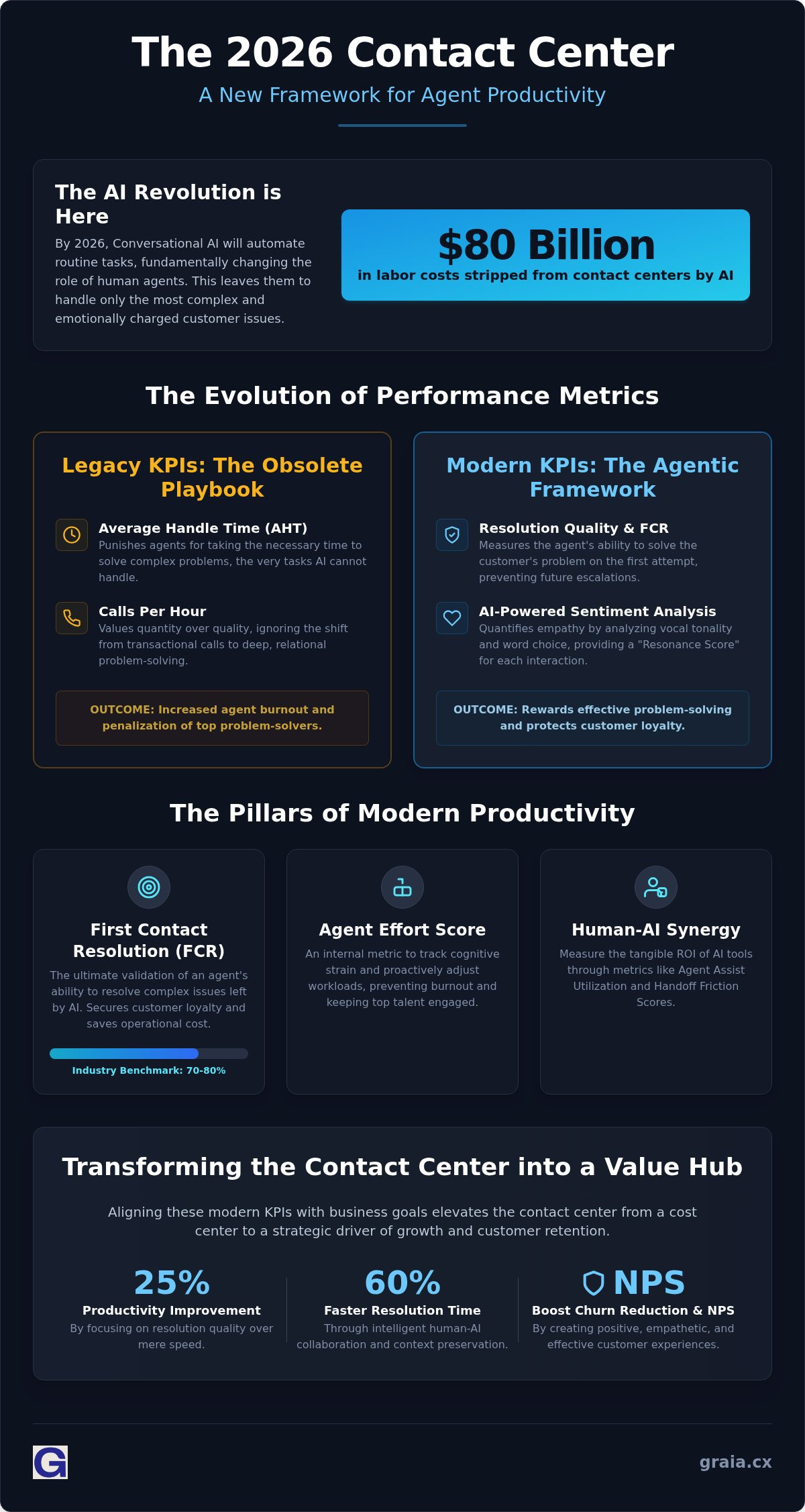
By 2026, conversational AI will strip $80 billion in labor costs from the global contact center market, leaving human agents to navigate only the most intricate and emotionally volatile customer journeys. If you're still relying on legacy key performance indicators for agent productivity like raw Average Handle Time, you aren't just measuring the wrong things; you're actively punishing your best problem solvers for doing exactly what the AI can't. We understand the tension of this transition. It's difficult to bridge the gap between automated efficiency and the nuanced value of a human connection, especially when your current reporting feels blind to the complexity of the modern workload.
This reference guide empowers you to master a sophisticated KPI framework designed for the Agentic CCaaS era. You'll learn how to leverage tools like Agent Assist to reduce cognitive load, measure the true ROI of human-AI synergy, and implement fair performance standards that prioritize resolution quality over mere speed. We are moving beyond transactional metrics to redefine what it means for a workforce to thrive in a digital first world. By the end of this guide, you'll have the clarity needed to drive a 25% improvement in productivity while protecting your most valuable asset: your people.
Key Takeaways
- Transition from transactional to relational metrics to properly value the complex, high-stakes interactions that define the 2026 contact center.
- Master modern key performance indicators for agent productivity that balance technical efficiency with the deep human empathy required for modern CX.
- Implement First Contact Resolution and real-time sentiment analysis as the primary pillars of a quality management strategy that prioritizes resolution over speed.
- Measure the tangible ROI of your human-AI partnership by tracking Agent Assist utilization and calculating precise handoff friction scores.
- Align your operational scorecard with high-level business goals like churn reduction and NPS to transform your contact center into a strategic value-creation hub.
Beyond Call Volume: Why Legacy Productivity Metrics are Obsolete in 2026
The industrial era of the contact center is dead. For decades, leaders viewed agents as transactional processors, measuring their worth through the cold lens of call volume and speed. By 2026, conversational AI is predicted to reduce contact center labor costs by $80 billion, a shift that fundamentally alters the terrain for human staff. As AI resolves nearly 10% of all interactions autonomously, it absorbs the routine password resets and status updates that once padded an agent’s stats. This leaves your human team with a concentrated stream of high-stakes, emotionally charged escalations.
Relying on traditional Key Performance Indicator (KPI) sets that prioritize Average Handle Time (AHT) is now a strategic error. In a world where AI handles the "easy" wins, a rising AHT isn't a sign of inefficiency; it's a marker of an agent doing the heavy lifting AI cannot touch. We must evolve toward a framework of "Agentic Productivity" that balances technical efficiency with deep empathy and successful outcomes.
The Rise of the Complex Inquiry
When routine tasks vanish, the "easy" calls that used to provide mental breathing room disappear too. Agents now face back-to-back complex cases, a shift that increases cognitive load and accelerates burnout. If your current key performance indicators for agent productivity still reward "calls per hour," you are penalizing your most skilled problem solvers for spending the time required to salvage a high-value relationship. True productivity in 2026 isn't about how fast an agent gets off the phone. It's about the depth of the resolution they provide and their ability to prevent future escalations.
Redefining Success with Agentic CCaaS
To capture the value created in this new environment, we must pivot from "calls per hour" to "resolutions per hour." Modern key performance indicators for agent productivity must account for how well an agent navigates the synergy between their own expertise and AI support. This requires a platform that preserves context across every touchpoint, ensuring agents don't waste time repeating questions the AI already asked. Implementing an Agentic CCaaS platform enables this shift by providing the data transparency needed to measure real-world impact. This isn't just about speed anymore. It's about the measurable impact of every human interaction on the bottom line, targeting a 60% faster average resolution time through intelligent collaboration.
The Core Pillars of Modern Agent Productivity: Efficiency Meets Empathy
Efficiency is the baseline. Empathy is the differentiator. In 2026, the most effective key performance indicators for agent productivity no longer treat these two forces as opposing goals. Instead, they recognize that a resolution reached with emotional intelligence is more valuable than one reached with speed alone. First Contact Resolution (FCR) remains the north star of this philosophy. With industry benchmarks currently sitting between 70% and 80%, FCR serves as the ultimate validator of an agent's ability to navigate the complexities that AI leaves behind. When an agent resolves a high-stakes issue on the first try, they don't just save operational costs; they secure customer loyalty.
To support this high-level performance, leaders are adopting the Agent Effort Score. This internal metric tracks the cognitive strain placed on your team. By monitoring the difficulty and frequency of escalations, you can proactively adjust workloads before they lead to burnout. It's a protective measure that ensures your best talent stays engaged and productive in an increasingly demanding environment.
Quantifying Empathy with AI
Modern sentiment detection has transformed empathy from a qualitative "vibe" into a quantitative metric. By analyzing vocal tonality and word choice in real time, AI provides a resonance score for every interaction. This allows managers to identify where agents are successfully de-escalating tension and where they need additional support. AI Empathy is the grounding of automation in human facts. When we measure resonance, we connect agent performance directly to long-term customer lifetime value, ensuring that every interaction strengthens the brand's emotional equity.
The Multilingual Productivity Advantage
Language barriers once acted as a massive drag on productivity, forcing centers to maintain expensive, siloed bilingual queues. Today, live call translation software has leveled the playing field. Agents can now provide expert support across 100+ languages without the need for specific linguistic hires. This technology doesn't just expand reach; it optimizes the workforce by allowing any available agent to handle any incoming request.
The productivity gains here are measurable. By reducing the "language gap" in AHT, centers see a 25% improvement in overall agent output. The software handles the heavy lifting of translation, significantly lowering the cognitive load on the agent. They focus on the solution while the AI handles the syntax. This seamless integration ensures that your key performance indicators for agent productivity remain consistent across every global market you serve. For more insights on balancing technology with human touch, explore our latest modern customer experience strategies.
Measuring Human-AI Synergy: New Metrics for the Agentic Contact Center
Measuring the productivity of a modern contact center in 2026 requires a departure from evaluating agents in isolation. We now operate in an environment of human-in-the-loop collaboration. Therefore, your key performance indicators for agent productivity must reflect the synergy between human intuition and machine precision. If an agent is ignoring AI-driven insights, they aren't just being traditional; they're being inefficient. Success is no longer a solo act. It is a choreographed performance between the agent and their digital co-pilot.
One critical metric is the Handoff Friction Score. This measures the seamlessness of the transition when a Conversational Agent escalates a complex case to a human. High friction occurs when agents must hunt for data or re-ask questions the customer has already answered. Low friction means the agent has the full story immediately, which is essential for hitting the target of 60% faster average resolution times. We also reward AI Training Contribution. This metric recognizes agents who identify gaps in the Knowledge Base and contribute their expertise to improve the AI's future performance, turning your best staff into architects of the system itself.
The Power of Agent Assist Tools
Strategic deployment of AI agent assist tools transforms how we evaluate performance. These tools act as a co-pilot, suggesting next-best-actions and real-time knowledge retrieval. By leveraging these assists, enterprises can target a 30% reduction in onboarding time for new hires, allowing agents to reach peak proficiency without months of classroom training. We measure success here through Utilization Rates. Are agents accepting or rejecting AI suggestions? High rejection rates often signal a knowledge base that needs refinement rather than a failing agent.
We also track the reduction in "dead air" during interactions. In multilingual environments, using real-time translation tools eliminates the awkward pauses once common in cross-language support. This keeps the momentum of the conversation high, ensuring that key performance indicators for agent productivity remain focused on active engagement rather than technical delays or linguistic barriers.
Evaluating the Agentic Swarm
In 2026, we utilize multi-agent architectures where bots and humans collaborate as a swarm. This requires a new layer of oversight. We now employ "Judges," which are AI-powered evaluators that monitor 100% of interactions. Unlike traditional random sampling, these judges provide a consistent, objective score for every conversation. They look for context preservation and resolution accuracy. This ensures that every handoff is evaluated for quality, preventing the "blind spots" that used to hide in the transition from bot to human. When agents know every interaction is supported and scored fairly, they can focus on what they do best: resolving the complex, high-value cases that define your brand.
Operationalizing Productivity: How to Build a Modern KPI Scorecard
Static scorecards are a relic of a transactional past. In 2026, building a framework that truly reflects performance requires a shift from historical reporting to real-time intelligence. We aren't just looking at what happened last month. We're looking at how agents are performing in the present moment. This requires integrating key performance indicators for agent productivity into a live dashboard, ideally powered by OData and Power BI, to provide a single source of truth for the entire enterprise. When data is siloed, your vision is fragmented; when it's unified, you gain the clarity needed to lead.
Step 1: Define Your Value Drivers
Is your contact center a drain on resources or a driver of growth? Most visionary leaders now view their centers as value-generation hubs. To reflect this, your scorecard must prioritize outcomes over activities. While AHT still matters for capacity planning, First Contact Resolution (FCR) should carry significantly more weight. High FCR directly correlates with reduced churn and improved NPS. By weighting these metrics correctly, you can accurately calculate your contact center ROI with AI and justify your technological investments to the board.
Step 2: Implement Real-Time Feedback Loops
Waiting for a monthly review to correct a performance dip is a legacy mistake that costs you customers. Modern systems enable "micro-coaching" through real-time feedback loops. By analyzing "Next Best Action" data from Agent Assist, managers can identify specific training gaps the moment they appear. If an agent consistently struggles with a specific product inquiry, the system flags it for immediate, supportive intervention. We also focus on automating the wrap-up process. By removing the administrative burden of post-call notes, we give agents the breathing room they need to remain emotionally resilient between high-complexity cases.
Trust is the foundation of high performance. Agents must have full transparency and access to their own performance data. When agents can see their own key performance indicators for agent productivity in real-time, they take ownership of their professional growth. This isn't about surveillance; it's about empowerment. A transparent environment reduces anxiety and fosters a culture of partnership where every team member feels like a stakeholder in the brand's success. Ready to transform your data into actionable strategy? Explore our latest CX leadership insights.
Elevating Performance with GraiaCX: The Multilingual, AI-Powered Future
The transition to an agentic workforce is no longer a distant vision; it's an immediate operational necessity. GraiaCX stands as the definitive solution for enterprises that refuse to choose between technical precision and human empathy. Our Agentic CCaaS platform doesn't just manage interactions. It orchestrates a high-performance ecosystem where humans and AI collaborate seamlessly to redefine the standard of service. By deploying our Agentic Swarm architecture, organizations achieve a 60% faster average resolution time, transforming the contact center from a bottleneck into a competitive engine. This isn't about replacing your team. It's about augmenting their potential to deliver a 25% improvement in agent productivity.
Managing a global workforce requires a single, unshakeable source of truth. GraiaCX provides this through deep OData integration with Power BI, allowing leadership to visualize key performance indicators for agent productivity with unprecedented granularity. We move beyond surface-level stats to reveal the true drivers of value, from sentiment resonance to the accuracy of AI-assisted resolutions. When you have this level of clarity, you don't just react to the market; you lead it.
Unifying the Omnichannel Desktop
Fragmented workflows are the silent killers of efficiency. Every time an agent switches between disconnected apps, you lose 10 to 15 seconds of momentum. GraiaCX eliminates this friction by consolidating voice, social, and email into a single, intelligent flow. Our platform utilizes contextual RAG (Retrieval-Augmented Generation) to ensure that agents never search for the same information twice. The system anticipates the agent's needs, surfacing the exact data required to resolve the case before the question is even asked. This unification reduces the cognitive load on your staff, allowing them to focus entirely on the human being on the other end of the line.
Future-Proofing Your Contact Center
Scaling a global support operation used to mean paying a 50% wage premium for bilingual staff or dealing with the limitations of siloed language queues. GraiaCX shatters these barriers. With Live Call Translation in over 100 languages, any agent can become a global communicator instantly. This allows you to scale into new markets without the massive overhead of localized hiring.
Consistency is equally vital for brand integrity. Our "Draft Mode" for email and chat interactions ensures that every response meets 100% brand consistency standards by providing AI-generated suggestions that agents can refine and approve. This ensures that your key performance indicators for agent productivity remain high, regardless of the agent's tenure or the complexity of the inquiry. The future of CX is human-plus-AI, and it's already here. Transform your agent productivity with GraiaCX today and reclaim your operational excellence.
Architecting the Future of High-Performance CX
The transition toward an agentic workforce is not a threat to human value; it is the ultimate elevation of it. By moving beyond transactional volume and embracing metrics that prioritize resolution quality and emotional resonance, you transform your contact center into a strategic engine of growth. We've explored how a modernized framework for key performance indicators for agent productivity balances AI precision with the irreplaceable nuance of human connection. This shift ensures your best problem solvers are rewarded for their expertise rather than penalized for the complexity of the cases they handle.
Success in 2026 demands a platform that unifies these forces into a single, intelligent flow. GraiaCX brings 25 years of CX innovation to help you achieve 60% faster resolution times and support global customers across 100+ languages. It's time to stop measuring your team with legacy yardsticks and start empowering them with the tools they deserve. Discover how GraiaCX boosts agent productivity by 25% and begin your transformation today. The path to operational excellence is clear, and we're ready to partner with you to build a more resilient, human-centric future.
Frequently Asked Questions
What are the most important KPIs for agent productivity in 2026?
The most critical key performance indicators for agent productivity in 2026 focus on First Contact Resolution (FCR) and sentiment resonance. Leaders now prioritize the Agent Effort Score to track cognitive load alongside Handoff Friction to measure the seamlessness of AI to human transitions. These metrics move beyond raw volume to evaluate how effectively agents resolve the complex, high stakes problems that automation cannot solve independently. Success is defined by the quality of the resolution rather than the speed of the transaction.
How does AI actually improve contact center agent productivity?
AI improves productivity by acting as a force multiplier for the human workforce. By deploying Conversational Agents to handle routine inquiries, you free your team to focus on high value interactions. Features like Agent Assist provide real time next best action suggestions, which can reduce onboarding time by 30%. This integrated approach targets a 25% improvement in agent productivity by eliminating the manual research and administrative wrap up tasks that typically slow down resolution cycles.
Should I still use Average Handle Time (AHT) to measure agents?
You should treat Average Handle Time as a capacity planning tool rather than a performance benchmark. Because AI now resolves a significant portion of simple interactions autonomously, the calls reaching human agents are naturally more complex and time consuming. Judging an agent solely on AHT in 2026 creates a perverse incentive to rush sensitive conversations. Instead, context adjusted AHT should be paired with resolution accuracy to ensure efficiency doesn't come at the expense of the customer experience.
Can AI help reduce agent burnout while increasing productivity?
AI is a powerful tool for protecting agent well being. By automating repetitive, robotic tasks, you reduce the monotony that leads to disengagement. Our platform achieves 40% fewer escalations, which means agents spend less time in high friction, repetitive loops. When agents feel supported by real time coaching and automated summaries, their cognitive load drops significantly. This balance of technology and empathy helps prevent burnout while maintaining high performance standards across the entire contact center.
How do I measure the productivity of a multilingual support team?
Measuring a multilingual team no longer requires siloed language queues or bilingual wage premiums. With Live Call Translation supporting over 100 languages, you can measure key performance indicators for agent productivity through a unified, language agnostic lens. Focus on FCR and sentiment scores across all interactions regardless of the language spoken. This allows you to compare performance fairly across global teams, ensuring that every agent is evaluated on their problem solving ability rather than their linguistic fluency.
What is the difference between efficiency and effectiveness in a contact center?
Efficiency measures how quickly an agent performs a task, often tracked through volume and speed. Effectiveness evaluates the quality and finality of the outcome. In an agentic contact center, effectiveness is the superior metric. An agent might be highly efficient at closing tickets, but if they don't achieve First Contact Resolution, they aren't effective. We prioritize effectiveness to drive 60% faster resolution times, ensuring that speed is always grounded in a successful customer result.
How do AI agent assist tools impact first-contact resolution (FCR)?
AI agent assist tools directly boost FCR by grounding every interaction in verified facts. These tools use hybrid RAG retrieval to surface the exact information an agent needs within seconds, preventing the "I'll have to call you back" scenarios that tank resolution rates. By providing real time transcripts and smart suggestions, agents can resolve more inquiries on the first attempt. This reduces the need for repeat contacts and significantly elevates the overall customer experience.
Is it possible to automate routine inquiries without losing human empathy?
It's entirely possible to automate routine inquiries while deepening brand empathy. GraiaCX’s Conversational Agents use advanced intelligence to understand intent and tone, ensuring routine interactions feel natural and respectful. By resolving simple tasks autonomously, you preserve your human agents' emotional energy for the moments that truly require a personal touch. This hybrid approach ensures that empathy is present in every interaction, whether it's delivered by a bot or a person.