
5 Essential Tools to Reduce Contact Centre Agent Churn in 2026
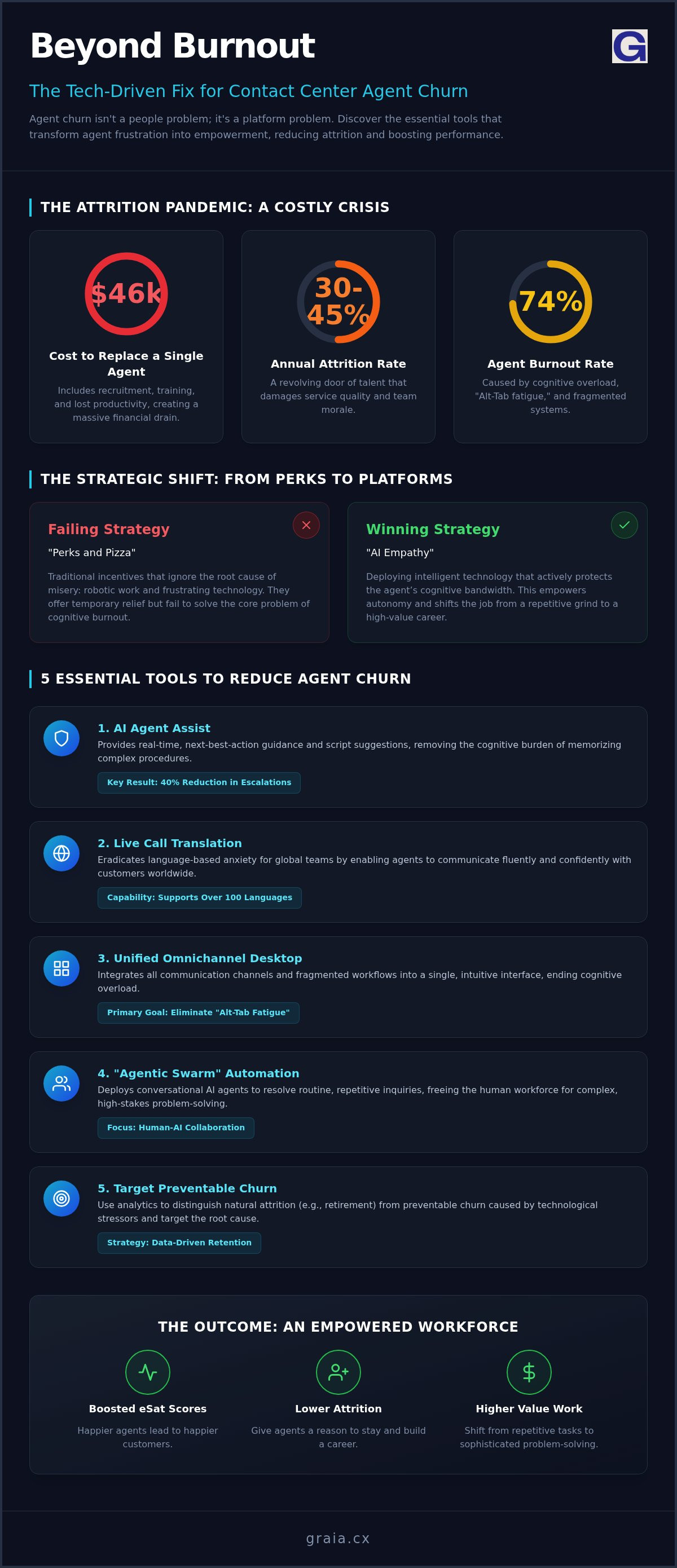
Replacing a single contact centre agent in 2026 can cost your organization up to $46,000 once lost productivity and recruitment fees are tallied. It's a staggering figure that represents more than just a financial burden. It's a symptom of a technological framework that treats humans like components rather than collaborators. You likely recognize the strain on your floor as agents navigate the cognitive overload of "Alt-Tab fatigue," jumping between fragmented systems while trying to maintain empathy. Implementing the right tools to reduce contact centre agent churn is no longer a luxury for the forward-thinking; it's a baseline requirement for operational survival.
We're entering an era where technology must do more than just record interactions. It must empower them. In this guide, you'll discover how agentic AI and intelligent automation are redefining the frontline experience, shifting the role from a repetitive grind to a sophisticated, high-value career. We will detail five essential tools, from real-time translation to AI-driven assistance, that transform the agent desktop. By the end, you'll understand how a unified, intelligent platform can lower attrition, boost your eSat scores, and finally give your staff the agency they deserve.
Key Takeaways
- Identify the critical distinction between natural attrition and preventable churn to target the specific technological stressors driving talent away.
- Leverage AI Agent Assist to provide real-time, next-best-action guidance, effectively removing the cognitive burden of memorizing complex procedures.
- Eradicate language-based anxiety for global teams by utilizing Live Call Translation, enabling agents to communicate fluently in over 100 languages.
- Integrate fragmented workflows into a unified omnichannel desktop, one of the most effective tools to reduce contact centre agent churn by eliminating "Alt-Tab fatigue."
- Transition toward an "Agentic Swarm" model where Conversational Agents resolve routine inquiries, freeing your human workforce for high-stakes, emotionally intelligent problem-solving.
The Attrition Pandemic: Why Traditional Retention Strategies Fail in 2026
The industry is bleeding talent. While natural attrition accounts for retirements or career shifts, churn represents a preventable exodus of skilled professionals driven by systemic frustration. In the modern call centre, agents aren't leaving simply for a higher salary. They're fleeing a technological environment that forces them to function like outdated processors rather than human problem-solvers. When your staff spends more time fighting software than helping customers, the result is a 74% burnout rate that no amount of culture-building can fix. Identifying effective tools to reduce contact centre agent churn starts with acknowledging that the problem isn't the people; it's the platform.
The Real Cost of a Revolving Door
Financial stability in the enterprise depends on retention. With the average annual attrition rate hovering between 30% and 45%, most organizations are trapped in a cycle of constant replacement. According to industry research, the total cost to replace a single agent can climb as high as $46,000 once you factor in recruitment, training, and lost productivity. This creates a "Resolution Gap" where service quality plummets. New hires often struggle with First Contact Resolution (FCR) during their first 90 days, placing an immense burden on veteran staff. This cycle breeds resentment and accelerates the departure of your most experienced talent, taking years of institutional knowledge with them.
Why Perks and Pizza No Longer Work
Traditional incentives fail because they ignore the root cause of agent misery: robotic work. Agents in 2026 expect their professional tools to mirror the intelligence and ease of their personal applications. They're exhausted by fragmented toolsets and the mental gymnastics required to resolve simple queries. To stop the bleed, leadership must pivot toward "AI Empathy." This isn't about soft skills; it's about deploying technology that actively protects the agent’s cognitive bandwidth. By implementing sophisticated tools to reduce contact centre agent churn, you move beyond surface-level perks and address the core technological frustrations that make the job feel unsustainable.
- Technological Parity: Agents want software that works as intuitively as the apps on their personal devices.
- Cognitive Protection: Tools must eliminate repetitive data entry and manual searching to prevent mental fatigue.
- Empowered Autonomy: Retention is driven by the ability to solve complex problems without navigating bureaucratic or technical hurdles.
Eliminating Cognitive Load: How Agent Assist AI Prevents Burnout
Traditional monitoring often feels like a spotlight, but modern tools to reduce contact centre agent churn function more like a safety net. Agents quit when the mental weight of the job exceeds the support they receive. With 87% of agents reporting high stress levels, the priority must shift from surveillance to empowerment. By deploying AI agent assist tools, you replace the anxiety of memorization with the confidence of real-time guidance. This technology doesn't just watch the interaction; it participates in it, acting as a sophisticated companion that absorbs the technical burden so the human can focus on the customer.
Real-Time Coaching and Next-Best-Action
GraiaCX’s Agent Assist transforms the desktop into a live coaching environment. Instead of fumbling through static PDFs or fragmented knowledge bases, agents receive script-locked suggestions tailored to the specific context of the conversation. This provides factual grounding that virtually eliminates the "fear of failure" for new hires during their first 90 days. The system uses real-time sentiment analysis to monitor the emotional temperature of the call. If a situation escalates, it alerts a supervisor only when an agent truly needs intervention. This targeted support has been shown to drive a 40% reduction in escalations, allowing staff to handle complex cases with newfound authority.
Automating the "Robotic" After-Call Work (ACW)
The most tedious part of an agent’s day isn't the conversation; it's the administrative aftermath. Manual data entry and call logging are the primary drivers of "robotic work" that lead to quiet quitting. Agent Assist automates this process by generating instant, accurate summaries and updating CRM records automatically. This saves between 5 and 10 minutes for every hour of work. By ensuring session continuity, the AI also ensures agents never have to ask a customer to repeat themselves, maintaining a seamless flow across channels. Reducing this administrative fatigue is essential for long-term retention. When you remove the mechanical grind, you allow your team to reclaim their energy for high-value interpersonal work.
Investing in these capabilities is the first step toward a more resilient workforce. If you want to see how these technologies integrate into a broader strategy, you can explore our latest insights on the evolution of the agent experience.
Breaking the Language Barrier: Reducing Stress with Live Call Translation
Language barriers represent more than a simple communication gap. For an agent, the inability to understand a customer’s nuance or urgency is a primary source of physiological stress and performance anxiety. In global environments, providing support in a non-native language can increase Average Handle Time (AHT) by 20% to 50%, while customer satisfaction scores typically drop by 23% when preferred language support is missing. These friction points are significant drivers of burnout. By integrating Live Call Translation into your stack, you provide one of the most effective tools to reduce contact centre agent churn. This technology allows agents to support over 100 languages natively, removing the "linguistic wall" that often leads to talent exodus.
Removing the Bilingual Premium Pressure
Traditional recruitment often forces a compromise. You either hire for linguistic fluency or for emotional intelligence, but rarely do you find both in abundance. Translation tools shift this paradigm by allowing you to hire for empathy and problem-solving first. This reduces the immense cognitive load of switching between languages during a single shift, a process that quickly drains an agent’s mental energy. Advanced platforms now offer "Formality Tuning," ensuring that interactions in high-stakes markets like Germany or Japan maintain the appropriate cultural register. This level of precision protects the agent from social friction and preserves the "Original Audio" to ensure that human empathy remains the focal point of the call.
Enhancing Agent Confidence in Global Markets
Confidence is the cornerstone of retention. When agents have access to real-time transcripts, they can process complex technical terms in foreign languages without the fear of misinterpretation. This technological safety net is bolstered by features like "Cancel Agent Message" windows, which allow staff to review and correct a translation before it reaches the customer, preventing embarrassing or costly errors. The results are measurable and immediate. Organizations utilizing these tools often see First Contact Resolution (FCR) scores climb by 5 to 10 points. For procurement teams looking to modernize their infrastructure, our live call translation software guide provides a comprehensive framework for selecting enterprise-grade solutions.
- Empathy Preservation: Maintaining the agent's original tone while translating the words ensures a genuine connection.
- Error Prevention: Real-time review windows give agents total control over the translated output.
- Operational Efficiency: Reducing the need for expensive, third-party interpretation services lowers costs while improving the agent experience.
Unified Engagement Platforms: Ending "Alt-Tab Fatigue" for Good
The mental tax of the modern contact centre isn't just the volume of calls. It's the friction of the interface. "Alt-Tab Fatigue" has become a pervasive industry ailment, where agents are forced to juggle upwards of 10 disconnected applications simultaneously. This fragmentation is a primary driver of systemic frustration. Transitioning to an Agentic Omni-Channel Platform is one of the most decisive tools to reduce contact centre agent churn. It replaces the chaos of multiple windows with a singular, high-performance workspace that respects the agent's focus and preserves their cognitive energy.
One Screen, One Story
GraiaCX integrates seamlessly with your existing CRM infrastructure, including Salesforce and ServiceNow, alongside legacy CCaaS systems like Genesys or Avaya. This creates a unified engagement platform where voice, chat, social, and email converge into a single stream of consciousness. The psychological benefit is profound. When an agent operates from a single source of truth, their confidence stabilizes. They no longer fear missing a critical piece of data buried in a background tab. This consolidation acts as a catalyst for growth, typically reducing average handle time (AHT) by 15-25% while improving the quality of the interpersonal connection. Session continuity ensures that customer context follows the interaction across every channel, so your staff never has to hunt for history.
Contextual Retrieval (RAG) vs. Traditional Search
Traditional internal wikis and rigid IVR systems are relics of a slower age. Agents often find these tools more hindering than helpful because they require manual navigation under intense pressure. We utilize Retrieval-Augmented Generation (RAG) to provide agents with instant, factual answers derived from your own secure knowledge base. Unlike traditional search, which forces an agent to hunt through pages of documentation, RAG retrieves the specific data needed and presents it as a coherent, actionable response. This eliminates the awkward silence of "hold" time. It empowers your staff to resolve issues with authority, directly addressing the tools to reduce contact centre agent churn by removing the stress of information scarcity.
Ready to unify your operations? You can learn more about how to modernize your agent desktop to support a more resilient, high-performing workforce.
Future-Proofing the Workforce: Building an Agentic CCaaS Strategy
The future of retention isn't found in better management of manual tasks, but in the complete removal of them. We're moving toward a model where humans and AI operate in a symbiotic "Agentic Swarm," a system where specialized digital agents and human experts work as a unified team. This evolution represents the pinnacle of tools to reduce contact centre agent churn because it fundamentally changes the nature of the work. By delegating routine, high-volume transactions to a Conversational Agent, you protect your human staff from the repetitive grind that leads to quiet quitting. An empowered agent is a loyal agent, and loyalty is built when a professional feels their time is spent on work that truly matters.
The Agentic Swarm: AI as a Teammate, Not a Threat
In this new operational framework, specialized AI agents handle the mechanical aspects of customer service, such as billing inquiries, shipping updates, or simple returns. This reduces agent boredom and ensures that human intervention is reserved for complex, emotionally charged, or high-stakes interactions. The transition is seamless. When a case escalates, the human agent receives a comprehensive summary of the AI’s previous interaction before they even say "hello." This removes the frustration of "starting over" for both the agent and the customer. Building this culture allows your staff to see AI not as a protective guide that handles the noise so they can focus on the signal, rather than a threat to their job security.
Measuring Success Beyond the Stopwatch
Retention requires a shift in how we define "good" work. In 2026, forward-thinking organizations are moving away from Average Handle Time (AHT) as the primary measure of success. Instead, they're prioritizing Agent Satisfaction (eSat) and Resolution Accuracy. Understanding the ROI of agentic AI involves looking at the long-term value of a stable, highly skilled workforce. GraiaCX utilizes 'Judges', which are specialized AI protocols that evaluate interactions based on brand voice, empathy, and factual precision rather than just speed. This provides agents with fair, nuanced feedback that recognizes their human contributions.
Modernizing your desktop isn't just a technical upgrade; it's an act of preservation for your workforce. By investing in an Agentic Omni-Channel Platform, you provide the tools required to transform the contact centre from a high-stress transition point into a high-value career destination. It's time to build a framework where your staff can finally thrive.
Reclaiming Human Potential in the Digital Frontline
The transition from a high-stress grind to a high-value career isn't a distant aspiration. It's an immediate operational necessity. By deploying intelligent tools to reduce contact centre agent churn, you're doing more than just protecting your bottom line. You're restoring the human element to a role that's been historically defined by mechanical repetition. Whether it's through real-time coaching or the elimination of "Alt-Tab fatigue," the goal remains clear. Empower your staff to solve problems with authority and empathy.
Organizations that embrace this shift are already seeing a 25% increase in agent productivity and 60% faster resolution times. With multilingual support in over 100 languages, your team can finally operate without boundaries. It's time to move beyond traditional retention strategies and build a future where technology serves the person. Empower your team with GraiaCX's Agentic CCaaS Platform and transform your workforce into a resilient, high-performing asset. Your agents are your greatest strength. Give them the platform they deserve.
Frequently Asked Questions
Can AI really reduce agent churn or does it just cause more anxiety?
AI reduces churn when it's deployed as a supportive teammate rather than a surveillance mechanism. Agents feel less anxiety when automation handles "robotic work" like data entry and routine billing queries, which currently drive a 74% burnout rate. By providing real-time guidance and factual grounding, AI removes the fear of failure for new hires. This collaborative approach transforms the role from a high-stress grind into a high-value career focused on genuine human connection.
What are the most common tools used to reduce contact centre agent attrition?
The most effective tools to reduce contact centre agent churn in 2026 include AI Agent Assist, Live Call Translation, and Unified Engagement Platforms. These technologies address the core drivers of attrition: cognitive overload and technical frustration. By consolidating fragmented applications and providing real-time coaching, these tools empower staff to resolve complex issues with authority. Organizations using these solutions typically see a 25% improvement in productivity and a significant boost in agent satisfaction scores.
How does real-time translation help with agent retention?
Real-time translation removes the "linguistic wall" that causes immense pressure in global contact centres. Supporting customers in a non-native language can increase Average Handle Time by up to 50%, leading to rapid exhaustion. GraiaCX provides live translation in over 100 languages, allowing you to hire for empathy and problem-solving rather than just bilingual skills. This reduces the cognitive load on your team, ensuring they feel confident and capable regardless of the customer's native tongue.
Is it possible to integrate agent assist tools with my existing Genesys or Avaya system?
GraiaCX is designed for seamless integration with your existing CCaaS infrastructure. Our platform connects natively with Genesys, Avaya, and NICE CX via SIP and iframe widgets; you don't need a "rip-and-replace" of your current technology stack. You can also unify your CRM data from Salesforce or ServiceNow into a single workspace. This allows you to deploy advanced agent assist capabilities immediately, providing your team with modern tools without disrupting your established operational workflows.
What is 'Alt-Tab Fatigue' and how does it impact agent burnout?
Alt-Tab Fatigue is the mental exhaustion caused by switching between 10 or more disconnected applications during a single customer interaction. It's a primary driver of burnout, yet only 3% of contact centres operate on a unified platform. Implementing unified workspaces is one of the primary tools to reduce contact centre agent churn by simplifying the agent desktop. This integration reduces Average Handle Time by 15-25% and allows agents to maintain focus on the customer conversation.
How much does it cost to replace a contact centre agent in 2026?
Replacing a contact centre agent in 2026 carries a total financial impact of up to $46,000 per person. While direct recruitment costs range from $10,000 to $20,000, the true burden includes lost productivity and the 90-day ramp-up period for new hires. With average attrition rates between 30% and 45%, these costs can devastate an enterprise's bottom line. Investing in retention technology is a strategic necessity to preserve institutional knowledge and maintain consistent service quality.
Can conversational AI handle routine tasks without frustrating customers?
Conversational AI resolves routine inquiries like refunds or scheduling without customer frustration by using Hybrid Flows and an Agentic Swarm architecture. This ensures 100% process accuracy while maintaining a natural, empathetic tone. If a case requires human intervention, the AI performs a seamless handoff, providing the live agent with a full summary of the interaction. Customers don't have to repeat themselves, and agents can step into the conversation with the context needed for immediate resolution.
Does GraiaCX protect agent and customer data from being used to train public AI models?
GraiaCX maintains a strict privacy-first approach where your data is never used to train public or third-party AI models. We utilize the Azure OpenAI Trust Framework to ensure all interactions remain confidential and are hosted within secure, regional environments. This architecture includes PII masking and prompt shields to protect sensitive information. You retain total sovereignty over your data, ensuring that your automation strategy remains compliant with global regulations and your own internal security standards.