
When to Replace IVR With Conversational AI for Better Service
IVR isn’t failing simply because it’s old. The right time to replace IVR with conversational AI is when callers’ needs no longer fit predictable menu options, routine enquiries lead to avoidable transfers, or customers struggle to reach the right support. Traditional IVR can still work well for simple, high-volume tasks.
When callers want to explain what they need in their own words, conversational AI can identify intent, resolve suitable routine requests and route complex issues to a human with context. The change needn’t mean rebuilding your phone operation from scratch: integrating with existing systems and taking a phased approach can preserve established workflows and controls.
This guide covers the signs that a menu has reached its limits, which interactions suit automation and where human support remains essential. You’ll also learn what to assess in speech handling, system integration and compliant interactions, so you can judge whether conversational AI can improve self-service while keeping support clear and consistent.
Key Takeaways
- Recognise when callers’ needs have outgrown fixed menus, and where traditional IVR still serves simple, predictable tasks.
- Assess whether an AI voice agent can understand callers clearly, handle uncertainty and pass useful context to a human when needed.
- Identify routine enquiries that could be automated while keeping people available for complex or sensitive conversations.
- Explore how conversational AI can work with existing phone flows and business systems rather than requiring a complete replacement.
- Understand the safeguards that support accurate, consistent interactions, especially when a conversation involves sensitive information or payments.
Key AI Voice Agent Features for IVR Replacement
Migration time depends on the phone platform, CRM and workflow integrations, the number of journeys and the testing each needs. One enquiry route connected to a well-documented CRM involves a different scope from several routes requiring authentication, case updates and payment hand-offs.
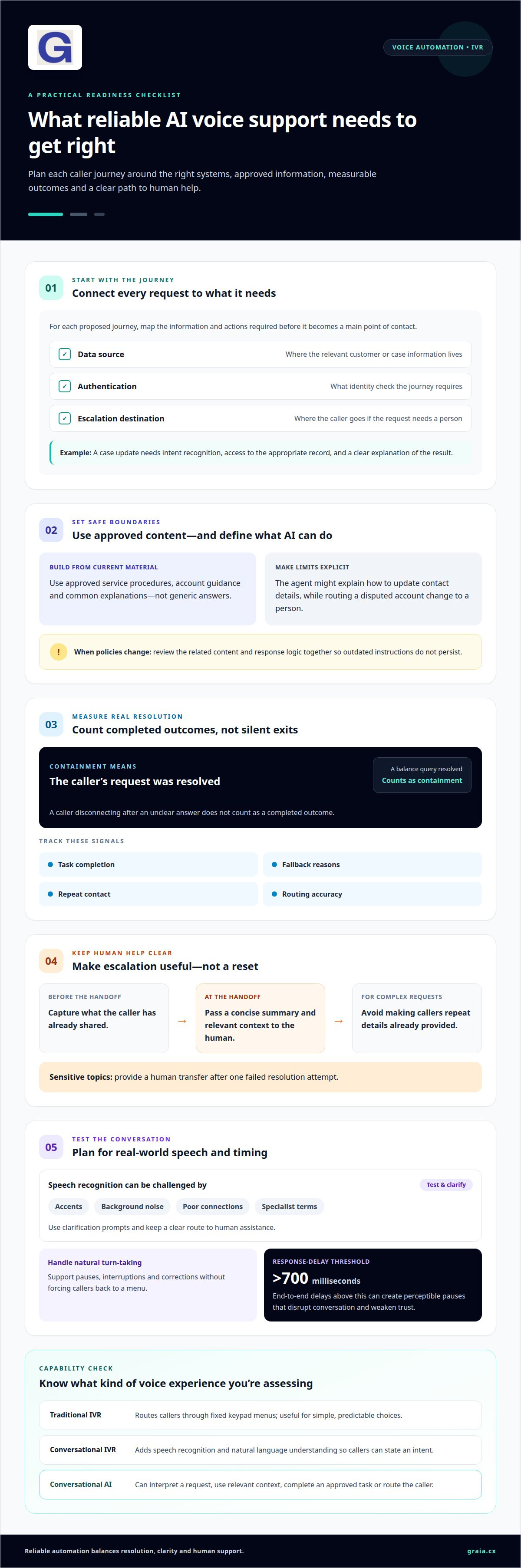
The terminology can be confusing, but the capabilities differ. Traditional IVR directs callers through fixed keypad menus. Conversational IVR adds speech recognition and natural language understanding, so callers can state an intent such as “I need to change my appointment”. Conversational AI is broader: it can interpret a request, use relevant context, complete an approved task or route the caller. An intelligent virtual agent is an AI-driven system that manages these interactions, often across voice and other channels.
With an existing phone and CRM setup, the key question is how the agent connects to systems that hold relevant information and enable actions. A caller asking for a case update needs more than speech recognition: the system must identify intent, retrieve the appropriate record in line with the organisation’s processes, and explain the result clearly. Map each proposed journey to its data source, authentication step and escalation destination. This reveals integration gaps before the new interaction becomes the main point of contact.
Train the system on current policies and customer-facing content, not generic answers. Use approved material, such as service procedures, account guidance and common explanations, and define what the agent can and cannot do. For instance, it might explain how to update contact details but route a disputed account change to a person. When a policy changes, review the relevant content and response logic together so outdated instructions don’t persist in conversations.
Measure containment by completed outcomes, not calls that simply end without a transfer. A resolved balance query counts as containment; a caller who disconnects after an unclear answer does not. Track task completion, fallback reasons, repeat contact and routing accuracy. For complex requests, escalation should include a concise summary and the context already shared, so callers don’t have to repeat details. For sensitive topics, provide a human transfer after one failed resolution attempt.
There are real limitations. Speech recognition can struggle with accents, background noise, poor connections and specialist terms, so systems need clarification prompts and a clear route to human assistance. Voice AI should also handle pauses, interruptions and corrections without forcing callers back to a menu. Response speed matters: end-to-end delays above 700 milliseconds can create perceptible pauses that disrupt conversation and weaken trust.
Conversational IVR versus traditional touch-tone menus
Traditional IVR asks callers to follow a predefined route: press a key, hear another menu, then choose again. This works when a request fits a stable option, such as checking opening hours or reaching a known department. Friction arises when callers must translate their needs into menu categories. Someone reporting a damaged delivery may not know whether to choose “orders”, “returns” or “complaints”. Each wrong turn adds effort before the conversation begins.
Conversational IVR changes the first step. Instead of choosing a number, callers describe their need in natural language, such as “I need to rearrange my appointment”. Speech recognition and intent detection can then guide the call towards the relevant service. That doesn’t mean every call should be handled by AI. A fixed menu can remain effective for a few predictable choices, while conversational handling suits varied requests that don’t follow a single path.
The distinction matters because conversational IVR often means a voice menu enhanced with speech, while conversational AI can interpret context and support a broader exchange. A basic voice IVR may recognise a spoken keyword but still send callers through rigid branches. A more capable system can clarify an ambiguous request, respond to the caller’s answer and direct the interaction according to intent. For example, “I can’t log in” could lead to access support, while “I need to change my email” may require a different workflow.
Caller frustration has a measurable commercial dimension. Forrester found that 65% of customers will switch brands after one bad experience. The Deepgram 2025 State of Voice AI Report states that 21% of enterprises are satisfied with traditional IVRs. These findings don’t prove every poor experience comes from phone menus, but they underline why businesses should examine callers’ journeys, abandonment points and repeat explanations before deciding what to deploy.
Use a practical comparison: list the common reasons people call, then mark which requests need a fixed choice, an open-ended explanation or a human decision. A caller checking a straightforward status may prefer a short automated route; someone describing a disputed charge may need context-sensitive questions and timely escalation. McKinsey notes that AI-enabled personalisation can lift CSAT scores by up to 5x compared with traditional IVR. To explore how these experiences can be designed, browse conversational AI insights.
First-call resolution and routine inquiry automation
First-call resolution improves when an automated interaction can complete a routine task, not just identify the caller’s intent. The key is connecting the conversation to the right information and workflow.
Self-Service and Call Containment
Call containment means resolving a caller’s request without transferring them to a human agent. It matters when a contact centre receives repeatable enquiries, such as order status or appointment changes, that an approved workflow can handle. Measure containment only when the caller’s issue is actually resolved. Review repeat calls within 48 hours, alongside task completion and fallback reasons, to distinguish successful self-service from an interaction that simply ended.
Static Menus and Rigid Call Flows
Static menus follow predefined branches, so an unexpected answer can leave callers at a dead end. A caller who says “my delivery arrived damaged” may not fit a menu offering only “track an order” or “request a return”. Natural language understanding can interpret the request and guide the next step. This matters when real enquiries cross categories or need clarification before routing.
Routine automation works best when each task has a clear outcome and an authorised data source. An account-status request, for example, may require a CRM lookup, an identity step and a plain-language response. McKinsey reports that contact centres using conversational IVR handle everyday requests 30-40% faster. That finding points to the value of streamlined journeys, but speed alone doesn’t prove resolution; task completion and repeat contact also matter.
CRM integration connects the conversation to customer records, while transcription and call summaries preserve useful context. If a request needs a person, a concise summary can show what the caller asked and what the system has already tried. This can prevent repeated explanations and help the receiving agent continue the interaction. Data access should match the task: an appointment query needs relevant booking information, not unrelated customer history.
Existing numbers and phone routing can remain part of a migration. Call forwarding can direct selected inbound calls to the conversational system, while SIP connections can link voice services across compatible telephony environments. The exact setup depends on the current phone architecture and how calls should return to a live team. A phased change can introduce automation for one journey while established routes continue handling others.
For example, a business could automate straightforward case-status enquiries, then send exceptions to a specialist queue with a transcript and summary. It can compare completion, transfer and repeat-contact patterns before extending automation to another journey. This keeps self-service focused on tasks the system can resolve, while sensitive or exception-driven conversations retain a clear route to a person.
Do AI voice agents work with existing phone systems?
Yes. Conversational AI can work within an existing phone-service flow and connect with CRM, ticketing and backend systems. Integration allows speech recognition to capture a request and identify intent and context, then retrieve information, carry out an approved workflow or route the call.
This differs from touch-tone IVR, which maps key presses to fixed branches, and basic voice IVR, which may respond to spoken keywords within a script. Conversational AI interprets natural-language requests, such as “I need to check my claim”, and can use the response to shape the next step. The experience depends on how accurately speech recognition handles callers’ words and how reliably connected systems provide the required information.
For a contact centre using CCaaS, CRM and ticketing tools, integration is as much a workflow question as a telephony one. A typical interaction captures speech, converts it to text, identifies intent and context, authenticates where needed, then retrieves data or triggers an approved action. It confirms the result or routes the caller with context. Every connection must support the task, such as finding a case record or sending a query to the right team.
Voice and chat should follow the same underlying policy, even when their scripts differ. A customer asking about an outage in chat and one calling the contact centre should receive consistent, approved information. Voice needs concise spoken prompts and opportunities to clarify; chat can present written details. Aligning the knowledge and workflows behind both channels reduces the risk of inconsistent answers across the customer experience.
Effective voice self-service journeys have a clear purpose and a reliable data source. Examples include checking order or account status, arranging an appointment, getting outage information, receiving a claims update or requesting password support. Payment workflows need particular care: a hybrid journey can use AI for the conversation while traditional IVR handles secure payment capture. Payment interactions must retain applicable security controls, including PCI DSS requirements.
A phased deployment can preserve existing numbers and core phone routing while adding AI at the start of selected call journeys. For example, callers can describe their need first, then continue through an established route if the system can’t complete the request. Call forwarding or SIP connectivity may form part of the design, depending on the telephony environment. The migration should keep a clear route to human assistance rather than forcing every interaction through automation.
Integration is not a 100% guarantee of resolution: speech, records and workflows all shape the result. A practical rollout tests the complete journey, from the caller’s spoken request to the CRM response and final confirmation. That reveals whether the connected systems support the intended task, and whether the hand-off preserves enough context for an agent to continue naturally.
Compliance and consistent customer interactions
Consistent service depends on more than a natural-sounding voice. Each interaction needs approved answers, clear boundaries and a reliable route to human support. Vonage research reports that 61% of consumers feel IVR makes for a poor customer experience. That finding makes friction worth examining, but replacing a menu only helps if speech recognition and language understanding guide requests accurately, especially when callers describe sensitive or unfamiliar situations.
Personalisation can make a call feel relevant when customer data is used for a clear purpose. For example, a CRM record might identify an existing case and route the caller to the right team, rather than ask them to explain the issue again. Use only the information needed for the task and avoid exposing unrelated account details. A tailored greeting can help; an unexpected disclosure of personal context can undermine trust.
Define what the AI can say, retrieve and do before deployment. Approved policy content can support routine requests, such as explaining a process or checking case progress. Set a separate rule for requests that require a person, including disputes or exceptions. If speech recognition is uncertain, the system can ask a brief clarifying question; if the request remains unclear, escalation should preserve the caller’s context.
Payment interactions need particular care. The research states that payment journeys using IVR, AI or a hybrid approach must maintain applicable security controls, including PCI DSS requirements. Conversational AI can explain balances, payment options and next steps before routing a caller into a secure payment workflow. Safeguards should address privacy, accuracy, data handling and escalation, so a misunderstood amount or failed payment does not leave the caller without a clear resolution.
Consistency also means aligning voice and written channels. If a customer receives one answer in chat and another by phone, confidence in both channels suffers. Shared approved content can help, while channel-specific wording keeps spoken prompts concise and written explanations easy to review. A service update, for example, should communicate the same status and next action whether the request arrives by phone or message.
Assess quality through resolved requests, routing accuracy, repeat contact and customer feedback, not through automation volume alone. Review fallback and transfer reasons to find where language understanding or policy content needs refinement. If you’re assessing how AI can support clearer, more consistent customer interactions, explore conversational AI guidance.
GraiaCX: Conversational Agent
GraiaCX’s Conversational Agent can understand caller intent and emotion, resolve routine enquiries and route complex requests with context. It’s a practical next step when fixed menus no longer match how customers explain their needs, while keeping human support available for sensitive or unusual cases.
For connected customer journeys, the Agentic Omni-Channel Platform brings voice, chat, email and social messaging together with AI-driven automation. Agent Assist provides real-time suggestions to support human agents, while Live Call Translation enables multilingual support in over 100 languages without requiring bilingual staff.
If you’re considering a more conversational approach to phone support, contact GraiaCX to discuss your requirements.
Make the Next Conversation Count
Deciding when to replace IVR with conversational AI becomes easier when you focus on the customer journey you want to improve first. Choose a call type where callers often need more than a fixed menu can offer, then design the experience around a clear outcome, useful context and a straightforward route to human support. This gives your team a practical starting point for improving service without losing sight of trust.
GraiaCX combines conversational automation with support for human agents and multilingual calls to help organisations create connected customer interactions. The next step is to schedule a consultation and discuss how these capabilities could fit your contact centre’s priorities and existing systems.
Contact GraiaCX to discuss your options. A more natural, responsive service experience can start with one well-chosen journey.
Frequently Asked Questions
Should You Replace IVR With Conversational AI?
Replace IVR when fixed menus repeatedly fail to match callers’ needs, not simply because the technology is old. The decision about when to replace IVR with conversational AI depends on whether routine requests can be handled accurately and callers can reach human help easily when needed. Keep touch-tone routes for simple, predictable tasks if they work well. Targeting the journeys that cause friction may be more appropriate than replacing every route.
How Does Conversational IVR Work?
Conversational IVR listens to a caller’s spoken request, interprets its meaning and responds or routes the call. For example, someone saying “I need to move my booking” could be asked for booking details, then guided to a suitable way to change it. The system needs relevant information and approved workflows to complete actions. If it can’t understand the request or the task needs human judgement, it should offer a hand-off to an agent.
Is IVR considered AI?
IVR isn’t necessarily AI. A system that plays recorded options and responds to keypad presses follows preset rules, not conversational intelligence. Some voice menus recognise spoken words but still match them to fixed commands. Conversational AI uses language understanding to interpret a caller’s meaning and respond more flexibly. The difference lies in how the system handles input: choosing from predefined options isn’t the same as interpreting an open-ended request.
What are the signs a business should replace its IVR with conversational AI?
Look for callers repeatedly choosing the wrong options, asking for an agent immediately or explaining the same issue after transfers. Another sign is a menu that keeps gaining branches as new services and exceptions arise. Review call reasons alongside transfer destinations and repeat contacts. If requests have predictable aims but are difficult to express through menu labels, conversational handling may provide a more direct route.
How does conversational AI compare with traditional IVR for customer service?
Traditional IVR gives callers a set route through keypad choices or tightly defined voice commands. Conversational AI lets them describe a request naturally, then uses its meaning to guide the interaction. That flexibility can help with requests that don’t fit one menu branch, but it depends on reliable recognition and well-designed fallbacks. A simple menu may remain clearer for a short, familiar transaction with few possible outcomes.
What call volumes and use cases justify replacing an IVR with conversational AI?
There’s no single call-volume threshold that makes a change worthwhile. Volume matters alongside how often requests recur, how consistent the answers need to be and whether connected systems can complete the task. High-frequency enquiries, such as delivery updates, may suit automation; unusual disputes may not. Assess the work involved per call and the consequences of an unsuccessful interaction, rather than treating call volume as the only deciding factor.
What is the cost of implementing conversational AI compared with maintaining an IVR in the UK?
There’s no single UK cost comparison that applies to every contact centre. Implementation costs depend on integration work, workflow complexity, data access, testing and ongoing content maintenance. Existing IVR costs may include telephony, support and manual menu updates. Compare the full operating effort for the same customer journeys, including transfers and repeat contacts. This gives a more useful picture than comparing software charges alone.
How can a business assess whether conversational AI will improve call containment and customer satisfaction?
Record a baseline for a month, then run a defined pilot on selected call journeys. Count containment only when the request is resolved, and track transfers, repeat contact, time to resolution and customer feedback. Segment results by enquiry type so a strong result for order updates doesn’t conceal problems with billing queries. Review unsuccessful interactions and caller comments, then refine the workflow before expanding the pilot.