
Voice AI Analytics for Clearer Customer Conversation Insights
A transcript captures the words, but not the whole conversation. Voice AI analytics and optimization combine analysis of what customers say with acoustic cues such as tone, pace, pitch and pauses to show how an interaction unfolds. This gives teams a clearer view of sentiment, recurring topics and potential friction points.
That distinction matters. Reviewing only a small sample of calls can leave patterns hidden, while AI-supported analysis can help teams examine conversations at scale and spot themes that deserve attention. It can also support live interactions, giving teams insight while a conversation is happening, not just after it ends.
This guide explains how voice analytics interprets spoken customer interactions, how it differs from speech and text analytics, and what it can reveal beyond traditional call-centre reviews. You’ll also learn how real-time analysis can inform an active conversation, while retrospective analysis can uncover trends, assess processes and guide coaching. Together, these approaches turn conversations into practical insight while keeping the human experience in view.
Key Takeaways
- Recognise how changes in pace, pitch, volume and pauses can signal emotional shifts behind a customer’s words.
- See how AI can surface recurring topics, objections and dissatisfaction across spoken interactions.
- Distinguish voice analytics from speech analytics and text analytics, so each source of insight is clear.
- Understand how automated analysis can reveal patterns that manual call reviews may overlook and support more focused coaching.
- Explore how live analysis can inform conversations as they happen, while retrospective reviews help teams spot trends and improve future interactions.
What Is Voice Analytics?
Voice analytics uses AI to examine spoken interactions, including customers’ words and acoustic cues in their delivery. For contact centres, it can turn individual calls into signals about sentiment, customer satisfaction and recurring emotional triggers.
Sentiment and Emotional Triggers
Sentiment analysis interprets language and vocal patterns to indicate whether a customer or agent sounds positive, neutral or negative. A customer repeating “I’ve already explained this” may signal frustration, particularly when paired with a faster speaking rate, raised volume or longer pauses.
These indicators can help distinguish a momentary concern from friction that warrants attention. Customer sentiment may show where an interaction is losing trust; agent sentiment can highlight pressure during difficult calls. Treat each score as an indicator, not a definitive account of someone’s feelings.
Tone and Topic Analysis
Tone analysis examines how a phrase sounds, while topic analysis identifies what the conversation is about. Combined with sentiment, these signals add context: “I understand” might sound reassuring or impatient, while repeated mentions of a delayed delivery may point to a specific service issue.
Psycholinguistic analysis adds another layer by examining language choices, including repeated words, emphasis and phrasing. Comparing these patterns with acoustic cues can provide useful insight into customer satisfaction, without treating a single phrase or vocal change as proof of an emotional state.
In the UK, voice AI analytics software costs depend on call volume, channels, integrations and analysis scope; pricing is provided after a quote request. Those factors influence the resources and capabilities required for a particular deployment.
How Voice Analytics Works
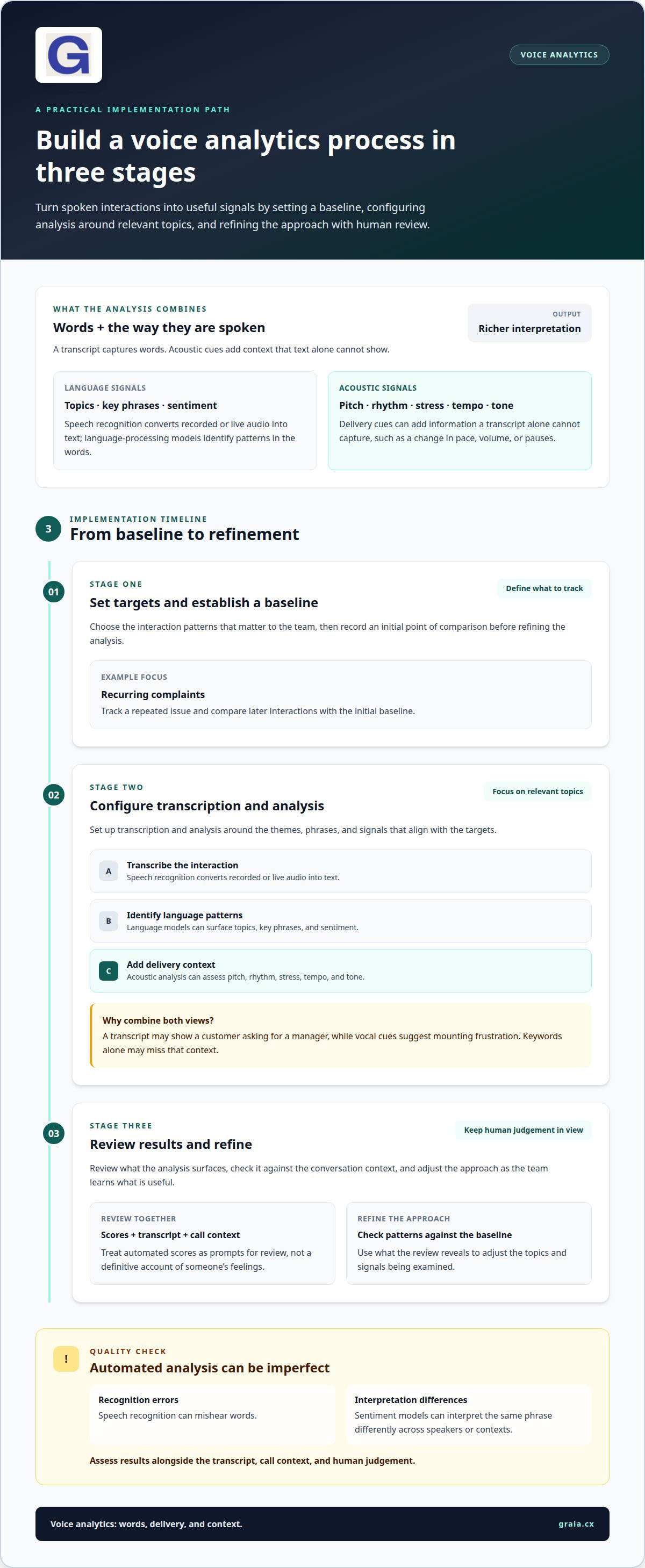
Speech recognition converts recorded or live audio into text, then language-processing models identify topics, key phrases and sentiment. Acoustic analysis can assess pitch, rhythm, stress, tempo and tone, adding information a transcript alone cannot capture.
For example, a transcript might show a customer asking to speak to a manager, while vocal cues suggest mounting frustration. Combining both views gives a contact centre a richer interpretation than keywords alone, although recognition errors or ambiguous speech can affect the result.
A business can implement voice analytics in three stages: set targets and establish a baseline, configure transcription and analysis around relevant topics, then review results and refine the approach. A team, for example, might track recurring complaints and compare later interactions with its initial baseline.
Accuracy and bias remain important considerations: speech recognition can mishear words, and sentiment models can interpret the same phrase differently across speakers or contexts. Treat automated scores as prompts for review, then assess them alongside the transcript, call context and human judgement.
AI-powered analysis of spoken customer interactions
AI analysis turns separate conversations into connected evidence about customer needs. It can identify recurring topics, important phrases and objections, then show how often they occur across calls. For example, more questions about delivery changes may point to unclear updates or a process customers find difficult.
Patterns are more useful when connected to operational decisions. If callers repeatedly mention long waits before reaching the right department, managers can examine call routing and staffing during those periods. Average wait time, resolution speed and customer sentiment offer different signals, helping teams determine whether the issue concerns access, handling or the outcome.
Complaint analysis can also reveal product and service issues. When customers repeatedly describe the same feature as confusing, teams can group those interactions by topic and examine the language used. This evidence can help product teams prioritise clearer guidance or improvements, while service teams can update responses to address the concern directly.
Customer sentiment adds context to complaint volume. A cluster of neutral enquiries about a new process may call for a different response than repeated complaints marked by frustration. Reviewing both topic and emotional direction helps contact centres distinguish ordinary information needs from experiences that may undermine satisfaction or increase the risk of customers leaving.
For employee development, analytics can identify conversations that resolved issues effectively and highlight behaviours worth sharing. A manager might review calls where agents explained a complex process clearly, then use those examples in coaching. Conversation scores can also be compared with predefined performance targets, keeping reviews focused on observable interaction patterns rather than impressions alone.
Trend analysis can also guide resource allocation. If a topic becomes more common during a service change, teams can focus on the issue, prepare relevant guidance and consider where additional support is needed. Repeated objections in sales conversations may also reveal gaps in product explanations, helping teams refine training around real customer language.
These insights work best when teams connect conversation themes to decisions and outcomes. A contact centre can track whether a process change reduces a recurring complaint, or whether targeted coaching improves resolution speed. For teams developing this approach, contact-centre analytics insights can offer a useful next perspective on turning interaction data into practical action.
Differences between voice, speech and text analytics
These terms describe connected but distinct ways of turning conversations into insight. For example, a call recording can be analysed as audio, recognised speech and searchable text.
Speech-to-Text and Language Processing
Speech-to-text converts spoken audio into written words, while natural language processing analyses the resulting text for meaning, topics and keywords. This distinction matters: transcription makes speech searchable, while language processing makes its content actionable.
For example, a transcript may contain “I need to cancel because the replacement never arrived”. Language processing can identify cancellation intent and a delivery problem, helping teams group similar interactions. Text analytics works on written content, such as emails or chat messages, rather than vocal signals. It can find themes in those channels, but cannot assess how a caller sounded.
Speech Recognition and Machine Learning
Speech recognition uses computational models to convert spoken language into text, and machine learning helps systems identify patterns in audio and language. Recognition quality affects every later analysis step: if “renew” is misheard as “remove”, topic classification may be wrong.
Accents, background noise, interruptions and industry terms can all complicate speech recognition. A contact centre discussing a specialist product may need its vocabulary reflected in the analysis. Reviewing transcripts against recordings helps reveal recurring recognition errors and shows where interpretation needs closer attention.
Speech analytics traditionally focused on spotting keywords and basic categorisation of audio interactions. Modern AI voice analytics can capture call audio, convert it into text, then use natural language processing to analyse tone, sentiment and keywords. The difference is scope: speech analytics can describe what was recognised, while voice analytics can combine language with acoustic cues.
Text analytics starts later in the process because it analyses written content, whether from a transcript, email or chat. It can identify repeated phrases, topics and customer intent, but a transcript alone cannot preserve pitch, tempo or pauses. For example, “That’s fine” may read as agreement in text, while vocal delivery adds context.
Compare UK platform options by capability rather than relying on a universal ranking. Assess whether each platform can analyse audio and transcripts, identify topics and sentiment, support real-time or retrospective analysis, and connect voice insights with chat, email or social interactions. These differences determine how well a platform fits a contact centre’s customer experience priorities.
Integration matters, too. A platform that connects conversation findings with existing customer records can make patterns easier to interpret across interactions. Teams, for instance, may distinguish a first-time query from repeat contact about the same issue, then focus on the underlying customer journey.
In practice, voice, speech and text analytics complement one another. Speech recognition creates a text record; text analytics interprets written content; voice analytics can add acoustic evidence. The right combination depends on whether the priority is searchable language, broader channel coverage or a richer understanding of spoken customer interactions.
Benefits over traditional call centre analytics
Traditional reviews rely on people selecting and listening to individual calls; AI can extend analysis across interactions. This means broader coverage, faster pattern detection and less manual work.
Operational and Call-Volume Metrics
Operational metrics connect conversation patterns with the work required to deliver customer service. Voice analytics can analyse 100% of customer interactions, compared with the small sample manual review can achieve, helping teams see more than isolated call outcomes.
For example, teams can consider average wait time, resolution speed and sentiment together. If customers express frustration during calls that also take longer to resolve, managers can investigate the process behind those interactions. Emerging issues may become visible within hours of first appearing, rather than after weeks of manual review.
Effective analysis needs relevant data and connections to existing systems. Core inputs include call audio or transcripts, alongside operational measures such as wait time and resolution speed. Integrating analytics with CRM and other systems helps teams relate conversation findings to customer records and service activity.
Recording, Monitoring, and Quality Assurance
A call recording preserves audio; voice analytics adds a searchable, structured interpretation of the interaction. Automated transcription and summaries can help a quality team review the substance of calls without listening to every full recording individually.
Monitoring can focus on defined indicators, such as specified keywords, process adherence or whether a required disclosure appears. For example, a quality reviewer can examine calls flagged for a missing phrase rather than manually scanning unrelated recordings. Analytics can identify potential compliance issues during or after a call, supporting timely review.
Post-call workflows can use transcripts and summaries to help agents or managers capture relevant details. When systems are integrated, conversation information can support CRM record updates and follow-up decisions. This reduces reliance on manual transcription while preserving human review for unclear or sensitive interactions.
Measuring Return on Investment
Measure return on investment by comparing operating outcomes before and after deployment with the solution and implementation costs. Establish a baseline first, then track measures tied to the intended improvement, such as manual review effort, resolution speed, recurring complaints or customer sentiment.
For example, if the goal is to reduce time spent reviewing calls, compare the manual review workload with the time needed to handle analytics-flagged interactions. If the aim is better resolution, monitor resolution speed alongside repeat complaints. A change in one metric alone does not establish value; consider service quality and customer outcomes together.
Set targets before making changes, then review whether results persist as workflows evolve. Automated analytics can surface patterns, but teams still need to decide which findings warrant action. This grounds investment decisions in operational evidence, not simply the volume of transcripts or alerts produced.
Real-time and retrospective conversation analysis
Real-time analysis interprets a customer conversation as it happens; retrospective analysis examines it afterwards. Together, they help customer service teams respond to immediate signals and recognise longer-term trends.
During a live call, analysis can flag a required disclosure, prohibited language or a departure from a regulatory script. An agent can receive a prompt while there’s still time to clarify information or correct an omission. For example, if a customer’s question reveals confusion about a policy, a timely suggestion can help the agent explain the relevant point clearly.
Real-time insight can also help a supervisor identify an interaction that needs support. A developing complaint, repeated request or negative shift in customer sentiment may indicate that a conversation warrants attention. The goal is not to interrupt every call, but to make useful signals visible while they can still shape the customer experience.
Retrospective analysis serves a different purpose. After calls, teams can review transcripts, summaries and trends to understand what happened across interactions. For example, a growing number of questions about the same policy change may reveal that existing guidance leaves customers uncertain. A 100% view of interactions can help expose recurring patterns beyond a small manual sample.
Post-call findings can support agent coaching, too. A manager might review conversations where customers raised the same objection, then identify explanations that helped resolve it. Comparing those examples with calls that ended unresolved gives coaching a clearer focus: which responses worked, where customers remained confused and what agents could try next.
The two approaches are more valuable together. A live signal can highlight an emerging issue; later analysis can establish whether it recurs across calls and what may be driving it. Teams can review high-level metrics weekly, then use monthly deep dives to examine a specific topic, process or customer journey in greater detail.
Useful targets should reflect the purpose of the analysis. A contact centre focused on script adherence might track flagged disclosures and review the relevant calls. A team addressing repeat complaints could compare complaint themes before and after a process change. These measures connect AI-driven signals with observable service outcomes, rather than treating alert volume as progress.
For a connected customer journey, the same analysis can help teams understand patterns across voice, chat, email and social interactions. Explore conversation analytics insights to see how organisations can turn live signals and post-call findings into more informed customer service decisions.
GraiaCX
GraiaCX helps contact centres connect conversation insights with customer service across voice and digital channels. Its Agentic Omni-Channel Platform brings voice, chat, email and social messaging together with AI-driven automation. Its Conversational Agent can understand intent and emotion, resolve routine enquiries autonomously and escalate to human agents.
For live agent interactions, Agent Assist provides real-time next-best-action suggestions to help teams respond with relevant guidance. These capabilities are useful when you want to turn analysis into practical improvements in how conversations are handled, rather than treating insights as reports alone.
Turn conversation insight into meaningful change
Make each insight useful by connecting it to a decision: refine a process, strengthen agent support or address a recurring customer need. A considered approach to voice AI analytics and optimization keeps the focus on better conversations, not simply generating more data.
GraiaCX’s Agent Assist provides agents with real-time next-best-action suggestions, while Live Call Translation supports multilingual conversations. These capabilities can help contact centres put customer insight into practice while supporting clearer, more responsive interactions.
Start with the customer experience you want to improve, then explore how the right capabilities can support that goal. Contact GraiaCX to discuss voice analytics and take a considered next step towards more informed conversations.
Frequently Asked Questions
What can voice data be used for?
Voice data can help organisations understand customer needs, service friction and how conversations progress. For example, a utility provider could identify repeated calls about confusing meter readings, then improve its guidance. Teams can also use interaction patterns to inform staff coaching, service design and customer journey decisions. Audio and transcripts should be handled with appropriate privacy and access controls, particularly when they contain personal or account information.
What is AI speech analytics?
AI speech analytics uses automated speech recognition and language-processing techniques to turn spoken interactions into structured information. A contact centre could identify recurring requests to change an appointment, then group them by topic for operational review. Depending on the system, analysis may include keywords, intent, sentiment or call outcomes. Speech analytics focuses on spoken interactions; text analytics can examine written channels such as email and chat.
What is an example of sentiment analysis?
A customer might say, “I’ve tried to update my address twice, and it still hasn’t changed.” Sentiment analysis could interpret the words as dissatisfaction and highlight the repeated effort as a possible service issue. This is an analytical signal, not a definitive judgement of that person’s feelings. An agent or manager can consider the surrounding conversation before deciding whether follow-up is needed.
What is voice AI analytics and optimisation?
Voice AI analytics and optimisation means analysing spoken interactions and using the resulting insight to improve service processes. For instance, a contact centre might find that customers often ask for clarification after a particular explanation. It could refine agent guidance and review later conversations to see whether the issue persists. Analysis informs decisions; teams still choose which changes fit their customer experience priorities.
What metrics can voice AI analytics track in contact centres?
Contact centres can track measures such as average wait time, resolution speed, sentiment, hold time and whether conversations meet defined targets. They can also monitor recurring topics, customer objections and phrases linked to a process. A team reviewing appointment support, for example, might compare resolution speed with repeat requests to reschedule. Combining service and conversation measures gives managers more context than a single score alone.
How can voice AI analytics improve agent performance and customer experience?
Voice analytics can give supervisors concrete coaching examples and help agents access relevant guidance during customer interactions. GraiaCX’s Agent Assist provides real-time next-best-action suggestions, while its Conversational Agent can understand intent and emotion and resolve routine enquiries autonomously. Teams could use recurring questions to clarify guidance, then coach agents to handle more complex cases with greater context and consistency.