
Using AI to Predict Customer Needs Through Analytics
Customer data is most valuable when it helps you respond to what people need next, not just describe what they have done. Using AI to predict customer needs means analysing behaviour and patterns to anticipate likely interests, questions or points of friction, then shaping marketing and support around those signals.
It is understandable to expect personalisation to make customer experiences more relevant. Predictive analytics goes a step further: it can help teams identify emerging intent and choose a timely next action. Data quality and how predictions are used remain central.
This article explains how behaviour modelling and machine learning turn customer signals into useful predictions, how real-time intent can inform a response, and where predictive insights can strengthen marketing. It also covers data quality, privacy and transparency, so anticipation feels helpful rather than intrusive.
Key Takeaways
- Distinguish predictive analytics from personalisation to see how anticipating a need can guide a timely next action.
- Learn how behavioural signals can reveal audience patterns, and why clean, well-organised data matters to useful predictions.
- Recognise real-time signs of customer intent or friction and understand how they can shape a relevant response.
- Explore how machine learning can support audience segmentation, churn-risk identification and recommendations.
- Compare the roles of analytics, conversational AI and agent-assistance tools when choosing an approach that fits your customer experience.
What is predictive analytics?
Predictive analytics uses artificial intelligence and machine learning to find patterns in customer data and estimate what may happen next. Traditional market research often captures views through surveys or interviews; predictive analytics can analyse ongoing behaviour and update predictions as new signals arrive.
For example, a marketing team can combine browsing, purchase and feedback sources to identify likely interests. AI can analyse millions of customer actions, helping teams turn patterns into timely campaigns rather than relying only on broad audience averages.
Personalized Campaigns and Experiences
Predictive analytics uses behaviour patterns to tailor campaigns and customer experiences to a person’s likely interests or next need. This matters because the same message rarely suits every customer at every stage.
For example, a retailer could distinguish between someone researching a product and someone returning to compare options. The first may respond to an explainer, while the second may need delivery details. Real-time behavioural data lets teams adapt content to what customers are doing in the moment.
Predictions can inform customer experience beyond advertising. A team might adjust a landing page, recommend relevant content or change an email’s timing. Sentiment analysis uses natural language processing to assess feelings expressed in feedback and social media posts. Together, behaviour and sentiment can help campaigns feel more relevant and support customer satisfaction.
Personalized Marketing at Scale
Personalised marketing at scale means using AI to identify meaningful audience patterns and tailor messages across large customer groups. It is useful when manual segmentation cannot keep pace with changing behaviour.
Models can group customers by patterns in purchase history, browsing activity or social interactions, then help marketing teams shape suitable campaign variations. For instance, people who repeatedly read comparison content may receive a detailed guide, while customers exploring a new category see an introductory message.
Scale does not mean sending every customer a different campaign. Teams can define useful segments, match each with relevant content, then test which messages prompt meaningful engagement. AI-generated findings can feed into marketing technology and customer experience workflows, helping teams act on insights without treating every customer as identical. This makes campaign choices more responsive to observed behaviour.
Next-Best-Action Outreach
Next-best-action outreach uses predictions to select a relevant response for a customer at a particular moment. Timing and context can determine whether an offer, reminder or helpful explanation feels useful.
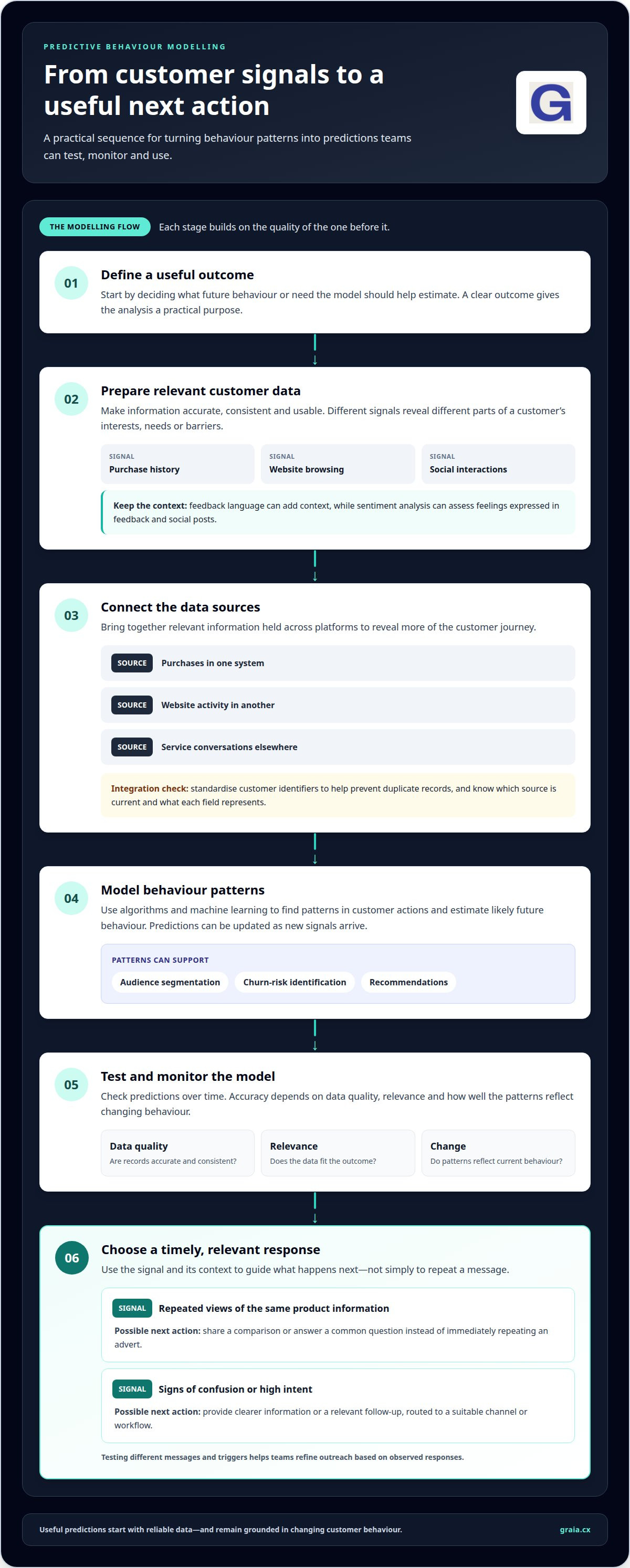
A system might detect that a customer has viewed the same product information several times. Rather than immediately repeating an advert, the next action could be sharing a comparison or answering a common question. Predictive engagement can trigger an action when the likelihood of a particular behaviour crosses a defined threshold.
Teams can route predictions into the channel or workflow that suits the situation. A high-intent signal may prompt a relevant follow-up; signs of confusion may call for clearer information. Testing different messages and triggers helps teams refine outreach over time, based on observed responses rather than the assumption that one action works for everyone.
AI-Enabled Customer Service
Generative AI can use customer context to create relevant service responses, while predictive analytics helps identify what support may be needed. This matters when customers expect useful answers without repeating their situation at every interaction.
For example, a conversational system can recognise a question about an order and respond with relevant information, while a model may identify recurring enquiries that call for clearer self-service content. Natural language processing can interpret customer wording and sentiment, helping distinguish a routine request from a frustrated interaction.
Personalised service depends on grounding responses in reliable information and directing complex needs appropriately. When automation handles routine enquiries, employees can focus on cases requiring judgement or empathy. Predictive insights can help teams improve service journeys, not merely produce faster replies.
What is predictive behaviour modelling?
Predictive behaviour modelling uses algorithms to find patterns in customer actions and estimate likely future behaviour. Implementation typically involves defining a useful outcome, preparing relevant data, integrating sources, then testing and monitoring a model. Accuracy depends on data quality, relevance and how well patterns reflect changing behaviour.
Data Readiness and Platform Integration
Data readiness means making customer information accurate, consistent and usable across the platforms that hold it. It matters because disconnected or outdated records can distort audience patterns and produce irrelevant predictions.
For example, a retailer might hold purchases in one system, website activity in another and service conversations elsewhere. Connecting these sources can reveal a fuller journey, while standardising customer identifiers helps prevent duplicate records. Predictive analytics works best when teams know which source is current and what each field represents.
Customer Data for Prediction
Customer data for prediction can include purchase history, website browsing behaviour and social media interactions. Each signal reveals a different part of a customer’s interests, needs or barriers.
A customer repeatedly viewing delivery information, for instance, may need clearer fulfilment details rather than another product recommendation. Language in feedback can add context, while regional or demographic patterns can help distinguish audience groups. Use only data that serves a defined prediction purpose, and retain enough context to interpret each signal fairly.
Privacy and transparency shape whether predictions earn trust. For UK organisations, GDPR should inform data-governance planning, alongside clear explanations of how customer information supports decisions. Customers should understand how their data is used and have meaningful control, including options to opt out where appropriate. Limiting access to relevant teams and organising data sources also helps prevent information from being used outside its intended purpose.
Data quality needs active attention. Missing fields, inconsistent labels and old records can teach algorithms patterns that no longer represent customers. A model trained on incomplete purchase histories, for example, may mistake a lack of recorded activity for lack of interest. Teams can review data definitions, remove or resolve inconsistencies, and monitor whether predictions remain useful as customer behaviour changes.
Automation can make a prediction actionable, but it should not obscure how a decision was reached. Some deep-learning models are difficult for stakeholders to interpret or validate, which can weaken confidence in their recommendations. Keep a clear record of the signals behind important outputs, involve people in reviewing consequential decisions, and compare suggestions with observed outcomes. This helps teams spot bias, unexpected results or changes in customer satisfaction.
For a practical perspective on turning customer intelligence into connected experiences, explore AI and customer experience insights.
Predicting and acting on customer intent in real time
Real-time intent prediction interprets current customer signals, such as clicks, page views and repeated searches, to anticipate what someone may need next. Unlike predictions based only on historical records, it can use activity from the current session. Historical behaviour can improve accuracy as the system learns which patterns matter.
Consider a customer returning repeatedly to a delivery information page before leaving checkout. That sequence may signal uncertainty, not a preference for another promotion. A predictive system can flag a potentially difficult session and enable a timely response, such as offering relevant delivery information or opening a chat. The intervention should address the observed friction.
Signals can also reveal likely intent without an obvious question. A visitor comparing several service options may be researching, while someone who returns to one option and opens its support details may be closer to deciding. Models can combine these actions to select a next step, then tailor the message to the customer’s preferences and context.
Machine-learning chatbots can use previous customer interactions to anticipate enquiries and provide relevant information in real time. For example, if a customer asks about changing an order, the system can respond with information related to that request rather than unrelated offers. Clear, relevant answers help meet expectations; a confusing response can increase frustration.
Real-time intervention also matters in contact-centre conversations. A system may summarise a customer session into an actionable narrative, then flag signs of high intent or difficulty for attention. When evaluating a solution such as NICE Enlighten, focus on whether it helps teams recognise useful signals and respond appropriately within their workflow.
Proactive support works best when the signal, response and customer need align. Repeated clicks on the same control or an abrupt drop-off may indicate frustration, but neither proves why someone stopped. A measured intervention could offer help without interrupting everyone. Teams can compare responses to different triggers and refine actions based on observed behaviour.
Predictions can inform more than chat. A high-intent session might prompt a relevant explanation, while signs of uncertainty could direct a customer towards support. Model outputs are useful when they enable a specific action through the appropriate channel, rather than simply adding another score to a dashboard.
To keep interventions customer-centred, teams should review whether alerts lead to helpful outcomes or unwanted interruptions. A suitable response respects the context, uses relevant information and leaves room for a person to take over. This turns real-time insight into a more responsive experience, rather than treating every behavioural signal as permission to contact someone.
Machine learning for predicting customer needs
Machine learning finds relationships between customer signals and outcomes, then applies those patterns to estimate likely needs. A model might learn that customers who view a comparison guide and revisit a product page often seek more detail before deciding. Marketing teams can use that insight to shape engagement around useful information, rather than simply increasing message frequency.
The outcome depends on what the model is designed to predict. A business might estimate customer lifetime value, identify churn risks, forecast sales or find cross-selling opportunities. Each goal needs a clear definition. For churn, for example, the team must decide which customer behaviours indicate a meaningful risk of leaving. This focus helps produce an output people can act on.
Recommendation systems offer a practical example. They can analyse previous purchases and interactions to suggest products or content a customer may find relevant. A customer who bought a camera and later browsed photography guides might receive an advanced tutorial, while a first-time visitor sees introductory material. A recommendation should reflect likely interest, not merely repeat a previous purchase.
Machine learning can also help marketing teams explore questions in natural language. A team might ask which audience segments have shown declining engagement, then use the trend to investigate possible causes. The question does not replace analysis: teams still need to understand which data supports the answer and whether the pattern suggests a useful action.
Social media interactions can provide another input, particularly when teams examine responses to a campaign or product launch. Recurring questions in comments, for example, may signal that product information is unclear. Models that analyse language can help organise those themes, allowing a team to refine campaign content or prepare more relevant answers across its platforms.
Predictions become more valuable when they connect to a decision. A team could use a churn-risk estimate to prioritise a retention message, or a sales forecast to adjust campaign resources. The prediction is not the strategy itself. People decide which response suits the business objective, customer context and available evidence.
To improve performance, teams can compare predicted outcomes with what customers actually do. If a recommendation is ignored, that result can inform future evaluation; if a campaign prompts useful engagement, the team can examine which audience patterns contributed. This learning cycle helps expose outdated assumptions and improve how models support customer experience over time.
Machine learning can sharpen marketing decisions, but it should not turn people into fixed labels. A customer’s preferences may change after a purchase, service interaction or shift in circumstances. Treat predictions as revisable signals, using them to make strategies more relevant, not to narrow the choices or information customers receive.
Which AI tools predict customer needs for businesses?
The right tools depend on the decision a business wants to improve. Predictive analytics software can identify patterns in customer and transaction data, while customer relationship management platforms can apply those insights to audience segments. For example, a retailer might use purchase history to identify customers likely to explore a related product category.
Some tools focus on understanding language and intent. Natural language processing can analyse customer messages, support enquiries or social media comments, helping teams identify recurring questions and emerging concerns. A customer service team could use these insights to improve its answers, while marketing could adjust campaign content to address a common point of confusion.
Other tools support recommendations or real-time engagement. A recommendation system can use previous purchases and interactions to suggest relevant content. Real-time engagement software can respond to current activity, such as offering help when a visitor appears stuck during checkout. Each tool serves a different purpose, so its value depends on the action it enables.
- Predictive analytics tools: find trends in historical customer and sales data.
- CRM and customer data platforms: organise customer records and use segments in campaigns.
- Language and sentiment tools: identify themes in messages, feedback and social media.
- Recommendation systems: suggest content or products based on previous interactions.
- Real-time engagement tools: respond to current behaviour with relevant support or information.
Integration matters as much as the model. If website activity, purchase records and service conversations remain isolated, each tool sees only part of the journey. Connected systems can give teams a more complete view, but they still need clear data definitions and a specific purpose for each prediction. A churn-risk signal, for instance, is useful only if it connects to a considered retention action.
Assess tools by the work they support, not by the number of features they advertise. A marketing team seeking better segmentation needs different capabilities from a contact centre aiming to understand customer intent during conversations. Teams should also consider how predictions are explained, how results can be evaluated, and whether the tool fits existing workflows.
Start with one clear use case, such as improving recommendations for returning customers. Define what a useful prediction would change, then assess whether the tool’s outputs lead to a relevant customer action. Reviewing actual outcomes helps teams identify weak signals, refine their approach and avoid treating an algorithm’s recommendation as an instruction.
For a closer look at AI applications in customer experience, explore practical AI insights.
GraiaCX
GraiaCX helps businesses turn customer interactions into more responsive service across voice, chat, email and social messaging. Its Agentic Omni-Channel Platform brings these channels together with AI-driven automation, supporting a more connected view of customer needs.
When customers need quick answers, the Conversational Agent can understand intent and emotion, then resolve routine enquiries autonomously. For more complex conversations, Agent Assist provides real-time suggestions to support human agents. Live Call Translation enables multilingual support in over 100 languages.
If you’re exploring how predictive customer insights could improve your service experience, contact GraiaCX to discuss your needs.
Turn prediction into a better customer experience
A useful next step is to choose one customer decision that deserves greater clarity. A disciplined approach to using AI to predict customer needs starts with a focused question, such as where people need more guidance or which interaction creates avoidable friction. Teams can then connect a prediction to a considered response and learn from what customers do next. The aim is not to automate every judgement, but to help people make more relevant decisions while keeping customer context in view.
That work also calls for a partner who understands how AI can support real customer conversations. GraiaCX brings conversational AI and agent support into customer service workflows, helping organisations explore how predictive insight can translate into a more responsive experience. If you’re ready to consider what that could look like for your organisation, explore AI with GraiaCX. Start with a clear need, build thoughtfully, and let each customer interaction inform what comes next.
Frequently Asked Questions
How can it help your marketing?
It helps marketing teams prioritise messages and resources around likely customer needs. For example, if analysis shows that a particular audience often seeks setup guidance after buying, a campaign could offer practical onboarding content rather than another sales message. Teams can also use predictions to decide which customer groups need attention first. Value comes from choosing a relevant response, then assessing whether it improves engagement or creates unnecessary contact.
How does AI predict customer needs?
AI prediction begins with a defined outcome, such as whether a customer may need renewal support. A model examines selected signals and compares them with past outcomes to identify relationships. It then estimates which current cases resemble those patterns. For instance, a subscription business might examine service enquiries and account activity together. The estimate supports a decision; it does not reveal a customer’s thoughts or explain every individual choice.
What data is needed to predict customer needs with AI?
The required data depends on the question being answered. A renewal prediction may use subscription status, previous renewal outcomes and support history, while a product-interest model may need category-level interactions. Consistent timestamps and clear outcome labels help teams understand what happened and when. Limit data to what supports the stated purpose, and consider customer preferences and information-handling controls before analysis begins.
What are the benefits of predicting customer needs with AI?
Prediction can help teams allocate attention before demand becomes an urgent service issue. For example, a forecast of rising enquiries about a new product could inform knowledge-base planning and agent preparation. Marketing can use similar insights to plan content that answers likely questions. Connecting customer experience decisions with operational planning helps teams focus effort where it is most useful, rather than relying only on broad assumptions.
What are the risks and limitations of using AI to predict customer needs?
Predictions can mislead when customer behaviour changes or data reflects incomplete assumptions. A model might treat low recorded engagement as low interest, even if a customer uses another channel. Automated decisions can also feel intrusive if they rely on sensitive or unexpected signals. Teams should review outcomes, explain the purpose clearly and provide a route to human support when an automated response does not fit the customer’s situation.