
Unified Customer Profile Benefits for Personalised Experiences
A customer record is only as useful as the context it brings together. The unified customer profile benefits come from combining details, preferences, purchases, interactions and behaviour into a 360-degree view of each customer. Instead of treating every channel as a separate conversation, teams can use that shared picture to make experiences more relevant and consistent.
It’s frustrating when one team knows a customer’s history while another sees only the latest interaction. A unified profile brings together information from systems such as CRM, marketing platforms, customer support, social media, websites and purchase records. This helps teams understand who they’re engaging with and what matters to them.
This article explains what a unified customer profile contains and how its data comes together. You’ll learn how it supports personalised experiences, helps teams use insights across channels and keeps customer information current as interactions happen. The result is a clearer view of the customer and useful context for the next conversation.
Key Takeaways
- Learn how master data management can help connect customer records and improve consistency across systems.
- Identify the customer details, transactions, preferences and interactions that add useful context to a profile.
- Explore how shared customer insights can help teams tailor communications and make experiences more relevant.
- See how timely updates can give teams fresher context as customer interactions change.
- Discover how GraiaCX offerings such as Conversational Agent and Agent Assist can support customer conversations across channels.
What Is a Unified Customer Profile?
A unified customer profile combines information from different systems into a 360-degree view of a person. It gives teams shared context for interpreting an interaction, understanding engagement and making decisions based on customer insights.
Consolidating Customer Data Across Channels
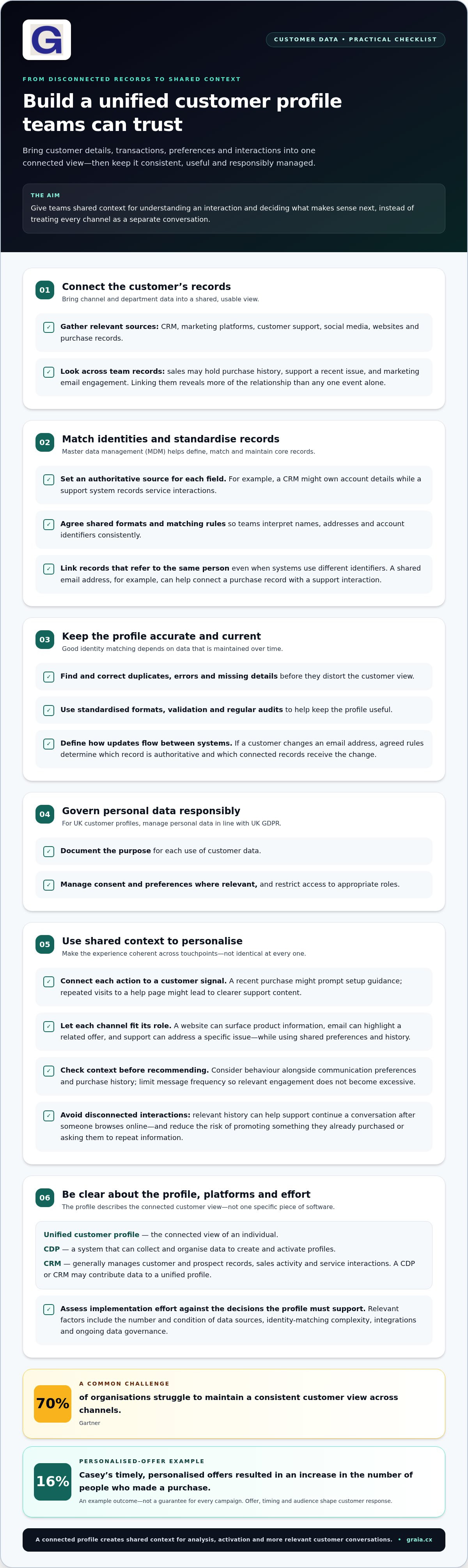
Consolidation brings customer records from channels and departments into a shared, usable view. A sales team might hold purchase history in a CRM, while support records a recent issue and marketing tracks email engagement. Connecting those details helps each team understand the wider relationship, rather than acting on one isolated event. Gartner reports that 70% of organisations struggle to maintain a consistent customer view across channels.
Master data management (MDM) provides a way to define, match and maintain core records, such as customer identity and contact details. Start by identifying the authoritative source for each data field: a CRM might own account details, while a support system records service interactions. Then set shared formats and matching rules so departments interpret names, addresses and account identifiers consistently. An identity service can link records that refer to the same person, even when systems use different identifiers.
MDM also clarifies how changes flow between systems. If a customer updates an email address, agreed rules determine which record becomes authoritative and which connected records receive the update. Teams can then use the same profile for analysis and activation across channels. This creates a stronger foundation for decisions about service, engagement and customer communications.
Improving Data Quality and Identity Resolution
Data quality work identifies and corrects duplicates, errors and missing details before they distort a profile. Identity resolution applies matching rules to determine whether records from a website, CRM and support database belong to the same person. For example, a shared email address can help link a purchase record with a support interaction. Standardised formats, validation and regular audits help keep the profile useful.
For UK customer profiles, govern the collection, storage and use of personal data under UK GDPR. Document the purpose of each data use, manage consent and preferences where relevant, and restrict access to appropriate roles.
Comparing Profiles with CDPs and CRMs
A unified customer profile is the connected view of an individual, while a customer data platform (CDP) is a system that can collect and organise data to create and activate profiles. A CRM generally manages customer and prospect records, sales activity and service interactions. These concepts can overlap: a CDP or CRM may contribute data to a unified profile, but the profile describes the result, not one specific platform.
Implementation costs depend on the number and condition of data sources, identity-matching complexity, integrations and ongoing data governance. Joining a few consistent systems requires different work from reconciling conflicting records across departments. Assess these factors against the decisions the profile needs to support to understand the effort and technology required.
Personalised customer experiences
A unified profile helps teams use customer history to shape more relevant experiences across touchpoints. The unified customer profile benefits are clearest when each action reflects a meaningful signal, such as a stated preference or recent purchase.
Consistent Personalised Experiences
Consistency means recognising the same customer context across channels instead of restarting the relationship at every interaction. If someone browses a product online and later contacts support, relevant history can help make the next conversation feel connected. Teams can use shared preferences to align service responses, follow-up messages and recommendations.
That doesn’t mean every channel should deliver identical content. A website can surface useful product information, an email can highlight a related offer, and a support agent can address a specific issue. The experience remains coherent because each touchpoint responds to the customer’s actions and known preferences. This reduces the risk of promoting an item they’ve already purchased or asking them to repeat information.
To make personalisation useful, connect each planned action to a customer signal. A recent purchase might prompt setup guidance; repeated visits to a help page might lead to clearer support content. Teams can also limit how often messages appear, so relevant engagement doesn’t become excessive. The profile informs the choice, while channel rules shape delivery.
Proactive Offers and Recommendations
Proactive personalisation uses patterns in customer behaviour to offer timely help or relevant recommendations before a customer asks. A retailer could recommend accessories related to a recent purchase, while a service business might share guidance after someone views a particular support topic.
Good recommendations reflect both interest and context. A product viewed once may signal curiosity, while repeated visits alongside a related purchase can suggest stronger intent. Teams can compare those actions with communication preferences and purchase history before choosing an offer. This helps make a message useful rather than simply adding more promotions.
Casey’s personalised, timely offers resulted in a 16% increase in the number of people who made a purchase. The example shows how matching offers to customer context can influence purchasing actions. It doesn’t mean every campaign will achieve the same outcome; the offer, timing and audience all shape how customers respond.
McKinsey indicates that organisations using advanced customer data unification and personalisation at scale generate 40 percent more revenue from those activities than slower-moving competitors. Among the unified customer profile benefits, this potential makes it useful to assess whether insights inform the audience, message and timing, rather than relying on broad segments alone.
Start with one journey, such as post-purchase support, and map the customer signals behind each message. Then compare engagement and purchase outcomes against the campaign’s starting point. For further ideas on shaping connected customer experiences, explore customer experience insights.
Real-time profile updates
A customer profile loses value when it misses a meaningful change. Real-time updates add information as interactions occur, helping teams work with current customer data. For example, when a customer changes a communication preference, the profile can reflect it before the next campaign or service conversation.
Real-time processing differs from scheduled batch updates, which collect changes and apply them at set intervals. If a support interaction reveals a delivery problem, an event-based process can promptly add that detail to the profile. A later service team can then see the issue and respond with context instead of relying on an outdated snapshot.
AI can help extract useful signals from customer conversations and other interactions. AI-powered customer service software can help teams use customer interactions to keep profiles current. For instance, a conversation may reveal a product concern or a request to change contact preferences. That signal can be added to the profile for relevant teams to use.
Automation still needs clear rules. A profile system should distinguish a confirmed customer statement from an inferred pattern, such as repeated visits to a product page. It should also define which system updates each field and how to handle conflicting changes. If a customer gives a new email address during support, an agreed validation rule can prevent an incomplete or mistyped value from replacing the existing record.
Teams can make updates more dependable by tracking each event, its source and its time. A record could show that a preference came from a recent support conversation, while a product interest came from website activity. This context helps staff assess how to use the information and avoid treating an uncertain signal as a confirmed request.
Fresh profiles also make patterns easier to interpret. If a customer reports a recurring issue across several interactions, support teams can see the sequence and address the underlying concern. Marketing teams can pause a related promotion while the issue remains unresolved. This connects profile updates to decisions instead of collecting data without improving the experience.
Measure whether updates arrive in time for their intended use. A team might compare the time between a preference change and its appearance in campaign systems, then check whether duplicate or conflicting records persist. These checks reveal where delays or data errors interrupt the customer relationship and which integration or validation rule needs attention.
Meaning and components of a unified customer profile
A unified customer profile is a connected view of a person’s identity, relationship and activity with an organisation. It brings together descriptive details, actual interactions and transaction records, helping teams understand customer context instead of relying on an isolated data point.
Consider a customer who browses a product page, opens an email and later calls support. A useful profile connects those events with relevant details, such as communication preferences or a previous purchase. The aim isn’t to store every available detail, but to make information that supports a decision understandable and available to the right team.
Identity and demographic attributes describe who the customer is. These can include a name, age, location and job title. A retailer might use location to show relevant delivery information, while a business-to-business team may use job title to understand a contact’s role. These fields provide context, but don’t explain what the customer has done or needs next.
Behavioural data captures actions over time. Website visits, content engagement, product usage and customer feedback can show which subjects matter to someone. Repeated visits to a help article about account access, for example, may point to a need for clearer guidance. Treat this activity as a signal, not proof of the customer’s intention.
Transactional and interaction records add another layer. Purchase frequency, average order value and payment history describe commercial activity; opened emails, calls, support tickets and social media interactions show contact history. Together, these records can help explain the customer relationship. A recent purchase followed by a support ticket gives a service team more context than either event alone.
Preferences and loyalty status add declared or assigned traits to this picture. A customer may prefer email, request fewer promotional messages or hold a particular loyalty status. Keeping these details distinct from observed behaviour helps teams avoid confusing what someone has stated with what their actions might suggest.
A practical profile can group information by its role:
- Identity: name, location and account identifiers.
- History: purchases, payments, calls and support tickets.
- Behaviour: website visits, content engagement and product usage.
- Relationship context: preferences, feedback and loyalty status.
For a useful record, preserve where each detail came from and what it represents. A preference stated during a support call differs from an interest inferred from browsing. That distinction helps marketing teams choose appropriate content and service teams respond more precisely to the customer’s actual history.
How does a unified customer profile improve personalisation and customer experience?
A connected profile helps teams turn customer context into useful decisions across the journey. An online retailer, for example, can combine checkout activity with service contacts to identify where customers struggle and improve the experience.
Personalisation improves when teams respond to a customer’s situation, not just a broad demographic group. A streaming service can use cross-device viewing behaviour to recognise someone who starts a programme on a television and finishes it on a tablet. It can then prioritise playback syncing and preferences, making the transition between devices seamless.
Profiles can also reveal customer segments that leaders weren’t actively pursuing. A retailer might find a group that repeatedly views a product category but rarely completes checkout. Comparing these patterns with purchase history can help teams investigate whether product information, payment options or the checkout journey needs attention.
Journey analysis connects profile insights with specific improvements. An online retailer could examine checkout stages and discover that a broken guest checkout option contributes to customer drop-off. That points to a practical action: repair the guest checkout experience, then assess whether more customers progress through the funnel.
Profile data can also improve how businesses evaluate marketing. Attribution modelling considers how paid, earned and owned touchpoints work together instead of crediting only the last click. If a customer discovers a product through editorial content, later sees a paid advert and finally purchases through an email, the combined view gives teams a fuller picture of what influenced the decision.
Customer attributes can also inform look-alike models that identify prospects with similar characteristics and high acquisition potential. Teams can use those insights to refine audience selection, then compare campaign engagement and conversion results. The profile supports a more deliberate test than simply expanding a campaign to a larger audience.
Value analysis should look beyond top-line sales. Comparing customer segments by profitability and long-term value can show whether a high-revenue group also generates sustainable returns. A segment with frequent purchases and strong retention, for example, may merit a different service or retention strategy from one driven by occasional large orders.
Measure the effect against a clear baseline. Track campaign engagement, customer satisfaction, first-contact resolution, cross-sell activity or churn, depending on the experience being improved. A checkout change calls for funnel and conversion measures, while a service improvement calls for resolution and satisfaction measures.
Explore practical customer experience insights to see how connected data can inform better journeys.
GraiaCX: Conversational Agent
GraiaCX can help teams turn customer service conversations into more responsive experiences. Its Conversational Agent understands intent and emotion, resolving routine enquiries autonomously. For more complex interactions, Agent Assist provides real-time next-best-action suggestions to support human agents.
The Agentic Omni-Channel Platform combines voice, chat, email and social messaging with AI-driven automation. This can suit organisations looking to coordinate customer conversations across channels, while Live Call Translation supports multilingual conversations in over 100 languages.
These capabilities complement a unified profile strategy by helping teams act on customer needs during service interactions. They’re especially relevant when a business wants to automate routine enquiries, give agents timely guidance or manage conversations across multiple channels. To discuss how GraiaCX could support your customer experience goals, contact GraiaCX.
Make customer context part of every decision
Choose a customer journey where better context could change a real decision. Map the signals teams need, who should act on them and how you’ll recognise a useful outcome. This keeps a profile initiative focused on customer needs instead of collecting information without a clear purpose.
The unified customer profile benefits become tangible when insight guides an action: a more relevant response, a smoother handover or a clearer way to resolve a recurring issue. Start with one journey, learn where information helps or falls short, then refine how teams use it. A thoughtful, focused approach can lay the foundations for more connected experiences across the organisation.
Explore ideas for strengthening customer interactions and shaping more connected service experiences in the GraiaCX blog. Use those ideas to identify a practical next step for your own customer journey. Progress starts with a clear purpose and a willingness to act on what customers show you.
Frequently Asked Questions
What Is a 360° Customer View?
A 360° customer view lets authorised teams understand a customer’s relationship with an organisation across different interactions. For example, a service adviser can see that a customer has an unresolved delivery issue before discussing a new order. The view brings relevant context into one place; it doesn’t mean every employee should see every personal detail. Access should match each role and business purpose.
What are the main benefits of a unified customer profile?
The main benefits are better-informed customer interactions, more coordinated decisions and less reliance on disconnected records. A complaints team can spot a repeat issue, while an account manager can avoid proposing an unsuitable change. Shared context can also help teams identify friction in the customer journey and decide where to improve it. The value depends on whether people use profile insights to make practical changes.
How can unified customer profiles increase marketing and sales effectiveness?
Unified profiles can help marketing and sales teams prioritise relevant conversations instead of relying on incomplete lists. A sales representative might see that a prospect has requested information but also raised a service concern, shaping the timing and focus of follow-up. Marketing teams can use stated preferences to tailor communications and avoid unsuitable messages. Reviewing responses by audience can guide future campaign and sales decisions.
What data sources are typically combined in a unified customer profile?
Common sources include CRM records, marketing systems, customer service platforms, website analytics and transaction databases. A business might also connect email engagement, social interactions, feedback and product usage. For instance, an account team could use CRM details alongside support history and billing records to prepare for a renewal discussion. The most useful sources clarify customer needs or support a defined business decision.
How do businesses create and maintain a unified customer profile?
Businesses create a unified profile by agreeing which customer information matters, connecting relevant systems and setting rules for matching and maintaining records. Assign an owner to important fields, document their source and define how to resolve conflicting updates. Then monitor duplicate records, completeness, accuracy and consistency. Regular reviews reveal whether the profile still serves its purpose, such as improving service handovers or campaign relevance.
What are the risks and challenges of unified customer profiles, including data quality and identity matching?
Key risks include inaccurate records, missed matches, false merges and inappropriate access to personal information. If two customers share a contact detail, an identity rule could wrongly combine their histories, leading to mistaken communications or service decisions. Poorly maintained preferences can also undermine trust. In the UK, organisations should manage personal data in line with UK GDPR, including clear purposes, suitable access controls and careful handling of consent preferences.