
Tracking AI Agent Performance Through Reviews, Metrics and Goals
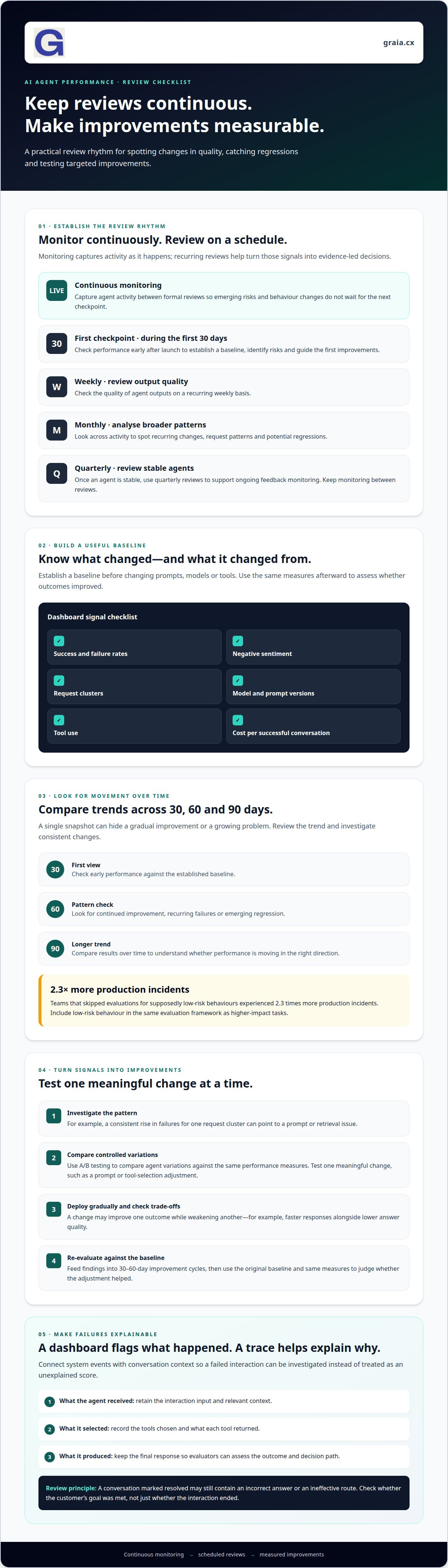
Performance reviews work best when they’re continuous, not occasional. Tracking agent performance improvements with AI means monitoring interactions as they happen, checking output quality weekly, and scheduling a broader monthly review. Set an early review checkpoint during the first 30 days after launch; once an agent is stable, quarterly reviews can support ongoing feedback monitoring.
A dashboard can show activity, but it cannot tell you by itself whether an agent solved the customer’s problem correctly or chose the right tool. That is the real challenge: efficiency matters only when the result is accurate, useful and appropriate to the task.
This guide explains what to monitor and how to turn performance signals into meaningful improvements. You’ll learn how to assess quality, efficiency, goal completion and tool selection, and use review cycles to spot regressions and guide changes. The aim is to improve customer outcomes while keeping human judgement in the loop.
Key Takeaways
- Build a baseline before changing an agent, then use dashboards to connect patterns in success, sentiment, requests, model versions and tools.
- Assess the agent’s decision path as well as its final answer; a conversation marked resolved may still contain an incorrect outcome.
- Track resource use and execution signals, including tokens per task, tool calls and end-to-end latency, to uncover inefficient workflows.
- Use clear, task-specific goals and validate automated evaluations against human judgement so performance scores reflect real customer outcomes.
- Turn recurring failures into targeted changes to prompts, tools, retrieval, guardrails or escalation, then measure whether the adjustment improves results.
How often should you review AI agent performance?
Monitor AI agent behaviour continuously and review performance on a recurring schedule. Early checks help establish baselines, identify emerging risks and guide improvements.
Continuous Monitoring and Dashboards
Continuous monitoring captures agent activity as it happens, while dashboards organise those signals for review. Establish a baseline before changing prompts, models or tools so later evaluations show whether outcomes improved. Track success and failure rates, negative sentiment, request clusters, model and prompt versions, tool use, and cost per successful conversation. These measures provide evidence to guide decisions.
Set a performance checkpoint during the first 30 days after launch. Review output quality weekly, analyse patterns monthly, and schedule quarterly reviews after the initial period for stable agents. Monitoring itself should remain continuous between reviews. This cadence combines rapid detection with time to assess broader changes, rather than relying on a single snapshot.
Compare trends across 30, 60 and 90 days to identify improvement or regression. A consistent rise in failures for one request cluster, for example, can point to a prompt or retrieval issue. Teams that skipped evaluations for supposedly low-risk behaviours experienced 2.3 times more production incidents. Include low-risk behaviour in the same evaluation framework as higher-impact tasks.
A/B Testing and Improvement Cycles
A/B testing compares controlled agent variations against the same performance measures. It matters because a change that improves one outcome may weaken another, such as speed improving while answer quality declines. Test one meaningful change at a time, such as a prompt or tool-selection adjustment, and deploy changes gradually. Feed evaluation findings into 30-60-day improvement cycles, then compare results with the original baseline.
How can businesses implement AI performance tracking for agents? Define the task and success criteria, establish a baseline and dashboard, then monitor interactions, review failures and test one targeted change. After deployment, evaluate again using the same criteria to see whether the change helped.
How can employers ensure AI performance scoring is fair and unbiased? Apply consistent criteria to comparable tasks, review results across request types, and include human oversight for disputed or unusual cases. EUR-Lex notes that AI systems monitoring workers may undermine data-protection and privacy rights, so distinguish employee monitoring from customer-service quality evaluation.
What UK GDPR considerations apply to AI monitoring of employees and customer service agents? Define the purpose of monitoring, limit data collection to what that purpose requires, and explain how performance data is used. Distinguishing between evaluating customer interactions and assessing individual workers is important when considering privacy safeguards.
How much do AI agent performance analytics tools cost in the UK? Costs depend on factors such as data volume, analytics capabilities and implementation needs; pricing is provided after a quote request. Compare options by the evaluation and monitoring functions needed, not dashboard features alone.
What is AI agent monitoring?
AI agent monitoring collects evidence about an agent’s technical operation and customer-facing behaviour. By connecting system events with conversation context, it helps teams understand errors and outcomes.
Monitoring and Observability
Monitoring tracks defined signals, while observability connects evidence to explain why behaviour changed. The distinction matters when a dashboard shows a failed conversation but not its cause.
For example, a failure alert may flag a rise in unsuccessful requests. Observability can connect that event to the conversation, model response, prompt version and tool call. Teams can then distinguish a technical fault from an unsuitable answer or missing context, and choose a targeted response instead of treating every error alike.
Production Monitoring and Agent Observability
Production observability connects an agent’s live activity to its inputs, decisions, tool use and final response. This matters because a completed conversation may still contain an incorrect answer or an ineffective route.
For each interaction, retain a trace showing what the agent received, which tools it selected, what each tool returned, and how it formed the response. A support request routed to the wrong knowledge source, for instance, may appear technically successful while failing to meet the customer’s goal. The trace gives evaluators a clear path for investigation.
Monitoring Agents and Human Agents
AI monitoring examines repeatable system behaviour, while human-agent monitoring assesses service quality and coaching needs. Separating these purposes helps teams interpret each conversation fairly.
An AI review can assess whether the agent selected an appropriate tool and used relevant context. A human review may focus on clarity, empathy and whether the guidance helped the customer. In a conversation involving both, record which actions came from the AI and which came from a person. This makes feedback more specific and avoids attributing an AI error to an employee.
Platforms combining contact-centre analytics and agent-assist capabilities can compare AI-agent outcomes with human coaching measures. Shared evaluation criteria help reveal where automation needs refinement and where an employee may benefit from guidance.
Monitoring and Feedback Frameworks
A monitoring and feedback framework defines what to capture, how to evaluate it, and how findings lead to action. This matters because unstructured feedback rarely shows whether a change addressed the original issue.
Connect each evaluation to a clear category, such as incorrect tool use, missing context or an incomplete answer. Then assign an appropriate response: correct a technical integration, revise an evaluation example or adjust agent behaviour. Repeat the same evaluation after the change. This creates a traceable link between observed errors and improvement decisions.
Traditional software monitoring often focuses on availability, response time and system errors. Agent monitoring must also interpret conversation context and whether the agent achieved its intended task. A tool call can succeed technically yet return irrelevant information, so monitoring needs to capture both the event and its effect on the interaction.
To explore practical approaches, use these AI agent monitoring insights to connect operational signals with meaningful feedback.
Goal completion and tool-selection quality
Measure whether an AI agent achieves the customer’s goal, not just whether its workflow ends. A “resolved” status can hide an incorrect answer, an unnecessary action or an unfinished task. Start with a clear question: did the agent solve the request accurately and safely? Then assess relevance, factual accuracy, task completion and whether the chosen tool supported the outcome.
For production agents, goal accuracy of at least 85% is a useful target; results below 80% call for immediate investigation. These figures need context: a routine enquiry and a sensitive financial task carry different consequences. Use separate evaluation criteria for each request type. An agent might complete 95% of tasks, yet only 70% of those completions could be correct. Completion alone would overstate its ability.
Evaluate tool selection separately. Check whether the chosen tool matched the request, whether its results were relevant, and whether the agent used them correctly. For example, an agent may successfully call an account lookup tool but answer using an unrelated record. Dashboards should connect tool choice to the conversation outcome so teams can identify where models or workflows need adjustment.
Human review adds context that automated scores can miss. Reviewers can assess tone, relevance and whether a response followed the customer’s intent. Human-agent quality assurance typically reviews 1-5% of conversations; targeted sampling can focus attention on failures, unusual tool use and escalations. Compare reviewer feedback with automated evaluation results, then resolve disagreements before treating a score as reliable.
Escalation quality is part of goal completion, not a separate measure of success. Evaluate whether the agent recognised its limits, transferred the interaction at the right moment, and gave the human agent useful context. A handoff that makes the customer repeat details signals a weak outcome, even if the transfer itself succeeded. Track escalation reasons and repeat-contact patterns alongside resolution quality.
Balance quality measures with efficiency measures. Track correctness, task completion and customer feedback alongside tool-call counts, latency and token use. Organisations focusing exclusively on efficiency metrics see a 23% increase in rework costs, while those balancing quality and efficiency achieve 15% better overall performance. Treat those measures as signals, not substitutes for task-specific evaluation. If an agent repeatedly uses 30% of its interactions for avoidable escalations, inspect the relevant request types and handoff rules before changing the model.
Performance-driven AI agents
A performance-driven agent is designed and refined around measurable outcomes, not activity alone. It must complete its task accurately, follow the intended workflow and deliver a useful customer experience. For document classification, an 80% accuracy target is a suggested minimum; routine customer-service agents have a different suggested accuracy range of 85-90%. Choose targets that match the task and the consequences of failure.
Start by defining the agent’s operational purpose in observable terms. For a returns enquiry, success might mean identifying the order, applying the correct policy and providing a relevant next step. Capture each part of that journey, not just the final status. A conversation marked complete can still hide a wrong policy, an irrelevant action or an answer that creates more work.
Then measure performance across three connected dimensions: outcome, process and experience. Outcome measures whether the requested task was completed correctly. Process measures whether the agent followed the intended workflow and used tools appropriately. Experience measures whether the response was relevant and helpful. A customer-satisfaction score of 90% or higher is cited as a top-performer benchmark, but it should sit beside task-specific evaluation.
Failures are valuable signals when teams classify them consistently. Group examples by cause, such as missing context, incorrect retrieval, unsuitable tool selection or an escalation that came too late. A customer-facing hallucination rate should remain below 2%; track this separately from task completion because a completed task can still contain fabricated details. Review the actual conversation and its action trace before changing prompts or models.
Performance also depends on efficiency. Track tokens per task, tool calls and end-to-end latency, then compare them with the quality of the result. For example, an agent that answers correctly but makes unnecessary calls may add avoidable costs and delays. Identify which actions add no value before optimising, so efficiency changes do not weaken accuracy.
Use evaluation results to decide what to improve. A pattern of incorrect answers may call for better retrieval or context; repeated workflow deviations may need clearer instructions or guardrails. Test a focused change against the existing baseline, then check both intended outcomes and possible regressions. This makes failures actionable and shows whether the agent improved in production.
The principle is simple: define success before deployment, capture evidence during real use, and refine against actual results. This framework keeps an agent aligned with its purpose as customer needs, tools and operating conditions change.
How can AI measure customer service agent performance?
AI measures customer-service performance by analysing interaction records against defined service goals. For a human agent, measures might include response time, accuracy, policy adherence, customer sentiment and whether the enquiry reached a useful outcome. For an AI agent, add task completion, tool selection and escalation quality. Keep these measures distinct so a strong score in one area does not conceal a weakness in another.
Start with a service-level measure that reflects the customer promise. For example, a service-level target could require answering 80% of calls within 20 seconds. Pair response speed with quality checks: a fast answer that gives incorrect information is not a good outcome. Review these measures together to see whether the process is both timely and effective.
AI can analyse transcripts and interaction data to flag patterns for review, such as repeated policy misunderstandings, unanswered questions, long pauses or negative sentiment. A human reviewer can then examine the interaction and decide whether the cause was unclear guidance, a process issue or an individual coaching need. This combination adds context to a signal instead of turning it into an automatic judgement.
Automated scoring needs its own quality controls. Among teams using LLM-as-a-judge methods, 93% encountered reliability issues. Validate automated evaluations against human ratings, using clear criteria and examples of strong, weak and borderline responses. If a model marks a compliant answer as incorrect, refine the evaluation criteria before using that score to guide coaching or operational decisions.
Sampling also matters. Human-agent quality assurance typically reviews 1-5% of conversations, while random monitoring of 1-2% of calls can yield statistically significant quality insights when criteria are specific. Use targeted review to investigate unusual outcomes, then compare those findings with random samples. This helps teams spot both known problems and issues that routine dashboards may not highlight.
Translate findings into an appropriate next action. A repeated knowledge gap may call for clearer reference material; a pattern of long call handling may point to an inefficient process. Track the same measures after intervention and review customer outcomes alongside agent experience. A score should support constructive coaching, not stand alone as a verdict on an individual’s performance.
To connect measurement with better service, explore practical customer-service AI insights and apply the measures that fit your support goals.
GraiaCX: Agentic Omni-Channel Platform
GraiaCX’s Agentic Omni-Channel Platform combines voice, chat, email and social messaging with AI-driven automation. It may suit teams whose performance reviews point to opportunities to automate routine enquiries and give human agents real-time assistance.
The Conversational Agent can understand intent and emotion, resolve routine enquiries autonomously, and provide a practical basis for assessing customer interactions. Agent Assist offers real-time next-best-action suggestions to support employees during conversations. Live Call Translation enables multilingual support in over 100 languages without the need for bilingual staff.
Discuss your performance goals and customer-service needs with GraiaCX. Contact GraiaCX to explore the platform and its AI capabilities.
Turn performance insight into lasting progress
Make evaluation part of how your service evolves, not a report reviewed only after problems arise. A disciplined approach to tracking agent performance improvements with AI connects operational decisions to the customer experience, while keeping people responsible for interpreting results and setting priorities.
Give each finding a clear owner and next action. That might mean refining a workflow, improving the information available to an agent or changing how a complex enquiry reaches a person. Consider the wider effect: does the change help customers and support teams, or merely improve one isolated measure? This broader view turns measurement into a sustained capability rather than a dashboard exercise.
As your service develops, use performance evidence to shape a deliberate roadmap for human and AI collaboration. Start a conversation about the outcomes you want to achieve and the challenges your teams face. Contact GraiaCX to discuss agent performance, and take the next step towards more purposeful improvement.
Frequently Asked Questions
How do quality assurance frameworks identify performance gaps?
Quality assurance frameworks identify gaps by comparing interactions with clear standards for accuracy, clarity, policy alignment and customer effort. For example, a reviewer might flag a billing conversation where the answer is correct but the explanation causes confusion. Grouping findings by cause helps distinguish a knowledge gap from a communication issue. Teams can then assign focused coaching or process changes instead of treating every low score as the same problem.
How do you know if an AI agent's output quality is declining?
Look for a sustained change across comparable interactions, not one unusual reply. If an agent starts misunderstanding a newly changed delivery policy, for example, review conversations about that policy separately from unrelated requests. Check whether answers remain relevant, supported by available information and consistent with the intended workflow. A sudden pattern of corrections, customer follow-ups or human takeovers can help pinpoint where quality is slipping.
How does AI eliminate repetitive tasks for agents?
AI can handle routine, repeatable requests by interpreting the enquiry and completing an appropriate workflow, such as retrieving an order update or answering a common question. This can reduce manual searching and copying between systems. Human agents can then focus on cases requiring judgement, sensitive communication or exception handling. Automate a well-defined task and keep a clear route to human support when a request falls outside its scope.
Why does improvement velocity matter more than absolute scores?
Improvement velocity shows whether teams can learn from evidence and make effective adjustments over time. An absolute score describes performance at one point, but not whether a change solved a recurring issue or introduced another. For example, a team can track how quickly repeated misunderstandings are resolved after guidance is updated. Faster, well-tested learning helps maintain progress as customer needs and operational processes change.
Which KPIs best track agent performance improvements with AI?
Choose KPIs that connect the agent’s task to its effect on customers. A practical set might pair correct resolution and repeat-contact rate with escalation quality, response time and customer feedback. For a booking agent, track whether the requested change was completed accurately and whether the customer needed to make another contact. Tracking agent performance improvements with AI is more meaningful when each KPI has a clear definition and informs a specific decision.
How can AI identify coaching needs and improve agent productivity?
AI can surface recurring patterns across interactions, such as unclear explanations, missed discovery questions or difficulty with a particular request type. A supervisor can review examples and distinguish an individual coaching need from outdated guidance or a broken process. Repeated errors across a team may point to unclear procedures, while a pattern affecting one agent may benefit from targeted practice. Use findings to guide supportive coaching, not as a standalone judgement.
What AI platforms compare agent performance and coaching outcomes?
Platforms combining contact-centre analytics with agent-assist capabilities can compare AI-agent outcomes with human coaching measures.